Wrinkles on Forearms: Why They Appear and How to Smooth Them
Your forearms keep an honest record of every sunny afternoon — here's how to read it and soften the creases
The Morning You Notice Them
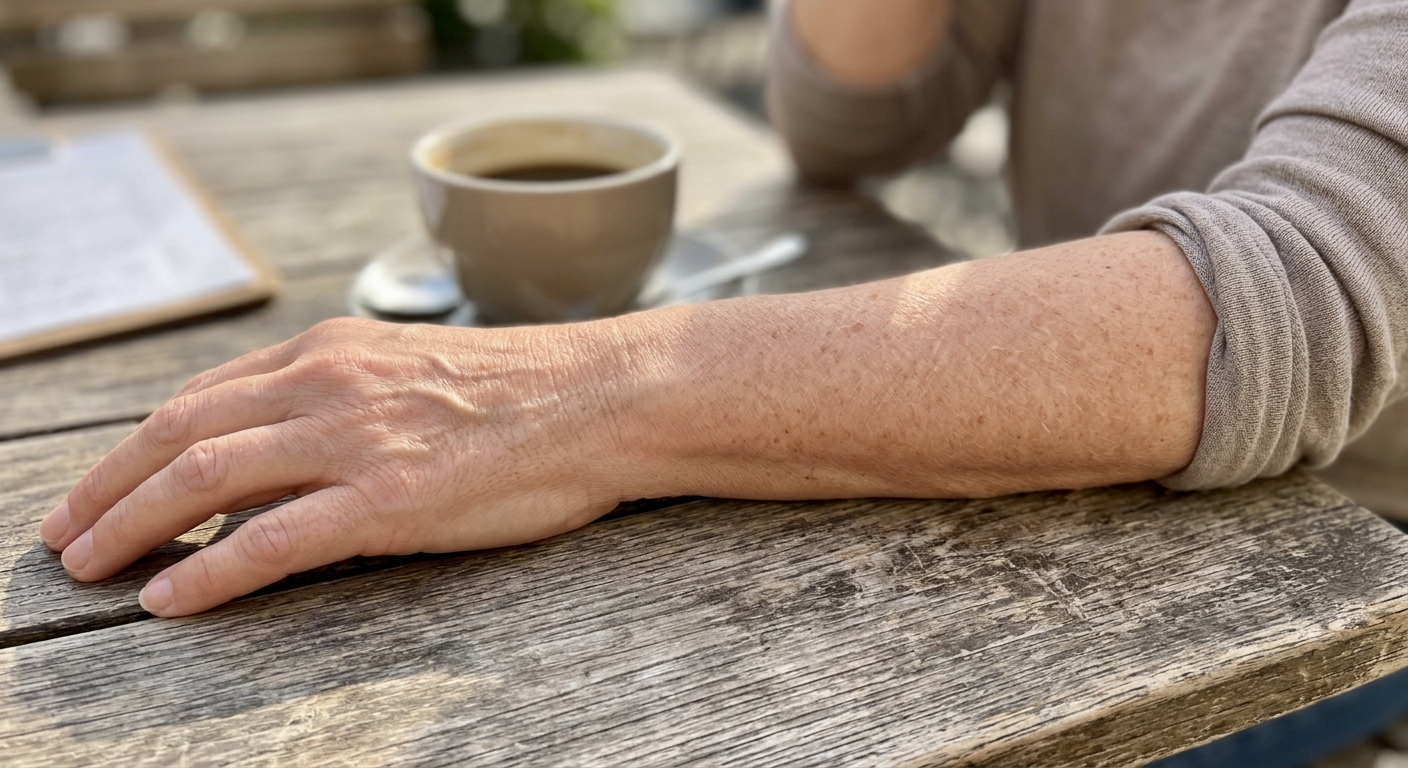
Most people meet their forearm wrinkles by accident. You rest your arm on a desk in flat afternoon light, glance down, and there they are: fine diagonal creases running across skin that looked smooth a year ago. Sometimes they seem to appear overnight, which is part of why “sudden wrinkles on my forearm” is such a common late-night search. The wrinkles are not actually sudden. They are the visible tipping point of damage that has been accumulating quietly for decades, in a place you almost never thought to protect.
The forearm is one of the most reliable aging records on the human body. Unlike the face, which gets daily moisturizer, serums, and at least occasional sunscreen, the forearm spends years exposed and untreated. That makes it an honest mirror — and, fortunately, a responsive one when you finally give it the right attention.
Your Forearm Is a Sun Diary
The single biggest driver of forearm wrinkling is not the passage of time. It is ultraviolet light. Dermatologists separate skin aging into two processes: intrinsic aging, the slow background decline everyone experiences, and photoaging, the far more aggressive damage caused by sun exposure. On the forearms, photoaging dominates.
Years of UV exposure trigger a process called solar elastosis, in which the skin’s elastic fibers break down and reorganize into thick, tangled, disordered clumps in the upper dermis. This elastotic material is a hallmark of sun-damaged skin, and it concentrates precisely at chronically exposed sites — the face, neck, the backs of the hands, and the forearms. The dermis underneath doesn’t just lose volume; it changes its mechanical character entirely. Research measuring the physical properties of photodamaged forearm skin found that the collagen surface becomes rougher and the tissue grows stiffer and harder than young skin, losing the supple resilience that lets healthy skin bounce back after it folds [1].
That stiffness is what you see as a crease. When skin is young and elastic, it unfolds the instant the tension releases. When the dermal scaffold is fragmented and rigid, the fold lingers — and over thousands of small movements, it etches in.
The dermis underneath doesn’t just lose volume; it changes its mechanical character entirely.
Why Forearms Age Faster Than You Expect
Two structural facts make the forearm especially vulnerable. First, it has very few oil glands compared with the face, so it has spent your whole life running on minimal natural lubrication. Dry skin shows fine lines more readily than well-hydrated skin, and chronically under-moisturized skin loses barrier integrity faster.
Second — and this is the big one — almost nobody applies sunscreen to their forearms with any consistency. The face gets the ritual. The arms get whatever is left over, if anything. Over decades, that gap in protection means the forearms absorb a far larger lifetime UV dose than the better-defended face, even though the face gets more direct sun. The result is skin that can look noticeably older from the elbow down than it does above the neck.
This also explains the asymmetry many drivers notice: in countries where you drive on the right, the left forearm — the one resting near the window — often shows more wrinkling and mottling than the right. The skin is simply reporting its exposure.
What Creams Can and Can’t Do
Walk down any body-care aisle and you’ll find lotions promising to erase crepey, wrinkled arms. Heavy moisturizers do something real but limited: they flood the outermost layer of dead cells with water and seal it with an occlusive film, which temporarily plumps fine lines and makes the surface feel smoother. The effect is genuine for a few hours and then fades with the film.
What lotion cannot do is rebuild the dermis. Forearm wrinkles are a structural problem rooted millimeters below the surface, in the layer where collagen and elastin live. Surface hydration never reaches that depth. Body scrubs and dry brushing have the same ceiling — they refine texture at the top while leaving the actual structural deficit untouched. None of this is harmful; it just explains why a drawer full of arm creams rarely moves the needle on real wrinkling.
Acids work best as a complement to a retinoid, not a replacement.
What Actually Rebuilds Forearm Skin
Retinoids — the most proven option
If one ingredient class has earned the right to be called evidence-based for photoaged skin, it is the retinoids. And remarkably, much of the foundational proof came from forearms, not faces. In a landmark New England Journal of Medicine study, researchers treated photodamaged forearm skin with topical tretinoin and took biopsies; the treated skin showed restored formation of new collagen in the dermis compared with untreated controls [2]. A later trial applied topical retinol to the photoaged forearms of older adults and documented a pronounced increase in type I collagen production within just four weeks, with no visible irritation in most participants [3].
The mechanism is twofold. Retinoids switch on fibroblasts to manufacture fresh collagen, and at the same time they suppress the matrix metalloproteinase enzymes that UV exposure activates to chew through existing collagen [4]. They address both sides of the equation — slowing the breakdown while accelerating the rebuild. This is the same biology at work whether you are treating the face or, as on the forearm, crepey skin on the arms.
Daily sun protection
Every bit of new collagen you build is undone by unprotected sun. A daily broad-spectrum sunscreen on the forearms — not just the beach-day application — is the single most cost-effective anti-aging step available, and it prevents the sun damage that started the problem in the first place. Long sleeves and UPF clothing do the same job without reapplication.
Hydration and gentle acids
Because forearm skin is naturally dry, a barrier-supporting moisturizer with ceramides, glycerin, or hyaluronic acid makes lines look softer immediately and keeps the skin resilient. Adding a low-strength alpha hydroxy acid can help too: a study applying glycolic acid to forearm skin found increased dermal collagen and thicker, better-organized elastic fibers over months of use [5]. Acids work best as a complement to a retinoid, not a replacement.
In-office treatments
For deeper damage, fractional laser resurfacing and microneedling create controlled micro-injuries that trigger a collagen-building wound-healing response. They deliver faster visible change than topicals but require multiple sessions and downtime, and they pair best with a consistent at-home retinoid routine.
A Smarter Way to Get Retinol Where It Counts
Here is the catch that has always limited topical retinol, especially on the body: the skin barrier is built to keep molecules out. Conventional retinol formulations often rely on penetration enhancers that work by disrupting that barrier — which is exactly why so many people get redness, peeling, and stinging and quit before they ever see results. On thin, already-compromised forearm skin, that irritation tradeoff is even harder to justify.
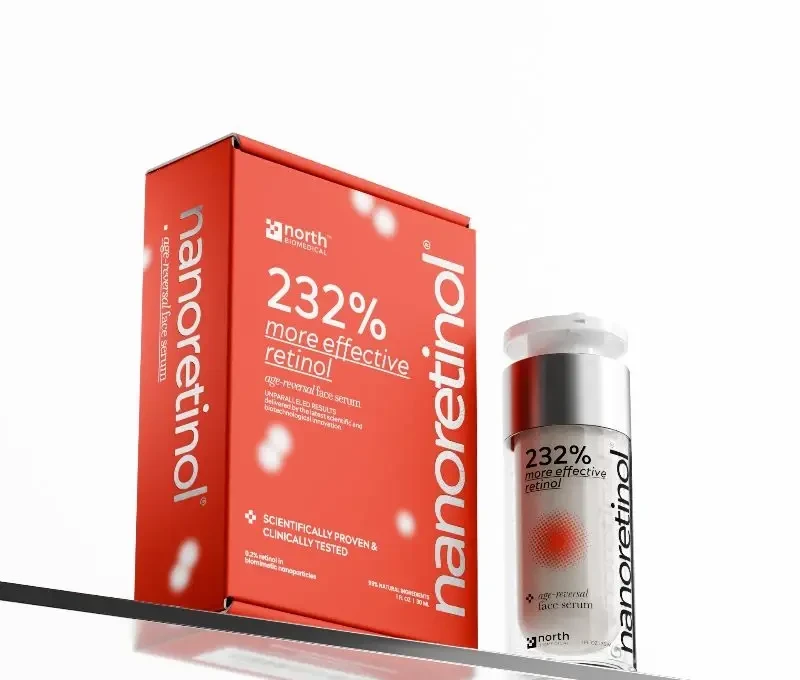
Nanoretinol was engineered to solve the delivery problem without the damage. It encapsulates retinol inside biomimetic lipid nanoparticles that the skin recognizes as “self” and waves through the barrier — a kind of biological Trojan horse — rather than forcing entry by breaking the barrier down. In North Biomedical’s clinical testing, this delivery approach proved 232% more effective at collagen recovery and 73% more effective at elastin recovery than conventional retinol, while being markedly gentler on skin cells. For a body site defined by collagen and elastin breakdown, getting more active ingredient to the fibroblasts — without the irritation that derails most routines — is precisely the point.
Starting Where the Damage Is
Forearm wrinkles feel discouraging because they seem to arrive without warning, but they are one of the more treatable signs of aging precisely because they are driven by something you can act on. The damage is structural, it is largely sun-made, and the dermis remains capable of building new collagen when given a proven active and consistent protection. Treat the forearms with the same seriousness you give your face — protection first, a real retinoid second, hydration throughout — and the skin that has quietly recorded every sunny afternoon can start writing a better entry.
References
- Shao Y, Qin Z, Wilks JA, Balimunkwe RM, Fisher GJ, Voorhees JJ, Quan T. “Physical properties of the photodamaged human skin dermis: Rougher collagen surface and stiffer/harder mechanical properties.” Experimental Dermatology. 2019;28(8):914-921. PMID: 29957839
- Griffiths CE, Russman AN, Majmudar G, Singer RS, Hamilton TA, Voorhees JJ. “Restoration of collagen formation in photodamaged human skin by tretinoin (retinoic acid).” New England Journal of Medicine. 1993;329(8):530-535. PMID: 8336752
- Sun M, Wang P, Sachs DL, Xu Y, Xu Y, Voorhees JJ, Fisher GJ, Li Y. “Topical Retinol Restores Type I Collagen Production in Photoaged Forearm Skin within Four Weeks.” Cosmetics. 2016;3(4):35. doi:10.3390/cosmetics3040035
- Mukherjee S, Date A, Patravale V, Korting HC, Roeder A, Weindl G. “Retinoids in the treatment of skin aging: an overview of clinical efficacy and safety.” Clinical Interventions in Aging. 2006;1(4):327-348. PMID: 18046911
- Ditre CM, Griffin TD, Murphy GF, Sueki H, Telegan B, Johnson WC, Yu RJ, Van Scott EJ. “Effects of alpha-hydroxy acids on photoaged skin: a pilot clinical, histologic, and ultrastructural study.” Journal of the American Academy of Dermatology. 1996;34(2 Pt 1):187-195. PMID: 8642081