Frankincense Oil for Skin: What the Research Shows and How to Use It Safely
Frankincense is sold as an ancient anti-aging secret. The evidence is real but thin, it mostly concerns a different part of the resin, and the oil itself can sensitise skin
Frankincense has been burned in temples and rubbed into skin for thousands of years, and today it is one of the most popular essential oils in anti-aging routines. Online, it is credited with fading wrinkles, shrinking pores, lifting dark spots and calming redness.
Some of those claims trace back to genuine research. The problem is that most of that research was not done on the oil in the bottle. This guide separates the two, explains what the studies actually measured, and shows how to use frankincense without paying for it in irritation.
What frankincense actually is
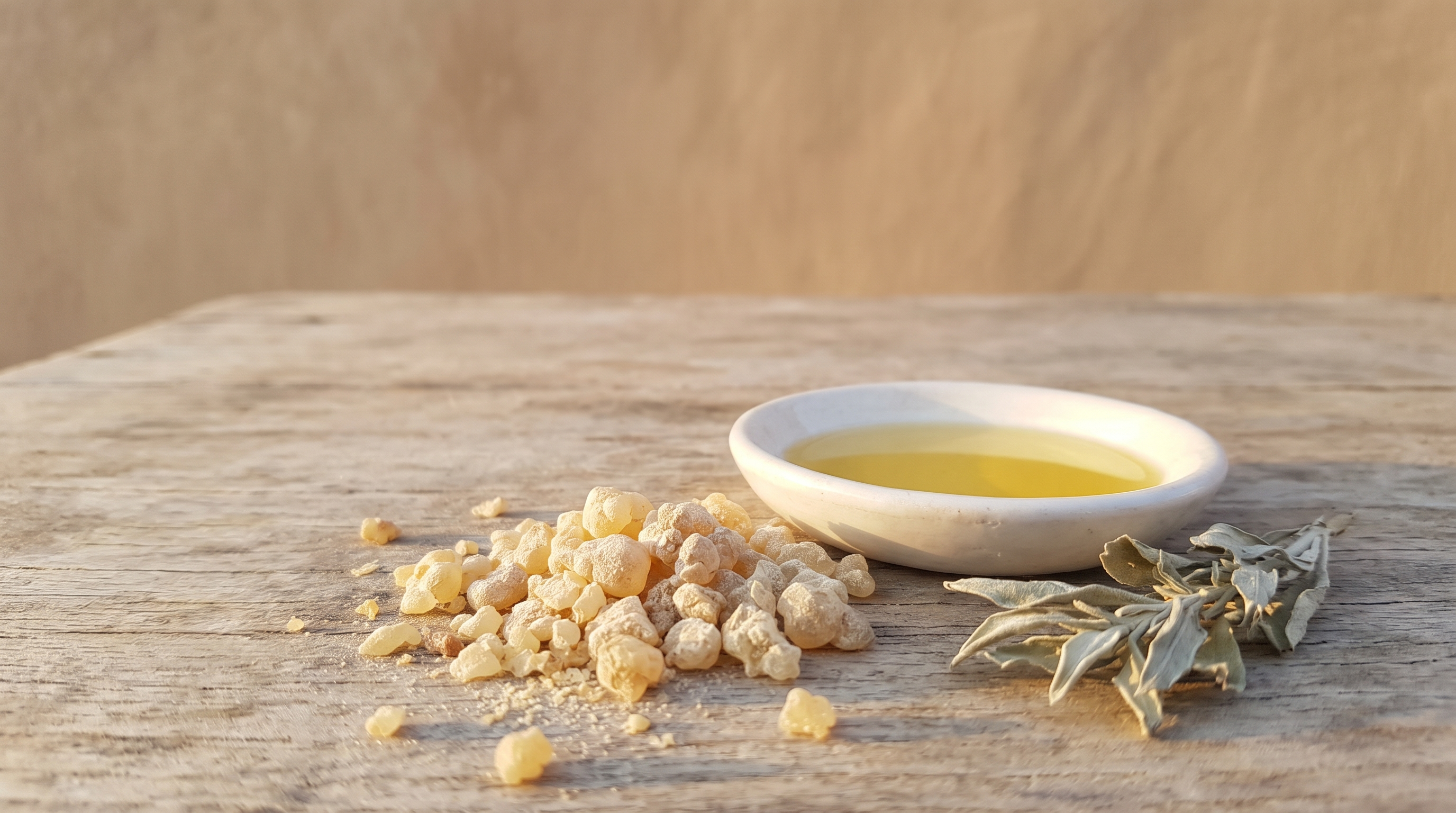
Frankincense is a dried resin that seeps from the bark of Boswellia trees, mainly Boswellia sacra, Boswellia carterii and Boswellia serrata. The resin contains two very different groups of compounds:
- Volatile oils, small fragrant molecules such as alpha-pinene and limonene. These are what steam distillation captures in a bottle of frankincense essential oil.
- Boswellic acids, large, heavy molecules that make up much of the resin. They do not evaporate, so distillation leaves them behind.
That split matters, because most of the skin research is on boswellic acids, not on the essential oil.
What boswellic acids do
Boswellic acids are the best-studied part of frankincense. Their main known action is blocking 5-lipoxygenase, an enzyme that makes inflammatory signals, and they also act on other parts of the immune response [1]. That is why Boswellia extracts have been tested in arthritis and bowel disease, and why skin researchers became interested.
Your skin had fewer fine lines after 30 days of a boswellia cream in one small trial, a result never shown for frankincense essential oil, which contains almost no boswellic acids.
The wrinkle study
The most cited skin trial gave 15 women a cream containing 0.5% boswellic acids for one half of the face and the same cream without them for the other half [2]. After 30 days of daily use, the treated side had less tactile roughness and fewer fine lines, better elasticity and less oil, and ultrasound suggested a change in the dermis. No side effects were reported.
Your skin had fewer fine lines after 30 days of a boswellia cream in one small trial, a result never shown for frankincense essential oil, which contains almost no boswellic acids.
Those are encouraging results, but they come from 15 people, one month and one research group. They also come from a purified extract in a cream, not from essential oil.
Calming irritated skin
Boswellic acids have also been tested as a soothing cream. In a randomized trial in women having radiotherapy for breast cancer, a Boswellia cream reduced redness and the need for steroid creams compared with a placebo cream [3]. Radiation burns are very different from everyday sensitivity, but the result fits the anti-inflammatory picture.
What the essential oil itself does
Studies on frankincense essential oil and skin are mostly laboratory work. In one, frankincense oil was applied to inflamed human skin cells grown in a dish, and it reduced several markers of inflammation and tissue remodelling [4]. It also slowed the growth of the cells and lowered one type of collagen, which is not what an anti-aging product is meant to do. The study was funded by an essential oil company, and cells in a dish do not behave like a face.
There is no published clinical trial showing that frankincense essential oil reduces wrinkles, dark spots or pores on human skin.
Your skin can react to an essential oil you have used for months without trouble, because the oil in an old bottle is not the oil you bought.
The risk: an oil that changes as it ages
Frankincense oil is mostly terpenes, the same family of molecules that give citrus peel and pine needles their smell. Fresh terpenes are rarely a problem. Once a bottle is opened, air slowly oxidises them, and limonene in particular turns into hydroperoxides that are much stronger skin allergens than the original compound [5].
Your skin can react to an essential oil you have used for months without trouble, because the oil in an old bottle is not the oil you bought.
Essential oils as a group are a well-documented cause of allergic contact dermatitis. Nearly 80 of them have caused it, and most reactions follow the use of pure oils or highly concentrated products [6]. Our guide to tea tree oil for skin covers the same problem with another popular oil.
How to use frankincense oil safely
If you want to try frankincense, these steps keep the risk low:
- Never apply it neat. Dilute it to about 1% for the face: roughly 1 drop of essential oil in a teaspoon (5 ml) of a carrier oil such as jojoba or squalane.
- Patch test. Apply the diluted blend to a coin-sized patch inside your forearm twice a day for a week before using it on your face.
- Buy small and keep it cold. Store the bottle tightly closed, away from light and heat, and replace it within a year of opening.
- Skip it on broken or very sensitive skin, and around the eyes.
- Stop at the first sign of itching or redness. An allergy, once it develops, is usually lifelong.
It also helps to know the difference between essential oils and carrier oils. Carrier oils, such as rosehip or argan, are pressed from seeds and nuts and are used in bulk to moisturise; essential oils are concentrated fragrance compounds used by the drop. If you want an oil for dryness and fine lines, our guide to the best face oil for aging skin compares the carrier oils, and our article on rosemary oil for skin looks at another essential oil with similar claims.
Where frankincense fits in an anti-aging routine
Frankincense oil can be a pleasant, aromatic part of a routine if your skin tolerates it. It is not a treatment for wrinkles, sun spots or sagging, and the best evidence points to a purified Boswellia extract that you will only find in a formulated cream.
If you are drawn to frankincense because you want a plant-based way to fight aging, our guide to natural retinol alternatives compares the plant-based options, including bakuchiol, the one botanical that has been tested head to head with retinol.
For wrinkles and loss of firmness, retinol remains the over-the-counter ingredient with the deepest evidence. In a 24-week trial in adults over 80, 0.4% retinol improved fine wrinkling and increased collagen production compared with the vehicle [7]. The reason many people look for alternatives is irritation, and that is the problem Nanoretinol was designed to solve. It carries 0.2% retinol inside biomimetic lipid nanoparticles, in a water-based gel made with 99% natural ingredients and suitable for sensitive skin. In North Biomedical’s clinical study it was 232% more effective in collagen recovery and 73% more effective in elastin recovery than conventional retinol, and users saw a 61% increase in skin firmness and a 56% increase in elasticity after 56 days, with milder side effects than conventional retinol [8].
If you enjoy frankincense, keep it as a diluted, occasional ritual, and let a well-tested retinol do the anti-aging work.
References
- Ammon HP. “Boswellic Acids in Chronic Inflammatory Diseases.” Planta Medica. 2006;72(12):1100-1116. doi:10.1055/s-2006-947227
- Pedretti A, Capezzera R, Zane C, Facchinetti E, Calzavara-Pinton P. “Effects of Topical Boswellic Acid on Photo and Age-Damaged Skin: Clinical, Biophysical, and Echographic Evaluations in a Double-Blind, Randomized, Split-Face Study.” Planta Medica. 2010;76(6):555-560. doi:10.1055/s-0029-1240581
- Togni S, Maramaldi G, Bonetta A, Giacomelli L, Di Pierro F. “Clinical Evaluation of Safety and Efficacy of Boswellia-Based Cream for Prevention of Adjuvant Radiotherapy Skin Damage in Mammary Carcinoma: A Randomized Placebo Controlled Trial.” European Review for Medical and Pharmacological Sciences. 2015;19(8):1338-1344. PubMed: 25967706
- Han X, Rodriguez D, Parker TL. “Biological Activities of Frankincense Essential Oil in Human Dermal Fibroblasts.” Biochimie Open. 2017;4:31-35. doi:10.1016/j.biopen.2017.01.003
- de Groot A. “Limonene Hydroperoxides.” Dermatitis. 2019;30(6):331-335. doi:10.1097/DER.0000000000000465
- de Groot AC, Schmidt E. “Essential Oils, Part IV: Contact Allergy.” Dermatitis. 2016;27(4):170-175. doi:10.1097/DER.0000000000000197
- Kafi R, Kwak HS, Schumacher WE, Cho S, Hanft VN, Hamilton TA, et al. “Improvement of Naturally Aged Skin with Vitamin A (Retinol).” Archives of Dermatology. 2007;143(5):606-612. doi:10.1001/archderm.143.5.606
- North Biomedical LLC. “Nanoretinol vs. Conventional Retinol: Efficacy in Collagen and Elastin Recovery.” Clinical Study Summary, 2024. Study summary