How Much Sunscreen to Use on Your Face: The Arithmetic Behind the Quarter Teaspoon
The SPF printed on your bottle was earned at a thickness almost nobody applies
There is a quiet failure built into almost every sunscreen routine, and it has nothing to do with which product you bought. The number on the bottle is a laboratory result, produced under conditions that have very little in common with a bathroom mirror at half past seven in the morning. Most people apply somewhere between a fifth and a half of the amount that number was earned with, which means most people are wearing a fraction of the protection they think they are.
This is a solvable problem, and solving it is free. It requires no new product, only a dose you can measure.
The Number Behind the Number
Every SPF figure on the market comes from a standardised test in which sunscreen is applied at 2 milligrams per square centimetre of skin. That thickness is not a recommendation invented by marketers. It is the reference condition that makes different products comparable.
Nobody applies it. Reviewing what people actually use under natural conditions, researchers found application rates clustering roughly between 0.39 and 1.0 mg/cm², which reduces the achieved protection factor considerably [1].
That gap is the entire subject of this article. Everything else, filter chemistry, brand, finish, is secondary to it.
Half the Dose Is Not Half the Protection
Here is where intuition fails. It would be reasonable to assume that applying half the tested amount gives you roughly half the SPF, so an SPF 50 applied thinly still lands you somewhere respectable.
If you have been choosing between SPF 30 and SPF 50 while applying a thin smear of either, you have been optimising the wrong variable.
It does not work that way. When researchers marked five areas on the backs of twenty volunteers and applied a sunscreen at 0.5, 1, 2 and 4 mg/cm², the measured relationship between quantity and protection proved exponential rather than linear [2]. Protection falls away faster than the dose does. Halving the layer costs you considerably more than half the benefit, which is why a thinly applied SPF 50 can perform worse than a generously applied SPF 30.
The practical conclusion is uncomfortable but simple: the SPF number is worth far less than the quantity. If you have been choosing between SPF 30 and SPF 50 while applying a thin smear of either, you have been optimising the wrong variable.
Turning the Standard Into Something You Can Measure
Milligrams per square centimetre is useless at a bathroom sink, so dermatology converted it into kitchen measures. The original teaspoon rule, built on the body-surface arithmetic of the rule of nines, allocates roughly half a teaspoon to the face and neck together, and a little over a teaspoon to each leg or to the front of the torso [3]. That rule has since been revisited and refined as researchers reconsidered the per-site amounts [4].
For the face alone, half a teaspoon minus the neck lands at approximately a quarter of a teaspoon, or about 1.25 millilitres. The widely used clinical shorthand for the same amount is the two-finger rule: squeeze two full lines of sunscreen along the length of your index and middle fingers, and that is a face-and-neck dose.
Measure it once with an actual measuring spoon. The volume is genuinely startling the first time, and that surprise is the point: the mental image of “enough sunscreen” that most people carry is roughly a third of the real figure. After you have seen it once, the two-finger version becomes reliable, because you now know what you are aiming at.
The Places the Dose Never Reaches
A correctly measured facial dose still fails if it is spread only over the areas you can see head-on in a mirror. The sites that get missed are consistent and predictable: the ears and the rim of the ear, the hairline and any part of the scalp where hair has thinned, the sides and back of the neck, the eyelids, and the strip under the jaw that catches light reflected off pavement and water.
In a randomised trial that followed 903 adults for four and a half years, the group assigned to daily sunscreen use showed 24% less skin ageing than the group applying it at their own discretion.
Spread the dose deliberately across all of them rather than concentrating it on the cheeks and forehead. If a cream is awkward on hair-bearing skin, a fluid or a stick will reach places a lotion will not.
Reapplication Is Part of the Dose, Not an Extra
A single morning application is not a day of protection. Sunscreen is removed by sweat, friction, towelling, and simple contact with clothing and hands, and organic filters degrade with light exposure over hours. The standard guidance of reapplying every two hours outdoors, and immediately after swimming or heavy sweating, exists because the film thins continuously from the moment you put it on.
For a normal indoor day with a commute at each end, a proper morning dose plus one midday top-up is a realistic target. For a day spent outside, treat the two-hour interval as a rule rather than a suggestion. Whether you are using mineral or chemical filters changes the chemistry of that degradation slightly, but not the need to reapply.
What the Right Dose Actually Buys You
The payoff is measurable, and it is about ageing rather than just burning. In a randomised trial that followed 903 adults for four and a half years, the group assigned to daily sunscreen use showed 24% less skin ageing than the group applying it at their own discretion [5]. That is a large effect from one habit, and it argues strongly that the relationship between sunscreen and skin ageing is worth taking seriously at the level of dose, not just intent.
What It Cannot Buy
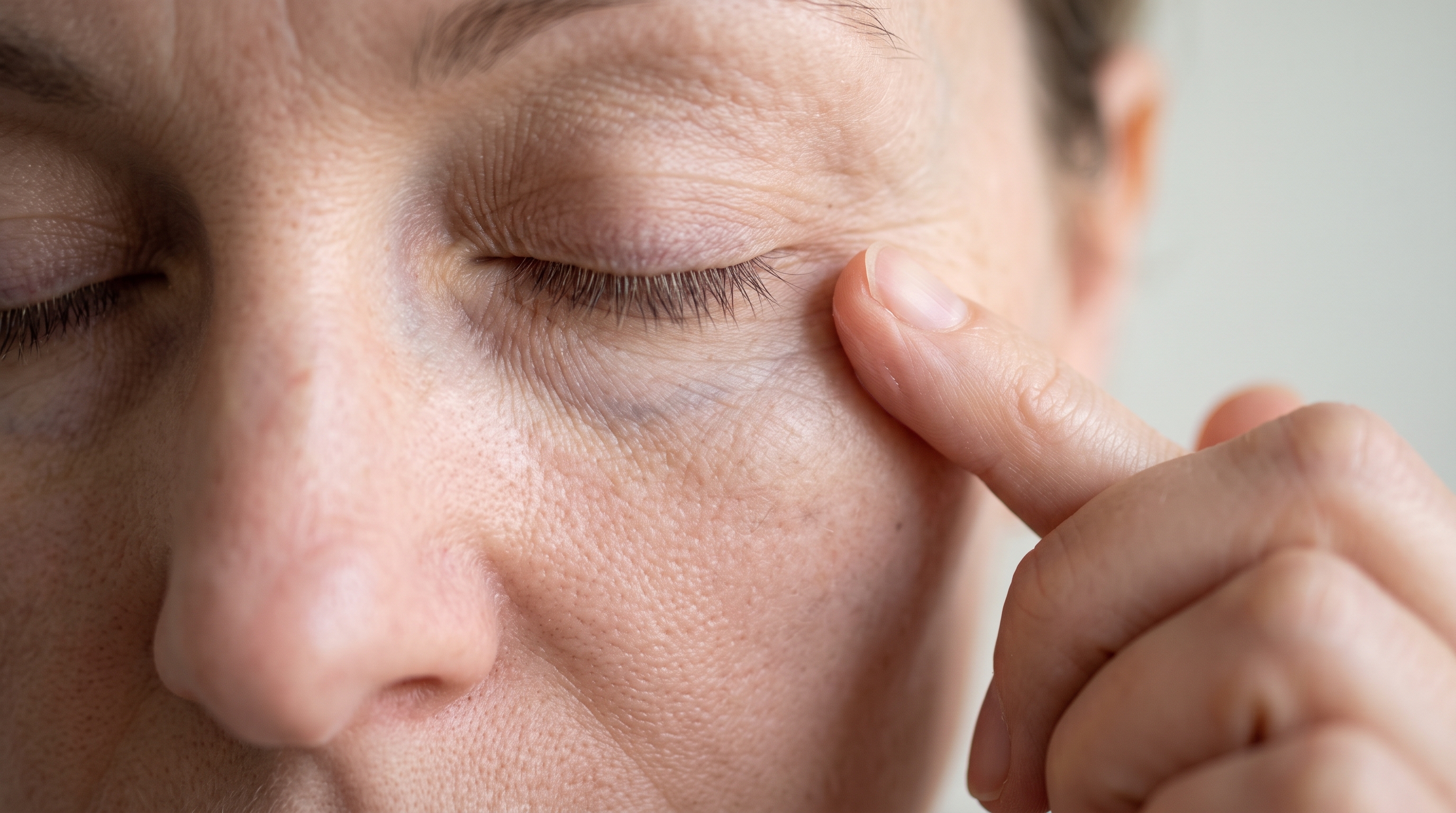
Prevention is not repair, and the distinction matters more the older you get. The mottled pigmentation across the cheekbones, the crosshatched texture at the temples, and the deepened lines on the forehead represent collagen and elastin that have already been broken down by accumulated sun exposure. Blocking tomorrow’s ultraviolet does nothing to rebuild any of it. A perfect quarter teaspoon, applied daily for the rest of your life, stops the debt growing and leaves the existing balance untouched.
Rebuilding is a different mechanism. In a randomised controlled trial in older adults, topical retinol applied to naturally aged skin produced significant improvement in fine wrinkling alongside increased glycosaminoglycan expression and procollagen synthesis [6]. Retinoid signalling remains the best-evidenced route back.
The catch has always been tolerance, and tolerance is what determines whether anyone stays on a retinoid long enough to see the benefit. Conventional retinol formulations get the molecule through by disrupting the skin barrier, which produces the familiar cycle of stinging, flaking, and quitting. Nanoretinol takes a different route, encapsulating 0.2% retinol in biomimetic lipid nanoparticles that the skin recognises as self and admits without that barrier damage, which is how it achieves 232% more effective collagen recovery than conventional retinol while remaining significantly gentler on skin cells. It is applied at night, and sunscreen the following morning is not optional alongside it.
Making the Dose Automatic
Do the measurement once. A quarter teaspoon for the face, half for face and neck, and two full finger-lengths as the version you will use every day thereafter. Spread it to the ears, hairline, and jaw, not just the flat planes of the face. Top it up once during the day.
Then accept the division of labour honestly. The morning dose is holding a line. The night-time step is the only one working on the ground you have already lost.
References
- Petersen B, Wulf HC. “Application of Sunscreen — Theory and Reality.” Photodermatology, Photoimmunology & Photomedicine. 2014;30(2-3):96-101. doi:10.1111/phpp.12099
- Faurschou A, Wulf HC. “The Relation Between Sun Protection Factor and Amount of Sunscreen Applied In Vivo.” British Journal of Dermatology. 2007;156(4):716-719. doi:10.1111/j.1365-2133.2006.07684.x
- Schneider J. “The Teaspoon Rule of Applying Sunscreen.” Archives of Dermatology. 2002;138(6):838-839. doi:10.1001/archderm.138.6.838-b
- Isedeh P, Osterwalder U, Lim HW. “Teaspoon Rule Revisited: Proper Amount of Sunscreen Application.” Photodermatology, Photoimmunology & Photomedicine. 2013;29(1):55-56. doi:10.1111/phpp.12017
- Hughes MC, Williams GM, Baker P, Green AC. “Sunscreen and Prevention of Skin Aging: A Randomized Trial.” Annals of Internal Medicine. 2013;158(11):781-790. doi:10.7326/0003-4819-158-11-201306040-00002
- Kafi R, Kwak HS, Schumacher WE, et al. “Improvement of Naturally Aged Skin With Vitamin A (Retinol).” Archives of Dermatology. 2007;143(5):606-612. doi:10.1001/archderm.143.5.606