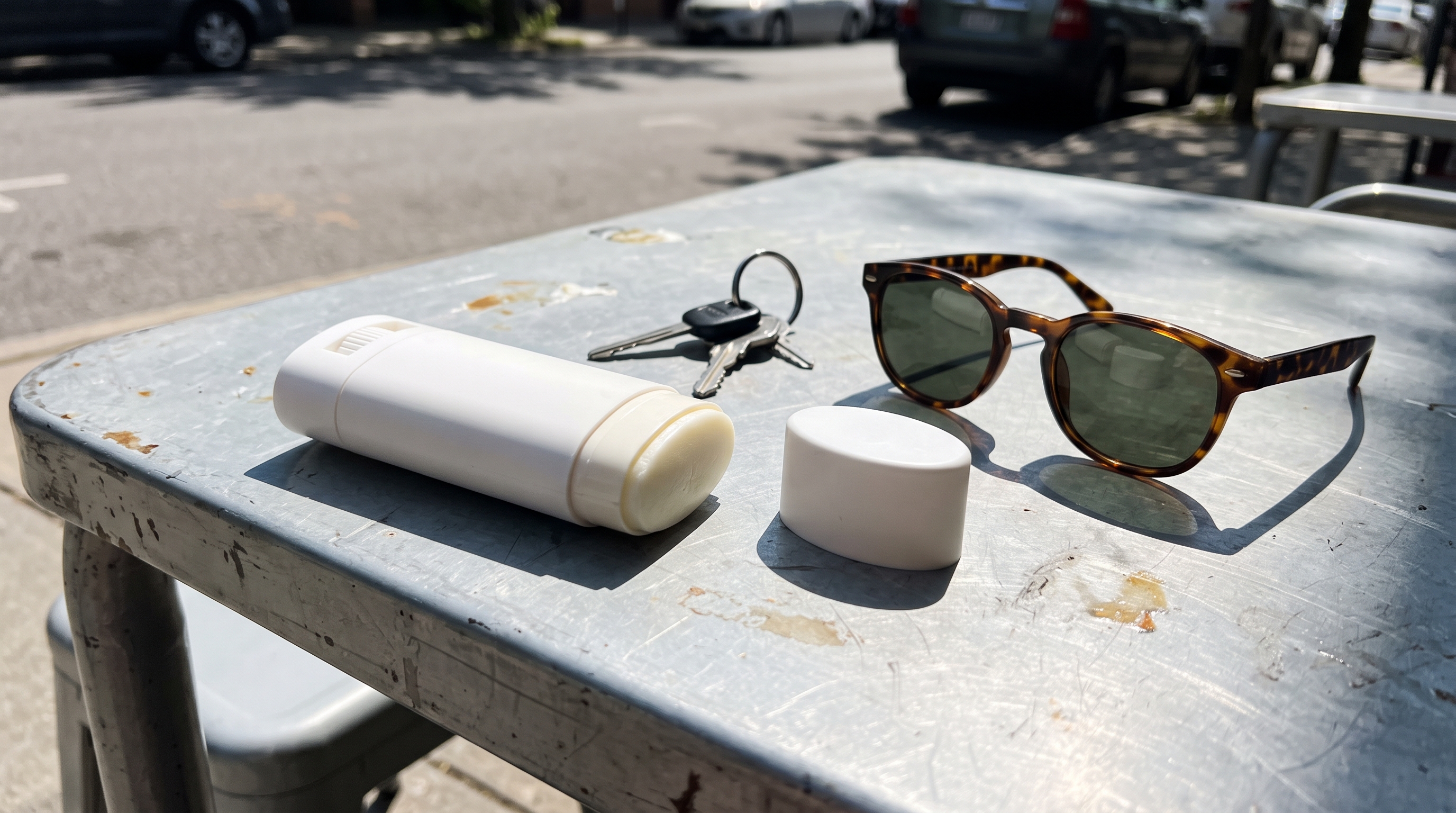
Sunscreen Stick: How Much Protection You Actually Get From One
The format solves the reapplication problem better than anything else on the shelf, and almost nobody uses it at the density its SPF number was certified at
The sunscreen stick solves a real problem. At two in the afternoon, with makeup on and a lunch meeting behind you, nobody is going to rub a white lotion into their face. A stick glides over the top of everything, takes fifteen seconds, and fits in a pocket. That convenience is why the format has quietly taken over the reapplication category.
It also creates a specific illusion. The number printed on the tube was earned under laboratory conditions that a few quick passes over the cheekbones do not reproduce, and the gap between those two situations is larger than most people assume.
The Number on the Label Is a Laboratory Condition
Every SPF rating in the world is certified at a standardised application density of 2 milligrams per square centimetre of skin. That is not a recommendation printed in small type somewhere. It is the physical condition under which the testing panel was irradiated, and the entire number is meaningless outside it.
Almost nobody applies that much. When researchers have measured what people actually put on, the figures cluster between roughly 0.39 and 1.0 milligrams per square centimetre, which is a fifth to a half of the certification density [2]. This holds across beach settings, daily-wear settings, and supervised studies where subjects knew they were being observed.
The consequence was demonstrated directly in a field study of holidaymakers. Only the volunteers who genuinely reached 2 milligrams per square centimetre avoided erythema, ultraviolet-induced DNA damage, and the suppression of acquired immunity that follows a sunburn [3]. Everyone below that threshold showed measurable damage despite wearing a product with a perfectly good SPF number on it.
Why Half the Dose Is Not Half the Protection
The intuitive assumption is that applying half as much sunscreen gets you half the protection. It does not work that way, and the direction of the error is unforgiving.
If you cannot see that you applied it, you probably did not apply enough.
In vivo work applying sunscreen at controlled densities on volunteers’ backs found that protection falls off far faster than the applied amount [1]. At a quarter of the standard test dose, an SPF 20 product delivered something in the region of SPF 2 to 3. The relationship is closer to a root function than a linear one, which means the last portion of the film you fail to apply costs you disproportionately more than the first.
For a stick, this matters more than for a lotion. A lotion squeezed onto fingertips gives you a visible, measurable blob. A stick meters itself out in whatever thin film the wax matrix happens to deposit per pass, and the feedback you get is cosmetic rather than quantitative. It looks finished long before it is.
The Measurement Nobody Has Published
Here is the part that gets glossed over in most stick sunscreen coverage, and it is worth being straight about: there is no peer-reviewed study measuring how much sunscreen a stick deposits per pass, or comparing delivered dose across stick, spray, and lotion formats.
The figures that circulate online, usually somewhere between four and twenty passes for adequate coverage, trace back to independent consumer testing and dermatologist commentary rather than to a journal. Those sources may well be right. They are simply not the same category of evidence as the application-density work above, and presenting them as though they were is how skincare misinformation gets built.
What you can do is arithmetic. The standard face dose works out to roughly a quarter of a teaspoon of product, which is a genuinely substantial amount of material. If a stick lasted you an entire summer of daily use, it was not delivering anything close to that. The practical test is visual: the film should be continuous and faintly visible on the skin before you blend it, not a barely-there sheen. If you cannot see that you applied it, you probably did not apply enough.
Where the Stick Genuinely Wins
None of this makes the format a bad buy. It makes it a format with a specific job, and at that job it beats everything else.
The sun damage already recorded in your face, the accumulated dermal changes from decades of exposure that happened before anyone told you to reapply, sits outside what any sunscreen can reach.
Reapplication is where sun protection is actually lost, and it is where the stick is unmatched. Modelling of solar exposure across a day found that a single reapplication roughly fifteen to thirty minutes after the first produced a two- to three-fold increase in effective protection compared with applying once [5]. Not because the first coat wore off in half an hour, but because the second coat fills in the parts of the film the first one missed.
That early second pass is the single highest-return thing you can do with a sunscreen, and it is the thing a lotion makes socially impossible once you have makeup on. A stick makes it trivial. The same applies to the ears, the hairline, the tops of the hands, and the bridge of the nose, all places that get missed and burned. If you are choosing sun protection to wear under a full face, our guide to the best SPF under makeup covers the base layer that the stick is meant to top up.
Filters, Photostability, and What to Look For
The filter system inside the stick matters more over a long day than the SPF number suggests.
Avobenzone, the most common organic UVA filter, degrades measurably under simulated solar radiation. Formulation work testing antioxidant stabilisers found that adding compounds such as ubiquinone improved avobenzone’s photostability and modestly raised measured SPF [6]. A stick built on an unstabilised avobenzone system is losing UVA protection through the afternoon even if the film stays physically in place.
Mineral sticks sidestep the photostability question, since zinc oxide and titanium dioxide do not photodegrade in any practical sense. They also tend to have the thicker, waxier drag that makes a stick easier to apply generously, which is an underrated advantage. The trade-off is the cast, and the choice between the two filter families is covered properly in our comparison of mineral versus chemical sunscreen.
Prevention Handles the Next Decade, Not the Last One
Sunscreen works. The randomised trial that settled the question followed 903 adults in Nambour, Australia for four and a half years and found that the group assigned to daily sunscreen use showed 24 percent less photoaging by skin-surface microtopography than the discretionary-use group [4]. That is the strongest anti-aging result in the entire category, and it comes from a product that costs very little.
What it does not do is undo anything. A stick applied properly every day from tomorrow protects the collagen you still have. The sun damage already recorded in your face, the accumulated dermal changes from decades of exposure that happened before anyone told you to reapply, sits outside what any sunscreen can reach.
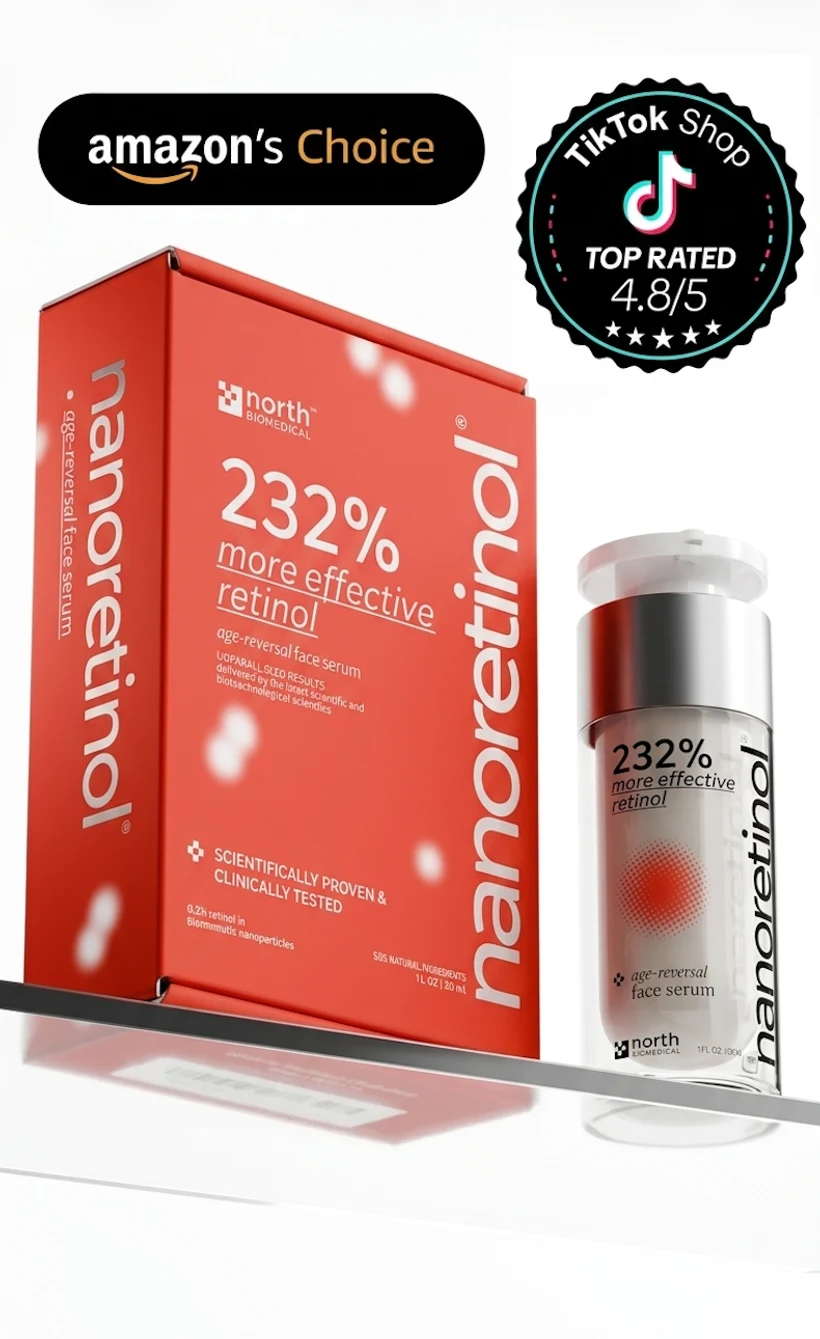
That repair job belongs to a retinoid, and it runs at night. The limitation there has always been delivery: conventional retinol formulations rely on chemistries that disrupt the epithelial barrier to get through it, which is the mechanism behind the burning, redness, and peeling that makes people quit. Nanoretinol encapsulates 0.2 percent retinol in biomimetic lipid nanoparticles that the skin recognises as its own and admits without that damage, and North Biomedical’s clinical study summary reports it as 232 percent more effective than conventional retinol in collagen recovery [7]. Prevention in the morning, repair at night, with neither one asked to do the other’s job.
Buying One That You Will Actually Use Correctly
Pick the stick you will apply heavily. That single criterion outranks SPF number, filter type, and price, because a generous application of SPF 30 beats a timid application of SPF 50 by a wide margin.
Practically, that means a formula soft enough to lay down a real film without dragging, a filter system you tolerate on your face, and a size you will genuinely carry. Then use it as a top-up over a properly applied morning base rather than as the base itself, apply it again fifteen minutes after the first pass, and accept that a stick you finish in six weeks is a stick that was doing its job.
References
- Faurschou A, Wulf HC. “The relation between sun protection factor and amount of sunscreen applied in vivo.” British Journal of Dermatology. 2007;156(4):716-719. doi:10.1111/j.1365-2133.2006.07684.x
- Petersen B, Wulf HC. “Application of sunscreen — theory and reality.” Photodermatology, Photoimmunology & Photomedicine. 2014;30(2-3):96-101. doi:10.1111/phpp.12099
- Narbutt J, Philipsen PA, Harrison GI, et al. “Sunscreen applied at ≥ 2 mg cm⁻² during a sunny holiday prevents erythema, a biomarker of ultraviolet radiation-induced DNA damage and suppression of acquired immunity.” British Journal of Dermatology. 2019;180(3):604-614. doi:10.1111/bjd.17277
- Hughes MC, Williams GM, Baker P, Green AC. “Sunscreen and prevention of skin aging: a randomized trial.” Annals of Internal Medicine. 2013;158(11):781-790. doi:10.7326/0003-4819-158-11-201306040-00002
- Diffey BL. “When should sunscreen be reapplied?” Journal of the American Academy of Dermatology. 2001;45(6):882-885. doi:10.1067/mjd.2001.117385
- Afonso S, Horita K, Sousa e Silva JP, et al. “Photodegradation of avobenzone: stabilization effect of antioxidants.” Journal of Photochemistry and Photobiology B: Biology. 2014;140:36-40. doi:10.1016/j.jphotobiol.2014.07.004
- North Biomedical LLC. “Nanoretinol vs. Conventional Retinol: Efficacy in Collagen and Elastin Recovery.” Clinical Study Summary, 2024. Study summary