How to Heal Sunburn Fast: What Actually Speeds It Up
The burn follows a fixed biological schedule, but almost everything people do to it makes that schedule longer
You want a number, so here it is. A first-degree sunburn runs about four to seven days from exposure to the end of peeling, and nothing you apply changes that schedule by much. What you do over those days decides whether you land at the short end or the long end, whether you peel in sheets or barely at all, and how much of the damage you are still carrying a decade from now.
The useful version of “fast” is not a cure that does not exist. It is removing every obstacle to a repair process that is already running.
Your skin was burning while you were driving home
The thing most people get wrong about sunburn is the timing. The damage is done at the moment of exposure, but the redness is not the damage. It is the inflammatory response to it, and that response takes hours to assemble.
Studies that biopsied and sampled human skin through the first day after ultraviolet exposure found erythema that built gradually rather than appearing at once, with dyskeratotic “sunburn cells” in the epidermis, an inflammatory infiltrate arriving in the dermis, and raised prostaglandin levels early in the reaction [1]. Reviews of the mechanism describe a cascade of prostaglandins, cytokines, and vasodilatory mediators released by damaged keratinocytes, which is precisely why the color peaks roughly 12 to 24 hours after you came inside [2].
This has one immediate practical consequence. The window where intervention helps most is the one where you feel fine, and waiting until it looks bad means waiting until the inflammatory cascade is fully underway.
The first 24 hours, in order of usefulness
Cool the skin repeatedly, not once. Cool showers or cool damp compresses for 10 to 15 minutes, several times, reduce the sensation of heat and the urge to scratch. Avoid ice directly on skin.
Take an anti-inflammatory early if you can take one safely. Because a large part of the visible reaction is prostaglandin-driven [2], an over-the-counter NSAID taken in the first hours blunts both the discomfort and some of the swelling. Check it against your own medications and conditions first.
The useful version of “fast” is not a cure that does not exist.
Drink more than you think you need. A burn of any size shifts fluid toward the skin and away from circulation, and mild dehydration is common after a day outside that ended badly.
Seal it with something bland. Reach for a plain, fragrance-free emollient or an occlusive ointment on intact skin. Avoid anything with alcohol, menthol, camphor, or added fragrance, all of which sting a barrier that is already failing.
Aloe is reasonable, with a caveat. A systematic review of four controlled trials covering 371 patients found aloe vera shortened the healing time of first and second degree burns by roughly nine days against control treatments, while noting the trials used different preparations and endpoints and were not directly comparable [3]. Those were thermal burns rather than sunburn, so treat aloe as a sensible soothing option rather than a proven accelerator, and choose a formula without added alcohol.
Peeling is not skin you should remove
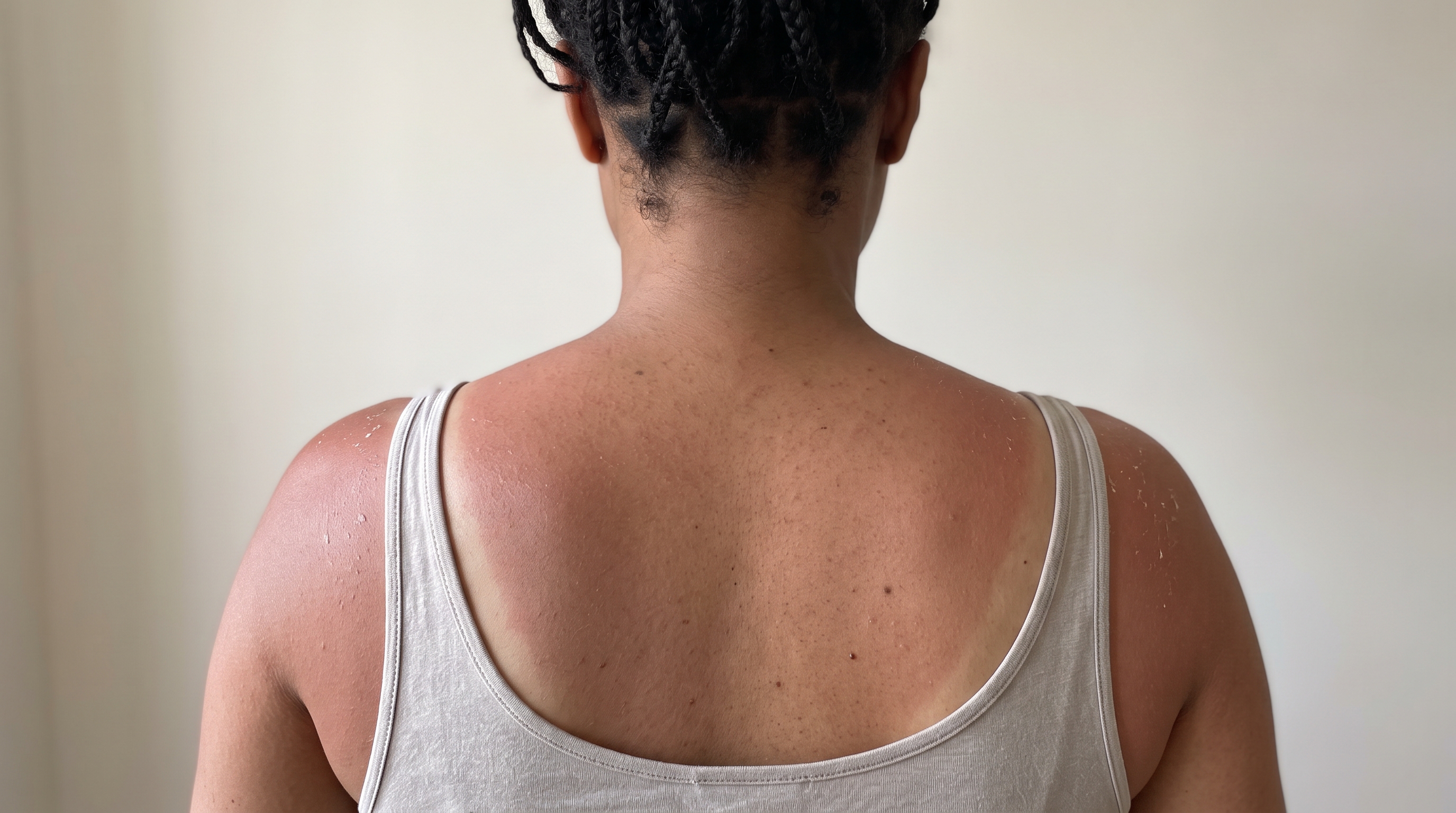
Around day three or four the peel arrives, and the instinct to help it along is almost universal. Resist it completely.
The sheets coming away are keratinocytes that absorbed enough ultraviolet energy to damage their DNA and then triggered their own destruction rather than divide with that damage intact. Ultraviolet exposure creates cyclobutane pyrimidine dimers in DNA, which produce a characteristic mutation signature if they are not repaired before the cell copies itself [4]. Peeling is your skin discarding cells that failed that check.
Pulling it early tears away the sheet before the fragile new layer underneath has matured, which is how a sunburn turns into weeks of patchy, sensitive, uneven skin. Keep it moisturized, let it release on its own, and do not exfoliate a peeling burn under any circumstances. What a compromised barrier needs at this stage is covered in more depth in our guide to repairing a damaged skin barrier.
Here is the part the search result you clicked on usually skips.
What to put down, and for how long
For the duration of the burn and the peel, pause retinoids, alpha and beta hydroxy acids, low-pH vitamin C serums, benzoyl peroxide, scrubs, cleansing brushes, and any hair removal on the affected area. Every one of them acts on the same stratum corneum the burn has already compromised.
Restart only when the skin has stopped peeling, stopped feeling tight, and tolerates a plain moisturizer without stinging. For most people that is somewhere between seven and fourteen days, and going back early is the most common reason a one-week problem becomes a one-month one.
When it stops being a skincare question
See a doctor for blistering across a large area, for a burn accompanied by fever, chills, nausea, severe headache, dizziness, or confusion, for any sunburn on an infant, or for a burn that is worsening after 48 hours. Extensive blistering is a second-degree injury with a genuine infection risk, and no topical routine is the right answer to it.
The second clock, the one nobody is watching
Here is the part the search result you clicked on usually skips. The burn resolves in a week. The consequences do not.
Ultraviolet radiation drives two separate processes: the UVB that produced your erythema also produces the DNA lesions described above, while UVA penetrates deeper into the dermis and does most of the structural work [5]. The distinction is laid out in our comparison of UVA and UVB. In the dermis, ultraviolet exposure induces matrix metalloproteinases that degrade collagen, and because repair after each insult is imperfect, the deficits accumulate across a lifetime as what researchers describe as solar scars [6].
That accumulation is what eventually surfaces as leathery texture, mottled pigmentation, and the thickened yellowish change of solar elastosis. One memorable burn is a rounding error. A pattern of them, every summer, is the mechanism behind most of what people later call aging. The longer view on all of it sits in our guide to sun damaged skin.
What to do once the peeling stops
The repair phase is where the actual opportunity is, and it is also the one nobody uses, because by then the skin looks fine again.
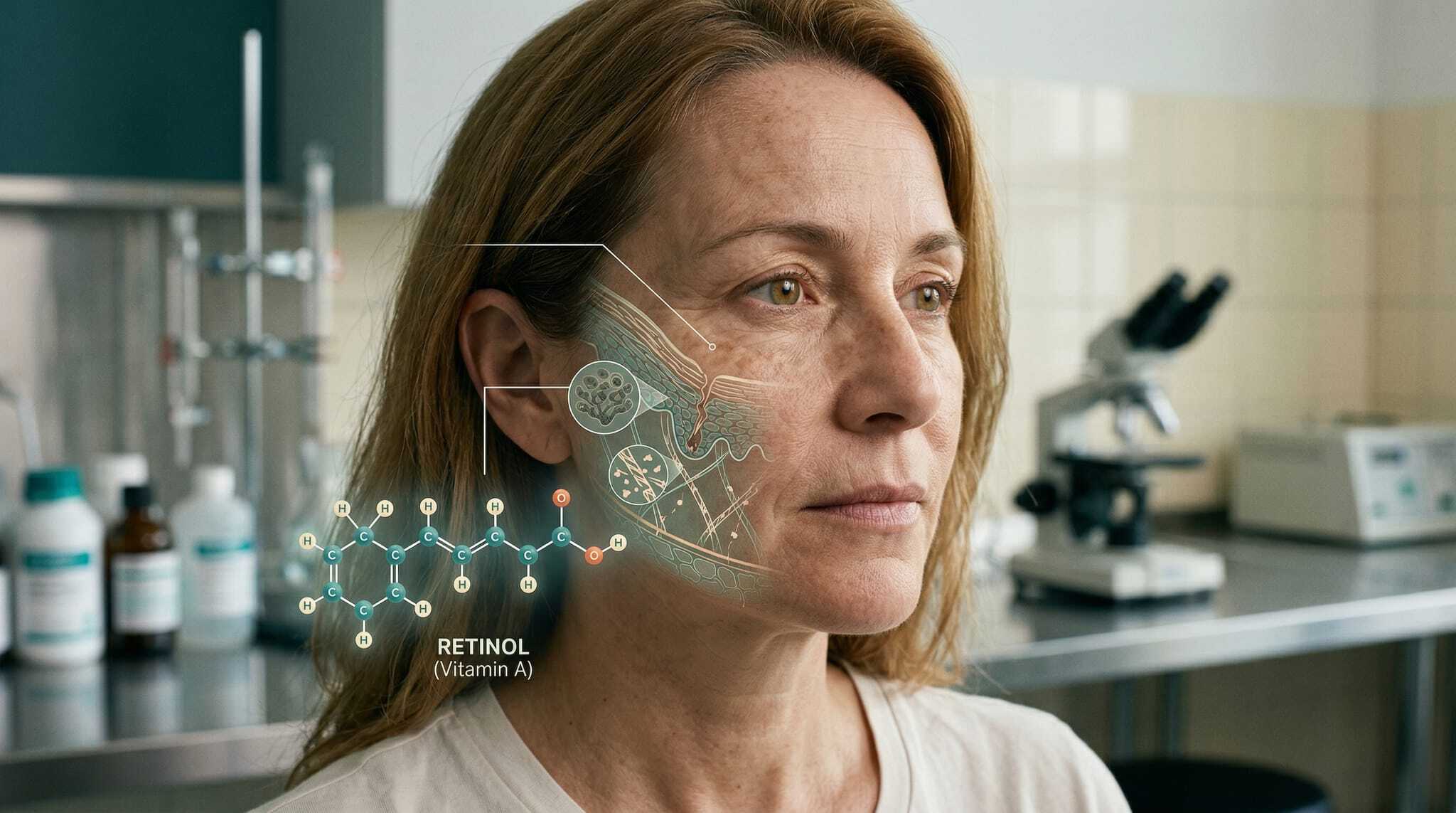
The ingredient class with the longest evidence for rebuilding photodamaged dermis is the retinoids. Experimental work going back to the 1980s showed that topical retinoic acid enhances the repair of ultraviolet-damaged dermal connective tissue, restoring collagen in skin that had already lost it [7]. The obstacle has never been whether retinoids work. It is that conventional formulations have to disrupt the skin barrier to deliver the molecule, which is a poor proposition for anyone whose barrier just spent a week recovering from a burn.
Nanoretinol takes the opposite route. Its 0.2% retinol is encapsulated in biomimetic lipid nanoparticles that are externally similar to skin cells, so the body recognizes them as “self” and allows passage through the epithelial barrier without that barrier being damaged. North Biomedical’s clinical study found it 232% more effective than conventional retinol in collagen recovery and 73% more effective in elastin recovery, with a 61% increase in firmness and a 56% increase in elasticity across 56 days of use. Two rules still apply and they are not negotiable here: it should never be applied to burned or damaged skin, so wait until the burn has fully resolved, and sunscreen within 24 hours of use is required.
After the Redness Fades
Fast healing is mostly a matter of not interfering. Cool the skin, take an anti-inflammatory early, keep it sealed with something bland, drink water, stop every active in your routine, and let the peel finish on its own timetable. Then treat the week afterward as the part that matters, because the burn you can see is temporary and the collagen it cost you is not.
References
- Gilchrest BA, Soter NA, Stoff JS, Mihm MC Jr. “The human sunburn reaction: Histologic and biochemical studies.” Journal of the American Academy of Dermatology. 1981;5(4):411-422. doi:10.1016/S0190-9622(81)70103-8
- Hruza LL, Pentland AP. “Mechanisms of UV-Induced Inflammation.” Journal of Investigative Dermatology. 1993;100(1):35S-41S. doi:10.1111/1523-1747.ep12355240
- Maenthaisong R, Chaiyakunapruk N, Niruntraporn S, Kongkaew C. “The efficacy of aloe vera used for burn wound healing: A systematic review.” Burns. 2007;33(6):713-718. doi:10.1016/j.burns.2006.10.384
- Brash DE. “UV Signature Mutations.” Photochemistry and Photobiology. 2015;91(1):15-26. doi:10.1111/php.12377
- Young AR, Claveau J, Rossi AB. “Ultraviolet radiation and the skin: Photobiology and sunscreen photoprotection.” Journal of the American Academy of Dermatology. 2017;76(3):S100-S109. doi:10.1016/j.jaad.2016.09.038
- Fisher GJ, Kang S, Varani J, Bata-Csorgo Z, Wan Y, Datta S, Voorhees JJ. “Mechanisms of Photoaging and Chronological Skin Aging.” Archives of Dermatology. 2002;138(11):1462-1470. doi:10.1001/archderm.138.11.1462
- Kligman LH, Duo CH, Kligman AM. “Topical Retinoic Acid Enhances the Repair of Ultraviolet Damaged Dermal Connective Tissue.” Connective Tissue Research. 1984;12(2):139-150. doi:10.3109/03008208408992779