Peptide Moisturizer: What the Peptides Actually Do and How to Choose One
Peptide creams range from well-tested formulas to label decoration. Here is how the peptide classes differ, what the trials show, and what to look for in the jar
Peptide moisturizers have become the default “gentle” anti-aging cream. They promise firmer skin and softer lines without the stinging some people associate with stronger actives, and many of them are pleasant, well-made products. The problem is that “peptide” describes a huge family of molecules, and the word on the front of the jar tells you almost nothing about which one is inside, how much of it there is, or whether it has ever been tested on human faces.
This guide explains what peptides are meant to do in a moisturizer, which ones have evidence behind them, and how to read a label so you can tell a well-built peptide cream from an ordinary moisturizer with a fashionable ingredient added.
What a peptide is, and why skin pays attention
A peptide is a short chain of amino acids, the same building blocks that make up proteins such as collagen and elastin. When collagen breaks down, it releases small peptide fragments, and skin cells appear to read some of those fragments as a signal that repair is needed. Cosmetic chemists borrowed that idea: apply the right fragment and you might nudge skin into producing more of its own structural proteins.
A comprehensive review by Gorouhi and Maibach sorted cosmetic peptides into four groups, and the distinction matters when you shop [1]:
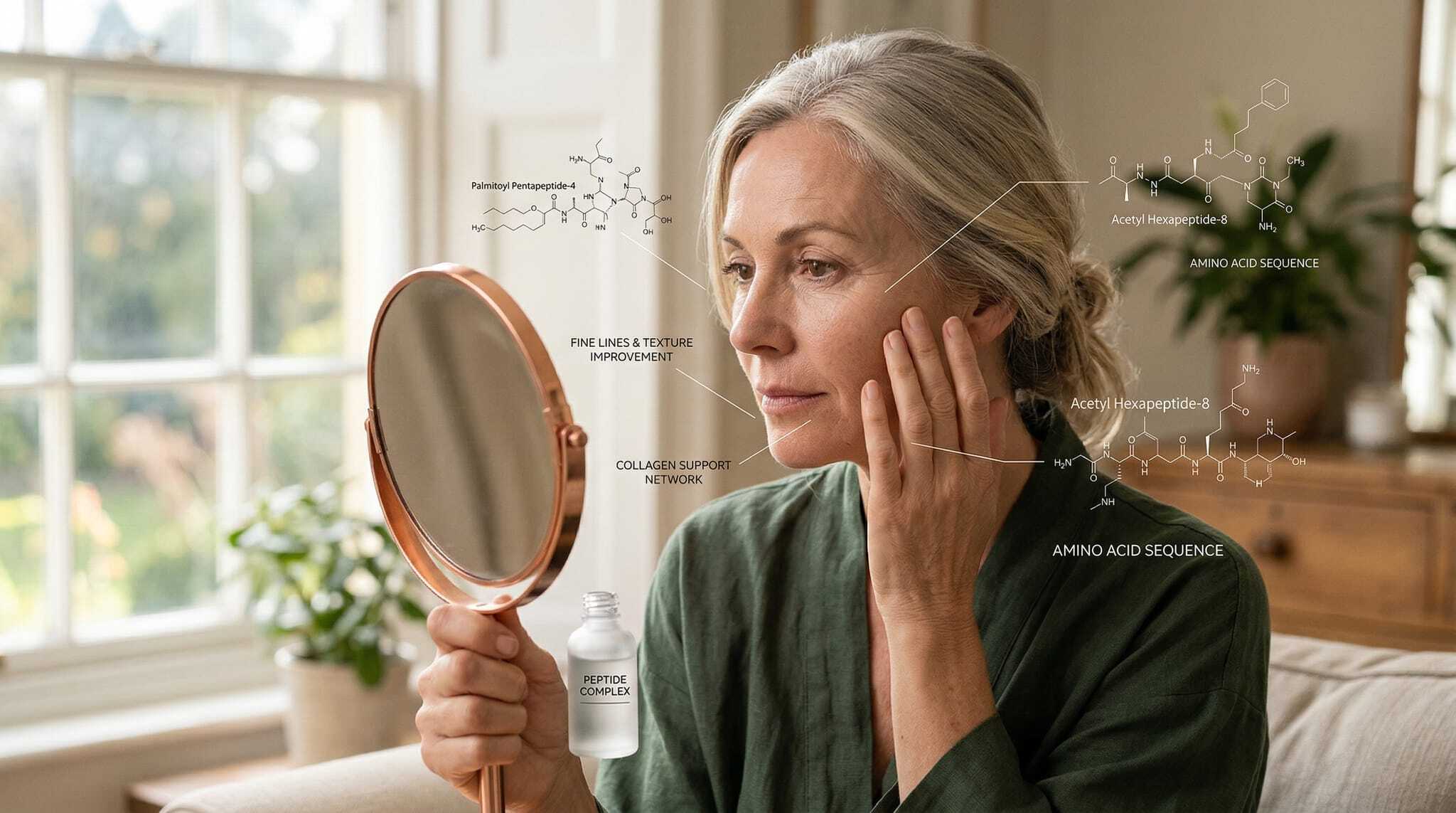
- Signal peptides send a “build more matrix” message to fibroblasts, the collagen-producing cells in the dermis. Palmitoyl pentapeptide-4 (sold as Matrixyl) is the best-known example.
- Carrier peptides deliver trace elements that enzymes need. Copper tripeptide-1 (GHK-Cu) is the classic one.
- Neurotransmitter-inhibiting peptides aim to relax the tiny muscle contractions behind expression lines. Acetyl hexapeptide-8 (Argireline) belongs here.
- Enzyme-inhibiting peptides try to slow the enzymes that break down collagen.
Most peptide moisturizers use one or two signal peptides, sometimes with a carrier or neurotransmitter peptide added.
The size problem every peptide cream faces
The outer layer of skin, the stratum corneum, is an excellent barrier. A widely cited analysis by Bos and Meinardi found that compounds used successfully on skin are almost all below about 500 daltons in molecular weight, because larger molecules struggle to get through [2]. Many cosmetic peptides are close to or above that line, and they are also water-loving, which the fatty outer layer resists.
A peptide can work beautifully in a laboratory dish and still barely reach the cells it is meant to talk to.
Formulators work around this in a few ways. Attaching a fatty acid tail, as in palmitoyl pentapeptide-4, makes a peptide more fat-soluble so it can cross the lipid layer more easily [3]. Leaving the product on the skin for hours helps too, which is one genuine advantage a moisturizer has over a rinse-off product. But the size problem is why peptide results in trials are modest and why the specific peptide matters more than the word “peptide.”
What the human trials show
The evidence for peptide creams is real, but it is thinner than the marketing suggests. Here are the strongest studies.
Palmitoyl pentapeptide-4. In a 12-week, double-blind, split-face study of 93 women aged 35 to 55, a moisturizer containing just 3 parts per million of palmitoyl pentapeptide-4 reduced wrinkles and fine lines significantly more than the same moisturizer without it, measured by image analysis and expert graders. The women themselves also noticed the difference, and the peptide was well tolerated [4]. This is one of the better-designed trials in the whole peptide category, and notably it tested the peptide inside a moisturizer.
Acetyl hexapeptide-8. In the original Argireline research, an oil-in-water emulsion containing 10% of the peptide reduced wrinkle depth by up to 30% after 30 days in healthy women volunteers [5]. That is an encouraging early result, but it came from a small study by the developers, and the effect is on expression lines rather than overall firmness.
Copper tripeptide-1. GHK-Cu occurs naturally in human plasma, and its levels fall with age. Laboratory work shows it supports collagen and glycosaminoglycan production and influences the activity of a large number of genes involved in tissue repair [6]. The human cosmetic trials are smaller and less rigorous than the laboratory data, so treat it as promising rather than proven. Our guide to copper peptides reviews that research.
Finished products. One of the few rigorous tests of a commercial “anti-aging” cream comes from the University of Manchester. After six months, 43% of people using the test product showed improvement in facial wrinkles compared with 22% on the vehicle, but the head-to-head difference between the groups was not statistically significant. Only after 12 months of use did the product show a significant benefit [7].
Even a well-formulated peptide cream is a slow, modest helper, not a replacement for the ingredients with decades of evidence behind them.
That Manchester result is a useful reality check. Peptide moisturizers can help, but expect subtle change measured in months.
How to choose a peptide moisturizer
Use these five checks when you compare products.
- Is the peptide named? Look for specific INCI names such as palmitoyl pentapeptide-4, palmitoyl tripeptide-1, palmitoyl tetrapeptide-7, copper tripeptide-1 or acetyl hexapeptide-8. “Peptide complex” with no names tells you nothing.
- Where is it on the list? Peptides work at low concentrations, so they are rarely near the top. But if they appear after the preservatives and fragrance, the amount may be tiny even by peptide standards.
- Is there a tested peptide, not just a trendy one? Signal peptides such as palmitoyl pentapeptide-4 have the most human data in a moisturizer format. Our guide to the best peptide serum compares the main options.
- Is the base doing its own job? A peptide cream is still a moisturizer first. A base with ceramides, cholesterol and fatty acids helps repair the barrier; research on barrier lipids showed that a complete mix of all three restored normal barrier recovery, while partial mixes could slow it [8]. Our guide to the best ceramide moisturizer explains what to look for.
- Is the claim sized honestly? “Botox in a jar” is not a serious claim. “Improves the look of fine lines over 8 to 12 weeks” is.
A few practical notes help too. Peptides are generally gentle, so a peptide moisturizer suits sensitive skin and can be used morning and night. Avoid applying it immediately after a strong acid exfoliant, because a very low pH can break down some peptides. Copper peptides are best kept apart from vitamin C serums at the same application.
Why peptides work best alongside retinol
Peptides and retinol are often framed as rivals, but the evidence points to a partnership. Retinol has the stronger, longer research record. In a controlled trial in elderly volunteers, 0.4% retinol applied to the arm for 24 weeks significantly improved fine wrinkling compared with vehicle and increased procollagen and glycosaminoglycan production in the skin [9]. Our comparison of peptides vs retinol sets out how the two differ.
The best-supported routine uses both: retinol at night to drive collagen renewal, and a peptide moisturizer to support the skin and keep it comfortable.
Where Nanoretinol fits
The reason many people reach for peptides instead of retinol is irritation. Conventional retinol formulations often rely on solvents and petroleum-derived ingredients that push retinol through the skin by disrupting its barrier, which causes the redness, peeling and burning people remember.
Nanoretinol takes a different route. It encapsulates stabilised 0.2% retinol in biomimetic lipid nanoparticles that the skin recognises as its own, so retinol reaches the cells without damaging the barrier. In North Biomedical’s study summary, it was 232% more effective in collagen recovery and 73% more effective in elastin recovery than conventional retinol, and 56 days of use produced a 61% increase in skin firmness and a 56% increase in elasticity. Its water-based gel absorbs fully, so it layers comfortably under a peptide moisturizer at night.
Building the routine around the jar
A good peptide moisturizer is a worthwhile product: gentle, supportive and quietly helpful for fine lines. Choose one with named, tested peptides in a barrier-friendly base, use it consistently for at least three months, and pair it with a well-delivered retinol and daily sunscreen for the changes you can actually see.
References
- Gorouhi F, Maibach HI. “Role of topical peptides in preventing or treating aged skin.” International Journal of Cosmetic Science. 2009;31(5):327-345. doi:10.1111/j.1468-2494.2009.00490.x
- Bos JD, Meinardi MMHM. “The 500 Dalton rule for the skin penetration of chemical compounds and drugs.” Experimental Dermatology. 2000;9(3):165-169. doi:10.1034/j.1600-0625.2000.009003165.x
- Schagen SK. “Topical peptide treatments with effective anti-aging results.” Cosmetics. 2017;4(2):16. doi:10.3390/cosmetics4020016
- Robinson LR, Fitzgerald NC, Doughty DG, et al. “Topical palmitoyl pentapeptide provides improvement in photoaged human facial skin.” International Journal of Cosmetic Science. 2005;27(3):155-160. doi:10.1111/j.1467-2494.2005.00261.x
- Blanes-Mira C, Clemente J, Jodas G, et al. “A synthetic hexapeptide (Argireline) with antiwrinkle activity.” International Journal of Cosmetic Science. 2002;24(5):303-310. doi:10.1046/j.1467-2494.2002.00153.x
- Pickart L, Margolina A. “Regenerative and protective actions of the GHK-Cu peptide in the light of the new gene data.” International Journal of Molecular Sciences. 2018;19(7):1987. doi:10.3390/ijms19071987
- Watson REB, Ogden S, Cotterell LF, et al. “A cosmetic ‘anti-ageing’ product improves photoaged skin: a double-blind, randomized controlled trial.” British Journal of Dermatology. 2009;161(2):419-426. doi:10.1111/j.1365-2133.2009.09216.x
- Mao-Qiang M, Feingold KR, Thornfeldt CR, Elias PM. “Optimization of physiological lipid mixtures for barrier repair.” Journal of Investigative Dermatology. 1996;106(5):1096-1101. doi:10.1111/1523-1747.ep12340135
- Kafi R, Kwak HSR, Schumacher WE, et al. “Improvement of naturally aged skin with vitamin A (retinol).” Archives of Dermatology. 2007;143(5):606-612. doi:10.1001/archderm.143.5.606