
Ice Pick Scars: Why Creams Fall Short and What Actually Works
Narrow, deep and stubborn, ice pick scars need a different plan from other acne scars. Here is what the research shows for TCA CROSS, punch techniques, microneedling and lasers, and where retinol fits
Ice pick scars are the small, sharp pits that look as if a needle had been pressed into the skin and left a hole behind. They usually sit on the cheeks, often in clusters, and they tend to outlast every other trace of a past breakout.
They are also the acne scar that frustrates people most, because so many treatments that help other scars barely change them. The reason is their shape. Once you understand it, the options that actually work make sense, and so do the ones that waste money.
What makes an ice pick scar different
Dermatologists divide atrophic acne scars into three main types: ice pick, rolling and boxcar [1]. Rolling scars are wide, soft dips with sloping edges. Boxcar scars are broader, with sharp vertical sides and a flat floor. Ice pick scars are narrow at the surface, usually less than 2 mm across, but they run deep, as a tight channel that can reach the lower dermis or beyond [1, 2].
That combination of a tiny opening and a deep shaft is the whole problem. A treatment that works on the surface never reaches the bottom of the scar, and a filler injected under the skin cannot lift a channel this narrow.
Your skin usually needs four to six treatment sessions, spaced at least 2 weeks apart, before a deep ice pick scar fills in, which is far slower than any cream label suggests.
Why creams cannot fill them
Scar creams, serums and peels sold for “acne scars” act mainly on the top layers of skin. They can even out tone and soften texture, but they cannot rebuild a column of lost collagen several millimetres deep.
Your skin usually needs four to six treatment sessions, spaced at least 2 weeks apart, before a deep ice pick scar fills in, which is far slower than any cream label suggests.
Retinoids are the one topical group with interesting scar data, and it is worth reading it carefully. In a study of 32 people with atrophic acne scars, tretinoin gel driven into the skin with a mild electric current twice a week for 3 months reduced scar depth in 94% of patients [3]. That result came from a clinic procedure called iontophoresis, not from a cream applied at home, and it covered atrophic scars in general rather than ice pick scars alone. A broader look at how the different scar types respond, and why the best plan usually mixes several methods, is in our guide to acne scar treatment, which compares the in-office options side by side.
TCA CROSS: the targeted fix
The treatment with the strongest track record for ice pick scars is TCA CROSS, short for chemical reconstruction of skin scars. A dermatologist presses a tiny amount of highly concentrated trichloroacetic acid, often 65% to 100%, into the base of each individual scar with a fine applicator. The acid triggers a small, controlled injury that heals by laying down new collagen from the bottom of the pit upwards.
In the original series of 65 patients with darker skin types, 82% of those treated with 65% TCA and 94% of those treated with 100% TCA had a good clinical response, and everyone in the 100% group who completed five or six sessions had excellent results, with no significant complications [4]. A later study gave 70% TCA every 2 weeks and found good or excellent improvement in 66% of patients, with 81% satisfied [5]. A review of acne scar treatments in skin of colour concluded that TCA CROSS showed efficacy in ice pick scars specifically [6].
This is a precise, scar-by-scar technique with acid strengths far beyond anything sold for home use. Never try to recreate it with a drugstore product; our explainer on the TCA peel covers how the different strengths of trichloroacetic acid behave on the skin and why the high concentrations stay in the clinic.
Punch excision and punch elevation
For the deepest or widest ice pick scars, the most direct option is to remove them. In punch excision, a dermatologist uses a small round blade slightly larger than the scar to cut it out, then closes the opening with a fine stitch. The deep pit is swapped for a thin, flat line that blends in far better. Punch elevation and punch grafting are related techniques used when the scar floor can be lifted or replaced [1].
Your skin showed real scar improvement 6 months after three needling sessions in one trial, but not yet at 3 months, so patience matters more than the tool.
These methods sit at the top of the treatment ladder for severe pitted scarring, because the most severe scars improve poorly with resurfacing procedures alone [6].
Microneedling and lasers as supporting players
Microneedling, fractional lasers and fractional radiofrequency stimulate new collagen across a whole area of skin. The highest level of evidence for acne scars overall belongs to these methods, but mostly for mild to moderate scars [6]. On their own they tend to soften the shallow scarring around ice pick scars more than the pits themselves.
Your skin showed real scar improvement 6 months after three needling sessions in one trial, but not yet at 3 months, so patience matters more than the tool.
In that randomized split-face trial, the needled side had significantly lower scar scores than baseline at 6 months, and patients rated the pain at about 1 out of 10 [7]. Our guide to microneedling benefits explains how needle depth and session spacing change results and when a professional treatment is worth the extra cost over a home roller.
Building a realistic plan
Most people with ice pick scars also have some rolling or boxcar scars, so the best results come from combining methods. A review of the evidence found that combination treatment generally beats any single approach [6], and an earlier overview made the same point about matching the method to each scar type [2]. A typical plan might look like this:
- Deep, isolated pits: TCA CROSS or punch excision first, one scar at a time.
- Surrounding uneven texture: microneedling or a fractional laser a few weeks after the pits have healed.
- Between sessions: a steady at-home routine with daily sunscreen and a gentle retinoid to keep pores clear and support collagen.
Expect months, not weeks. Scars that took years to form rarely disappear in a single visit, and photos taken under the same light every few months are the best way to judge progress.
Where retinol fits around treatment
No cream will erase an ice pick scar, but what you put on your skin between procedures still matters. Every new breakout is a chance for a new scar, and topical retinoids are a standard part of keeping acne under control. Retinol also supports the collagen-building process that procedures depend on: in a trial on aged skin, it increased procollagen production and improved fine wrinkles over 24 weeks [8].
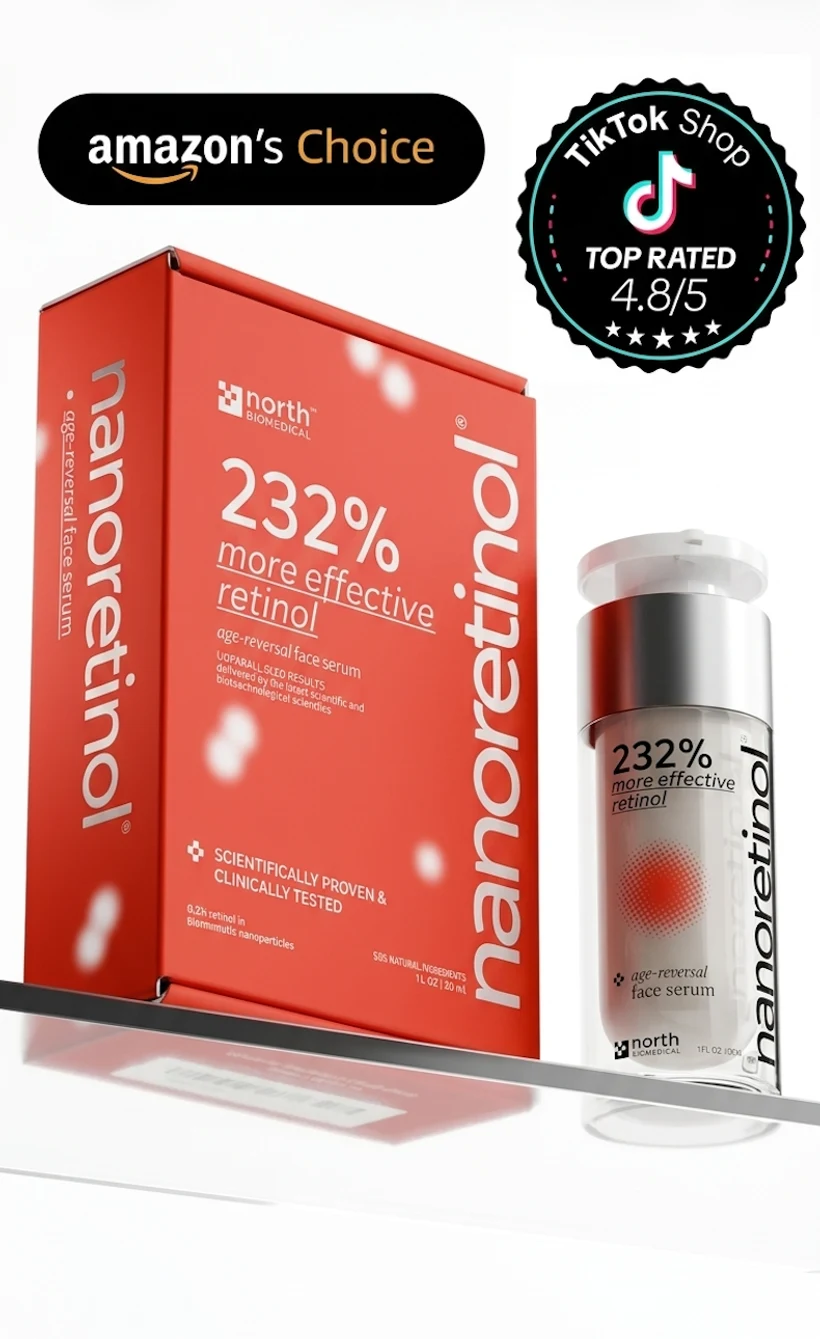
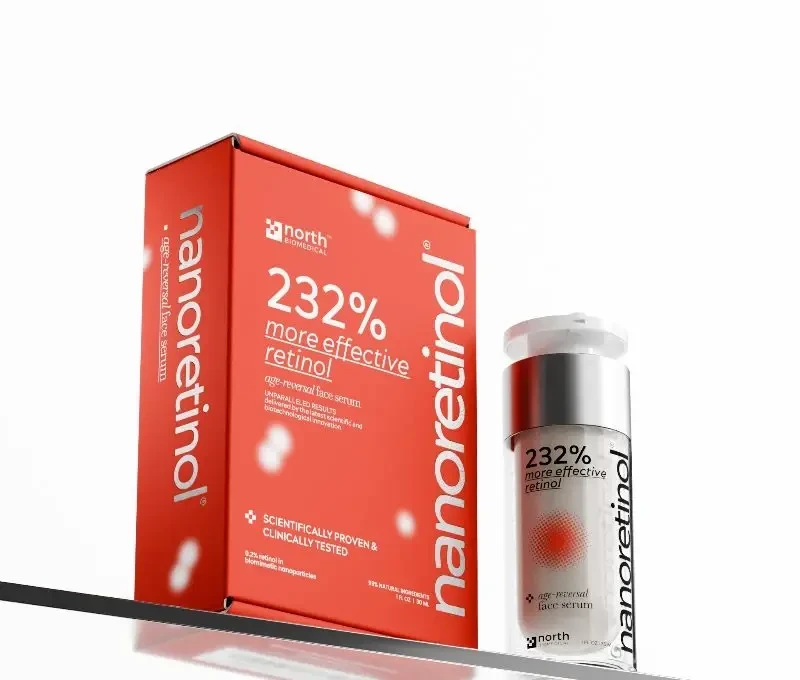
Nanoretinol is a gentler way to bring retinol into that routine. It carries 0.2% retinol in biomimetic lipid nanoparticles, in a light, water-based gel suited to oily and combination skin. In North Biomedical’s clinical study it was 232% more effective in collagen recovery than conventional retinol and produced a 61% increase in firmness after 56 days, with milder side effects than conventional retinol [9]. Follow your dermatologist’s instructions on pausing it before a procedure, and wait until treated skin has fully healed before you start again, since retinol should never go on broken skin.
References
- Jacob CI, Dover JS, Kaminer MS. “Acne Scarring: A Classification System and Review of Treatment Options.” Journal of the American Academy of Dermatology. 2001;45(1):109-117. doi:10.1067/mjd.2001.113451
- Fabbrocini G, Annunziata MC, D’Arco V, De Vita V, Lodi G, Mauriello MC, et al. “Acne Scars: Pathogenesis, Classification and Treatment.” Dermatology Research and Practice. 2010;2010:893080. doi:10.1155/2010/893080
- Schmidt JB, Donath P, Hannes J, Perl S, Neumayer R, Reiner A. “Tretinoin-Iontophoresis in Atrophic Acne Scars.” International Journal of Dermatology. 1999;38(2):149-153. doi:10.1046/j.1365-4362.1999.00586.x
- Lee JB, Chung WG, Kwahck H, Lee KH. “Focal Treatment of Acne Scars with Trichloroacetic Acid: Chemical Reconstruction of Skin Scars Method.” Dermatologic Surgery. 2002;28(11):1017-1021. doi:10.1046/j.1524-4725.2002.02095.x
- Agarwal N, Gupta LK, Khare AK, Kuldeep CM, Mittal A. “Therapeutic Response of 70% Trichloroacetic Acid CROSS in Atrophic Acne Scars.” Dermatologic Surgery. 2015;41(5):597-604. doi:10.1097/DSS.0000000000000355
- Gupta A, Kaur M, Patra S, Khunger N, Gupta S. “Evidence-Based Surgical Management of Post-Acne Scarring in Skin of Color.” Journal of Cutaneous and Aesthetic Surgery. 2020;13(2):124-141. doi:10.4103/JCAS.JCAS_154_19
- Alam M, Han S, Pongprutthipan M, Disphanurat W, Kakar R, Nodzenski M, et al. “Efficacy of a Needling Device for the Treatment of Acne Scars: A Randomized Clinical Trial.” JAMA Dermatology. 2014;150(8):844-849. doi:10.1001/jamadermatol.2013.8687
- Kafi R, Kwak HS, Schumacher WE, Cho S, Hanft VN, Hamilton TA, et al. “Improvement of Naturally Aged Skin with Vitamin A (Retinol).” Archives of Dermatology. 2007;143(5):606-612. doi:10.1001/archderm.143.5.606
- North Biomedical LLC. “Nanoretinol vs. Conventional Retinol: Efficacy in Collagen and Elastin Recovery.” Clinical Study Summary, 2024. Study summary