Neem Oil for Skin: What the Bitter Seed Oil Can and Cannot Do
Neem oil has a long folk record and real antimicrobial chemistry. What the studies actually tested, why the smell and allergy risk matter, and how to use it safely
Few skincare oils announce themselves like neem. Open the bottle and the smell arrives first: garlic, sulfur and roasted nuts, with a bitterness you can almost taste. In a cool bathroom it turns cloudy and half solid. None of that has stopped neem from becoming one of the most searched natural oils for blemishes, dry patches and aging skin.
Behind the reputation sits a tree with a long history in Ayurvedic medicine and a chemistry that genuinely interests researchers. Behind the marketing sits a much thinner layer of human evidence. This guide walks through both, so you can decide whether neem belongs in your routine and how to use it safely if it does.
What neem oil is
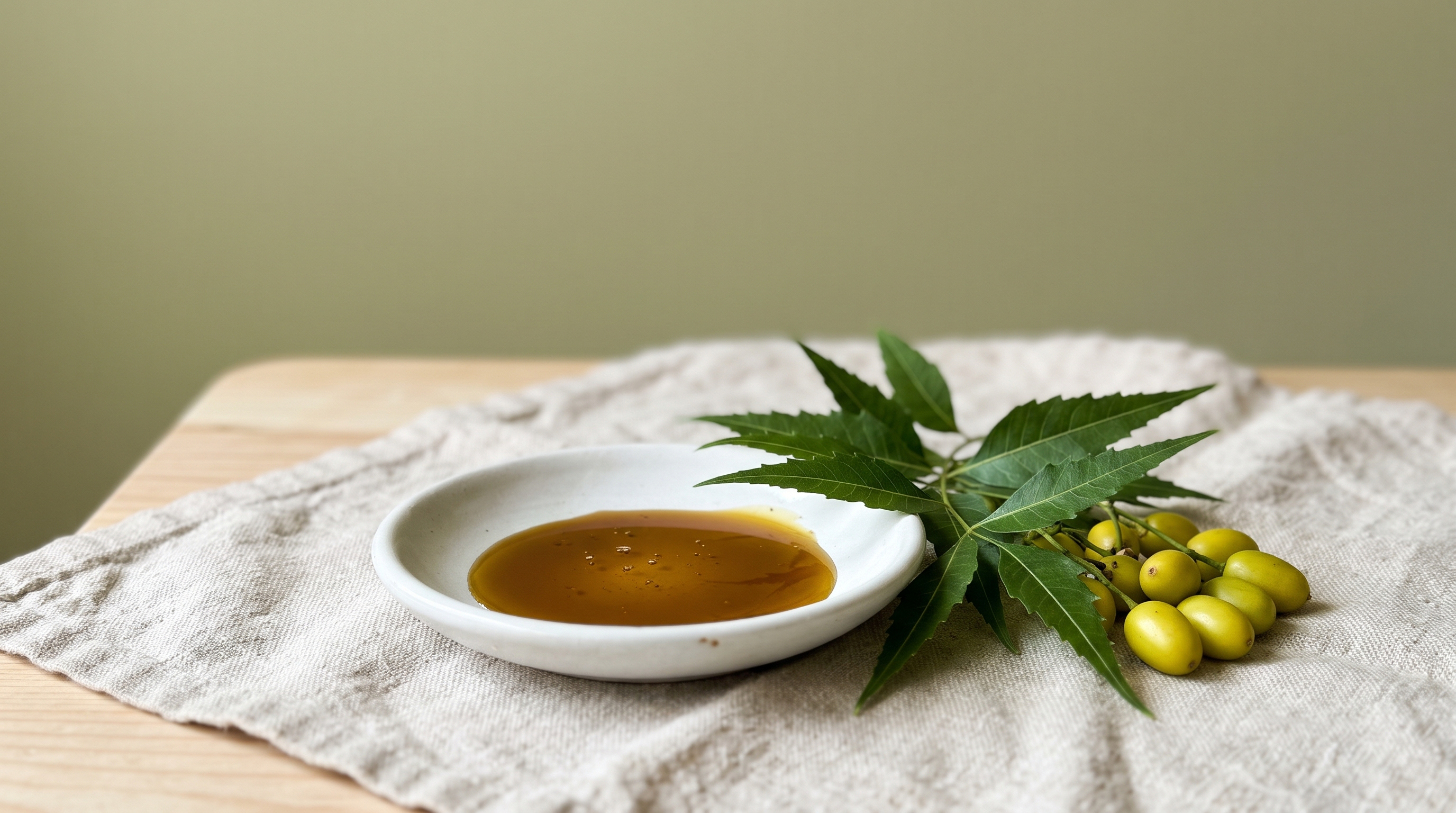
Neem oil is pressed from the seed kernels of Azadirachta indica, an evergreen tree native to the Indian subcontinent. Its leaves, bark and seeds have been used for centuries in traditional medicine, and modern reviews credit the tree with a broad set of antioxidant, anti-inflammatory and antimicrobial compounds [1].
Two families of ingredients matter for skin:
- Limonoids: bitter compounds such as azadirachtin, nimbin and nimbidin. They give neem its smell, its taste and much of its power to repel insects, and they are the focus of most laboratory research on the plant [1].
- Fatty acids: the oil itself is a blend of palmitic, stearic, oleic and linoleic acids. In 60 seed samples collected across one Indian state, oleic acid ranged from 25% to 58% of the fatty acids and linoleic acid from 6% to 17% [2].
That second range is worth noticing. Neem oil is not one standard product. Bottles pressed from different trees can differ widely in how rich, how saturated and how stable they are, which helps explain why people describe the same oil so differently.
Seed oil vs leaf extract
As with moringa and green tea, one plant name on the label can hide two very different ingredients.
Neem seed oil is the thick, pungent oil sold in bottles and used in soaps, balms and hair oils.
Your skin will not treat a 2-week neem oil habit as a wrinkle treatment, because the only anti-wrinkle results so far come from mice rather than people.
Neem leaf extract is made by steeping the leaves in water or alcohol. It concentrates the leaf’s polyphenols and goes into the watery part of creams, toners and face washes.
Most of the studies that make neem sound like an anti-aging ingredient used the leaves, not the oil.
Your skin will not treat a 2-week neem oil habit as a wrinkle treatment, because the only anti-wrinkle results so far come from mice rather than people.
What the research actually shows
Blemishes and inflammation. Breakouts turn red and swollen partly because skin bacteria prompt white blood cells to release reactive oxygen and inflammatory signals. In a cell study, neem extract significantly suppressed both the reactive oxygen and the inflammatory cytokines that acne bacteria provoked, and it was among the strongest of the Indian herbs tested [3]. That is a plausible mechanism. It was measured in cells in a dish, though, and no published controlled trial has shown that plain neem oil clears breakouts on human faces.
Sun-related aging. The most quoted anti-aging study applied an alcohol extract of neem leaves to the skin of hairless mice exposed to UVB light. The treated mice formed fewer wrinkles, and the extract shifted the balance between collagen production and the enzyme that breaks collagen down [4]. Mouse skin is thinner and repairs itself differently from human skin, and the extract was not seed oil. The result is a reason for more research, not a reason to expect smoother skin from a bottle of neem oil.
Human skin use. The best controlled human data on neem seed oil come from outside cosmetics. In a randomized trial in Kenya, 96 children with sand flea infestations of the feet were treated either with 20% neem seed oil in coconut oil or with a standard potassium permanganate foot bath. The neem blend did not kill more fleas within a week, but it reduced acute skin inflammation and left more children free of pain [5]. The trial shows that a diluted neem blend can be used on skin under study conditions. It says nothing about the face, wrinkles or tone.
The downsides: smell, allergy and safety
Neem’s drawbacks are practical, and they are real.
The smell lingers. Even diluted, neem leaves a garlicky note on skin, hair and pillowcases. Many people who buy it for the face end up using it only on body spots and feet for that reason alone.
Your skin can take 2 or 3 days to show a reaction to neem oil, so a patch test tells you far more than a quick sniff of the bottle.
Allergy is a growing concern. Dermatologists have reported allergic contact dermatitis in people using neem oil as a natural remedy, and a 2025 report described neem as an emerging cause of contact dermatitis as its use spreads [6, 7]. Allergic rashes are often delayed: an itchy, red patch can appear a day or more after contact and spread beyond the area you treated.
Your skin can take 2 or 3 days to show a reaction to neem oil, so a patch test tells you far more than a quick sniff of the bottle.
It is poisonous if swallowed. Neem oil is for skin only. Doctors have reported serious poisoning, with vomiting, drowsiness and seizures, in infants and young children who were given the oil by mouth [8]. Store it out of children’s reach, as you would any medicine.
Damaged skin reacts first. Skin that is cracked, freshly exfoliated or prone to eczema is the most likely to sting or develop a rash. Keep neem off broken skin entirely.
How to use neem oil if you want to try it
- Patch test: apply a drop of your diluted blend to the inner forearm twice a day for three days and watch for itching or redness.
- Dilute it: neem is too strong and too pungent to use neat on the face. A cautious starting point is about one part neem to ten parts carrier oil. Jojoba makes a good partner because it is light and stable, as our guide to jojoba oil for skin explains.
- Spot treat: dab the blend on a blemish or a rough patch rather than sealing the whole face in it.
- Use it at night: the smell then has hours to fade before you leave the house.
Choose cold-pressed oil in dark glass, store it somewhere cool, and check that the label lists Azadirachta Indica Seed Oil with no added fragrance. If the oil smells sharp or rancid rather than simply garlicky, replace it.
How neem compares with other blemish oils
If calming blemishes is your main goal, neem is neither the only option nor the best studied. Tea tree oil has small human acne trials behind it, though it needs the same care with dilution. Tamanu oil has a milder smell and a similar folk record for blemishes and marks. Black seed oil is another pungent traditional oil whose skin claims rest on similarly early research.
All of these oils work on the surface: they soothe, soften and may help keep bacteria in check. None of them changes how much collagen your skin makes.
Neem oil, aging skin and retinol
Neem can play a supporting role for blemish-prone skin, but nothing in its research record shows that it can rebuild the collagen that keeps skin firm. For that job, the ingredient with human evidence is retinol. In a study comparing retinol with prescription retinoic acid, four weeks of retinol thickened the epidermis and switched on the genes for type I and type III collagen, and 12 weeks of a retinol formula significantly reduced facial wrinkles [9].
Retinol’s drawback is that conventional formulas can leave skin dry, red and peeling, because they rely on petroleum-derived chemicals that loosen the skin barrier to push retinol through. Nanoretinol takes a different route. It delivers 0.2% retinol inside biomimetic lipid nanoparticles that the skin recognises as its own, in a light, water-based gel that is 99% natural ingredients. In North Biomedical’s clinical study it was 232% more effective in collagen recovery and 73% more effective in elastin recovery than conventional retinol, and users saw a 61% increase in firmness and a 56% increase in elasticity after 56 days, with milder side effects than conventional retinol [10].
If you want both, keep them apart. Apply Nanoretinol at night to clean, dry skin, and use diluted neem as a spot treatment on a different night or on body skin. That way, if your skin does react to neem, you will know which product caused it.
References
- Alzohairy MA. “Therapeutics Role of Azadirachta indica (Neem) and Their Active Constituents in Diseases Prevention and Treatment.” Evidence-Based Complementary and Alternative Medicine. 2016;2016:7382506. doi:10.1155/2016/7382506
- Kaushik N, Vir S. “Variations in Fatty Acid Composition of Neem Seeds Collected from the Rajasthan State of India.” Biochemical Society Transactions. 2000;28(6):880-882. PubMed 11171243
- Jain A, Basal E. “Inhibition of Propionibacterium acnes-Induced Mediators of Inflammation by Indian Herbs.” Phytomedicine. 2003;10(1):34-38. doi:10.1078/094471103321648638
- Ngo HT, Hwang E, Seo SA, Park B, Sun ZW, Zhang M, Shin YK, Yi TH. “Topical Application of Neem Leaves Prevents Wrinkles Formation in UVB-Exposed Hairless Mice.” Journal of Photochemistry and Photobiology B: Biology. 2017;169:161-170. doi:10.1016/j.jphotobiol.2017.03.010
- Elson L, Randu K, Feldmeier H, Fillinger U. “Efficacy of a Mixture of Neem Seed Oil (Azadirachta indica) and Coconut Oil (Cocos nucifera) for Topical Treatment of Tungiasis. A Randomized Controlled, Proof-of-Principle Study.” PLoS Neglected Tropical Diseases. 2019;13(11):e0007822. doi:10.1371/journal.pntd.0007822
- Tamagawa-Mineoka R, Masuda K, Katoh N. “Allergic Contact Dermatitis Due to Neem Oil: A Case Report and Mini-Review.” Journal of Dermatology. 2020;47(2):e48-e49. doi:10.1111/1346-8138.15182
- El Kaderi Y, Kerre S, Herman A. “Allergy to Neem Oil: An Emerging Cause of Contact Dermatitis.” Contact Dermatitis. 2025;93(4):339-340. doi:10.1111/cod.14832
- Dhongade RK, Kavade SG, Damle RS. “Neem Oil Poisoning.” Indian Pediatrics. 2008;45(1):56-57. PubMed 18250509
- Kong R, Cui Y, Fisher GJ, Wang X, Chen Y, Schneider LM, Majmudar G. “A Comparative Study of the Effects of Retinol and Retinoic Acid on Histological, Molecular, and Clinical Properties of Human Skin.” Journal of Cosmetic Dermatology. 2016;15(1):49-57. doi:10.1111/jocd.12193
- North Biomedical LLC. “Nanoretinol vs. Conventional Retinol: Efficacy in Collagen and Elastin Recovery.” Clinical Study Summary, 2024. Study summary