
Runner's Face: What Endurance Training Actually Does to Your Skin
The gaunt, weathered look blamed on mileage has three suspected causes, and only two of them survive contact with the evidence
The Look That Gets Blamed on Mileage
Anyone who runs seriously has heard the warning, usually from someone who does not. Log enough miles and your face will eventually pay the bill: hollow cheeks, slack skin along the jaw, a weathered quality around the eyes that makes a 45-year-old marathoner read older than a sedentary friend of the same age.
The observation is not imaginary. Line up a group of lifelong endurance athletes against matched non-athletes and the athletes often do look older in the face, even while they look considerably younger everywhere else. What is wrong is the explanation. The popular theory holds that the repeated vertical impact of running shakes the face loose, stretching collagen and dragging tissue downward one footstrike at a time.
That mechanism has remarkably little behind it.
Cause One: The Fat You Cannot See Leaving
The face is not padded with one uniform layer of fat. It is built from discrete compartments, deep pockets that provide structural scaffolding and superficial pockets that sit above them and give the surface its smoothness [1]. The deep compartments, including the deep medial cheek fat, are the load-bearing ones. When they shrink, the superficial fat resting on top loses its support and slides, which registers on a face as hollowing and sagging at the same time.
Endurance training drives body fat percentage down. That is usually the entire point. But fat loss is systemic, and the face has no way to opt out. A runner who drops from 22% body fat to 12% across three seasons is making withdrawals from those facial compartments along with everywhere else, and the deep structural pockets are among the first to thin [1].
This is why the effect tracks leanness rather than mileage. Two runners at identical weekly volume, one at 18% body fat and one at 9%, will not have the same face. It also explains why the change often seems to arrive suddenly, during the season an athlete finally hits race weight, rather than accumulating quietly across decades of training.
Cause Two: The Sun You Were Not Thinking About
The second cause is the one that does the lasting damage, and it has nothing to do with running as a movement. It has to do with where running happens.
Two runners at identical weekly volume, one at 18% body fat and one at 9%, will not have the same face.
Ultraviolet exposure is the dominant driver of visible facial aging in anyone who spends real time outdoors. Even low doses of solar UV activate matrix metalloproteinases, the enzymes that break down the collagen and elastin holding the dermis together [2]. This is the mechanism that separates photoaged skin from skin that has simply gotten older, and it is cumulative. Every unprotected hour adds to a total the skin keeps permanent count of, a process covered in more depth in our guide to sun damaged skin.
Runners build that total faster than almost anyone, because the sport puts them outside for hours, frequently at midday, frequently in summer, and they protect themselves poorly. In a survey of 697 runners, only 36% reported using sun protection frequently, and facial sunscreen specifically was used frequently by just 42% [3]. The most common reason for skipping it was not skepticism or inconvenience but simple forgetfulness, cited by 49% of respondents [3]. Broader reviews of outdoor athletes find the same pattern across sports, with more than half of collegiate athletes reporting they never use sunscreen despite training roughly four hours a day for most of the year [4].
Sweat compounds the problem in a purely practical way. It carries sunscreen off the face within the first few miles, so even the runners who do apply it are often unprotected for the majority of the session.
The Cause That Does Not Hold Up
Which brings us back to the bouncing theory. The idea feels intuitive. The face moves up and down thousands of times per run, and surely, over years, that stretches something.
Facial aging science does not support it. The structures that determine whether a face holds its shape are the retaining ligaments, fibrous tethers that anchor soft tissue to the facial skeleton, together with the fat compartments they interact with [7]. Sagging is attributed to attenuation of those ligaments combined with volume loss underneath them, not to repetitive mechanical loading. No controlled study has demonstrated that running-induced facial motion accelerates skin laxity. That is an absence of evidence rather than proof of harmlessness, but it is a conspicuous absence given how confidently the claim circulates.
That same study found photodamaged skin was already forming 56% less collagen I than sun-protected skin, which is a fair description of the deficit a runner accumulates across decades of outdoor training.
The evidence that does exist points the opposite direction. Regular exercise appears to protect skin rather than damage it. In research comparing active older adults with sedentary controls, the exercisers showed a thinner, more youthful stratum corneum and attenuated epidermal thinning, with muscle-derived interleukin-15 identified as the mediator [5].
What Actually Reverses It
Once the two real causes are separated, the response becomes straightforward, because each one needs a different answer.
For the volume side, the honest answer is that no topical product will direct fat back into your cheeks. What you can control is how extreme the deficit becomes and how long you hold it. Athletes who spend the off-season at a moderate body fat percentage, rather than defending race weight year round, generally keep more facial fullness. For anyone wanting options beyond that, our article on facial volume loss covers the structural approaches.
For the photoaging side, both prevention and repair are genuinely available. Prevention means sunscreen that survives a long run, which in practice means a water-resistant formulation applied generously and, for longer sessions, a brimmed hat that does not depend on reapplication to keep working. Choosing sunscreen suited to mature skin is worth doing deliberately rather than grabbing whatever is in the drawer.
Repair means collagen. Topical retinoids remain the best-evidenced way to rebuild what UV has degraded. In the landmark controlled trial on photodamaged skin, tretinoin produced an 80% increase in collagen I formation, while vehicle-treated skin showed a 14% decrease over the same period [6]. That same study found photodamaged skin was already forming 56% less collagen I than sun-protected skin, which is a fair description of the deficit a runner accumulates across decades of outdoor training [6]. Our guide to boosting collagen production covers the wider toolkit.
Where Nanoretinol Fits
For most runners the obstacle is not motivation. It is tolerance. Skin that has been sun-exposed, wind-exposed and repeatedly stripped of its oils by sweat and hot showers does not respond well to conventional retinol, which depends on disrupting the skin barrier in order to get through it. That disruption produces the burning and peeling that ends most retinol attempts inside the first month.
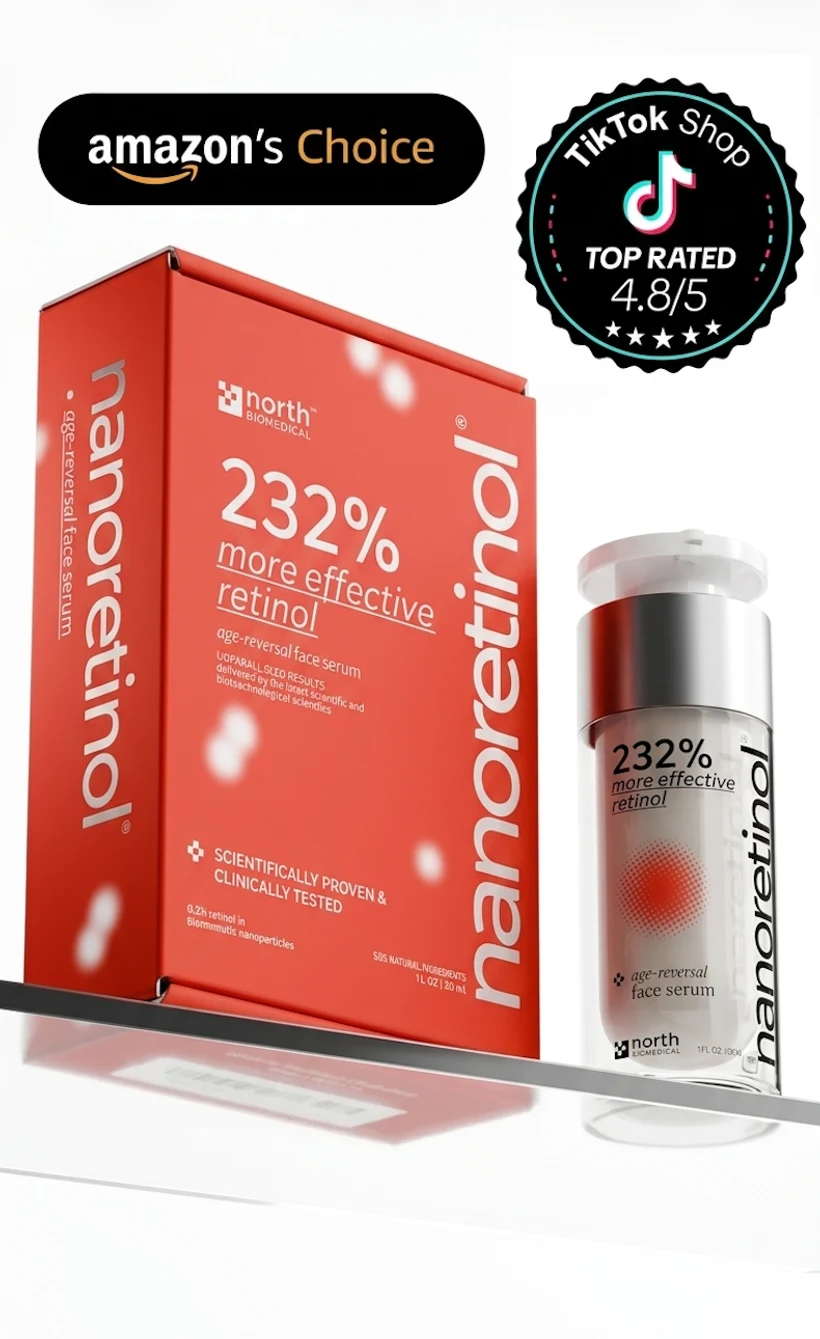
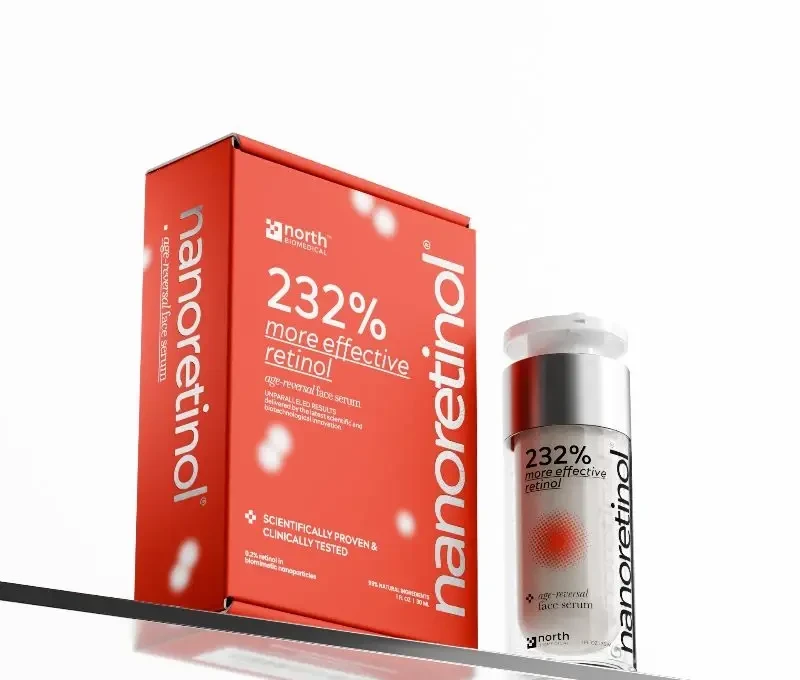
Nanoretinol takes a different route. Its 0.2% retinol is encapsulated in biomimetic lipid nanoparticles that the skin recognizes as self and allows through the epithelial barrier, so the active reaches its target without the barrier damage conventional formulations rely on. In North Biomedical’s clinical study it proved 232% more effective than regular retinol in collagen recovery and 73% more effective in elastin recovery, with drastically reduced cytotoxicity. Across 56 days of use, skin firmness increased 61% and elasticity increased 56%.
For a face carrying a decade of accumulated ultraviolet exposure, collagen and elastin are precisely the two structures that need rebuilding.
Running Is Not the Villain
Runner’s face is real, but the story attached to it is wrong. It is the product of a lean body composition and a large lifetime UV dose arriving together in people who happen to train outdoors. Neither of those requires giving up the sport. One asks for a slightly less aggressive relationship with race weight, and the other asks for the sunscreen you were already supposed to be wearing, plus a retinoid capable of recovering the collagen you did not protect.
References
- Rohrich RJ, Pessa JE. “The Fat Compartments of the Face: Anatomy and Clinical Implications for Cosmetic Surgery.” Plastic and Reconstructive Surgery. 2007;119(7):2219-2227. doi:10.1097/01.prs.0000265403.66886.54
- Fisher GJ, Kang S, Varani J, Bata-Csorgo Z, Wan Y, Datta S, Voorhees JJ. “Mechanisms of Photoaging and Chronological Skin Aging.” Archives of Dermatology. 2002;138(11):1462-1470. doi:10.1001/archderm.138.11.1462
- Tenforde AS, Fredericson M, Toth KES, Sainani KL. “Sun Protective Behaviors and Attitudes of Runners.” Sports (Basel). 2021;10(1):1. doi:10.3390/sports10010001
- Kliniec K, Tota M, Zalesińska A, Łyko M, Jankowska-Konsur A. “Skin Cancer Risk, Sun-Protection Knowledge and Behavior in Athletes: A Narrative Review.” Cancers (Basel). 2023;15(13):3281. doi:10.3390/cancers15133281
- Crane JD, MacNeil LG, Lally JS, Ford RJ, Bujak AL, Brar IK, Kemp BE, Raha S, Steinberg GR, Tarnopolsky MA. “Exercise-Stimulated Interleukin-15 Is Controlled by AMPK and Regulates Skin Metabolism and Aging.” Aging Cell. 2015;14(4):625-634. doi:10.1111/acel.12341
- Griffiths CEM, Russman AN, Majmudar G, Singer RS, Hamilton TA, Voorhees JJ. “Restoration of Collagen Formation in Photodamaged Human Skin by Tretinoin (Retinoic Acid).” New England Journal of Medicine. 1993;329(8):530-535. doi:10.1056/NEJM199308193290803
- Rossell-Perry P, Paredes-Leandro P. “Anatomic Study of the Retaining Ligaments of the Face and Applications for Facial Rejuvenation.” Aesthetic Plastic Surgery. 2013;37(3):504-512. doi:10.1007/s00266-012-9995-x