Salt Scrub Guide: Benefits, Risks and How to Use One on Your Body
Salt scrubs promise smooth legs, softer elbows and a mineral boost. Here is what salt actually does to skin, how it compares with sugar, and how to use a salt scrub without stinging or over-scrubbing
A salt scrub is one of the most satisfying steps in a shower routine. The grains melt into warm oil, the skin on your legs and arms turns noticeably smoother, and the rinse leaves a soft, slightly slick finish that lasts the rest of the day.
That smoothness is real, but it is mostly a surface effect, and salt is a sharper tool than it looks. The mineral claims on the jar are also stronger than the evidence. This guide explains what a salt scrub does, how salt compares with sugar, what the studies on sea salt actually show, and how to use one without stinging or over-scrubbing.
What a salt scrub actually does
Your outer layer of skin, the stratum corneum, is a wall of flattened dead cells held together by lipids. It renews itself constantly, and healthy skin sheds those cells in a quiet, invisible process [1]. When the process slows, as it does in dry winter air, on aging skin or on rough patches such as elbows, knees and shins, the old cells pile up and skin looks dull, flaky and feels rough.
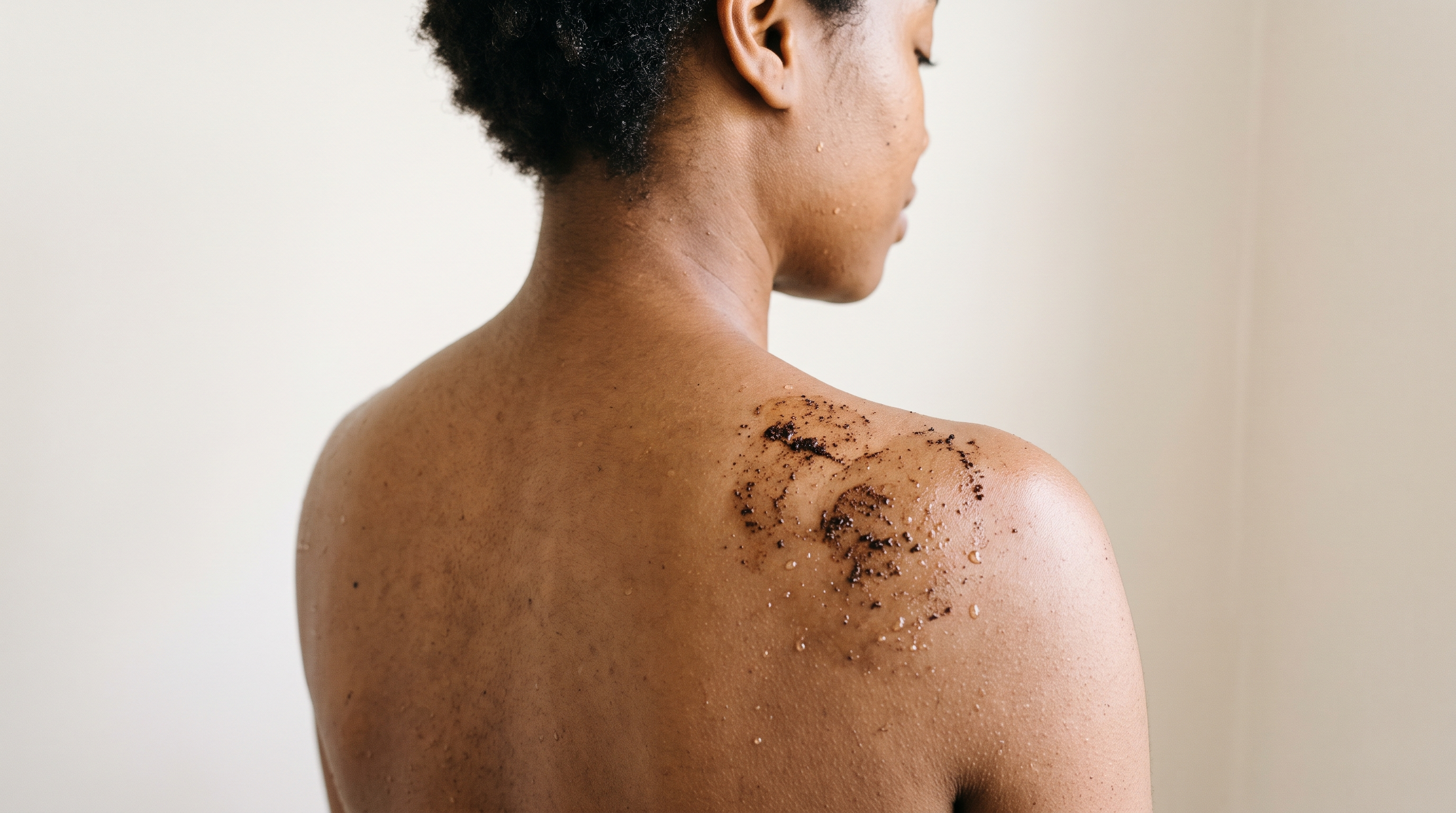
A salt scrub is physical exfoliation. The grains lift that loose top layer as you move them over wet skin, and the oil in most scrubs then coats the fresh surface. That is why skin feels smooth straight away. The effect fades over a few days as new cells reach the surface, which is why scrubs are something you repeat rather than a one-off fix.
Your skin only needs about 30 seconds of light circles on each area, and pressing harder than that strips the lipids that keep it soft.
Salt versus sugar
Salt and sugar scrubs look alike, but they behave differently:
Your skin only needs about 30 seconds of light circles on each area, and pressing harder than that strips the lipids that keep it soft.
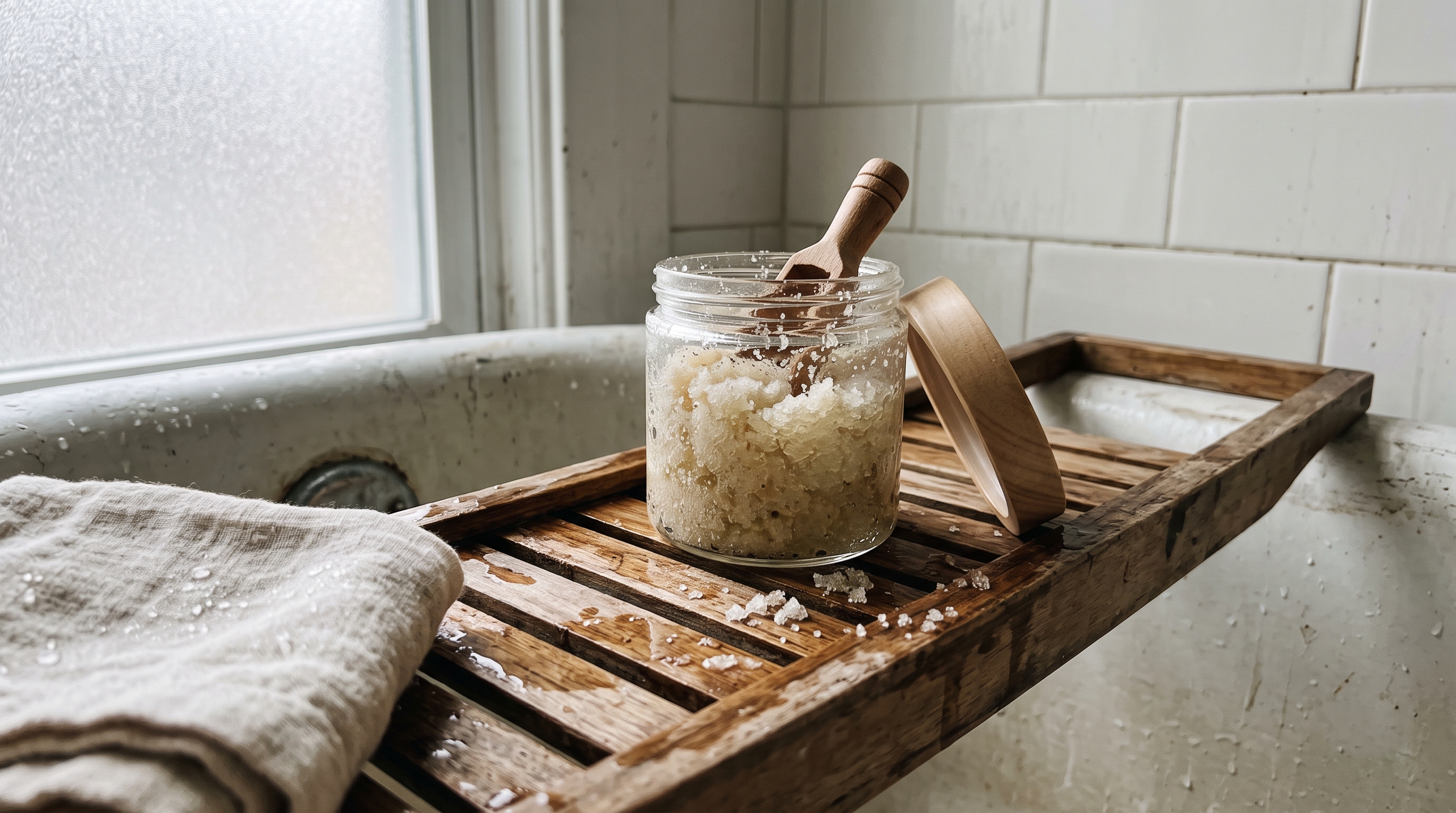
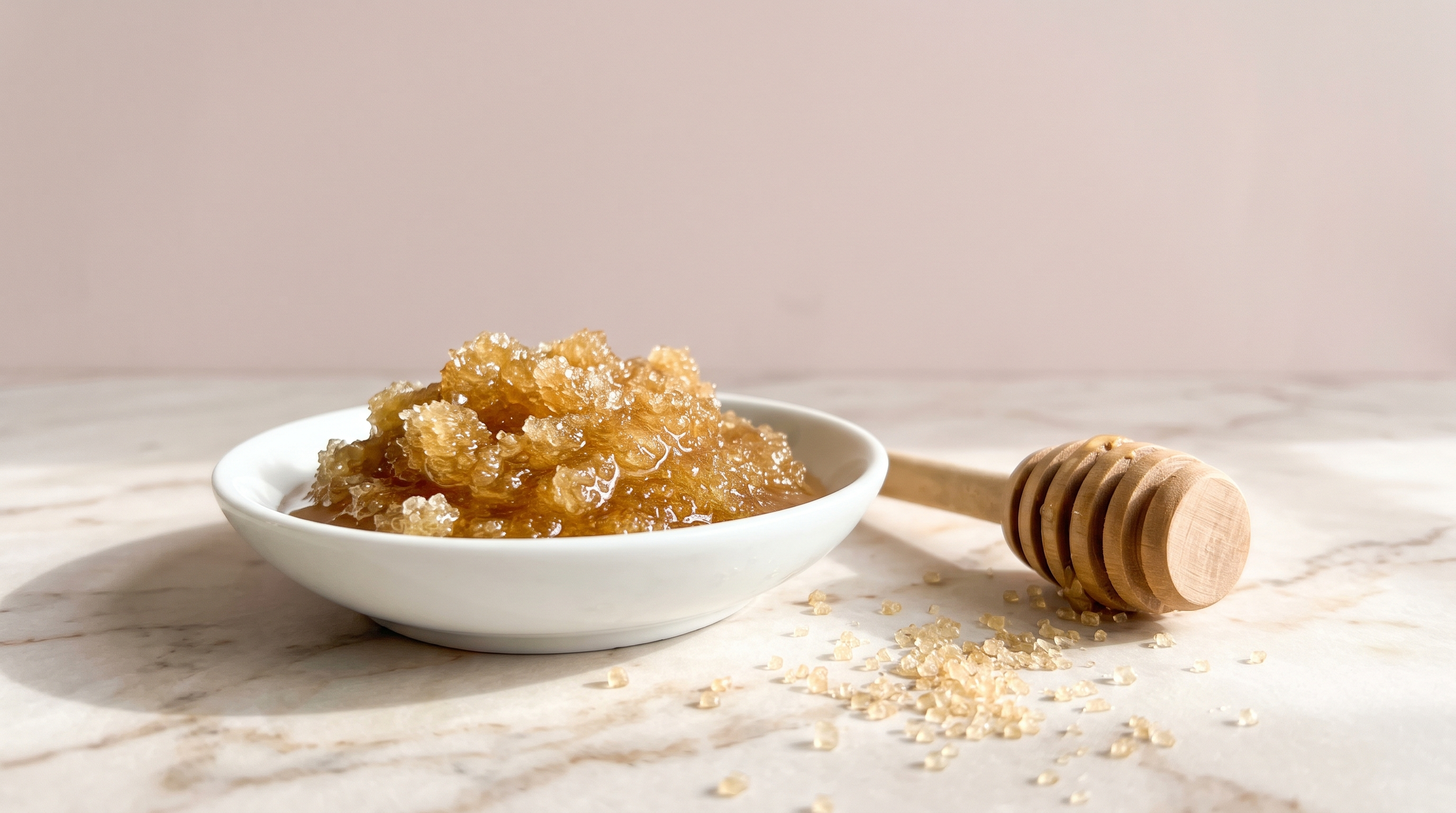
- Grain shape. Salt crystals are hard, angular cubes with sharp edges. Most sugar scrubs use finer, softer grains, so sugar tends to be the gentler choice.
- Dissolving. Both dissolve in water, but sugar softens faster, so it loses its bite quickly in a warm shower. Salt holds its edge longer.
- Stinging. Salt stings on anything open: a shaving nick, a scratch, a patch of broken skin. Sugar is much less likely to.
- Best use. Salt suits thick, rough skin on feet, heels, knees and elbows. Sugar is better for larger areas and more sensitive skin.
Coffee grounds are a third gritty option with their own caffeine claims, which our coffee scrub guide puts to the test, and if you are still weighing grit against acids, our guide to the best body scrub explains why chemical exfoliants often beat any grain on aging body skin.
Sea, Dead Sea, Himalayan and Epsom salt
The type of salt matters less than the jar suggests.
- Sea salt is mostly sodium chloride with traces of other minerals. It is the standard choice and works well for exfoliation.
- Dead Sea salt is much richer in magnesium chloride. This is the only salt with meaningful skin research behind it, covered below.
- Himalayan pink salt is also mostly sodium chloride. Its colour comes from trace iron, and there is no evidence that it does anything special for skin.
- Epsom salt is magnesium sulfate. It dissolves quickly, so it gives a softer scrub, but claims that it “detoxes” skin or tops up your magnesium are not supported. A review of transdermal magnesium concluded that the idea of absorbing useful amounts through the skin is scientifically unsupported [2].
What the Dead Sea salt research shows
The best study of salt on skin did not involve scrubbing at all. Volunteers with dry, atopic skin soaked one forearm in a 5% solution of magnesium-rich Dead Sea salt for 15 minutes, while the other forearm was soaked in tap water [3]. The salt-soaked arm ended up better hydrated, less rough and less red, and in people whose skin barrier started out leaky, barrier function improved too [3].
Your skin got smoother and less red after 6 weeks of 15 minute Dead Sea salt soaks in one study, a better result than plain tap water soaks.
Your skin got smoother and less red after 6 weeks of 15 minute Dead Sea salt soaks in one study, a better result than plain tap water soaks.
That supports Dead Sea salt as a skin-friendly mineral, but it says nothing about scrubbing. In a scrub, the salt is in contact with skin for a minute or two and is mostly rinsed away, so the realistic benefit is exfoliation plus whatever oil the scrub leaves behind.
How to use a salt scrub
- Use it at the end of your shower, when skin is warm and soft.
- Take a small scoop and spread it over damp skin, one area at a time.
- Massage in slow, light circles for about 30 seconds, then move on. Let the grains do the work.
- Rinse with lukewarm water. If the scrub contains oil, the shower floor will be slippery, so step carefully.
- Pat dry and apply a moisturizer while skin is still slightly damp.
That last step matters. Moisturizers help the stratum corneum hold water and keep its shedding process working smoothly, and skin that is left dry after exfoliation flakes faster [4].
How often: once or twice a week is plenty for most people. Thick, rough skin on the feet can take more; thin skin on the chest and inner arms needs less.
When to skip a salt scrub
- On your face. Salt crystals are too sharp for facial skin. Use a gentle facial exfoliant instead.
- Right after shaving or waxing. Wait at least a day, or the salt will sting every tiny nick.
- On sunburn, rashes, eczema or broken skin.
- On skin you treat with retinol the same night. Retinol already speeds up renewal. Pair them on alternate evenings.
Bumpy arms and rough legs
Many people buy a salt scrub for the small rough bumps on the backs of the arms and thighs. That is keratosis pilaris, a buildup of keratin inside hair follicles [5]. Scrubbing can flatten the bumps for a day, but harsh scrubbing often makes them redder. Reviews list keratin-softening creams and topical retinoids among the treatments that actually help [5], and our guide to keratosis pilaris treatment explains how to combine them. For a daily option that exfoliates in the shower without grit, see our guide to exfoliating body wash.
Long-term smoothness
A salt scrub is a good occasional polish for rough skin, but it only works on the surface. Crepey, thin, rough-textured body skin changes when the deeper structure changes, and that structure is collagen.
Retinol is one of the best-studied ways to rebuild it, and the evidence comes from body skin. In a trial on the arms of older adults, retinol lotion improved fine wrinkling and increased collagen production over 24 weeks compared with the plain lotion base [6]. Nanoretinol carries 0.2% retinol in biomimetic lipid nanoparticles, in a light, water-based gel that absorbs fully without a greasy finish. In North Biomedical’s clinical study, it was 232% more effective in collagen recovery than conventional retinol and produced a 61% increase in firmness after 56 days, with milder side effects than conventional retinol [7]. Keep the salt scrub for one or two shower nights a week and use Nanoretinol on the evenings in between.
References
- Harding CR. “The Stratum Corneum: Structure and Function in Health and Disease.” Dermatologic Therapy. 2004;17(Suppl 1):6-15. doi:10.1111/j.1396-0296.2004.04s1001.x
- Gröber U, Werner T, Vormann J, Kisters K. “Myth or Reality: Transdermal Magnesium?” Nutrients. 2017;9(8):813. doi:10.3390/nu9080813
- Proksch E, Nissen HP, Bremgartner M, Urquhart C. “Bathing in a Magnesium-Rich Dead Sea Salt Solution Improves Skin Barrier Function, Enhances Skin Hydration, and Reduces Inflammation in Atopic Dry Skin.” International Journal of Dermatology. 2005;44(2):151-157. doi:10.1111/j.1365-4632.2005.02079.x
- Rawlings AV, Harding CR. “Moisturization and Skin Barrier Function.” Dermatologic Therapy. 2004;17(Suppl 1):43-48. doi:10.1111/j.1396-0296.2004.04s1005.x
- Hwang S, Schwartz RA. “Keratosis Pilaris: A Common Follicular Hyperkeratosis.” Cutis. 2008;82(3):177-180. PubMed: 18856156
- Kafi R, Kwak HS, Schumacher WE, Cho S, Hanft VN, Hamilton TA, et al. “Improvement of Naturally Aged Skin with Vitamin A (Retinol).” Archives of Dermatology. 2007;143(5):606-612. doi:10.1001/archderm.143.5.606
- North Biomedical LLC. “Nanoretinol vs. Conventional Retinol: Efficacy in Collagen and Elastin Recovery.” Clinical Study Summary, 2024. Study summary