Lip Scrub: When Exfoliating Your Lips Helps and When It Makes Them Worse
Lip skin is thin, has no oil glands and dries out faster than your face. Here is what a lip scrub can do, how often to use one and what it cannot fix
Few skincare products feel as instantly rewarding as a lip scrub. A minute of gentle rubbing, a wipe, and the dry flakes that were catching on your lipstick are gone. It is also one of the easiest products to overuse, because the skin of your lips is built very differently from the skin on the rest of your face.
This guide explains why lips flake in the first place, what a scrub actually removes, how often to use one, which ingredients are worth avoiding, and why the fine lines around your mouth need a different kind of care altogether.
Why lips flake so easily
The outer layer of skin, the stratum corneum, is a wall of flattened dead cells held together by fats. How many cell layers it has depends on where you look. In a study that counted those layers in skin from 301 people, the face averaged about 9 layers, compared with 13 on the trunk and 86 on the heel [1]. The same study found that water loss through the skin tracked the number of layers: the thinner the wall, the leakier it was.
Lips sit at the thin end of that range, and they have a second problem: they get none of the natural sebum that helps protect the cheeks and forehead.
Your lips have no oil glands of their own, so a flake you scrub away today can return within 2 days unless something seals the fresh surface underneath.
Researchers comparing lips with cheek skin in 138 women aged 16 to 78 found clear differences in hydration, water loss and elasticity between the two sites, and linked the drying and chapping that younger people complain about to the weak barrier of the lip surface [2]. A second study looked at what flaking actually is. When the researchers tape-stripped the lips of 40 women, they found that the drier the lips were, the more the shed cells came off in uneven, thick clumps rather than as a smooth, thin layer [3]. In other words, visible flaking is a symptom of dryness. The cells are not shedding cleanly because there is not enough water in the surface for the enzymes that release them to work properly.
That finding explains both why a lip scrub feels so good and why it is not a fix on its own.
Your lips have no oil glands of their own, so a flake you scrub away today can return within 2 days unless something seals the fresh surface underneath.
What a lip scrub actually does
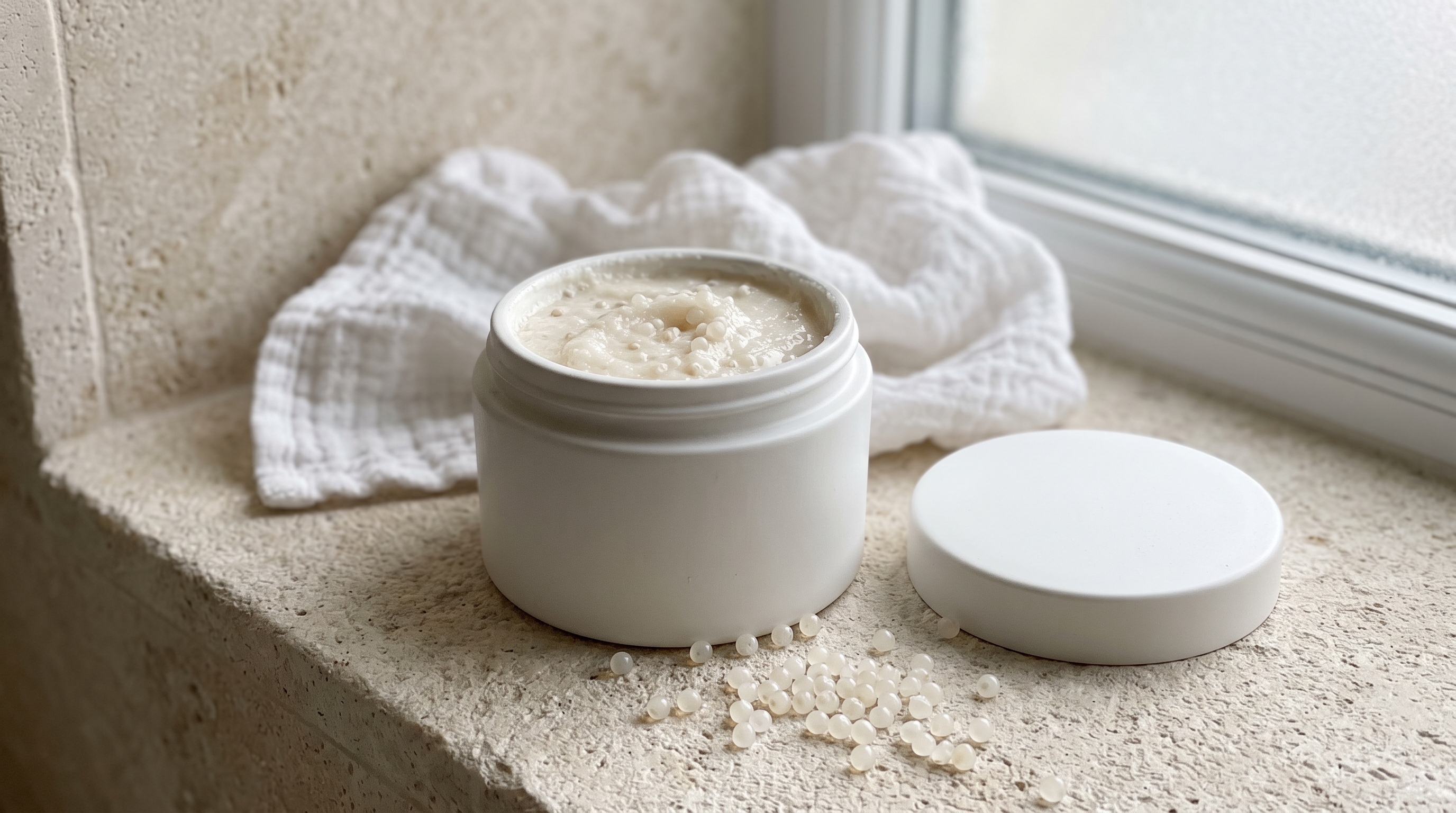
A lip scrub is a physical exfoliant: small grains, usually sugar, suspended in an oil or butter. Rubbing them over the lips lifts the loose, half-detached flakes that would have come away eventually, and the oil leaves a temporary film behind.
That is useful for three things:
- Smoothing before lipstick or balm. Removing raised flakes gives colour a more even surface and lets a balm sit on the lip rather than on dead skin.
- Cosmetic polish. Lips look softer and slightly fuller straight away, because light reflects off a smoother surface.
- A reminder to moisturize. The best part of most scrubs is the oil or butter that comes with them.
What a scrub cannot do is make the barrier stronger. If your lips are flaking because they are dry, scrubbing removes the evidence, but the new surface underneath is just as thin and just as quick to lose water. Without an occlusive balm on top, the flakes come back. Our guide to the best lip balm for dry lips explains which balm ingredients actually seal water in, and that step matters more than the scrub.
How often to use a lip scrub
Your lip scrub works best as a once- or twice-weekly reset, and scrubbing more than 2 days a week usually leaves lips rougher than they were before.
Over-exfoliated lips look shiny, feel tight or tender, and sting when you eat salty or acidic food. If that happens, stop scrubbing for a week and use only a plain balm until the stinging settles.
A simple routine that works for most people:
- Soften first. Scrub after a shower or after pressing a warm, damp cloth to your lips for a minute. Damp flakes lift more easily and need less pressure.
- Use a pea-sized amount and light pressure. Move in small circles for 20 to 30 seconds. Let the grains do the work; you are polishing, not sanding.
- Wipe, do not rub dry. Remove the scrub with a damp cloth.
- Seal immediately. Apply a thick balm or ointment straight away. At night, a lip mask gives a heavier overnight layer.
- Skip it when lips are cracked or bleeding. Open cracks need protection, not friction.
Your lip scrub works best as a once- or twice-weekly reset, and scrubbing more than 2 days a week usually leaves lips rougher than they were before.
What to look for, and what to avoid
Lip products cause more allergic reactions than people expect, partly because lips are thin and partly because we reapply lip products many times a day. A systematic review of allergic contact dermatitis from lip care products found 58 reported cases across 47 reports, involving lipsticks, balms, glosses and lip plumpers [4]. The ingredients most often responsible were castor oil, benzophenone-3 (a sunscreen filter), gallates (antioxidants), waxes and colophony, a pine resin.
When you choose a scrub:
- Prefer fine, rounded grains. Fine sugar dissolves as you use it, which makes it self-limiting. Coarse salt, ground shells or seeds have sharper edges.
- Look for a simple base. Plant oils, shea butter, petrolatum or squalane are all reasonable carriers.
- Be cautious with flavourings and cooling agents. Peppermint, menthol and cinnamon give a tingle that is easy to mistake for a sign the product is working. On thin lip skin, that tingle is usually irritation.
- Treat persistent redness as a signal. If your lips stay red, swollen or itchy after a new product, stop using it. Lip dermatitis that keeps returning is worth a patch test with a dermatologist.
If your concern is colour rather than texture, a scrub will not change it. Our guide to dark lips covers why lips darken and what actually helps.
DIY or store-bought?
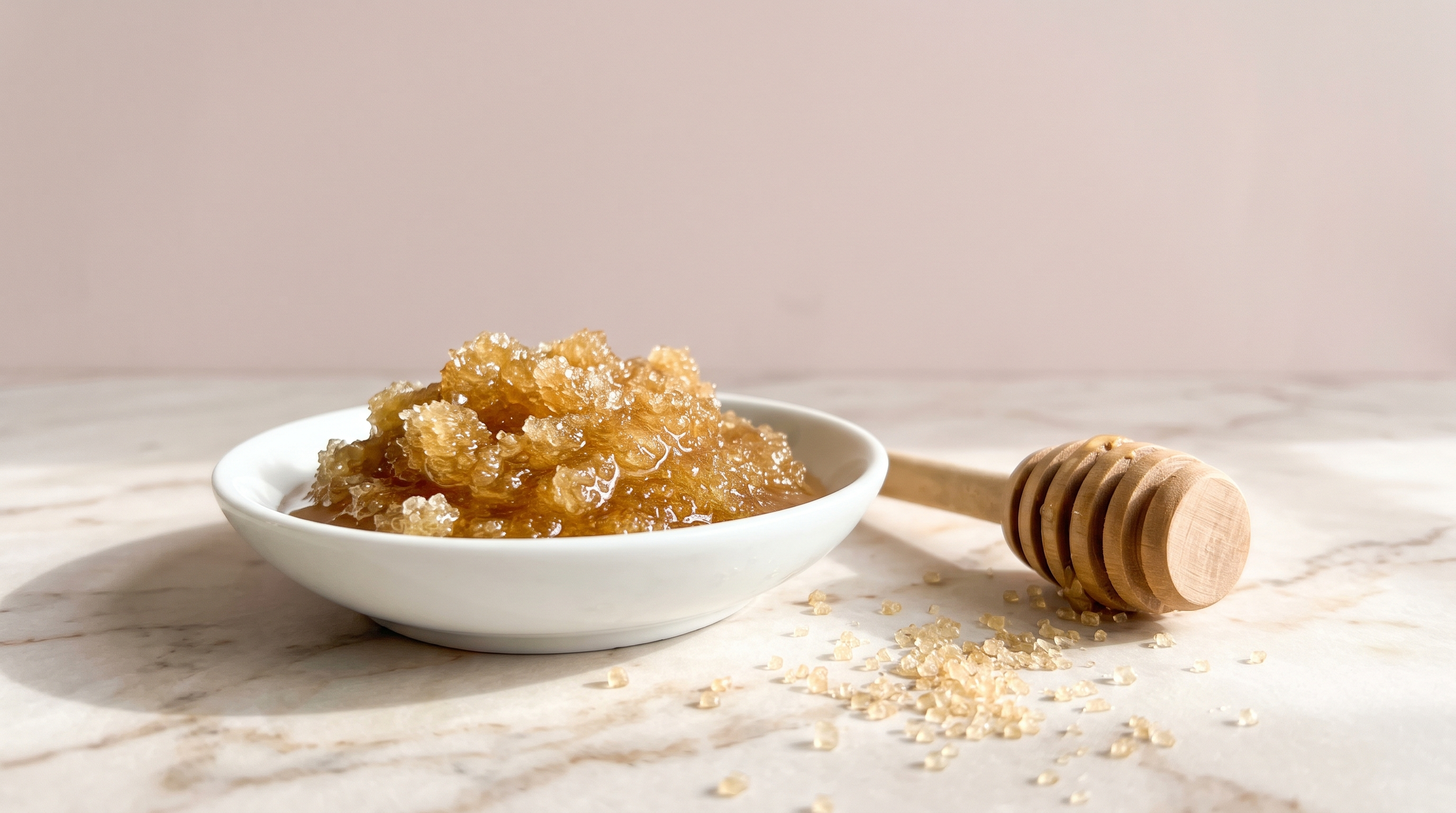
A homemade scrub of one part fine sugar to one part honey or a plain oil works perfectly well. It has the advantage of a short, known ingredient list, which matters if you react easily. Make small batches, keep them dry, and throw them away after a week or two, because water from a damp finger can let microbes grow in a preservative-free mix.
A shop-bought scrub adds convenience, a preservative system and often a nicer texture. It is not more effective. The grain and the balm afterwards are what count.
The lines around your mouth are a different problem
Many people reach for a lip scrub because their lips look older: thinner, more creased, with fine vertical lines running into the skin above the lip. Exfoliating the lip itself does nothing for those lines, because they are not on the lip. They form in the skin around the mouth, and they are driven by lost collagen and elastin, repeated muscle movement and years of sun.
That skin is also unusually fragile. When researchers measured different areas of the face, they found the barrier was weaker on the nasolabial fold and chin than on the cheek, with higher water loss and smaller surface cells [5]. It is an area that needs collagen support delivered gently.
That is where a retinoid belongs in the routine. In a randomized, vehicle-controlled trial in older adults, a 0.4% retinol lotion significantly reduced fine wrinkling over 24 weeks and increased procollagen and the water-binding molecules that plump skin [6]. Our guide on how to get rid of lip wrinkles explains how retinoids fit with other options for perioral lines.
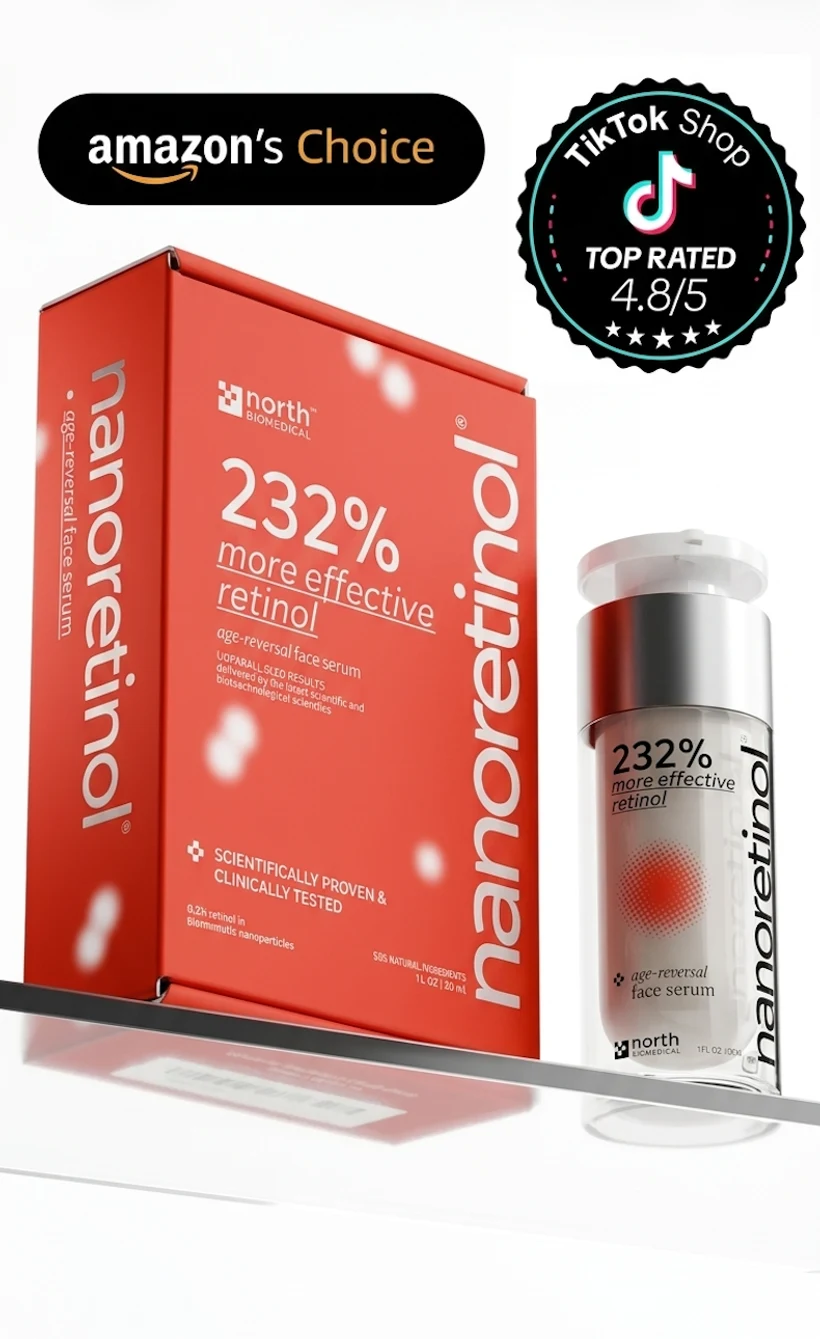
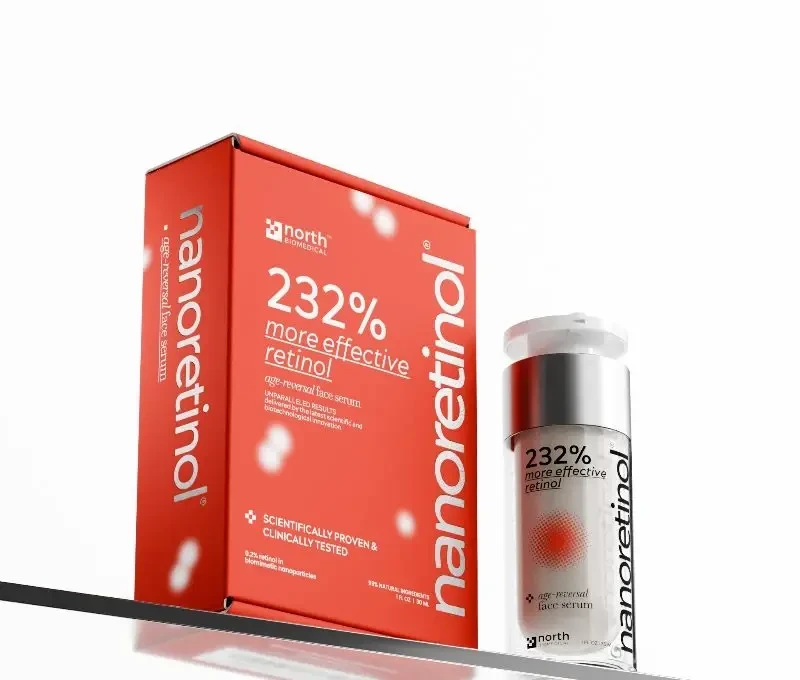
The difficulty is that conventional retinol often irritates exactly this kind of thin, reactive skin, and the corners of the mouth are one of the first places it peels. Nanoretinol was developed to avoid that trade-off. Its 0.2% retinol is carried in biomimetic lipid nanoparticles that the skin recognizes as its own, so it reaches the skin cells without breaking down the barrier the way many conventional formulas do. In North Biomedical’s study it was 232% more effective in collagen recovery than conventional retinol, and in clinical use it increased skin firmness by 61% over 56 days [7]. Its water-based gel absorbs fully and is gentle enough for sensitive skin.
Used at night on the skin around your mouth, keeping it off the lips themselves, with a scrub once or twice a week and a good balm every day, it covers both halves of the problem: the flakes on the lip and the lines beside it.
References
- Ya-Xian Z, Suetake T, Tagami H. “Number of cell layers of the stratum corneum in normal skin - relationship to the anatomical location on the body, age, sex and physical parameters.” Archives of Dermatological Research. 1999;291(10):555-559. doi:10.1007/s004030050453
- Tamura E, Ishikawa J, Sugata K, Tsukahara K, Yasumori H, Yamamoto T. “Age-related differences in the functional properties of lips compared with skin.” Skin Research and Technology. 2018;24(3):472-478. doi:10.1111/srt.12456
- Kim J, Yeo H, Kim T, Jeong ET, Lim JM, Park SG. “Relationship between lip skin biophysical and biochemical characteristics with corneocyte unevenness ratio as a new parameter to assess the severity of lip scaling.” International Journal of Cosmetic Science. 2021;43(3):275-282. doi:10.1111/ics.12692
- Pal B, Kumari S, Kumari A, Singh SK, Babbar H. “Allergic contact dermatitis to lip care cosmetic products - a systematic review.” Cutaneous and Ocular Toxicology. 2024;43(1):13-21. doi:10.1080/15569527.2023.2275022
- Kobayashi H, Tagami H. “Distinct locational differences observable in biophysical functions of the facial skin: with special emphasis on the poor functional properties of the stratum corneum of the perioral region.” International Journal of Cosmetic Science. 2004;26(2):91-101. doi:10.1111/j.0412-5463.2004.00208.x
- Kafi R, Kwak HS, Schumacher WE, Cho S, Hanft VN, Hamilton TA, King AL, Neal JD, Varani J, Fisher GJ, Voorhees JJ, Kang S. “Improvement of naturally aged skin with vitamin A (retinol).” Archives of Dermatology. 2007;143(5):606-612. doi:10.1001/archderm.143.5.606
- North Biomedical LLC. “Nanoretinol vs. Conventional Retinol: Efficacy in Collagen and Elastin Recovery.” Clinical Study Summary, 2024. Study summary