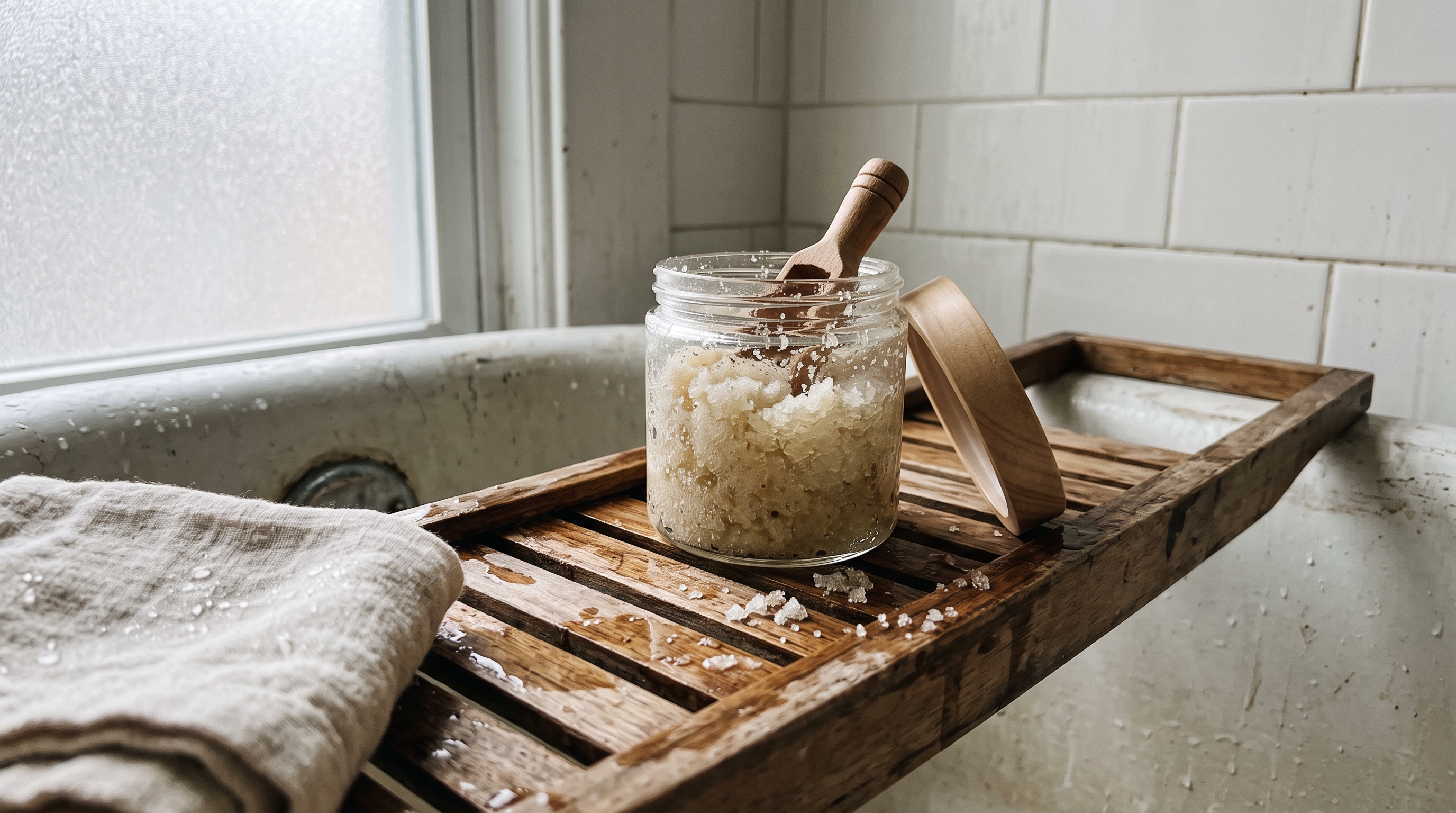
Best Body Scrub: What Actually Works on Aging Body Skin
The grit is the least important variable in the jar, and the evidence on why is more useful than any product list
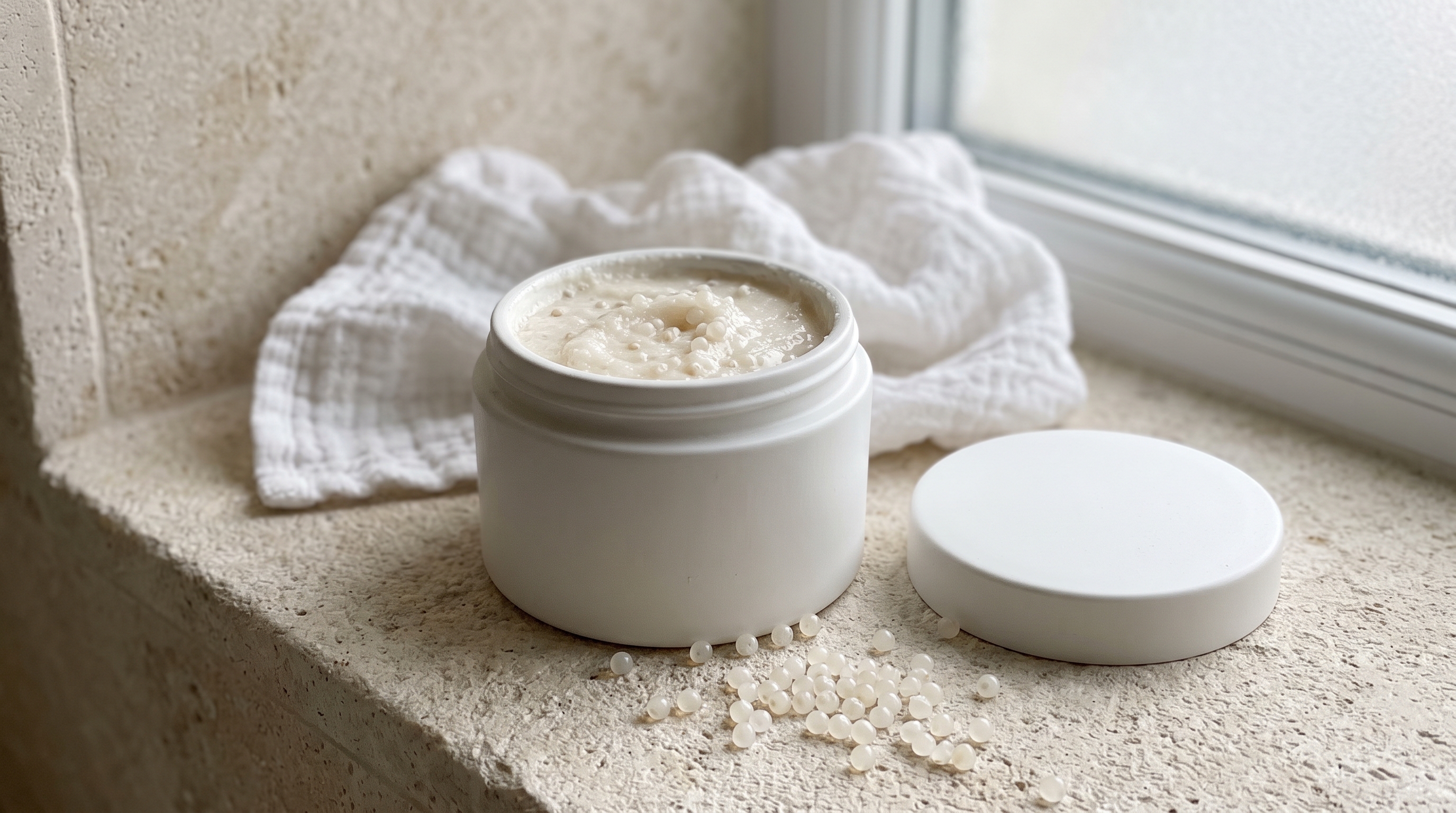
The body scrub aisle sells a very specific promise. Salt, sugar, crushed walnut shell, coffee grounds and apricot kernel, all suspended in oil, all promising skin that feels new. They do deliver a sensation, which is most of why people keep buying them.
What that sensation represents is worth understanding before you decide how much grit belongs in your routine. The skin on your body ages differently from the skin on your face, and it responds to abrasion differently too.
What You Are Actually Trying to Remove
The outer layer of your skin is a stack of dead, flattened cells called corneocytes, held together by lipids and by protein rivets. They form in the layers below, migrate upward, flatten, and eventually shed. That shedding is invisible when it works.
It works less well with age. Measuring epidermal cell renewal across age groups, Grove and Kligman found that the transit time for a cell to travel through and off the stratum corneum lengthens substantially in older adults, while the number of cells in the horny layer itself stays roughly the same [1]. The cells are not piling up in greater numbers. They are staying longer, and skin that holds onto its surface cells longer looks duller and feels rougher.
So the impulse behind body scrubbing is sound. The layer really is sticking around. The question is whether sanding it off is the right way to deal with that.
The Barrier Does Not Distinguish Between Types of Abrasion
Researchers testing mechanical damage on full-thickness porcine and human skin ran tape-stripping, rotating brushes, microneedle devices and razors across skin samples and measured what happened to barrier function. Transepidermal water loss rose in proportion to how much stratum corneum had been removed, in a dose-dependent way [2]. Push harder, remove more, leak more water.
Transepidermal water loss is the standard measurement here, and a systematic review and meta-analysis of healthy adults established the reference ranges that make an elevated reading meaningful [4]. It remains the most direct available proxy for whether a barrier is intact.
What that sensation represents is worth understanding before you decide how much grit belongs in your routine.
None of this makes exfoliation forbidden. It makes it a dose. A light pass with a fine-grain scrub removes a small amount of surface material and the barrier repairs quickly. A vigorous scrub with angular particles removes considerably more, and the repair takes longer.
Age changes that arithmetic. Reviewing the aged epidermal permeability barrier, Ghadially documented slower recovery kinetics after barrier disruption in older skin, alongside altered lipid biochemistry [5]. Older skin starts from a worse baseline and climbs back more slowly after each insult. A weekly scrub that a thirty-year-old absorbs without consequence can leave a sixty-year-old in a state of continuous low-grade repair.
Why Acids Usually Beat Grit
The alternative is chemical, and the mechanism is more precise.
Van Scott and Yu’s foundational work on alpha hydroxy acids showed that at low concentrations they reduce corneocyte cohesion, loosening the rivets that hold surface cells together so those cells release on their own schedule instead of being scraped off [3]. At higher concentrations the effect extends to detachment of the entire stratum corneum, which is what a clinical peel does. The consumer-strength version sits at the gentle end of that same spectrum.
The practical advantage is uniformity. A scrub delivers whatever pressure your hand applies, which is more on your shins and less on the backs of your arms. An acid distributes evenly across whatever it touches.
For rough, bumpy body skin specifically, a 2025 review of topical keratolytics found 10 percent lactic acid and 20 percent urea or ammonium lactate among the most effective first-line options for keratosis pilaris, improving both follicular plugging and general texture [6]. Neither of those is a scrub.
Most people use one product at one pressure across all of it.
If You Still Want a Scrub
There are good reasons to want one. Acids sting on freshly shaved skin, some people dislike the tingling, and the physical ritual has a real place in a routine people will actually keep. Four things separate a scrub worth using from one that causes the roughness it was bought to fix.
Particle shape matters more than particle size. Rounded particles such as jojoba beads, fine sugar, or well-milled rice roll across the skin. Angular particles such as crushed shell, apricot kernel and coarse salt cut into it. The abrasive that feels most effective is usually the one doing the most incidental damage.
The vehicle is half the product. A scrub suspended in a rich oil or butter leaves behind a lipid film that partly offsets what the abrasion removed. A scrub in a foaming, surfactant-heavy base strips surface lipid at the same time as it removes cells, which is the worst available combination. Which oil that base is built from matters for the same reasons it matters when choosing a body oil.
Match the region to the pressure. Heels, elbows and knees tolerate real abrasion. Inner arms, the chest, the neck and the abdomen do not. Most people use one product at one pressure across all of it.
Frequency should follow feel, not the calendar. If skin is tight, shiny, or stinging when lotion goes on, the last session removed more than it should have. Our guide to how often to exfoliate works through the same signal-reading logic for facial skin.
Where Exfoliation Runs Out of Road
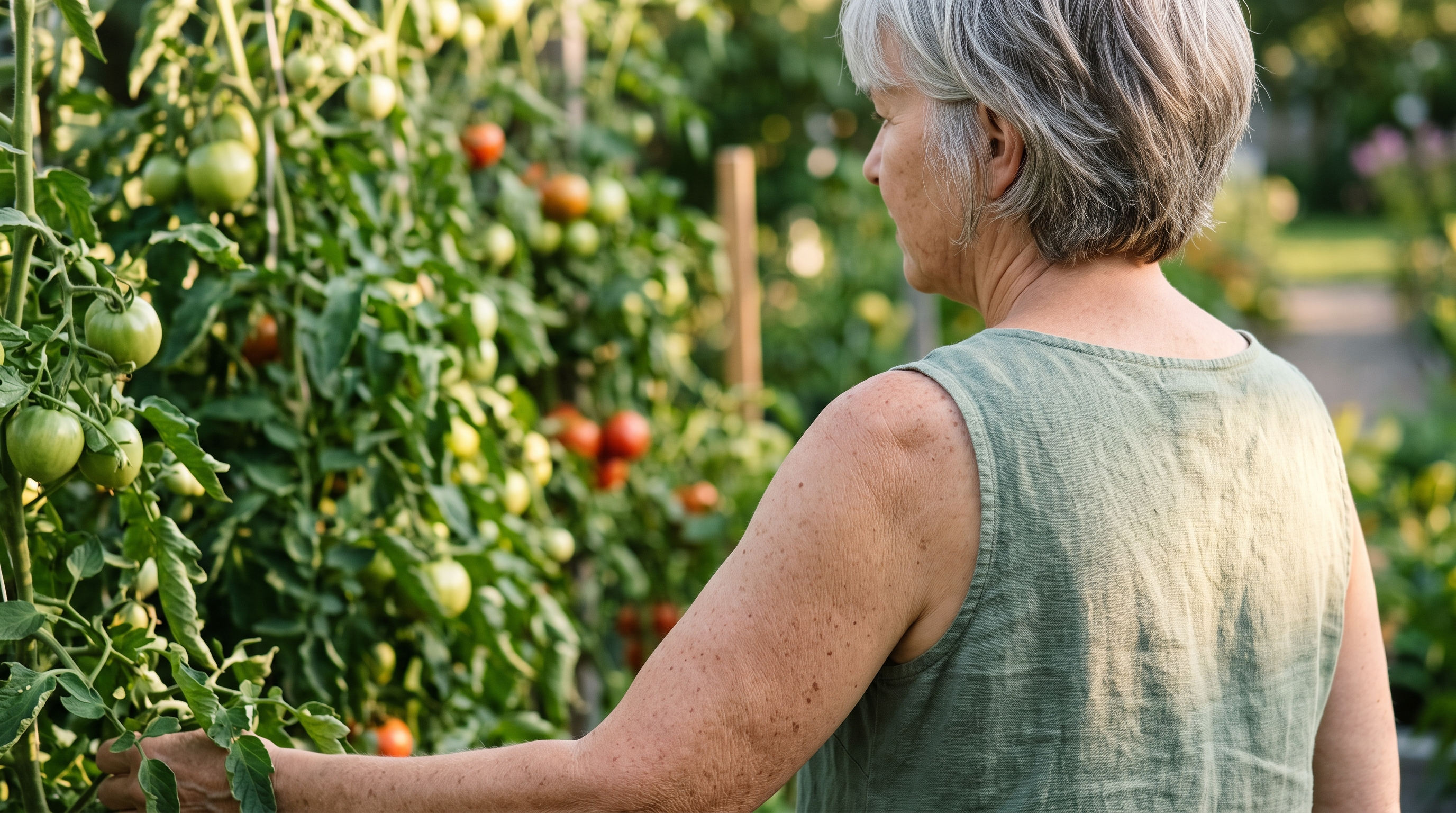
Here is the limit worth being honest about. Everything above happens in the outer fraction of a millimeter. Crepiness, laxity, and the fine papery texture on forearms and chest are not surface problems. They are collagen and elastin problems in the dermis underneath, and no amount of surface removal reaches them.
That much is settled evidence. In a randomized, vehicle-controlled trial, topical tretinoin applied to photodamaged skin measurably increased type I procollagen formation on biopsy [7]. Retinoids rebuild the layer scrubs cannot touch. Exfoliation can make that layer’s condition more visible and it can clear the path for a treatment product to absorb, but it is preparation rather than treatment. Our guide to the best body serum for crepey skin covers what belongs in the treatment slot.
The Delivery Problem on Body Skin
Body skin is where retinol has always been hardest to use well. The surface area is enormous, the skin on shins and forearms is often already dry and barrier-compromised, and conventional retinol formulations depend on chemistries and petroleum derivatives that break down the epithelial barrier in order to push the molecule through it. On a face that produces stinging. Across two arms, two legs and a chest, it produces enough irritation that most people quit within a month.
Nanoretinol was built around that specific problem. It encapsulates 0.2 percent retinol in biomimetic lipid nanoparticles that the skin recognizes as self and admits through the barrier rather than having it forced open, and the phospholipids in those nanoparticle membranes are absorbed as nourishment as the retinol releases. North Biomedical’s clinical study summary reports 232 percent greater collagen recovery and 73 percent greater elastin recovery than conventional retinol, with drastically reduced cytotoxicity [8]. On body skin that has been scrubbed for years, a retinol that does not require a compromised barrier in order to work is the more sensible place to start.
What To Do With Your Existing Jar
Keep it for heels, elbows, and the week before an event when you want your legs to look their best. Choose a fine, rounded grit in an oil base, use it lightly, and stop the moment skin feels tight rather than smooth.
For everything the scrub was really bought to solve, the dull tone, the rough patches, the papery forearms, the work happens either with an acid on the surface or with a retinol underneath it. The grit was always the least important variable in the jar.
References
- Grove GL, Kligman AM. “Age-associated changes in human epidermal cell renewal.” Journal of Gerontology. 1983;38(2):137-142. PMID: 6827031
- Dabboue H, Builles N, Frouin É, Scott D, Ramos J, Marti-Mestres G. “Assessing the Impact of Mechanical Damage on Full-Thickness Porcine and Human Skin Using an In Vitro Approach.” BioMed Research International. 2015;2015:434623. doi:10.1155/2015/434623
- Van Scott EJ, Yu RJ. “Hyperkeratinization, corneocyte cohesion, and alpha hydroxy acids.” Journal of the American Academy of Dermatology. 1984;11(5):867-879. PMID: 6096420
- Akdeniz M, Gabriel S, Lichterfeld-Kottner A, Blume-Peytavi U, Kottner J. “Transepidermal water loss in healthy adults: a systematic review and meta-analysis update.” British Journal of Dermatology. 2018;179(5):1049-1055. PMID: 30022486
- Ghadially R. “Aging and the epidermal permeability barrier: implications for contact dermatitis.” American Journal of Contact Dermatitis. 1998;9(3):162-169. PMID: 9744909
- Dampa E. “The Effectiveness of Topical Keratolytics (Alpha Hydroxy Acids/Beta Hydroxy Acids/Urea) in Treating Keratosis Pilaris: A Review of the Literature.” Cureus. 2025;17(12):e100507. doi:10.7759/cureus.100507
- Griffiths CEM, Russman AN, Majmudar G, Singer RS, Hamilton TA, Voorhees JJ. “Restoration of Collagen Formation in Photodamaged Human Skin by Tretinoin (Retinoic Acid).” New England Journal of Medicine. 1993;329(8):530-535. PMID: 8336752
- North Biomedical LLC. “Nanoretinol vs. Conventional Retinol: Efficacy in Collagen and Elastin Recovery.” Clinical Study Summary, 2024. Study summary