Serum vs Moisturizer: What Each One Is Physically Built to Do
One is engineered to get something into your skin, the other is engineered to keep something in — and the difference is measured in daltons, not marketing tiers
The usual answer to “serum or moisturizer?” is that serums are more concentrated and moisturizers are more hydrating, so you should probably buy both. That is true in the way that “cars are faster than bicycles” is true — accurate, and useless for deciding anything.
The genuinely useful distinction is not about strength or price tier. It is about direction. A serum is formulated to move a molecule into skin. A moisturizer is formulated to keep water from leaving it. Those are opposite engineering problems, and they produce opposite formulations.
A Moisturizer Is a Retention System
Every moisturizer is assembled from three functional classes, in varying ratios [1]:
- Humectants (glycerin, hyaluronic acid, urea, propanediol) attract and bind water into the stratum corneum.
- Emollients (esters, light oils, squalane) slot into the gaps between corneocytes, smoothing surface texture and improving how the skin feels.
- Occlusives (petrolatum, butters, waxes, silicones) lay a hydrophobic film over the top and slow transepidermal water loss.
Glycerin is the most-studied of these and deserves its ubiquity. Beyond simply holding water, it participates in corneocyte maturation and supports barrier recovery, and skin produces it endogenously through sebaceous triglyceride hydrolysis and aquaporin-3 transport [2]. Reviews of moisturizer therapy consistently find that this combination — draw water in, then slow its escape — is what produces measurable improvement in dry and barrier-compromised skin [3].
Notice what none of those three mechanisms are: none of them signal a cell to do anything. A moisturizer’s success is defined by what stays on and just inside the surface.
That is true in the way that “cars are faster than bicycles” is true — accurate, and useless for deciding anything.
A Serum Is a Delivery System
A serum is typically water- or glycol-based, low in viscosity, low in occlusive load, and high in the concentration of whatever active it exists to carry. Strip away the occlusive film and the thick emulsion, and you get a vehicle that spreads thin, makes intimate contact with the stratum corneum, and does not trap its cargo in a layer of oil.
The reason this matters comes down to a well-known constraint in dermatological pharmacology. Bos and Meinardi’s analysis of skin penetration established what is now called the 500 dalton rule: molecules above roughly 500 Da rarely cross intact skin in meaningful amounts, and virtually every effective topical drug and common contact allergen falls below that threshold [4].
This single number explains most of the skincare aisle. Retinol is about 286 Da and can cross. Niacinamide is 122 Da and crosses easily. High-molecular-weight hyaluronic acid runs into the hundreds of thousands of daltons — it is not going anywhere, which is exactly why it works as a surface humectant and never as a dermal filler in a bottle.
So the honest framing of the question is not “which product is better.” It is: do I have an active worth delivering? If the answer is no, a well-built moisturizer alone is a complete routine. If the answer is yes, the serum is the vehicle that gives it a chance.
Why the Vehicle Decides the Outcome
Two products can list the same active at the same percentage and perform completely differently, because the vehicle governs how much of that active partitions out of the formula and into the skin rather than staying dissolved in the product.
This is why concentration on a label is a weak predictor of results, and why formulation science has spent decades on carriers rather than doses. Lipid-based nanoparticle systems are one of the most-developed answers: solid lipid nanoparticles and nanostructured lipid carriers were adopted in dermatological and cosmetic formulation specifically because they improve the stability of sensitive actives, form a fine occlusive film, and modulate how the active is released at the skin surface [5][6].
It carries 0.2% retinol inside biomimetic lipid nanoparticles that are externally similar enough to skin cells that the body recognizes them as “self” and admits them through the epithelial barrier — rather than forcing a path through it with petroleum-derived solvents.
Retinol is the ingredient that most needs this help. When it does arrive intact, the effect is real: a controlled comparison on human skin found that topical retinol increased epidermal thickness and the molecular markers of dermal remodeling much as retinoic acid did, with better tolerability [7]. But retinol is unstable in light and air, it is the reason most anti-aging serums exist at all, and in conventional formulations most of the dose never reaches the cells that respond to it. What does get through often arrives alongside solvents that damage the barrier on the way in — which is where the burning, flaking, and redness come from.
What This Means for Your Routine
Three practical consequences follow directly from the physics.
Thinnest to thickest, and it is not arbitrary. A serum applied to bare skin makes direct contact with the stratum corneum. The same serum applied over a heavy occlusive has to get through that film first. Layering order exists for delivery reasons, not aesthetic ones.
A moisturizer over a serum is not redundant — it is the second half of the job. Actives that increase cell turnover transiently stress the skin barrier, and the occlusive layer on top is what keeps that stress tolerable. People who abandon retinoids for irritation are very often people who skipped this step. If the two layers roll into crumbs, the problem is usually dose, rubbing, or film compatibility; this moisturizer-pilling test isolates the offending pair.
If you can only afford one, buy the moisturizer. An intact, comfortable barrier is the foundation everything else is built on, and a serum applied to inflamed, over-stripped skin will underperform no matter what is in it.
Where Nanoretinol Fits
Nanoretinol is a serum in the strict sense of the word: its entire design is delivery. It carries 0.2% retinol inside biomimetic lipid nanoparticles that are externally similar enough to skin cells that the body recognizes them as “self” and admits them through the epithelial barrier — rather than forcing a path through it with petroleum-derived solvents.
That distinction is the whole point. Conventional retinol formulations increase penetration by destabilizing the barrier, which is why they trade efficacy against irritation. The nanoparticle route sidesteps that trade entirely. In North Biomedical’s clinical study, it delivered 232% greater collagen recovery and 73% greater elastin recovery than conventional retinol, with drastically reduced cytotoxicity and side effects that were milder when they occurred at all.
The formula itself reflects the serum-versus-moisturizer split. It is water-based, gel-like, 99% natural ingredients, and absorbs to a matte finish with no occlusive residue — because sealing the surface is the next product’s job, not this one’s.
The Practical Answer
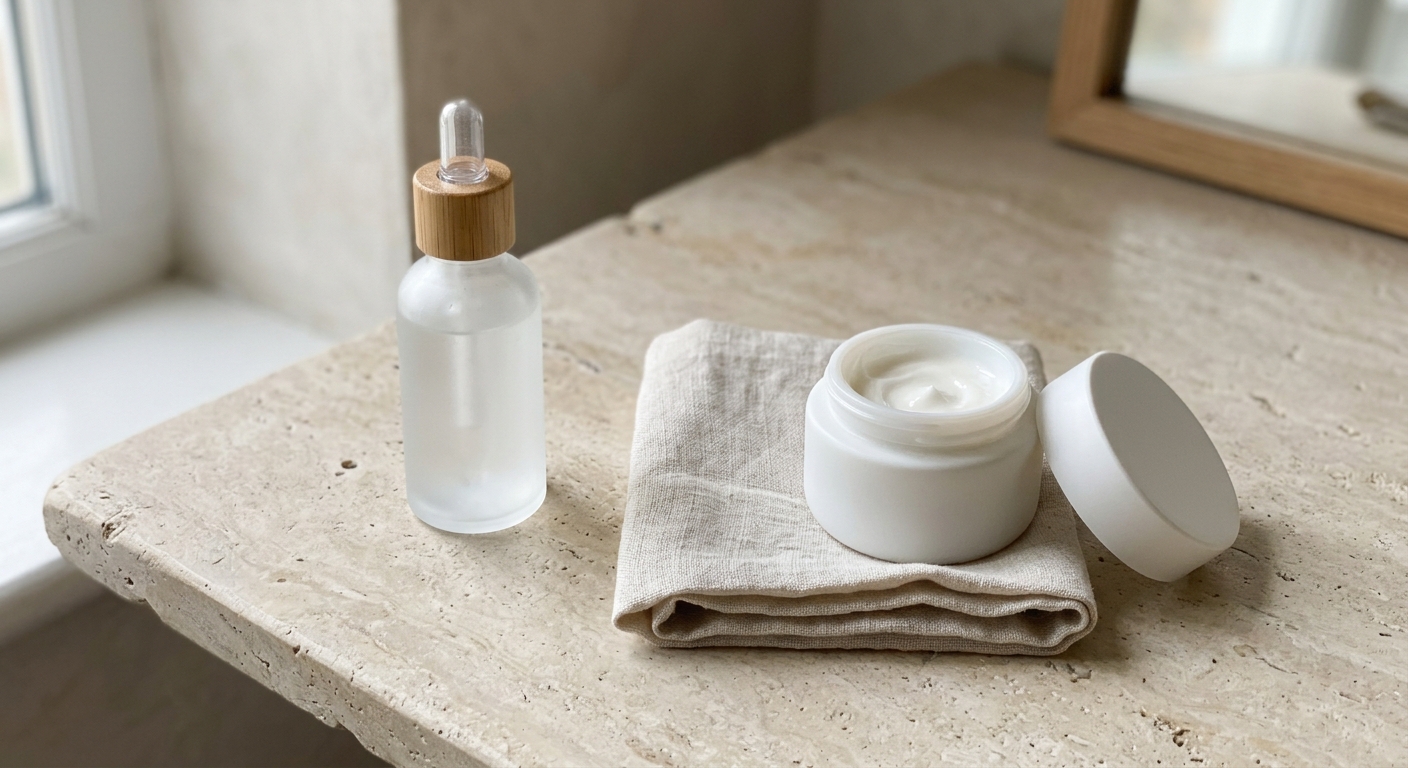
Stop treating serum and moisturizer as competing purchases at different price points. One is a delivery vehicle and one is a retention layer, and a good routine uses each for the thing it is physically capable of doing.
Choose the moisturizer for how well it keeps your barrier comfortable. Choose the serum for what it delivers and how well it delivers it. Then apply them in that order, and let each do its own job.
References
- Sethi A, Kaur T, Malhotra SK, Gambhir ML. “Moisturizers: The Slippery Road.” Indian Journal of Dermatology. 2016;61(3):279-287. doi:10.4103/0019-5154.182427
- Fluhr JW, Darlenski R, Surber C. “Glycerol and the skin: holistic approach to its origin and functions.” British Journal of Dermatology. 2008;159(1):23-34. doi:10.1111/j.1365-2133.2008.08643.x
- Purnamawati S, Indrastuti N, Danarti R, Saefudin T. “The Role of Moisturizers in Addressing Various Kinds of Dermatitis: A Review.” Clinical Medicine & Research. 2017;15(3-4):75-87. doi:10.3121/cmr.2017.1363
- Bos JD, Meinardi MM. “The 500 Dalton rule for the skin penetration of chemical compounds and drugs.” Experimental Dermatology. 2000;9(3):165-169. doi:10.1034/j.1600-0625.2000.009003165.x
- Müller RH, Radtke M, Wissing SA. “Solid lipid nanoparticles (SLN) and nanostructured lipid carriers (NLC) in cosmetic and dermatological preparations.” Advanced Drug Delivery Reviews. 2002;54 Suppl 1:S131-S155. doi:10.1016/s0169-409x(02)00118-7
- Puglia C, Bonina F. “Lipid nanoparticles as novel delivery systems for cosmetics and dermal pharmaceuticals.” Expert Opinion on Drug Delivery. 2012;9(4):429-441. doi:10.1517/17425247.2012.666967
- Kong R, Cui Y, Fisher GJ, Wang X, Chen Y, Schneider LM, et al. “A comparative study of the effects of retinol and retinoic acid on histological, molecular, and clinical properties of human skin.” Journal of Cosmetic Dermatology. 2016;15(1):49-57. doi:10.1111/jocd.12193