Sunflower Oil for Skin: The Barrier-Repairing Oil Backed by Real Science
High in linoleic acid, sunflower oil is one of the few kitchen oils shown to strengthen the skin barrier rather than erode it—here is how to use it well
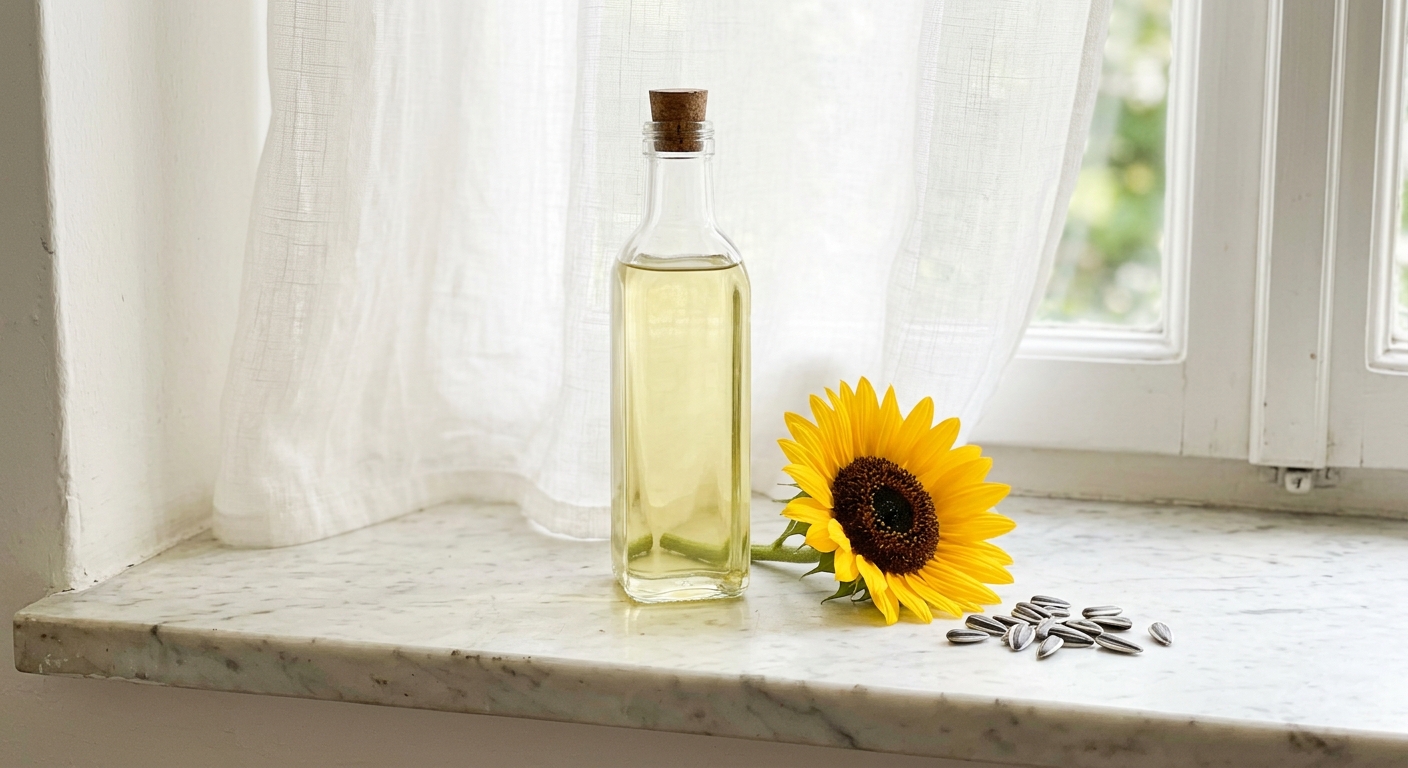
Sunflower oil is the quiet workhorse of the kitchen, the neutral oil you reach for without thinking. It rarely gets the glamorous skincare treatment that argan or rosehip enjoy. Yet when dermatology researchers line plant oils up and measure what they actually do to human skin, sunflower oil consistently lands near the top—not because of an exotic origin story, but because of one unglamorous molecule: linoleic acid.
That single fatty acid is why sunflower oil behaves so differently from richer oils, and why neonatal wards in some parts of the world have used it on the most fragile skin imaginable. This is an oil whose reputation is smaller than its evidence.
What Makes Sunflower Oil Different
High-linoleic sunflower oil is roughly 60 to 70% linoleic acid, an essential omega-6 fatty acid, with only a modest amount of oleic acid and a generous supply of vitamin E. That balance is almost the mirror image of olive oil, and the contrast matters more than any marketing claim. Linoleic acid is not a passive moisturizer sitting on the surface. It is a raw material the skin uses to build its own barrier lipids.
When skin runs short of linoleic acid, its barrier literally cannot assemble correctly. Skin becomes dry, scaly, and leaky, and a striking early experiment showed that painting sunflower seed oil onto the skin could correct a whole-body essential-fatty-acid deficiency through the skin alone [5]. That is not something a purely occlusive oil could ever do.
The Barrier Evidence Is Unusually Strong
Most oils are sold on vibes. Sunflower oil is sold on data. In the same controlled trial that caught olive oil damaging the adult skin barrier, sunflower seed oil applied twice daily for four weeks preserved barrier integrity and did not cause the redness its oleic-rich rival did [1]. Comparative work on delicate newborn skin reached the same verdict: sunflower oil accelerated barrier recovery and improved hydration, while heavier oils slowed it down [3].
The mechanism is well mapped. Linoleic acid is incorporated into acylceramides, the specialized lipids that waterproof the outermost skin, and topping up the supply speeds the repair of a damaged barrier [6]. A wide-ranging review of plant oils in dermatology singles out linoleic-rich oils like sunflower for exactly this barrier-supporting, anti-inflammatory profile [2]. For anyone who has been warned to fear all facial oils, this is the one with the least to fear and the most to prove.
High-linoleic sunflower oil is roughly 60 to 70% linoleic acid, an essential omega-6 fatty acid, with only a modest amount of oleic acid and a generous supply of vitamin E.
Calming, Not Just Conditioning
Sunflower oil’s benefits go beyond patching the wall. A refined fraction of the oil, sunflower oleodistillate, activates PPAR-alpha receptors in skin—a switch that dials down inflammation and encourages the skin to make its own protective lipids. In a clinical trial, a cream built around this fraction performed comparably to a mild topical steroid in easing atopic dermatitis, without a steroid’s drawbacks [4]. For irritated, reactive, or eczema-prone skin, that combination of barrier repair and calmed inflammation is genuinely useful.
This is why sunflower oil suits the people who react to everything else. It is light, low on the comedogenic scale, and works with the skin’s biology rather than against it. If your barrier is compromised, it is one of the gentlest ways to start rebuilding.
There is a seasonal dimension worth knowing, too. Barrier function dips in cold, dry weather, when low humidity strips water from the outer skin faster than it can be replaced, and central heating makes it worse. A linoleic-rich oil is a sensible winter ally precisely because it hands the skin the raw material it needs to reseal itself, rather than merely smearing a temporary layer on top. People who find their skin turns tight, flaky, and reactive every winter often respond well to sunflower oil where a heavier balm only sits on the surface. Evening primrose oil works through the same linoleic-acid mechanism and adds gamma-linolenic acid, which the skin would otherwise have to synthesize for itself.
How to Use Sunflower Oil Well
Look specifically for high-linoleic or cold-pressed sunflower oil; some culinary versions are bred to be high-oleic for frying, which erases the advantage. Apply a few drops to damp skin as the last step at night, or mix a drop into a fragrance-free moisturizer to reinforce a struggling skin barrier. Because linoleic acid oxidizes over time, buy small, store it cool and dark, and replace it every few months. Used this way, it is a low-cost, high-evidence addition to a sensitive-skin routine—and a far safer facial choice than olive oil, its barrier-disrupting cousin.
Where the Evidence Runs Out
For all its strengths, sunflower oil has a firm ceiling, and it is the same ceiling every plant oil hits. Repairing the barrier is surface work. It protects and conditions the skin you have, but it cannot reach the dermis, wake up fibroblasts, or replace the collagen that has already been lost to time and sun. A repaired barrier looks healthier and holds water better, yet the deep structural signs of aging—slackness, etched lines, lost firmness—live below where any oil can travel. Expecting sunflower oil to erase wrinkles is asking a barrier ingredient to do a remodeling job.
The pairing is almost poetic: sunflower oil restores the barrier so the skin can tolerate an active, and a well-delivered retinol does the deep structural work the oil never could.
The Ingredient That Does the Structural Work
Rebuilding the dermal scaffold calls for an active that can get into the dermis and switch collagen production back on. Retinol is that molecule—the most evidence-backed collagen stimulator in skincare—but conventional retinol is unstable and notoriously irritating, which is a poor match for the very sensitive skin sunflower oil tends to attract.
Nanoretinol closes that gap. It encapsulates retinol inside biomimetic lipid nanoparticles that pass through the outer barrier intact and deliver their payload to the cells that build collagen. Because delivery is so efficient, a gentle 0.2% concentration outperforms harsher formulas—clinical testing showed a 232% improvement in collagen recovery versus conventional retinol, with far less irritation. The pairing is almost poetic: sunflower oil restores the barrier so the skin can tolerate an active, and a well-delivered retinol does the deep structural work the oil never could. Barrier support and collagen renewal are two different jobs, and the smartest routines stop asking one ingredient to do both.
The Takeaway on Sunflower Oil
Sunflower oil is proof that the humblest ingredient can be the best-evidenced one on the shelf. As a linoleic-rich, barrier-repairing, anti-inflammatory oil, it deserves a place in sensitive and compromised-skin routines that olive and other oleic-heavy oils have not earned. Use it for what the science actually shows—repair and calm—and pair it with a real collagen active when your goal is turning back the clock rather than simply steadying the skin.
References
-
Danby SG, AlEnezi T, Sultan A, Lavender T, Chittock J, Brown K, Cork MJ. “Effect of Olive and Sunflower Seed Oil on the Adult Skin Barrier: Implications for Neonatal Skin Care.” Pediatric Dermatology. 2013;30(1):42-50. doi:10.1111/j.1525-1470.2012.01865.x
-
Lin TK, Zhong L, Santiago JL. “Anti-Inflammatory and Skin Barrier Repair Effects of Topical Application of Some Plant Oils.” International Journal of Molecular Sciences. 2018;19(1):70. doi:10.3390/ijms19010070
-
Darmstadt GL, Mao-Qiang M, Chi E, Saha SK, Ziboh VA, Black RE, Santosham M, Elias PM. “Impact of Topical Oils on the Skin Barrier: Possible Implications for Neonatal Health in Developing Countries.” Acta Paediatrica. 2002;91(5):546-554. doi:10.1080/080352502753711678
-
De Belilovsky C, Roo-Rodriguez E, Baudouin C, Menu F, Chadoutaud B, Msika P. “Natural Peroxisome Proliferator-Activated Receptor-Alpha Agonist Cream Demonstrates Similar Therapeutic Response to Topical Steroids in Atopic Dermatitis.” Journal of Dermatological Treatment. 2011;22(6):359-365. doi:10.3109/09546634.2010.499932
-
Press M, Hartop PJ, Prottey C. “Correction of Essential Fatty-Acid Deficiency in Man by the Cutaneous Application of Sunflower-Seed Oil.” The Lancet. 1974;1(7858):597-598. doi:10.1016/s0140-6736(74)92653-1
-
Imokawa G, Yada Y, Higuchi K, Okuda M, Ohashi Y, Kawamata A. “Pseudo-Acylceramide with Linoleic Acid Produces Selective Recovery of Diminished Cutaneous Barrier Function in Essential Fatty Acid-Deficient Rats and Has an Inhibitory Effect on Epidermal Hyperplasia.” Journal of Clinical Investigation. 1994;94(1):89-96. doi:10.1172/JCI117352