Vitamin E for Skin: The Complete Science-Backed Guide to Tocopherol Benefits
How alpha-tocopherol protects against UV damage, fights wrinkles, and fades dark spots — plus how to use it correctly
If your skincare routine doesn’t include vitamin E, it probably should. This fat-soluble antioxidant has been a dermatology workhorse for over 50 years — protecting skin from UV damage, fighting free radicals, and supporting everything from wound healing to hyperpigmentation treatment.
But not all vitamin E is created equal, and how you use it matters far more than most beauty brands will tell you. Here’s what the science actually says.
What Is Vitamin E, Exactly?
Vitamin E isn’t a single molecule — it’s a family of eight compounds: four tocopherols and four tocotrienols (alpha, beta, gamma, and delta forms of each). Alpha-tocopherol (α-tocopherol) is the most abundant form in human skin and the most studied for dermatological benefits.[1]
Your skin receives vitamin E primarily through sebaceous gland secretion, which acts as a natural delivery system to the skin surface. UV exposure rapidly depletes these stores — which is why supplementation (topical or oral) becomes relevant as you age.[2]
How Vitamin E Protects Your Skin
Free Radical Defense
Vitamin E is the skin’s primary lipid-soluble antioxidant. It sits within cell membranes and intercepts reactive oxygen species (ROS) before they can damage collagen, elastin, and DNA. Research shows that even at a ratio of one vitamin E molecule per 2,000 phospholipid molecules, it provides meaningful protection against lipid peroxidation.[3]
This is why vitamin E appears in virtually every antioxidant skin care formulation on the market, and why a plain vitamin E cream can be a useful budget moisturizer once you know whether its label lists tocopherol or the slower-acting tocopheryl acetate.
UV Photoprotection
Here’s where it gets interesting. Vitamin E alone provides modest UV protection. But when combined with vitamin C, the photoprotective effect becomes significantly stronger. Multiple clinical studies have demonstrated that oral co-supplementation of vitamins C and E increases the Minimal Erythemal Dose (MED) — the amount of UV needed to cause sunburn — and reduces UV-induced DNA damage.[4]
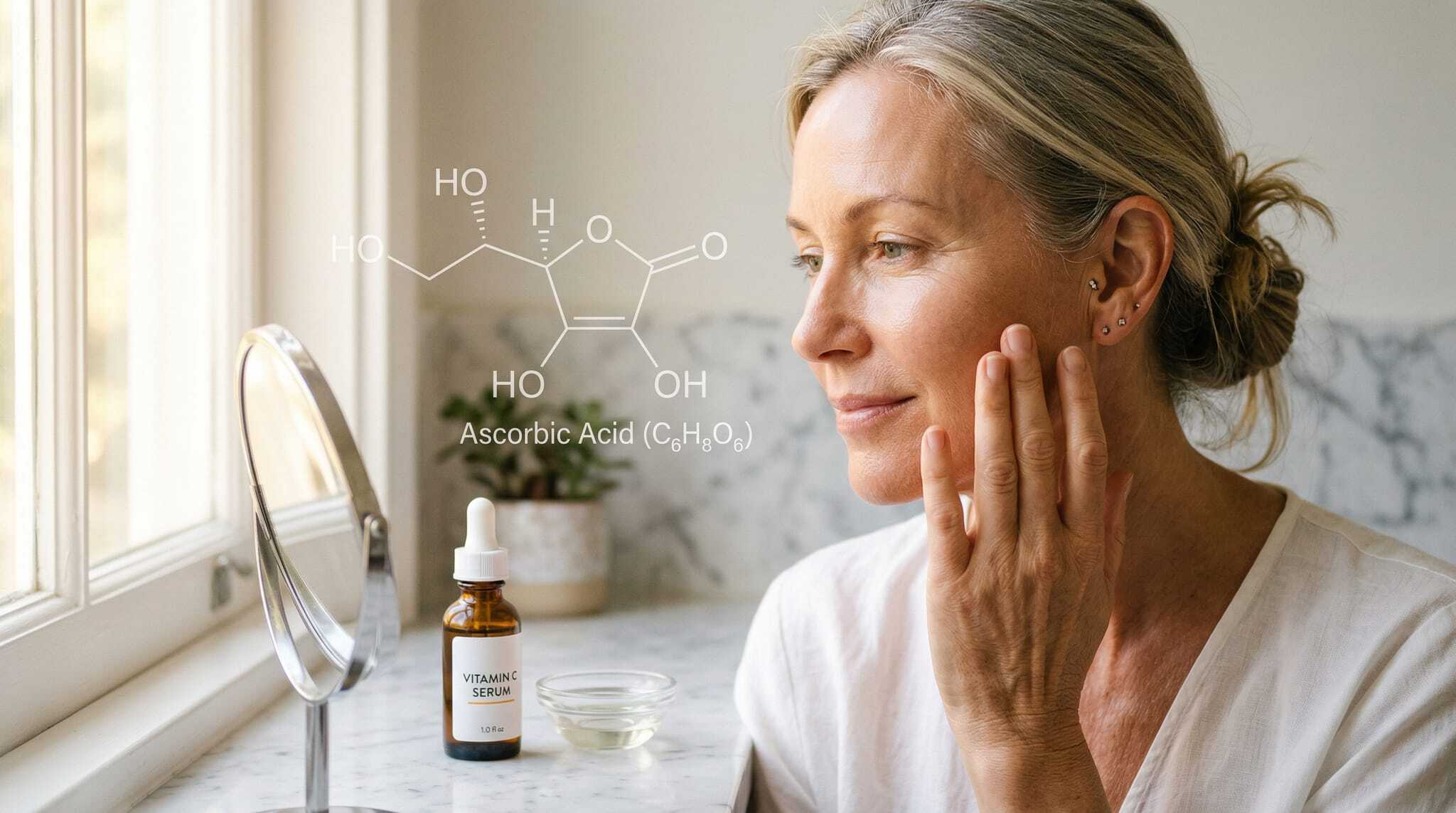
This synergy is well-documented: vitamin C regenerates oxidized vitamin E, creating a recycling loop that extends antioxidant protection. If you’re already using a vitamin C serum, adding vitamin E amplifies its effectiveness.
Your skin receives vitamin E primarily through sebaceous gland secretion, which acts as a natural delivery system to the skin surface.
Anti-Aging and Wrinkle Reduction
A clinical study using 5% d-alpha-tocopherol cream demonstrated noticeable reduction in periorbital wrinkles after four months of daily use.[5] The mechanism is straightforward: by neutralizing the free radicals that break down collagen and glycosaminoglycans, vitamin E slows the structural degradation that causes fine lines.
A 2020 randomized controlled trial found that a serum combining vitamin C, tocopheryl acetate, and raspberry leaf cell culture extract significantly improved skin elasticity, radiance, and wrinkle appearance.[6]
For targeted wrinkle concerns, pairing vitamin E with proven actives like retinol or peptides creates a comprehensive anti-aging strategy.
Vitamin E for Hyperpigmentation
Alpha-tocopherol inhibits tyrosine hydroxylase activity and suppresses melanogenesis in both cultured melanoma cells and normal human melanocytes.[7] Translation: it can help fade dark spots and even out skin tone.
This makes vitamin E a complementary ingredient alongside dedicated brightening actives like vitamin C, kojic acid, or tranexamic acid for addressing dark spots on face.
Topical vs. Oral: Which Delivery Method Works?
Topical vitamin E penetrates the stratum corneum and reaches the living layers of the epidermis. Most over-the-counter anti-aging creams contain 0.5–1% vitamin E, typically as tocopheryl acetate (a more stable ester form that converts to active tocopherol in the skin).[1]
Oral vitamin E supports systemic antioxidant defense. The recommended daily intake is 15 mg (22.4 IU) for adults, though most photoprotection studies used higher doses in combination with vitamin C.[4]
Stability matters. Pure alpha-tocopherol oxidizes when exposed to air and light. Look for formulations using tocopheryl acetate or tocopheryl phosphate, which resist oxidation but still penetrate skin effectively. Dl-alpha-tocopherol acetate is the most stable form available.[1]
If you notice redness or irritation, discontinue use and consult a dermatologist.
Who Should Use Vitamin E?
Vitamin E is generally well tolerated across skin types. It’s particularly beneficial for:
- Mature skin (40+): Endogenous vitamin E levels decline with age, making topical replenishment more important
- Sun-exposed skin: UV radiation depletes skin vitamin E stores significantly
- Dry or compromised barriers: Vitamin E supports the stratum corneum’s ability to maintain hydration[5]
- Post-procedure skin: Its wound-healing and anti-inflammatory properties support recovery after chemical peels or microneedling
One caution: Some people develop contact dermatitis from topical vitamin E. If you notice redness or irritation, discontinue use and consult a dermatologist.
How Nanoretinol® Enhances Antioxidant Delivery
Traditional skincare faces a fundamental challenge: getting active ingredients past the skin barrier in stable, effective concentrations. This is where nanotechnology changes the equation.
Nanoretinol® uses lipid nanoparticle encapsulation to deliver retinol deep into the skin while protecting it from oxidative degradation — the same degradation that vitamin E fights on the surface. Used together, vitamin E provides broad antioxidant defense while Nanoretinol® delivers targeted retinoid activity at the cellular level.
This combination approach — surface antioxidant protection plus deep nanoparticle-delivered actives — represents the direction modern skincare science is heading.
The Bottom Line
Vitamin E isn’t a miracle ingredient, but it’s one of the most evidence-backed antioxidants in dermatology. Its role in UV protection (especially paired with vitamin C), wrinkle reduction, and hyperpigmentation management is supported by decades of peer-reviewed research.
The key is using it correctly: choose stable formulations, pair it with complementary actives, and understand that consistency matters more than concentration.
References
-
Keen MA, Hassan I. “Vitamin E in dermatology.” Indian Dermatology Online Journal. 2016;7(4):311-315. doi:10.4103/2229-5178.185494
-
Thiele JJ, Weber SU, Packer L. “Sebaceous gland secretion is a major physiologic route of vitamin E delivery to skin.” Journal of Investigative Dermatology. 1999;113(6):1006-1010. doi:10.1046/j.1523-1747.1999.00794.x
-
Rizvi S, Raza ST, Ahmed F, et al. “The role of vitamin E in human health and some diseases.” Sultan Qaboos University Medical Journal. 2014;14(2):e157-e165. PMCID:PMC3997530
-
Eberlein-König B, Placzek M, Przybilla B. “Protective effect against sunburn of combined systemic ascorbic acid (vitamin C) and d-alpha-tocopherol (vitamin E).” Journal of the American Academy of Dermatology. 1998;38(1):45-48. doi:10.1016/S0190-9622(98)70537-7
-
Sauermann K, et al. “Topical vitamin E modulates photoaging markers in murine and human skin.” International Journal of Clinical and Experimental Dermatology. 2024;9(2):1-8. Available at: opastpublishers.com
-
Rattanawiwatpong P, et al. “Anti-aging and brightening effects of a topical treatment containing vitamin C, vitamin E, and raspberry leaf cell culture extract: A split-face, randomized controlled trial.” Journal of Cosmetic Dermatology. 2020;19:671-676. doi:10.1111/jocd.13305
-
Ichihashi M, et al. “Alpha-tocopherol inhibits melanogenesis.” As reviewed in: Michalak M, et al. “Bioactive Compounds for Skin Health: A Review.” Nutrients. 2021;13(1):203. PMCID:PMC7827176