Sunscreen for Retinol: How to Choose the Right SPF for Retinol-Treated Skin
What retinol really does to sun sensitivity, which filters and formulas suit sensitised skin, and why the pair works better than either alone
Every retinol label carries the same line in small print: use sunscreen. Most people read it as a box to tick. In practice it is the half of the routine that decides whether the retinol is worth using at all, and the sunscreen you pick matters more once a retinoid is in your skin.
Here is what retinol actually changes about how your skin handles daylight, what to look for in a sunscreen when your face is already working hard at night, and how to make the two habits support each other.
Does Retinol Make Your Skin Sun-Sensitive?
Yes, but not in the way most people imagine. Retinoids are not classic photosensitisers, the kind of drug that reacts with light and burns the skin. When researchers tested a tretinoin gel under patches and then exposed volunteers to ultraviolet and visible light, they found a low potential for phototoxic or photoallergic reactions [1].
The sensitivity comes from somewhere else: the outer layer of the skin. In a classic study of intensive retinoic acid on the back, the horny layer shrank to less than half its normal thickness, and phototoxic and irritant substances then produced exaggerated reactions because they penetrated more easily [2]. Retinol is much gentler than prescription retinoic acid, but the direction of travel is the same.
Your skin can end up with an outer layer less than half its normal thickness after 40 days of strong retinoid use, which leaves sunlight less to get through than before.
That thinner layer is also more reactive. Wind, heat and the sun all sting more in the first weeks of a new retinoid, which is why a sunburn during that period can feel out of proportion to the time you spent outside.
Your skin can end up with an outer layer less than half its normal thickness after 40 days of strong retinoid use, which leaves sunlight less to get through than before.
Retinol Breaks Down in Daylight Too
There is a second reason retinol belongs at night: light destroys it. Laboratory work at the US Food and Drug Administration showed that natural retinoids, including retinol, decompose under ultraviolet light and can form reactive by-products [3]. An analysis of commercial cosmetics found that retinoid content fell steadily over time, and that light degraded these ingredients more than heat did [4].
So a morning retinol does two unhelpful things at once. It leaves you with less active ingredient than you paid for, and it adds breakdown products to skin that is already being hit by the sun. Apply retinol in the evening, and let sunscreen handle the daytime. Our guide on how to use retinol walks through the full night routine.
How to Choose a Sunscreen for Retinol Users
Any broad-spectrum sunscreen you will wear every day is better than a perfect one you skip. Within that, a few features make life easier for retinol-treated skin:
- Broad spectrum, SPF 30 or higher. Broad-spectrum protection covers the long-wave rays that drive wrinkles as well as the short-wave rays that burn. SPF 30 is the practical floor for daily wear; go higher for long days outdoors.
- Mineral filters if your skin is reactive. Zinc oxide and titanium dioxide sit on the surface and rarely cause allergic reactions. In a European study of 1,031 patients with suspected sunscreen allergy, octocrylene, oxybenzone and avobenzone were the filters most often responsible, while newer filters rarely were [5]. Our comparison of mineral vs chemical sunscreen covers the trade-offs in detail.
- Fragrance-free and low in alcohol. Fragrance and high-alcohol sprays or gels are the usual culprits when sunscreen stings over a retinoid.
- A moisturising base. Formulas with glycerin, ceramides or squalane can double as your morning moisturiser, which means one less layer on skin that is already busy.
- Tinted, if you have dark spots. Tinted formulas that contain iron oxides add some protection against visible light, which matters for anyone using a retinoid to fade pigmentation.
What Sun Exposure Undoes
Retinol builds collagen slowly; ultraviolet light takes it apart quickly. In a landmark study, a single exposure to ultraviolet light switched on collagen-destroying enzymes in human skin, and repeated exposures kept them elevated for a week [6]. Pretreating the skin with tretinoin blocked 70 to 80% of that enzyme surge, which is one reason retinoids are so useful in sun-damaged skin.
Your skin breaks down 58% more collagen after ultraviolet exposure than skin kept in the dark, which can quietly cancel weeks of retinol work.
Your skin breaks down 58% more collagen after ultraviolet exposure than skin kept in the dark, which can quietly cancel weeks of retinol work.
The good news is that sunscreen measurably slows the damage. In a randomised trial of 903 adults in Australia, people assigned to daily broad-spectrum sunscreen showed no detectable increase in skin aging over four and a half years, and 24% less aging than those who used sunscreen when they felt like it [7]. Our article on retinol and sun damage explains what a retinoid can and cannot reverse once that damage is done.
Using Enough, and Using It Again
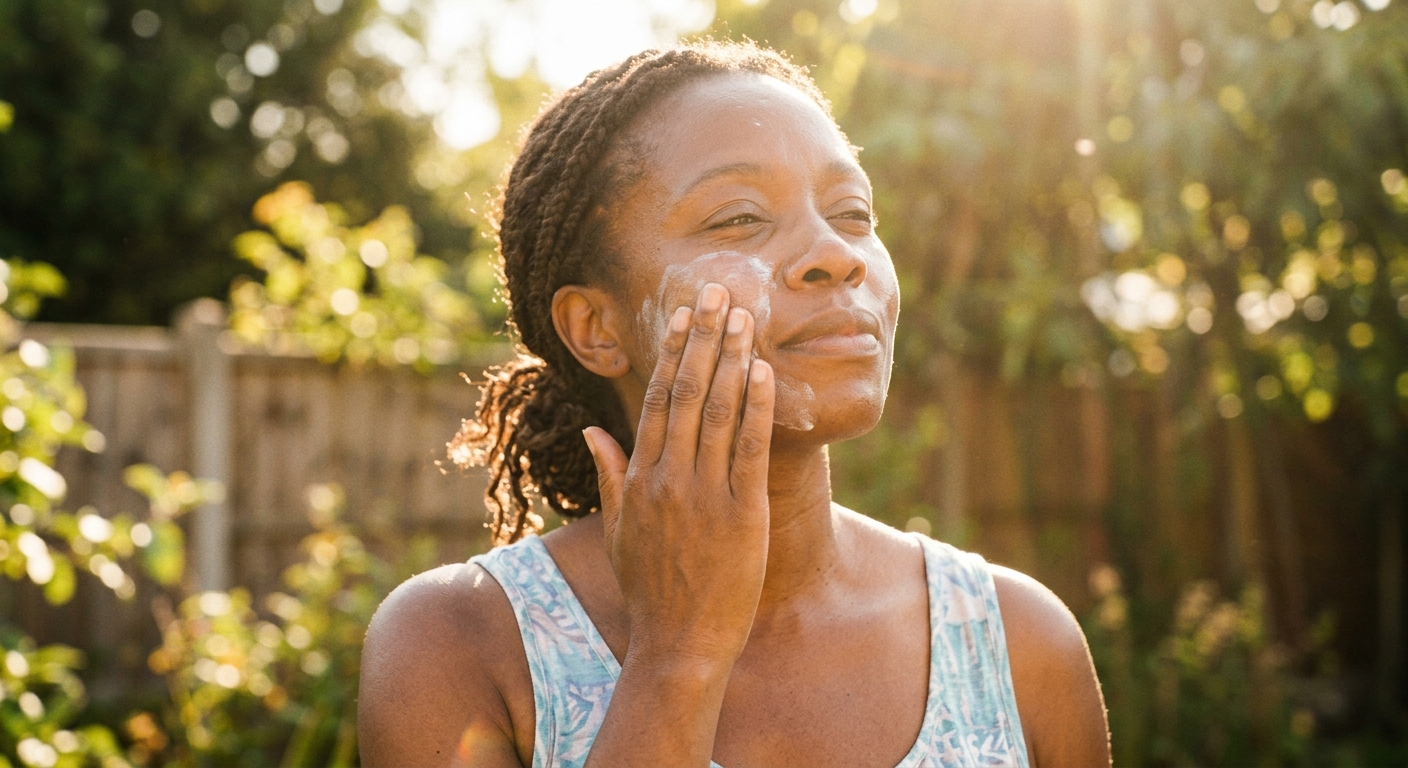
Most people apply only a quarter to a half of the sunscreen used in laboratory SPF testing, which cuts the real protection far below the number on the bottle. A good rule is two finger-lengths for the face and neck. Our guide to how much sunscreen to use breaks the amount down by body area.
Reapply every two hours outdoors, after swimming or sweating, and after towelling off. Indoors near a bright window, a morning layer plus a reapplication at lunchtime is a sensible habit, especially in your first months on retinol.
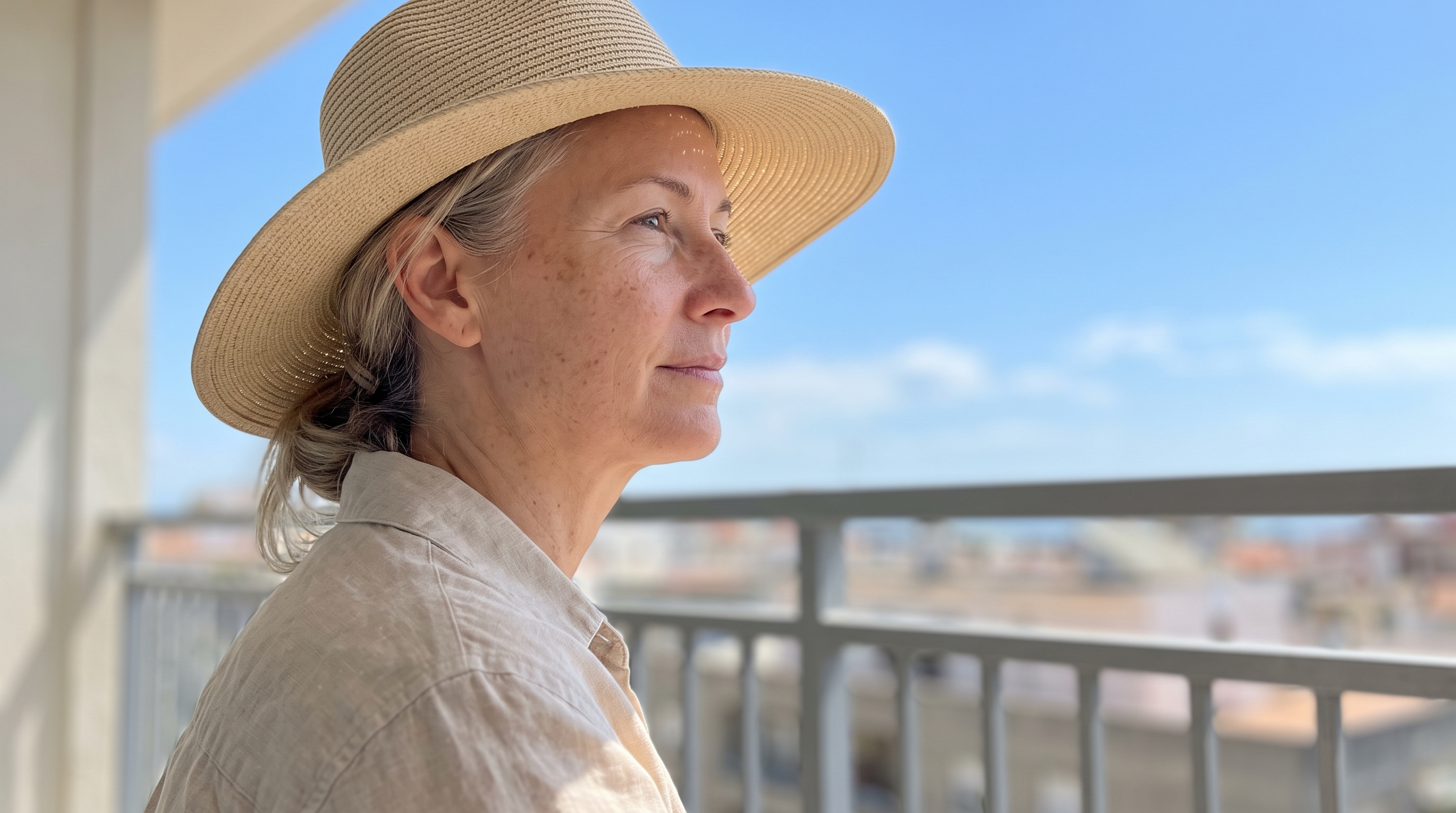
Hats, shade and timing count as well. A wide-brimmed hat protects the forehead and temples, the very places where many people apply retinol for lines.
Why the Pair Works Better Than Either Alone
Retinol and sunscreen are not two separate anti-aging steps. They are one strategy. Retinol rebuilds the matrix at night: in a year-long trial, a stabilised 0.1% retinol improved crow’s feet fine lines by 44% and mottled pigmentation by 84% compared with its vehicle [8]. Sunscreen protects that new collagen by day. Skip the sunscreen and much of the night’s work is undone by lunchtime; skip the retinol and the sunscreen only slows decline rather than reversing any of it.
Where Nanoretinol Fits
The retinol you choose shapes how sensitive your skin feels in the first place. Many conventional retinol formulas rely on chemicals and petroleum derivatives that loosen the lipids of the skin barrier to push the active in. That is what causes the burning, redness and peeling that make the sun feel harsher.
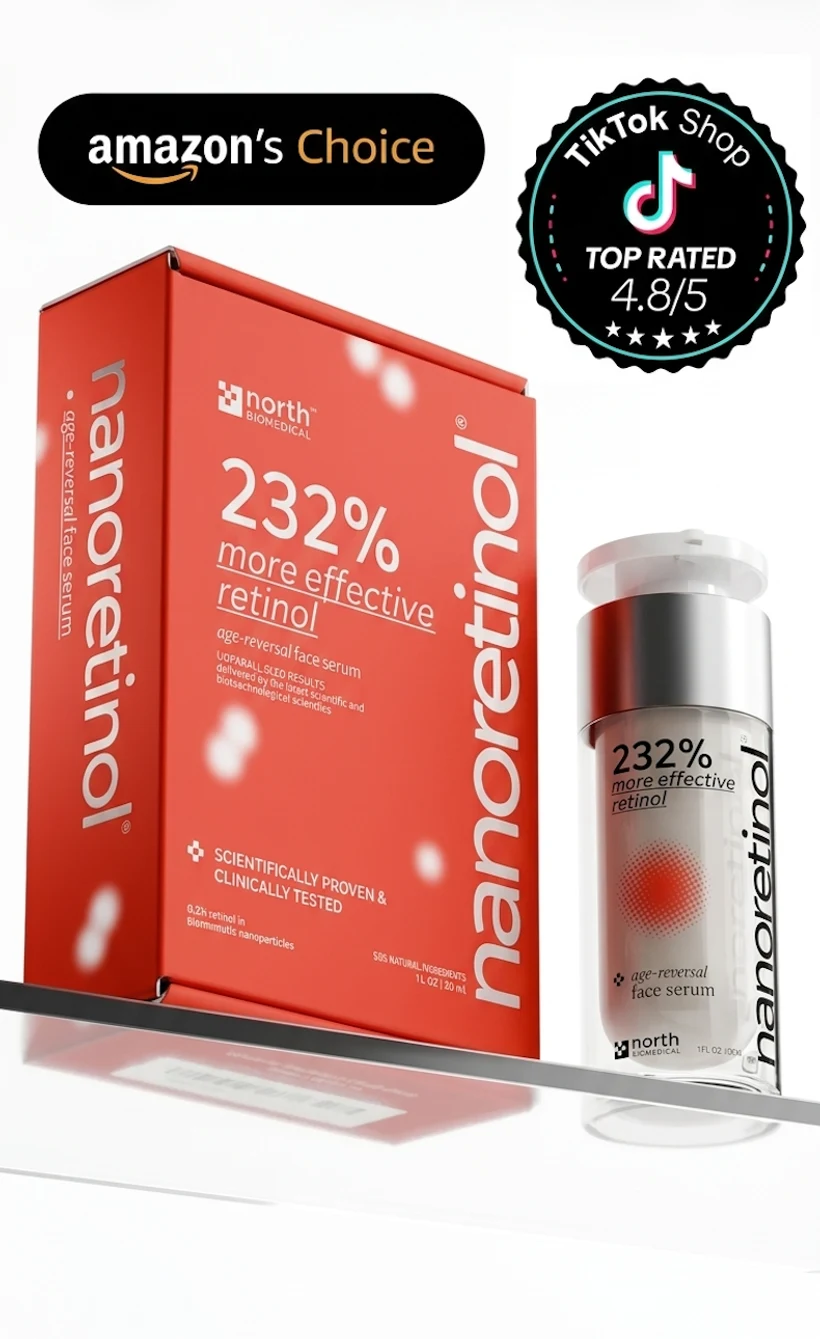
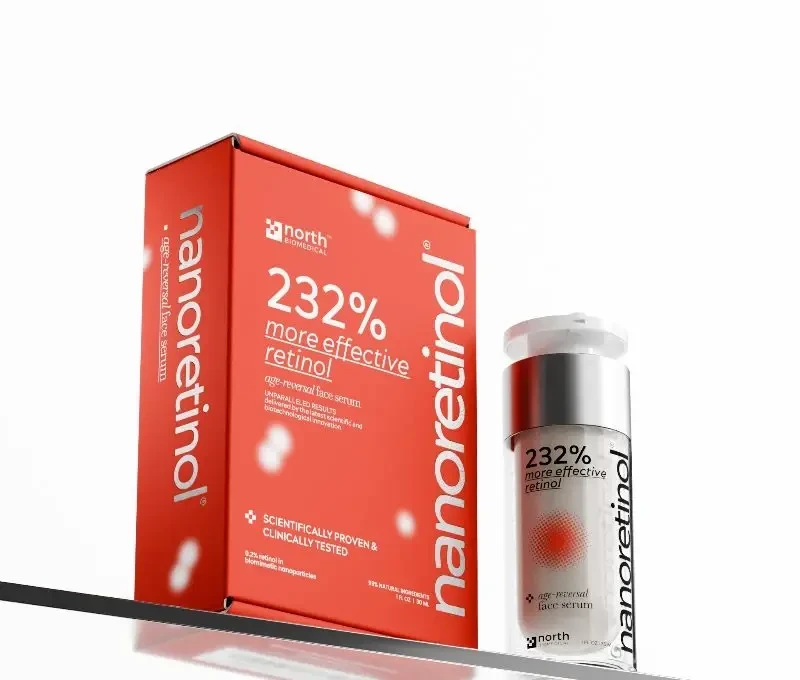
Nanoretinol, from North Biomedical, takes a different route. Its 0.2% retinol is fully stabilised inside biomimetic lipid nanoparticles that the skin recognises as its own, so the active crosses the barrier without breaking it down. The water-based gel absorbs completely to a smooth matte finish, which makes it easy to follow with a moisturiser at night and sunscreen in the morning. In laboratory testing it was 232% more effective than conventional retinol in collagen recovery, and in clinical use it increased skin firmness by 61% and elasticity by 56% in 56 days, with side effects that, when present, were milder than those of conventional retinol.
Apply it at night, and use sunscreen within 24 hours after application, as its directions state.
A Simple Day-and-Night Rule
Retinol at night, sunscreen every morning, more sunscreen when you are outside. Choose a broad-spectrum SPF 30 or higher that feels good enough to wear daily, favour mineral and fragrance-free formulas if your skin is reactive, and use enough of it. Do that, and the work your retinol does overnight is still there when you look in the mirror a year from now.
References
- Murray J, Potts A. “The phototoxic and photoallergy potential of clindamycin phosphate 1.2%/ tretinoin 0.025% gel for facial acne: results of two single-center, evaluator-blinded, randomized, vehicle-controlled phase 1 studies in healthy volunteers.” Journal of Drugs in Dermatology. 2014;13(1):16-22. PubMed: 24385115
- Kaidbey KH, Kligman AM, Yoshida H. “Effects of intensive application of retinoic acid on human skin.” British Journal of Dermatology. 1975;92(6):693-701. doi:10.1111/j.1365-2133.1975.tb03152.x
- Tolleson WH, Cherng SH, Xia Q, et al. “Photodecomposition and phototoxicity of natural retinoids.” International Journal of Environmental Research and Public Health. 2005;2(1):147-155. doi:10.3390/ijerph2005010147
- Temova Rakuša Ž, Škufca P, Kristl A, Roškar R. “Retinoid stability and degradation kinetics in commercial cosmetic products.” Journal of Cosmetic Dermatology. 2021;20(7):2350-2358. doi:10.1111/jocd.13852
- European Multicentre Photopatch Test Study (EMCPPTS) Taskforce. “A European multicentre photopatch test study.” British Journal of Dermatology. 2012;166(5):1002-1009. doi:10.1111/j.1365-2133.2012.10857.x
- Fisher GJ, Wang ZQ, Datta SC, et al. “Pathophysiology of premature skin aging induced by ultraviolet light.” New England Journal of Medicine. 1997;337(20):1419-1428. doi:10.1056/NEJM199711133372003
- Hughes MC, Williams GM, Baker P, Green AC. “Sunscreen and prevention of skin aging: a randomized trial.” Annals of Internal Medicine. 2013;158(11):781-790. doi:10.7326/0003-4819-158-11-201306040-00002
- Randhawa M, Rossetti D, Leyden JJ, et al. “One-year topical stabilized retinol treatment improves photodamaged skin in a double-blind, vehicle-controlled trial.” Journal of Drugs in Dermatology. 2015;14(3):271-280. PubMed: 25738849