Sunscreen Indoors: Do You Actually Need It? The Glass Evidence
What window glass really transmits, why your screens are irrelevant, and where the honest cutoff sits
The advice arrives with total confidence and no numbers: wear sunscreen indoors, because UV comes through windows and your laptop is aging your face. Half of that is measurably true. The other half has been tested with a radiometer and is measurably false.
Whether indoor sunscreen is worth a step in your routine depends on which rays reach you, through what, and for how many hours a day. All three of those have been quantified, so this question has a real answer rather than a vibe.
The Question Is Really About UVA
Sunlight that reaches skin splits into two bands that matter. UVB is the shorter, higher-energy fraction that burns and drives most skin cancer risk. UVA is longer, roughly 95% of the ultraviolet reaching ground level, and it penetrates deeper into the dermis where collagen and elastin live.
UVA is the aging band. It generates reactive oxygen species in fibroblasts, upregulates the matrix metalloproteinases that cut collagen apart, and produces the fragmented elastin and dermal disorganization that show up clinically as leathery, crepey, unevenly pigmented skin [3]. That distinction is what makes the indoor question answerable, and it is unpacked further in our breakdown of UVA versus UVB.
What Window Glass Does and Doesn’t Stop
The measurements are unambiguous on one point and messy on the other. Every type of commercial and automobile glass blocks the large majority of UVB. UVA transmission is where glass type decides the outcome: laminated glass offers substantially better UVA protection than tempered glass, and ordinary annealed window glass sits between them [1].
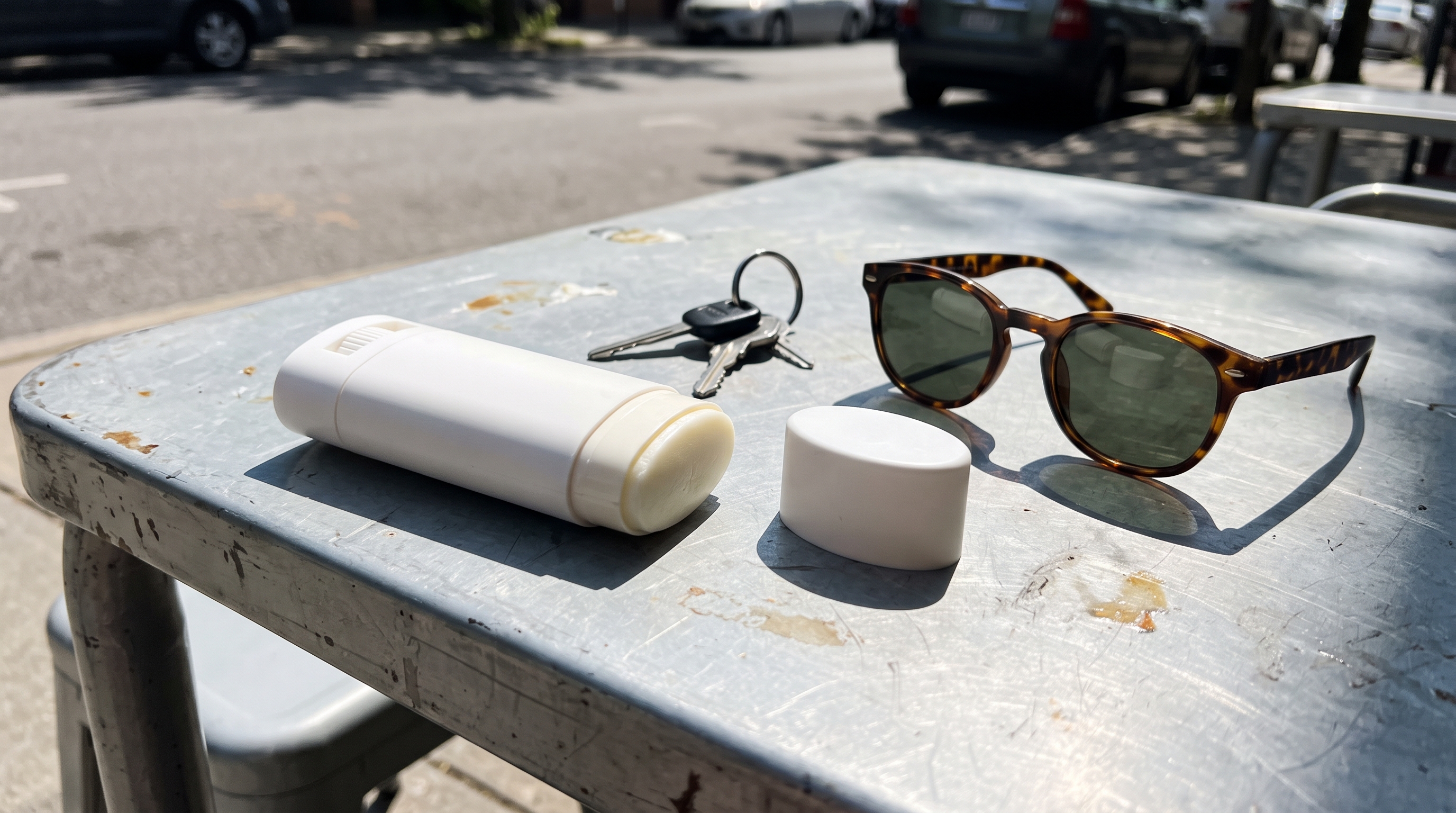
So the popular claim is directionally right. Standard single-pane and tempered office glazing lets a meaningful share of UVA through while removing almost all UVB, which means an indoor desk by a sunny window delivers the aging band without the burning band. You get no warning signal, because the sensation people associate with sun damage comes mostly from UVB.
Window glass removes the ray that would have warned you and passes a good share of the one that ages you.
Two caveats keep this from being an emergency. Intensity falls off sharply with distance from the pane, and modern low-emissivity or laminated glazing in newer buildings cuts UVA far more than the single-pane glass most of this advice was written about.
The Car Is the Worst Room in Your House
The strongest indoor exposure most people get is behind the wheel. In a cross-sectional study of 29 cars from 15 manufacturers, front windshields blocked an average of 96% of UVA, a narrow range of 95% to 98%. Driver-side windows averaged just 71%, with a range from 44% to 96%, and only 4 of 29 cars blocked more than 90% [2].
That is a 25-percentage-point gap between the glass in front of you and the glass beside you, and it aligns with the clinical pattern of left-sided facial photodamage reported in drivers in left-hand-drive countries. Windshields are laminated by safety regulation. Side windows are usually tempered, which is why they leak.
A commute is not indoors, and the driver’s side window is the single leakiest piece of glass most people sit next to daily.
If you drive more than about 20 minutes a day, sunscreen on the face, ears and left forearm is doing real work. The accumulated damage from sun exposure is a dose problem, and commuting is a daily dose.
Your Screens Are Not the Problem
This is where the standard advice collapses. Researchers measured UVA and UVB emission from indoor lamps and from the screens of televisions, tablets and computers specifically to establish a safe distance from the source. Their conclusion was that the lamps and electronic devices tested emit no ultraviolet radiation and therefore pose no health risk to the population [4].
No UV from your monitor means no photoaging pathway from your monitor. Any product sold on the premise that it shields you from computer-screen UV is solving a problem that instrumentation could not detect.
Blue Light Is a Separate Question
Visible light is a different claim, and it deserves a narrower answer than it usually gets. Human melanocytes carry Opsin-3, a blue-light-sensitive receptor, and blue wavelengths can trigger sustained pigmentation through that pathway in melanin-rich skin [5].
That is a real mechanism for pigment, not for wrinkles, and the doses used in that work are closer to sunlight than to a laptop at 60 cm. The reasonable reading: if you have melasma or stubborn facial pigmentation, a tinted sunscreen with iron oxides is worth using during daylight hours near windows. If your concern is lines and laxity, screens are not your variable.
A Defensible Rule for Indoor SPF
Put the evidence together and the cutoff is about hours and glass, not about being technically indoors.
Worth it: a daily commute or any regular driving, a desk within a couple of feet of a sunny single-pane or tempered window, several hours a day in a conservatory or by floor-to-ceiling glazing, and any history of melasma.
Not worth a dedicated step: a windowless office, a room you pass through, an evening in front of a television, or screen time as such.
The cost-benefit here is helped by the fact that the underlying habit pays off. In the 4.5-year Nambour randomized trial, the daily sunscreen group showed no detectable increase in skin aging, and aged 24% less than the discretionary-use group [6]. A year of daily broad-spectrum use also produced measurable improvement in clinical photoaging scores in a separate one-year study [7]. Both effects come from prevention, which is covered in more depth in our guide to sunscreen and skin aging.
What Sunscreen Cannot Do
Prevention has a hard limit: it acts on the exposure you have not had yet. If you are asking this question at 45, you are carrying decades of accumulated UVA dose that was absorbed long before the indoor debate reached you, and the solar elastosis already in the dermis does not reverse because you started applying SPF at your desk.
Photodamaged skin forms 56% less new collagen I than sun-protected skin from the same person, and retinoids are the best-documented topical route back: 10 to 12 months of daily tretinoin raised collagen I formation by 80% while vehicle-treated skin declined [8]. The obstacle has always been that getting a retinoid deep enough to do that means fighting the same barrier it irritates.
Nanoretinol changes the route rather than the dose, encapsulating 0.2% retinol in biomimetic lipid nanoparticles the skin recognizes as its own and admits without the epithelial barrier being broken down. In North Biomedical’s clinical study summary, Nanoretinol vs. Conventional Retinol: Efficacy in Collagen and Elastin Recovery (2024), that delivery produced 232% greater collagen recovery and 73% greater elastin recovery than conventional retinol, with a 61% increase in skin firmness across 56 days.
Where That Leaves Your Routine
Sunscreen indoors is not a moral rule, it is a dose calculation. Glass near you and hours beside it decide the answer, and your devices do not enter the equation at all. Handle the commute, handle the sunny desk, skip the screen anxiety, and spend the attention you save on the half of the problem prevention cannot touch: the collagen already lost.
References
- Almutawa F, Vandal R, Wang SQ, Lim HW. “Current status of photoprotection by window glass, automobile glass, window films, and sunglasses.” Photodermatology, Photoimmunology & Photomedicine. 2013;29(2):65-72. doi:10.1111/phpp.12022
- Boxer Wachler BS. “Assessment of levels of ultraviolet A light protection in automobile windshields and side windows.” JAMA Ophthalmology. 2016;134(7):772-775. doi:10.1001/jamaophthalmol.2016.1139
- Battie C, Jitsukawa S, Bernerd F, Del Bino S, Marionnet C, Verschoore M. “New insights in photoaging, UVA induced damage and skin types.” Experimental Dermatology. 2014;23(Suppl 1):7-12. doi:10.1111/exd.12388
- Duarte IA, Hafner MFS, Malvestiti AA. “Ultraviolet radiation emitted by lamps, TVs, tablets and computers: are there risks for the population?” Anais Brasileiros de Dermatologia. 2015;90(4):595-597. doi:10.1590/abd1806-4841.20153616
- Regazzetti C, Sormani L, Debayle D, Bernerd F, Tulic MK, De Donatis GM, Chignon-Sicard B, Rocchi S, Passeron T. “Melanocytes sense blue light and regulate pigmentation through Opsin-3.” Journal of Investigative Dermatology. 2018;138(1):171-178. doi:10.1016/j.jid.2017.07.833
- Hughes MC, Williams GM, Baker P, Green AC. “Sunscreen and prevention of skin aging: a randomized trial.” Annals of Internal Medicine. 2013;158(11):781-790. doi:10.7326/0003-4819-158-11-201306040-00002
- Randhawa M, Wang S, Leyden JJ, Cula GO, Pagnoni A, Southall MD. “Daily use of a facial broad spectrum sunscreen over one-year significantly improves clinical evaluation of photoaging.” Dermatologic Surgery. 2016;42(12):1354-1361. doi:10.1097/DSS.0000000000000879
- Griffiths CE, Russman AN, Majmudar G, Singer RS, Hamilton TA, Voorhees JJ. “Restoration of collagen formation in photodamaged human skin by tretinoin (retinoic acid).” New England Journal of Medicine. 1993;329(8):530-535. doi:10.1056/NEJM199308193290803