Best Korean Sunscreen: The Filters You Can't Buy in America
Why Korean SPF feels different on the skin, what the PA rating actually measures, and how to judge a formula you can't find on a US shelf
Ask anyone who has switched to a Korean sunscreen what changed, and the answer is almost never about protection. It is about texture. The formula disappeared. It did not pill under makeup. It did not leave a grey film or sting the eyes by mid-afternoon.
That reaction is worth taking seriously, because the single biggest failure mode of any sunscreen is the bottle that stays in the drawer. But the texture story is only half of what is going on. Korean formulators are working with a palette of UV filters that American formulators are not allowed to use, and that difference is chemical, not cosmetic.
What You Are Actually Choosing Between
| If your priority is… | Look for… | What it means in practice |
|---|---|---|
| Strongest UVA coverage | A high PA rating plus a modern UVA filter | PA++++ corresponds to the top measured UVA band [2]. |
| Wearing it every single day | Fluid or essence textures, no white cast | Cosmetic acceptability drives reapplication more than any label claim. |
| Makeup compatibility | Alcohol-light chemical or hybrid formulas | Heavy mineral bases are the usual cause of pilling. |
| Sensitive or reactive skin | Fragrance-free, simple filter systems | Fewer filters means fewer variables when something stings. |
The Filter Gap Is Real
The United States regulates sunscreen as an over-the-counter drug, and the approved filter list sits inside a monograph that has barely moved in decades. Ecamsule reached the US market in 2006, but through a single new-drug application tied to specific products rather than as a general addition. Europe, Japan and Korea took a different regulatory route and have spent that time adopting filters the US has never cleared [6].
Three of those filters explain most of what people notice in Korean sunscreen:
Bis-ethylhexyloxyphenol methoxyphenyl triazine, sold as Tinosorb S, absorbs across both UVB and UVA and is notably photostable. Its more useful property is what it does to its neighbours. In controlled irradiation testing, adding Tinosorb S to formulas containing avobenzone substantially reduced the photodegradation of both avobenzone and ethylhexyl methoxycinnamate, two filters that otherwise break down under the very light they are meant to block [1].
Methylene bis-benzotriazolyl tetramethylbutylphenol, or Tinosorb M, works partly by absorption and partly by scattering, which lets formulators reach broad-spectrum numbers without loading up on titanium dioxide.
Diethylamino hydroxybenzoyl hexyl benzoate, marketed as Uvinul A Plus, is a dedicated long-UVA absorber that does not need a stabiliser babysitting it.
A sunscreen that degrades on your face by lunchtime is protecting you at a number that no longer exists.
The practical consequence is that a Korean formula can hit high UVA protection with a thin, elegant, alcohol-light base. An American formula chasing the same UVA number usually has to lean on more avobenzone, more stabilisers, or more zinc oxide, and each of those choices costs something in texture.
What PA Actually Measures
SPF is a UVB number. It describes how much longer skin takes to redden, and it says close to nothing about the wavelengths that drive aging.
The PA system is the UVA counterpart used across Korea and Japan. It derives from persistent pigment darkening, a method that reads the tanning response several hours after a controlled UVA dose rather than the redness response. The PPD approach was validated as a reproducible way to assign a UVA protection factor, and it remains the basis for the plus signs on the bottle [2]. Four pluses is the top band; anything below three pluses is not a serious anti-aging sunscreen regardless of its SPF.
This distinction matters because UVA is the part of the spectrum doing the structural damage. Ultraviolet exposure induces matrix metalloproteinases in human skin, and those enzymes degrade the collagen scaffolding of the dermis; repeated low-level exposure produces cumulative loss long before anything looks like a burn [4]. If you want to understand which ray does what, our breakdown of UVA versus UVB covers the mechanism in more detail.
How to Judge a Korean Sunscreen You Cannot Test First
Buying a sunscreen that is not sold in US stores means buying it on specification. Four things are worth checking.
Read the filter list, not the marketing. A formula built on Uvinul A Plus or Tinosorb S and M is doing something a US formula cannot. A formula built on octinoxate and a little zinc is not, whatever the country of origin.
Check the PA rating, not just SPF 50+. Two sunscreens can both say SPF 50+ and differ substantially in UVA protection.
Prefer a texture you will over-apply. Laboratory SPF is measured at 2 mg/cm², and real-world users apply far less. Beach studies measuring what people actually put on found application rates around a quarter of the testing standard, which means the protection achieved is a fraction of the number on the label [5]. A fluid you apply generously outperforms a thick cream you apply sparingly.
The number on the bottle assumes you applied about twice as much sunscreen as you probably did.
Buy from a seller with turnover. Heat and time degrade filters. Grey-market stock that has sat in a warehouse through a summer is a real risk with imported sunscreen.
Readers deciding between filter types more broadly will find the mineral versus chemical comparison useful, and anyone whose main complaint is a chalky finish should start with why mineral sunscreen leaves a white cast.
The Part Sunscreen Cannot Do
Daily sunscreen use is one of the few interventions with randomised evidence behind it for aging rather than cancer. In a trial of 903 adults followed for four and a half years, the group assigned to daily broad-spectrum application showed no detectable increase in skin aging over the study period, while the discretionary-use group continued to age measurably [3].
Sunscreen is the one product in your routine that changes what happens tomorrow rather than what already happened, and that also defines its limit. Prevention is not repair. The collagen already degraded by twenty summers does not come back because you found a better SPF. Rebuilding that scaffolding is a separate job, and it belongs to the retinoid pathway.
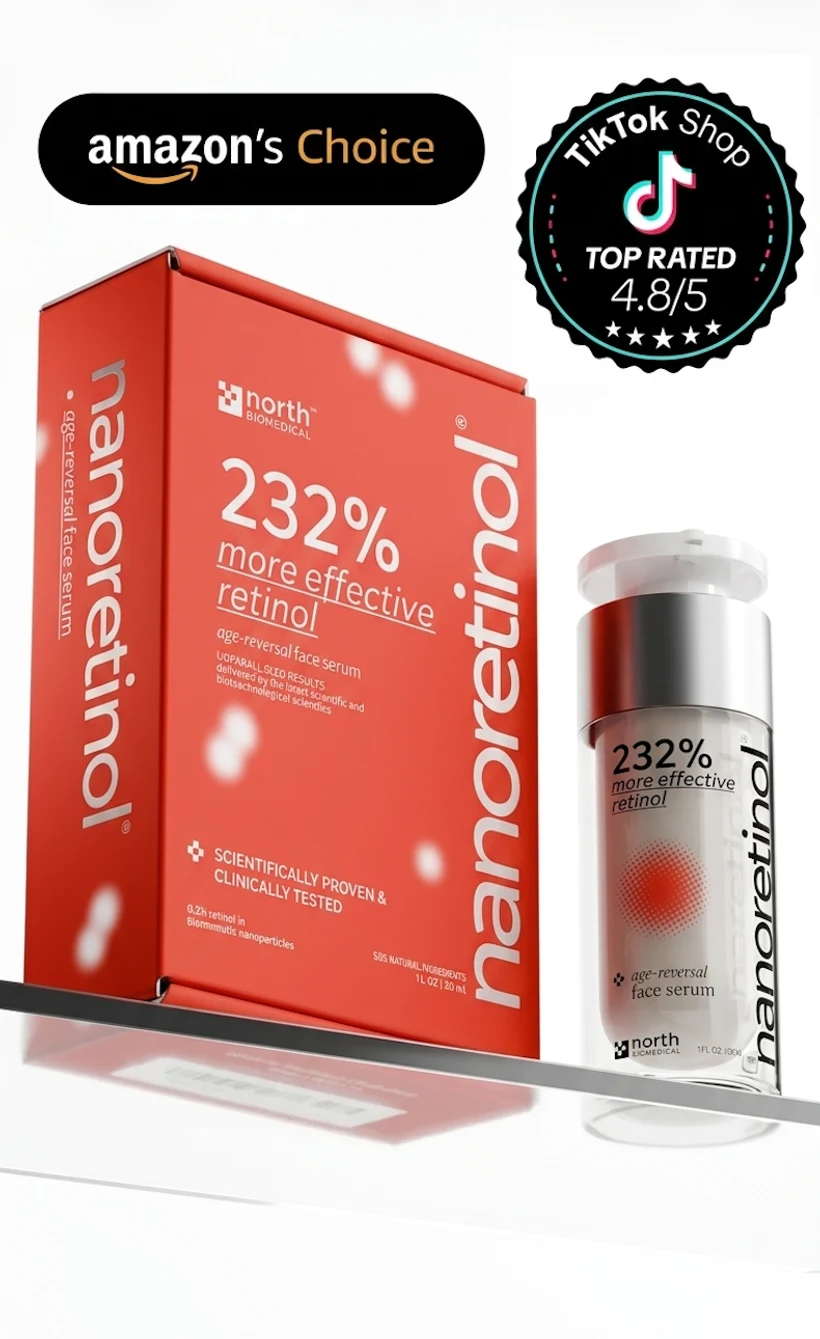
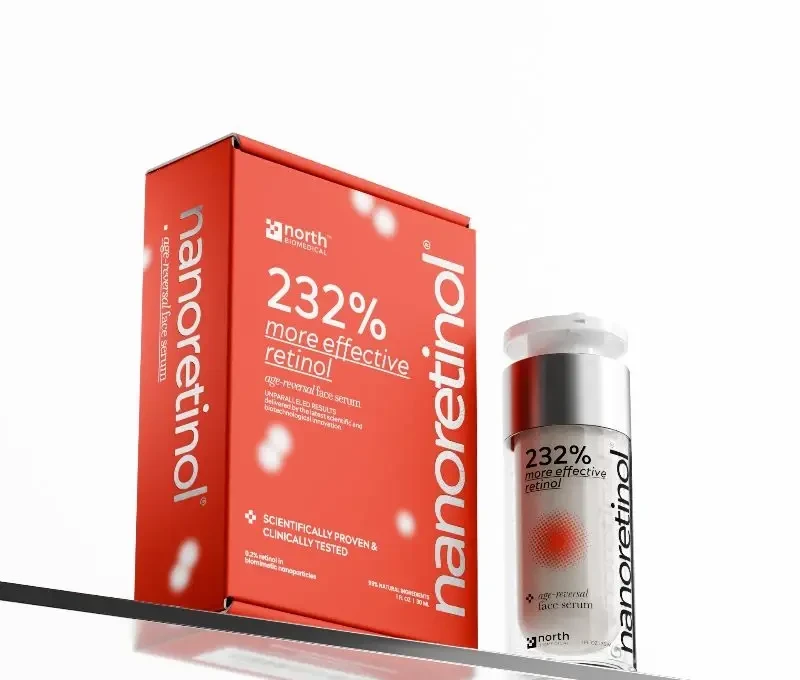
That is where delivery becomes the deciding factor. Conventional retinol formulations have to get through the epithelial barrier, and most of them do it by disrupting it, which is why irritation and peeling are so common. Nanoretinol takes the opposite approach: a stabilised 0.2% retinol encapsulated in biomimetic lipid nanoparticles that the skin recognises as self and admits without barrier damage. In North Biomedical’s clinical study summary, that delivery produced 232% greater collagen recovery and 73% greater elastin recovery than conventional retinol, alongside a 61% increase in firmness and a 56% increase in elasticity over 56 days.
The two products are complements, not competitors. Retinoids increase photosensitivity, so the standard guidance is to apply Nanoretinol at night and use sunscreen within 24 hours. A well-chosen Korean SPF in the morning and a well-delivered retinoid at night is a more complete strategy than either one alone. For readers building the daytime half of that routine around older skin specifically, our guide to sunscreen for mature skin covers the formulation trade-offs.
Choosing Without Overthinking It
If you want a simple rule: pick the highest PA rating you can find in a texture you genuinely enjoy wearing, confirm the filter list includes at least one modern UVA absorber, and buy it somewhere with fast stock turnover. The elegance that makes Korean sunscreen popular is not a frivolous benefit. It is the mechanism by which the product actually gets used, and a sunscreen that gets used is the only kind that works.
References
- Chatelain E, Gabard B. “Photostabilization of Butyl methoxydibenzoylmethane (Avobenzone) and Ethylhexyl methoxycinnamate by Bis-ethylhexyloxyphenol methoxyphenyl triazine (Tinosorb S), a New UV Broadband Filter.” Photochemistry and Photobiology. 2001;74(3):401-406. doi:10.1562/0031-8655(2001)074<0401:POBMAA>2.0.CO;2
- Moyal D, Chardon A, Kollias N. “UVA protection efficacy of sunscreens can be determined by the persistent pigment darkening (PPD) method.” Photodermatology, Photoimmunology & Photomedicine. 2000;16(6):250-255. doi:10.1034/j.1600-0781.2000.160603.x
- Hughes MC, Williams GM, Baker P, Green AC. “Sunscreen and Prevention of Skin Aging: A Randomized Trial.” Annals of Internal Medicine. 2013;158(11):781-790. doi:10.7326/0003-4819-158-11-201306040-00002
- Fisher GJ, Wang ZQ, Datta SC, Varani J, Kang S, Voorhees JJ. “Pathophysiology of Premature Skin Aging Induced by Ultraviolet Light.” New England Journal of Medicine. 1997;337(20):1419-1429. doi:10.1056/NEJM199711133372003
- Bech-Thomsen N, Wulf HC. “Sunbathers’ application of sunscreen is probably inadequate to obtain the sun protection factor assigned to the preparation.” Photodermatology, Photoimmunology & Photomedicine. 1992;9(6):242-244. PMID: 1343224
- Jansen R, Osterwalder U, Wang SQ, Burnett M, Lim HW. “Photoprotection: Part II. Sunscreen: Development, efficacy, and controversies.” Journal of the American Academy of Dermatology. 2013;69(6):867.e1-867.e14. doi:10.1016/j.jaad.2013.08.022