Powder Sunscreen: What a Brush-On SPF Actually Delivers
The milligram arithmetic behind the format everyone reaches for at midday
Powder sunscreen solved a real problem. Reapplying a cream sunscreen over finished makeup at one in the afternoon means either wrecking the makeup or skipping the sunscreen, and most people skip the sunscreen. A brush-on mineral powder that dusts over the top without disturbing anything is an elegant answer to that.
The format is genuinely convenient. The useful question is how much protection actually lands on your face when you use it, and that turns out to be a question about milligrams rather than about SPF numbers.
The dose the label is tested at
Every SPF figure on every sunscreen sold is generated under one standard condition: the product is applied at 2 milligrams per square centimetre of skin. That is a genuinely thick layer, closer to a visible film than to the sheer finish most people aim for.
Almost nobody applies that much. When researchers weighed what 42 sunbathers actually put on themselves, the average came out at roughly 0.5 milligrams per square centimetre, a quarter of the tested dose [1]. The labelled SPF was, for those people, a number describing a product they were not really using.
The shortfall would be tolerable if protection fell off proportionally. It does not. Measuring SPF against applied thickness in vivo produces an exponential relationship rather than a straight line: apply half the standard amount and the effective SPF drops to roughly the square root of the labelled figure, and at a quarter of the amount it falls to roughly the fourth root [2]. Apply an SPF 50 at a quarter dose and you are left with something closer to single digits than to the 12 that simple division would suggest.
This is the arithmetic every sunscreen has to survive, and it is the arithmetic a powder has to survive twice.
What a powder can physically carry
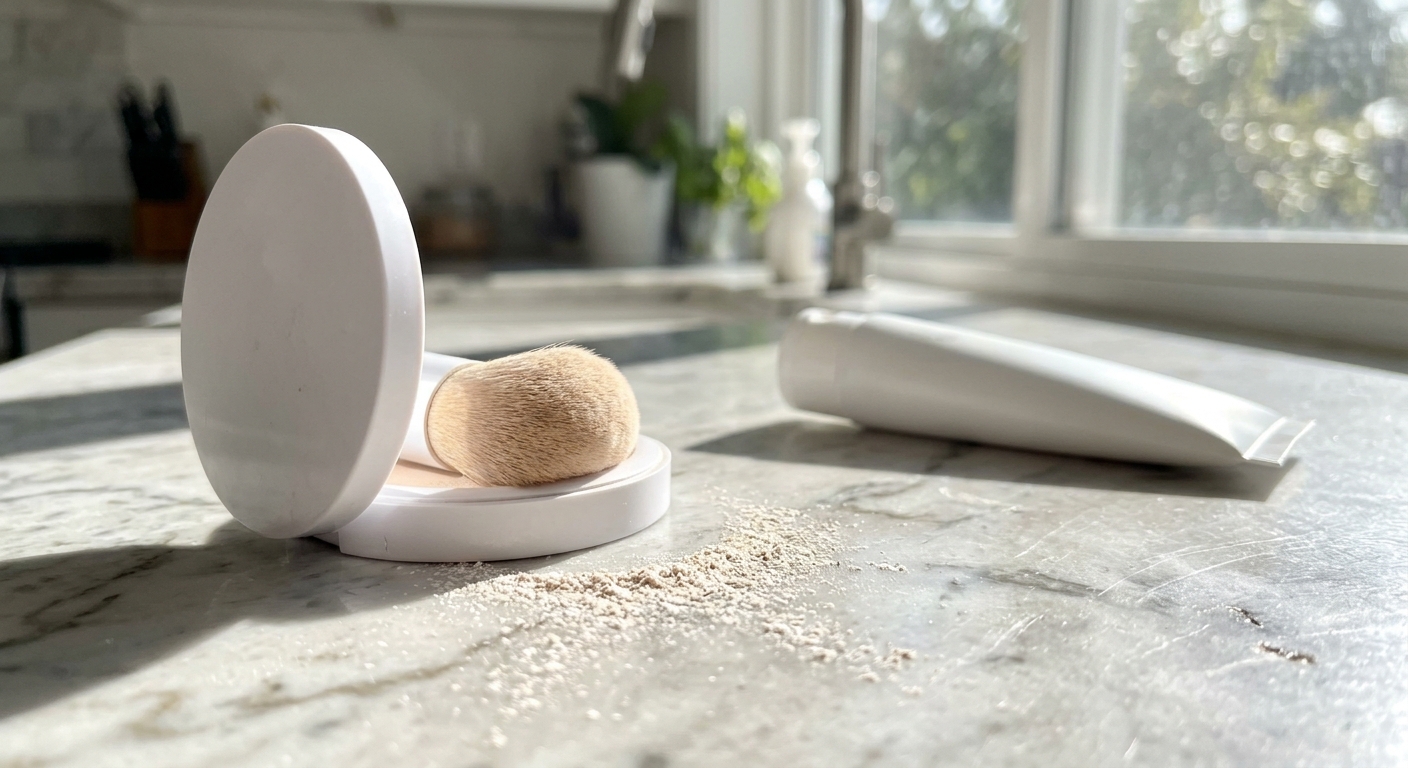
Mineral powders filter UV with titanium dioxide or zinc oxide, and those filters work. The constraint is how much of them a brush can move onto skin.
The useful question is how much protection actually lands on your face when you use it, and that turns out to be a question about milligrams rather than about SPF numbers.
A formulation study of a water-resistant compact powder built around titanium dioxide as its sole filter measured the best-performing version, at 25% titanium dioxide, at SPF 15.06 [3]. That is a real, useful figure, and it is also a laboratory figure, produced under controlled application rather than by someone swirling a brush over their nose in a car.
Particle size compounds the problem. Work published in Scientific Reports found that titanium dioxide dispersions with the smallest particle size produced the highest protection, averaging SPF 8.61 against 6.43 and 7.08 for larger-particle samples [4]. Mineral powders sit in a narrow band, and the difference between a well-milled formula and a poorly milled one is real but small.
Now apply the dose curve. If a powder is tested at 2 milligrams per square centimetre to earn its label, and a brush deposits a fraction of that, the effective protection lands well below what the tin claims. No formulation trick escapes this, because the limit belongs to the delivery format rather than to the chemistry inside it.
Where reapplication timing comes in
The case for powder rests on it being better than nothing at hour four, which is a fair case. Reapplication genuinely matters, and it matters earlier than most people assume. Modelling of cumulative UV exposure found that reapplying around twenty minutes after the initial application, rather than waiting the conventional two to three hours, meaningfully reduced total dose received [5]. The early top-up compensates for the thin initial layer.
That is precisely the job a powder is suited to. Used as a top-up over a properly applied cream or lotion base, it adds filter to a film that is already there. The two together approach the tested dose in a way neither reaches alone.
Used as the entire sun protection strategy, it does not. If you are choosing a daily base layer, our comparison of mineral and chemical sunscreens covers the filter chemistry, and SPF 30 vs 50 explains why the gap between those two numbers matters less than the gap between applying enough and not.
When powder is genuinely the right tool
There are situations where a brush-on format is not a compromise at all.
Its 0.2% retinol is carried inside biomimetic lipid nanoparticles the skin recognises as self and admits intact, in a water-based, 99% natural formulation suitable for all skin types including sensitive.
The scalp and hairline are the clearest case. A part line burns readily and no lotion is going to be applied there willingly. A powder is the only format most people will actually use on a scalp, which makes it the best format for that site by default.
Over finished makeup at midday, the same logic holds. The realistic alternative is nothing.
For oily and combination skin, a mineral powder doubles as shine control, which raises the odds it gets reapplied at all. Compliance accounts for most of the real-world effect in sun protection.
What powder should not be is the first and only application of the day on bare skin, or the strategy for a beach, a hike, or anything involving water or sweat.
Why any of this matters for how you age
Ultraviolet exposure does not merely darken skin. Within hours of a UVB dose below the level that causes visible sunburn, human skin upregulates matrix metalloproteinases that degrade dermal collagen, driven through AP-1 signalling [6]. The photoaging you see at fifty is the accumulated output of thousands of subclinical doses, most of them collected on ordinary days rather than on holidays.
The prevention side of this is proven rather than assumed. In a randomised trial in Nambour, Australia, adults assigned to daily sunscreen use showed 24% less skin aging over four and a half years than the discretionary-use group [7]. Daily use works. Our page on sunscreen for mature skin covers choosing one, and tinted sunscreen covers the visible-light gap that clear formulas leave open.
Prevention is the entire scope of what any sunscreen offers, though, powder or otherwise. It stops the next increment of collagen breakdown. It does nothing about the collagen already lost to the last thirty years of increments, and that lost collagen is what the mirror is showing you.
Repair is a separate job with a separate tool. Topical retinoids remain the most evidence-backed way to rebuild dermal collagen, and the obstacle has always been tolerance rather than efficacy. Conventional retinol crosses the skin barrier by chemically disrupting it, which produces the burning and peeling that ends most attempts within weeks.
Nanoretinol changes the delivery instead of the dose. Its 0.2% retinol is carried inside biomimetic lipid nanoparticles the skin recognises as self and admits intact, in a water-based, 99% natural formulation suitable for all skin types including sensitive. Measured against conventional retinol it achieved 232% greater collagen recovery and 73% greater elastin recovery with drastically reduced cytotoxicity, and across 56 days delivered a 61% increase in firmness and a 56% increase in elasticity.
Because retinoids increase photosensitivity, the morning filter becomes more important rather than less. Block in the daylight, rebuild overnight.
Using it the way it works
Treat powder sunscreen as what it is: the best available top-up, and a poor base layer. Apply a full cream or lotion sunscreen in the morning at a dose that looks like too much, because too much is approximately correct. Then keep the powder for the hours after, for the scalp, and for the days when the alternative is nothing at all.
That is not a small role. Reapplication is where most people’s sun protection collapses, and a format you will actually use at two in the afternoon is worth more than a superior one sitting in a drawer.
References
- Bech-Thomsen N, Wulf HC. “Sunbathers’ Application of Sunscreen Is Probably Inadequate to Obtain the Sun Protection Factor Assigned to the Preparation.” Photodermatology, Photoimmunology & Photomedicine. 1992;9(6):242-244. PMID: 1343224
- Faurschou A, Wulf HC. “The Relation Between Sun Protection Factor and Amount of Sunscreen Applied In Vivo.” British Journal of Dermatology. 2007;156(4):716-719. doi:10.1111/j.1365-2133.2006.07684.x
- Muliadi R, Aspadiah V, Sahumena MH, Aftira N. “Sunscreen Innovation: Development of a Water-Resistant Compact Powder Formula Based on Titanium Dioxide for Optimal UV Protection.” Journal of Pharmaceutical and Sciences. 2025;8(3):1442-1451. doi:10.36490/journal-jps.com.v8i3.961
- Ghamarpoor R, Fallah A, Jamshidi M. “Investigating the Use of Titanium Dioxide (TiO2) Nanoparticles on the Amount of Protection Against UV Irradiation.” Scientific Reports. 2023;13:9793. doi:10.1038/s41598-023-37057-5
- Diffey BL. “When Should Sunscreen Be Reapplied?” Journal of the American Academy of Dermatology. 2001;45(6):882-885. doi:10.1067/mjd.2001.117385
- Fisher GJ, Datta SC, Talwar HS, Wang ZQ, Varani J, Kang S, Voorhees JJ. “Molecular Basis of Sun-Induced Premature Skin Ageing and Retinoid Antagonism.” Nature. 1996;379(6563):335-339. doi:10.1038/379335a0
- Hughes MCB, Williams GM, Baker P, Green AC. “Sunscreen and Prevention of Skin Aging: A Randomized Trial.” Annals of Internal Medicine. 2013;158(11):781-790. doi:10.7326/0003-4819-158-11-201306040-00002