Tretinoin Cream: What It Actually Does, How to Use It, and the Gentler Path to the Same Results
The prescription gold standard for wrinkles works — but the irritation makes most people quit. Here's the science, and a smarter way to get retinoid results.
If you have spent any time researching how to soften wrinkles, you have run into tretinoin cream. It is the ingredient dermatologists reach for when a patient is serious about reversing visible aging — and it is one of the few topical treatments with decades of rigorous clinical evidence behind it. But it is also the ingredient that quietly defeats more people than almost any other in skincare. They start strong, their skin flakes and stings for three weeks, and the tube ends up in a drawer.
Understanding what tretinoin actually does — and why it behaves the way it does — is the key to deciding whether it belongs in your routine, and what to do if your skin can’t tolerate it.
What Tretinoin Cream Is
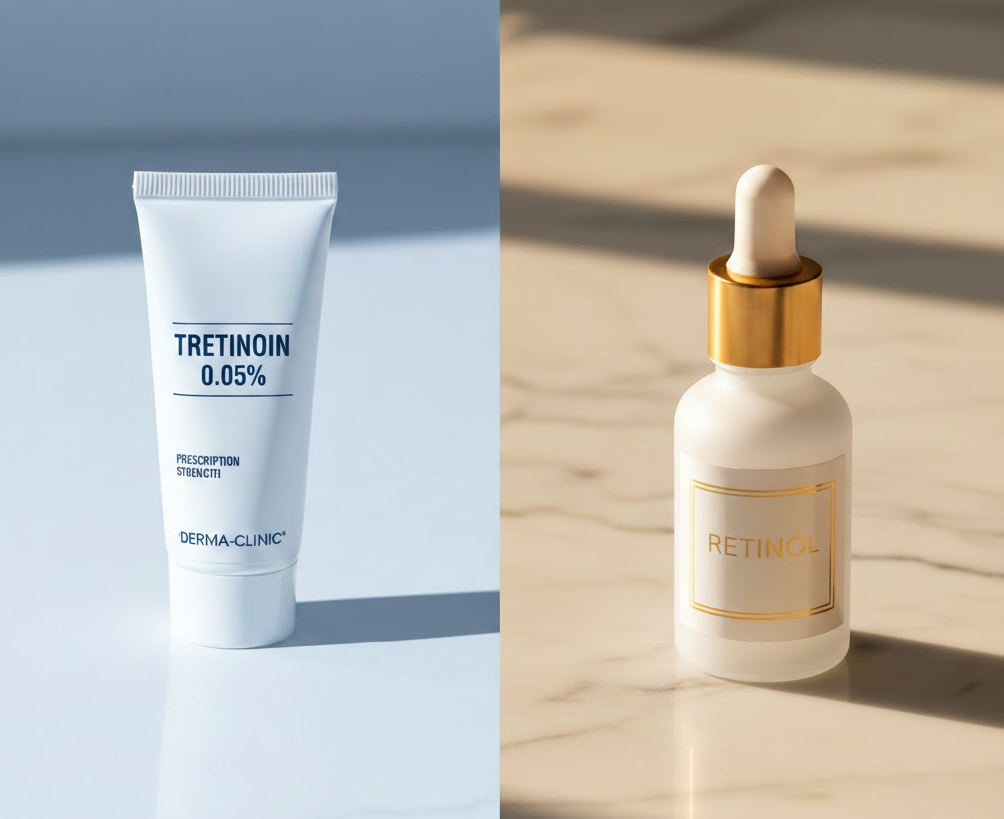
Tretinoin is all-trans retinoic acid, the biologically active form of vitamin A. This is the crucial distinction between tretinoin and the retinol you buy over the counter. Retinol has to be converted by your skin cells through two chemical steps before it becomes the active molecule. Tretinoin skips the line — it is already the finished product your skin receptors recognize [1].
Because it is a drug, tretinoin cream requires a prescription in the United States. It comes in strengths that typically range from 0.025% to 0.1%, and it is sold under brand names as well as generics. The higher the percentage, the more active molecule per application — and, predictably, the more potential for irritation. Tretinoin skips the conversion line that ordinary retinol must travel, which is exactly why it works faster and stings harder than anything you can buy off the shelf.
How It Actually Works
Tretinoin’s effects come down to how it talks to your cells. Retinoic acid binds to specialized receptors inside skin cells called retinoic acid receptors, which act like switches on your DNA. When tretinoin flips those switches, it changes which genes the cell expresses [4].
The downstream effects are remarkable and well documented. Tretinoin accelerates the turnover of surface skin cells, which smooths rough texture and helps unclog pores. It disperses clumped melanin, which is why it fades dark spots over time. And most importantly for anti-aging, it ramps up the production of new collagen in the dermis — the structural protein that keeps skin firm and that we lose at roughly 1% per year from our mid-twenties onward.
Understanding what tretinoin actually does — and why it behaves the way it does — is the key to deciding whether it belongs in your routine, and what to do if your skin can’t tolerate it.
The collagen evidence is not marketing. In a landmark study, researchers found that collagen synthesis is measurably reduced in photodamaged skin, and that treating that skin with topical tretinoin produced an 80% increase in collagen I formation [2]. A separate sixteen-week double-blind, vehicle-controlled trial confirmed visible improvement in photoaged skin on tretinoin-treated areas while the placebo areas did not change, with biopsies showing a thickened epidermis and new dermal collagen [3].
What Tretinoin Cream Is Used For
Dermatologists prescribe tretinoin cream for several overlapping concerns:
- Fine lines and wrinkles caused by sun damage and collagen loss
- Acne, by keeping pores clear and reducing the plugs that lead to breakouts
- Uneven tone and dark spots, including post-inflammatory hyperpigmentation and sun-induced discoloration
- Rough or dull texture, by speeding the shedding of dead surface cells
A 2022 systematic review of randomized controlled trials concluded that topical tretinoin reliably improves the clinical signs of photoaging — fine wrinkling, mottled pigmentation, and roughness — across multiple well-designed studies [3]. This is as close to settled science as skincare gets.
The Catch: Why So Many People Quit
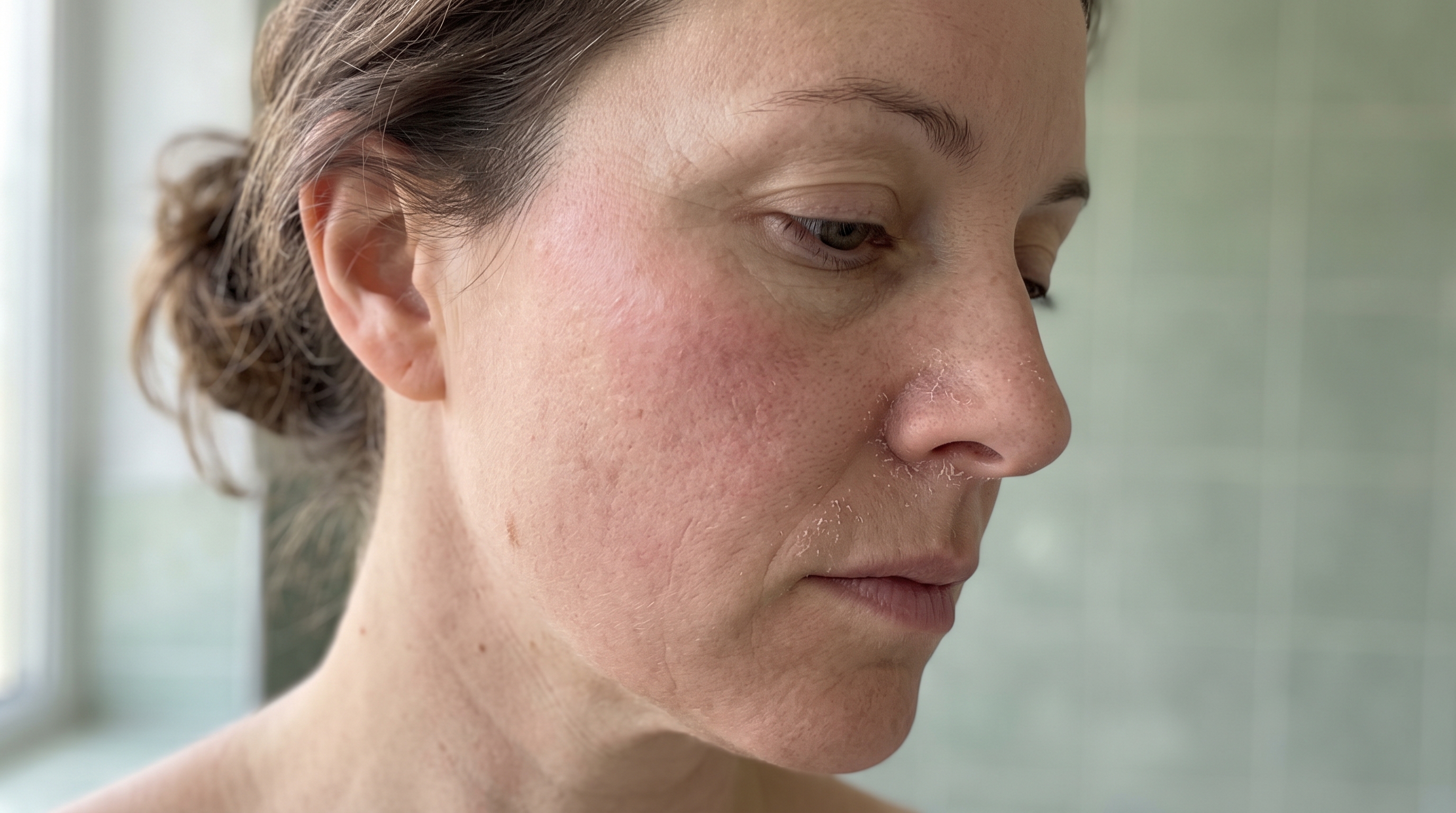
Here is the part the before-and-after photos never mention. Tretinoin’s potency and its side effects come from the same source. The very receptor activity that rebuilds collagen also disrupts the cohesion of cells in the outermost layer of skin during the adjustment period. Tretinoin’s power and its sting come from the same molecular event, which is why the strongest formulas are so often the ones people abandon. The result is the infamous “retinization” phase: redness, peeling, stinging, and dryness that can last several weeks.
This is not a rare reaction. It is the expected one. Research on retinoid tolerability has documented that daily use can sharply elevate transepidermal water loss — a direct measure of a compromised skin barrier — in sensitive users [5]. When your barrier is leaking moisture, everything stings, and the temptation to stop is overwhelming.
These strategies work — but they also reveal the core tension: the dose that transforms your skin is often the dose your skin can’t comfortably take.
The conventional workarounds help but don’t solve the problem. Dermatologists recommend starting two nights a week, applying a pea-sized amount to dry skin, buffering with moisturizer, and easing up at the first sign of irritation. One study found that using tretinoin every other night produced comparable collagen benefits to nightly use with significantly fewer reports of stinging and scaling. These strategies work — but they also reveal the core tension: the dose that transforms your skin is often the dose your skin can’t comfortably take.
How to Use Tretinoin Cream
If you and your dermatologist decide tretinoin is right for you:
- Apply at night only. Retinoic acid is degraded by sunlight, and it makes skin more sun-sensitive.
- Start low and slow. Two or three nights a week at the lowest strength, building up as tolerated.
- Use a pea-sized amount for the entire face. More is not better; more is just more irritation.
- Always wear sunscreen the next morning. This is non-negotiable while using any retinoid.
- Pair with a simple, barrier-supporting moisturizer and skip other exfoliating acids until your skin adapts.
Expect the payoff on a schedule rather than a deadline: our week-by-week breakdown of how long tretinoin takes to work sets out what the trial data says arrives at week 12, week 24 and month 12.
Tretinoin is not for everyone. It is not used during pregnancy or breastfeeding, and people with very sensitive or reactive skin often find even the lowest strength intolerable. That is precisely the gap that newer delivery technology was designed to close.
The Gentler Path to the Same Biology
The frustration with tretinoin is rarely about whether it works — the data is overwhelming that it does. The frustration is about getting the active molecule into the dermis without burning the barrier on the way in. That is a delivery problem, and delivery is exactly where the science has advanced.
This is the principle behind Nanoretinol. Instead of flooding the skin’s surface with raw active and relying on chemical disruption to drive it inward, Nanoretinol encapsulates a stabilized retinol inside biomimetic lipid nanoparticles. These particles are externally similar to your own skin cells, so the body recognizes them as “self” and allows them through the epidermal barrier rather than being forced across it. The retinol is released where it is needed, without the barrier-shredding mechanism that makes conventional retinoids sting.
The results from North Biomedical’s clinical study reflect that difference. Compared with conventional retinol, the encapsulated form was 232% more effective in collagen recovery and 73% more effective in elastin recovery, while clinical use over 56 days produced a 61% increase in skin firmness and a 56% increase in elasticity. Just as importantly, it proved significantly gentler at the cellular level, with drastically reduced cytotoxicity. At a stabilized 0.2% concentration in a water-based, 99% natural formula, it is designed for the people tretinoin leaves behind — including those with sensitive skin and the delicate eye area.
None of this makes tretinoin obsolete. For some people, under a dermatologist’s care, it remains the right tool. But if you have tried the prescription route and quit because your skin couldn’t take it, the lesson is not that retinoids don’t work for you. It is that the delivery method matters as much as the molecule — and that the gentler path may get you to the same place.
Where That Leaves You
Tretinoin cream is the most thoroughly validated anti-aging topical in dermatology, with real, biopsy-confirmed collagen building behind its reputation. It is also a demanding ingredient that asks your skin barrier to weather a difficult adjustment. Knowing both halves of that truth lets you make an honest decision: commit to the prescription and its retinization period, or pursue the same underlying biology through a delivery system built to be kind to your skin from the first night. Either way, the science of retinoids is firmly on your side.
References
- Szymański Ł, Skopek R, Palusińska M, et al. “Retinoic Acid and Its Derivatives in Skin.” Cells. 2020;9(12):2660. doi:10.3390/cells9122660
- Griffiths CE, Russman AN, Majmudar G, Singer RS, Hamilton TA, Voorhees JJ. “Restoration of collagen formation in photodamaged human skin by tretinoin (retinoic acid).” New England Journal of Medicine. 1993;329(8):530-535. doi:10.1056/NEJM199308193290803
- Sitohang IBS, Makes WI, Sandora N, Suryanegara J. “Topical tretinoin for treating photoaging: A systematic review of randomized controlled trials.” International Journal of Women’s Dermatology. 2022;8(1):e003. doi:10.1097/JW9.0000000000000003
- Weiss JS, Ellis CN, Headington JT, Tincoff T, Hamilton TA, Voorhees JJ. “Topical tretinoin improves photoaged skin. A double-blind vehicle-controlled study.” JAMA. 1988;259(4):527-532. PMID: 3336176
- Mukherjee S, Date A, Patravale V, Korting HC, Roeder A, Weindl G. “Retinoids in the treatment of skin aging: an overview of clinical efficacy and safety.” Clinical Interventions in Aging. 2006;1(4):327-348. doi:10.2147/ciia.2006.1.4.327