Vitamin E Serum: Which Form Works and How to Use It
Vitamin E is your skin's main fat-soluble antioxidant, and mature skin has less of it. Here is what a serum can do, which form to look for on the label and how to fit it into a routine with retinol
Vitamin E is one of the oldest ingredients in skincare, and it turns up in so many formulas that it is easy to treat it as background noise. A dedicated vitamin E serum is a different proposition. It is meant to top up the antioxidant your skin uses to protect its own fats from sunlight and pollution, and that only works if the bottle contains the right form, in a stable base, applied at the right time of day.
This guide explains why skin runs short of vitamin E, what the research says a serum can and cannot do, how to read the label and how to combine a vitamin E serum with retinol. For the broader picture, see our guide to vitamin E for skin.
Why skin runs short of vitamin E
Vitamin E is the main fat-soluble antioxidant in skin, and research on its role points to photoprotective and barrier-stabilizing effects [1, 2]. A surprising amount of it reaches the surface through your own oil. In one study, vitamin E was a significant part of human sebum and was secreted continuously on the cheek and forehead, and its levels tracked closely with squalene, a marker of oil flow [3]. Your cheeks carry about 20 times more vitamin E in their outer layer than your upper arms, because oil glands keep pushing it up to the surface.
That supply is under constant attack. Vitamin E is lowest in the very outer layer of skin, the layer that meets sunlight first, and it is easily used up there [4]. Age adds to the shortfall. In skin samples from young and older adults, alpha-tocopherol in the epidermis of naturally aged skin was 61% of young levels, and in photoaged skin just 56% [5].
So dry, mature or sun-exposed skin, with less oil, less stored vitamin E and more daily exposure, is exactly where a topical source makes the most sense.
Tocopherol or tocopheryl acetate: read the label
Vitamin E appears on ingredient lists in several forms, and they do not behave the same way.
Your cheeks carry about 20 times more vitamin E in their outer layer than your upper arms, because oil glands keep pushing it up to the surface.
- Tocopherol (often written alpha-tocopherol or d-alpha-tocopherol) is the free form, the one that directly neutralizes free radicals. It is also the least stable and darkens as it oxidizes.
- Tocopheryl acetate is an ester, a more stable version that skin must convert back to free tocopherol before it can act as an antioxidant.
How well that conversion happens is still debated. Lab work on pig skin found some conversion, which our guide to vitamin E cream covers. But in a three-month study in people who applied tocopheryl acetate to their arms twice daily, the ester was well absorbed into the skin with no evidence that it turned into free tocopherol [6]. Mouse studies described in the same paper had found that only the free form reduced UV-induced skin tumors [6].
For a serum you are buying specifically for antioxidant protection, that makes free tocopherol the safer bet. Tocopheryl acetate is fine in a moisturizer, where it mainly helps keep the formula stable, but it is a weaker reason to buy a dedicated serum.
Vitamin E works better with vitamin C
The strongest evidence for vitamin E serums comes from combinations. In a study on pig skin, researchers applied 15% L-ascorbic acid with 1% alpha-tocopherol for four days before UV exposure [7]. Each vitamin alone offered some protection against redness and sunburn cells, but the combination was clearly better, reaching a fourfold antioxidant protection factor and also reducing DNA damage [7].
The two vitamins support each other: vitamin E guards fats in cell membranes, and vitamin C helps regenerate vitamin E after it neutralizes a free radical. Ferulic acid is often added as a third partner to stabilize the pair, as our guide to ferulic acid serum explains. None of this turns a serum into sunscreen. It is a second layer of defense that works underneath one.
Oil serum or water serum
Pure vitamin E oils dissolve tocopherol in a carrier oil. They feel rich, suit dry and mature skin and work well at night or under moisturizer in winter, but can feel heavy on oily skin.
Your skin can lose 45% of its surface vitamin E after one dose of sun too weak to turn it pink, so a morning serum makes more sense than a night one.
Water-based antioxidant serums usually pair vitamin E with vitamin C and often ferulic acid. They are lighter, layer easily under sunscreen and suit most skin types.
Gel or lotion serums sit in between and are a reasonable choice for combination skin.
Whatever the format, packaging matters. Choose an opaque, airless or dropper bottle, store it away from heat and light, and replace it if the serum turns noticeably darker or smells off.
Allergy and the scar myth
Vitamin E is generally well tolerated. A review of the published reports found that allergic contact reactions are uncommon given how widely it is used [8]. The picture changes on broken skin. In a double-blind study of surgical scars, topical vitamin E either did nothing or made the scar look worse in 90% of cases, and 33% of patients developed a contact rash [9]. Keep vitamin E serums for intact skin, and patch test first if you react easily.
How to use a vitamin E serum with retinol
Timing matters more than most labels admit. Your skin can lose 45% of its surface vitamin E after one dose of sun too weak to turn it pink, so a morning serum makes more sense than a night one. In that study, a single small dose of simulated sunlight cut alpha-tocopherol in the outer layer by almost half [4].
A simple split works well:
- Morning: cleanse, apply a vitamin E serum or a vitamin C and E serum, then moisturizer and sunscreen.
- Night: cleanse, apply retinol to dry skin, then moisturizer. A rich vitamin E oil can go on top on very dry nights.
Our guide to antioxidant skin care covers how other antioxidants fit the same morning slot.
Defense by day, repair by night
A vitamin E serum protects the collagen and lipids you already have, but it does not tell skin to make more. That is the job of a retinoid, and it is why the two belong at opposite ends of the day.
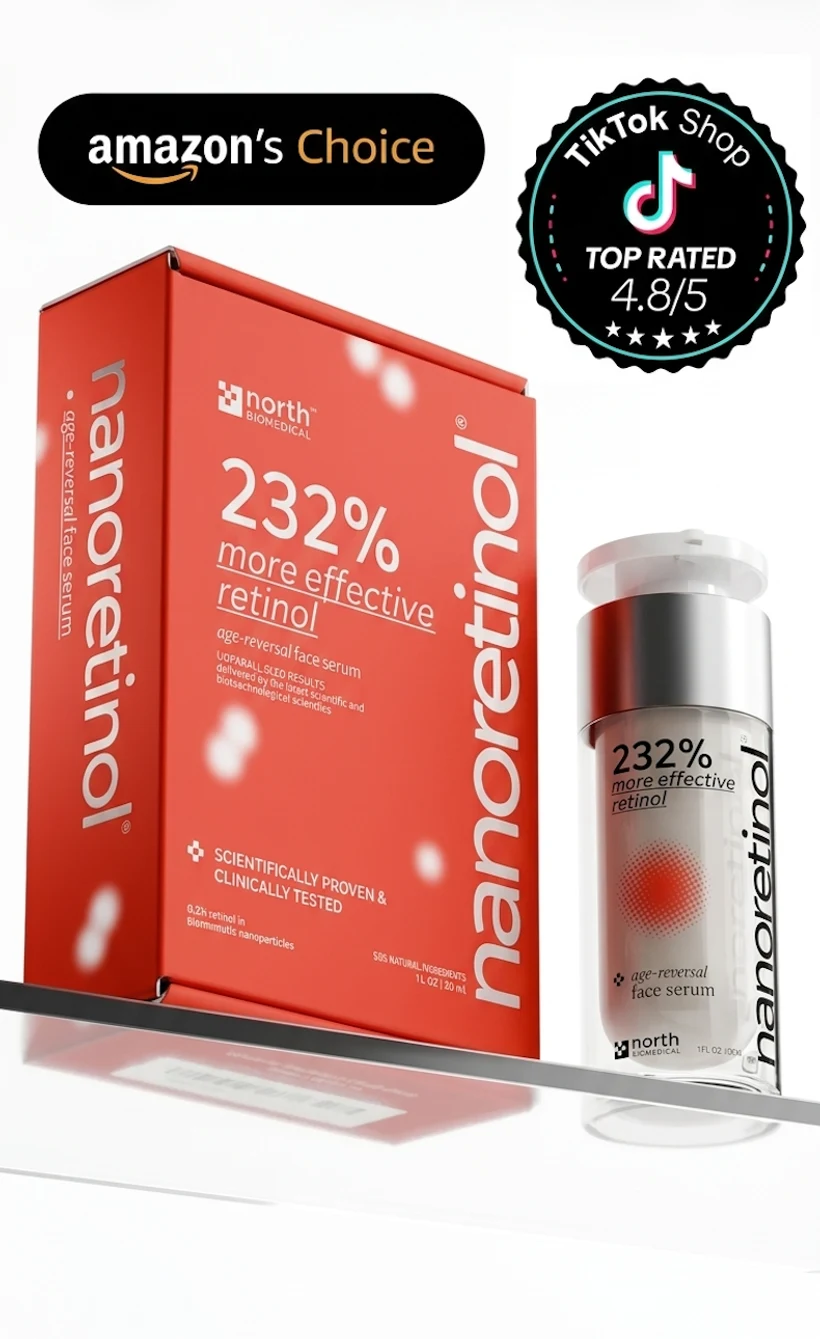
The usual obstacle is irritation. Many conventional retinol formulas use chemicals and petroleum derivatives that loosen the barrier’s lipids through lipid mobility, leading to redness and peeling. Nanoretinol encapsulates 0.2% retinol in biomimetic lipid nanoparticles that the skin recognizes as its own, so it reaches its target without damaging the epithelial barrier. In North Biomedical’s study it was 232% more effective than conventional retinol in collagen recovery and 73% more effective in elastin recovery, and in 56 days of clinical use it produced a 61% increase in skin firmness and a 56% increase in elasticity [10].
Use a vitamin E serum under sunscreen in the morning, apply Nanoretinol at night, and each step does the job it is best at.
References
- Thiele JJ, Hsieh SN, Ekanayake-Mudiyanselage S. “Vitamin E: critical review of its current use in cosmetic and clinical dermatology.” Dermatologic Surgery. 2005;31(7 Pt 2):805-813. doi:10.1111/j.1524-4725.2005.31724
- Keen MA, Hassan I. “Vitamin E in dermatology.” Indian Dermatology Online Journal. 2016;7(4):311-315. doi:10.4103/2229-5178.185494
- Thiele JJ, Weber SU, Packer L. “Sebaceous gland secretion is a major physiologic route of vitamin E delivery to skin.” Journal of Investigative Dermatology. 1999;113(6):1006-1010. doi:10.1046/j.1523-1747.1999.00794.x
- Thiele JJ, Traber MG, Packer L. “Depletion of human stratum corneum vitamin E: an early and sensitive in vivo marker of UV induced photo-oxidation.” Journal of Investigative Dermatology. 1998;110(5):756-761. doi:10.1046/j.1523-1747.1998.00169.x
- Rhie G, Shin MH, Seo JY, Choi WW, Cho KH, Kim KH, Park KC, Eun HC, Chung JH. “Aging- and photoaging-dependent changes of enzymic and nonenzymic antioxidants in the epidermis and dermis of human skin in vivo.” Journal of Investigative Dermatology. 2001;117(5):1212-1217. doi:10.1046/j.0022-202x.2001.01469.x
- Alberts DS, Goldman R, Xu MJ, Dorr RT, Quinn J, Welch K, Guillen-Rodriguez J, Aickin M, Peng YM, Loescher L, Gensler H. “Disposition and metabolism of topically administered alpha-tocopherol acetate: a common ingredient of commercially available sunscreens and cosmetics.” Nutrition and Cancer. 1996;26(2):193-201. doi:10.1080/01635589609514475
- Lin JY, Selim MA, Shea CR, Grichnik JM, Omar MM, Monteiro-Riviere NA, Pinnell SR. “UV photoprotection by combination topical antioxidants vitamin C and vitamin E.” Journal of the American Academy of Dermatology. 2003;48(6):866-874. doi:10.1067/mjd.2003.425
- Kosari P, Alikhan A, Sockolov M, Feldman SR. “Vitamin E and allergic contact dermatitis.” Dermatitis. 2010;21(3):148-153. PubMed: 20487657
- Baumann LS, Spencer J. “The effects of topical vitamin E on the cosmetic appearance of scars.” Dermatologic Surgery. 1999;25(4):311-315. doi:10.1046/j.1524-4725.1999.08223.x
- North Biomedical LLC. “Nanoretinol vs. Conventional Retinol: Efficacy in Collagen and Elastin Recovery.” Clinical Study Summary, 2024. Study summary