When to Start Using Retinol: The Biology Behind the Right Age
The honest answer is not a birthday — it is a measurable shift in what your skin is doing that most people reach before they notice it
Search this question and you will be given a number. Twenty-five. Thirty. “Your late twenties.” The numbers are confidently stated and almost never sourced, which should be the first clue that they are a convention rather than a finding.
There is a better way to answer it. The research on what changes in aging skin is unusually specific about timing, and once you know what is actually declining, and when, the right moment to start becomes a decision you can make about your own face rather than a rule you inherit.
What is actually declining, and from when
Two separate processes age skin, and they run on different clocks.
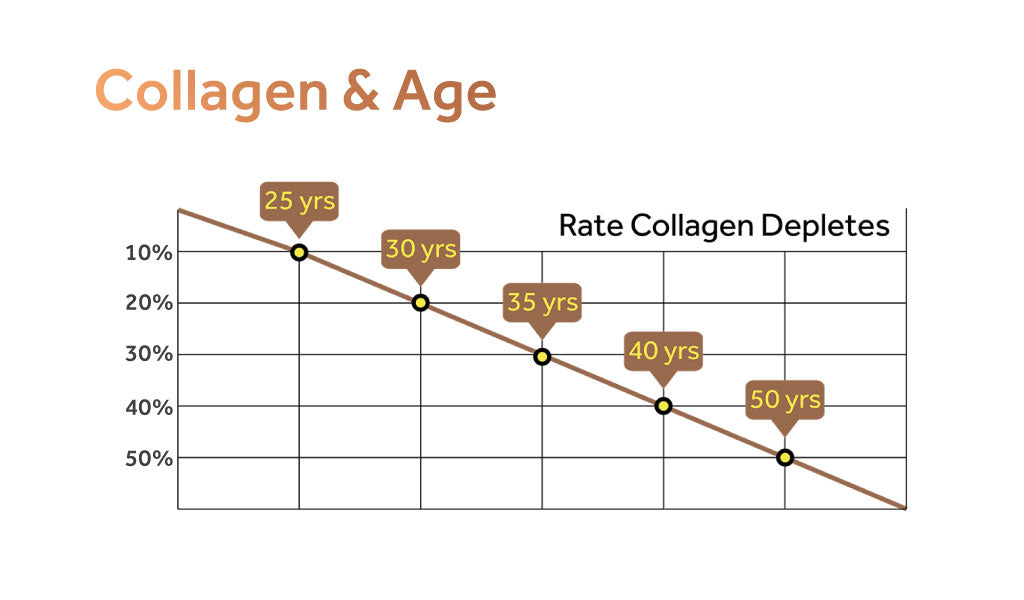
The first is collagen production. Studies of chronologically aged skin, taken from sun-protected sites so that photoaging is excluded, show that older skin produces measurably less type I procollagen than young skin. The cause is not only fewer fibroblasts but fibroblasts that have collapsed and lost mechanical attachment to a fragmented collagen matrix, which further reduces their output [1]. It is a self-reinforcing decline: less collagen means less scaffolding, and less scaffolding means fibroblasts make even less collagen.
The second is epidermal turnover. The rate at which new keratinocytes replace old ones at the surface slows with age, and it slows earlier than most people assume. Classic measurements of epidermal cell renewal found the transit time lengthening substantially between young adulthood and middle age [2]. Slower turnover is what produces dullness, rough texture, and pigment that lingers after it should have cleared.
Dullness is not a hydration problem. It is old cells staying on the surface longer than they used to.
Neither process announces itself. There is no moment at which collagen production stops. It tapers, and the visible consequence arrives years after the biochemical one.
Why “what age” is the wrong question
The reason no reputable source can give you a firm age is that the two clocks above are modulated heavily by things that are not age at all.
Ultraviolet exposure is the largest. Sun-exposed skin shows the collagen degradation profile of much older sun-protected skin, because UV induces the enzymes that dismantle the matrix. A fair-skinned 28-year-old with a decade of unprotected sun has skin doing what a diligently protected 40-year-old’s skin is doing. Genetics, smoking, and hormonal status all shift the curve too.
So the useful trigger is not a birthday. It is an observation: the first fine line that is still visible when your face is at rest, or the first persistent loss of the even, reflective texture you used to have. That is the point at which the taper has become visible, and it is the point at which a retinoid has something to work on.
For most people that lands somewhere in the late twenties to mid thirties, which is why the conventional numbers are not wrong so much as unexplained. If you are already building a routine around that stage, our skincare routine for your 30s covers what else belongs alongside it.
What starting earlier actually buys you
There is a real distinction between prevention and correction, and retinoids do both, but not equally.
Correction is well documented. In a vehicle-controlled study of naturally aged skin in elderly adults, topical retinol significantly reduced fine wrinkling and increased both glycosaminoglycan and procollagen I expression compared with vehicle [3]. Mechanistic work in naturally aged human skin confirmed the pathway, showing that retinol increases collagen production and stimulates the dermal matrix in vivo [4]. Even substantially aged skin responds.
Retinol is one of very few topical ingredients that has been shown to change what skin cells do, rather than how skin looks while the product sits on it.
Prevention is the stronger argument for starting at the first sign rather than the tenth. Retinoids suppress the matrix metalloproteinases that break collagen down while stimulating new synthesis, so applying them while the matrix is still largely intact preserves a structure that is much harder to rebuild once it has fragmented. Reviews of the clinical evidence across the retinoid family consistently frame the benefit as cumulative and dose-dependent over months to years [5], and the original tretinoin photoaging trials that founded the category showed improvement that continued to accrue with duration of use [6].
The corollary matters as much: retinol is only worth starting if you will also wear sunscreen. In a randomised trial, daily sunscreen use prevented detectable skin aging over four and a half years where discretionary use did not [7]. Starting a retinoid without daily photoprotection means spending every night rebuilding what the next day removes.
The real reason most people start too late
Very few people delay retinol because they concluded they were too young. They delay because they tried it, it burned, and they stopped.
This is the dominant failure mode, and it is a formulation problem rather than an ingredient problem. Conventional retinol is poorly soluble and does not readily cross the epithelial barrier, so most formulations solve the delivery problem chemically, using penetration enhancers and petroleum-derived solvents that increase lipid mobility in the barrier. That is to say, they get the retinol in by partially breaking the structure that keeps water in and irritants out. The redness, flaking, and stinging that follow are the barrier reporting the damage, and reviews of retinoid cosmeceuticals note that tolerability, not efficacy, is the usual limit on real-world results [8].
The practical consequence is that a first-time user’s product choice matters more than their age. A well-tolerated retinoid used for three years beats a strong one abandoned in week two, every time.
Starting on the gentler route
This is the specific problem Nanoretinol was developed to solve. Rather than forcing retinol through the barrier, it encapsulates it in biomimetic lipid nanoparticles that are externally similar to the skin’s own cells, so the barrier recognises them as self and admits them intact. Nothing has to be disrupted for the active to arrive.
The consequences are measurable in both directions. In North Biomedical’s clinical study, Nanoretinol proved 232% more effective than conventional retinol in collagen recovery and 73% more effective in elastin recovery, while demonstrating drastically reduced cytotoxicity in cellular assays. The formulation is water-based, 99% natural, 0.2% retinol, and suitable for sensitive skin and the eye contour. For a first retinoid, that combination removes the exact obstacle that ends most people’s first attempt.
If you want the full mechanics of ramping up, applying, and reading your skin’s response, our retinol guide for beginners walks through the protocol in detail, the question of how much active you actually need is handled in our retinol concentration guide, and the wider set of defensive habits is covered in how to prevent wrinkles.
Answering it for yourself
Look at your face in daylight, relaxed, without makeup. If you can see a line that stays when your expression does not, or if your skin no longer bounces light the way it did, the biology has already started and a retinoid has a job to do. If you cannot, and you are in your twenties with disciplined sun protection, you are not behind.
The number was never the point. Starting something you can tolerate, and continuing it for years, is.
References
- Varani J, Dame MK, Rittie L, Fligiel SEG, Kang S, Fisher GJ, Voorhees JJ. “Decreased Collagen Production in Chronologically Aged Skin.” The American Journal of Pathology. 2006;168(6):1861-1868. doi:10.2353/ajpath.2006.051302
- Grove GL, Kligman AM. “Age-associated Changes in Human Epidermal Cell Renewal.” Journal of Gerontology. 1983;38(2):137-142. doi:10.1093/geronj/38.2.137
- Kafi R, Kwak HSR, Schumacher WE, Cho S, Hanft VN, Hamilton TA, King AL, Neal JD, Varani J, Fisher GJ, Voorhees JJ, Kang S. “Improvement of Naturally Aged Skin With Vitamin A (Retinol).” Archives of Dermatology. 2007;143(5):606-612. doi:10.1001/archderm.143.5.606
- Shao Y, He T, Fisher GJ, Voorhees JJ, Quan T. “Molecular basis of retinol anti-ageing properties in naturally aged human skin in vivo.” International Journal of Cosmetic Science. 2017;39(1):56-65. doi:10.1111/ics.12348
- Mukherjee S, Date A, Patravale V, Korting HC, Roeder A, Weindl G. “Retinoids in the treatment of skin aging: an overview of clinical efficacy and safety.” Clinical Interventions in Aging. 2006;1(4):327-348. doi:10.2147/ciia.2006.1.4.327
- Kligman AM, Grove GL, Hirose R, Leyden JJ. “Topical tretinoin for photoaged skin.” Journal of the American Academy of Dermatology. 1986;15(4):836-859. doi:10.1016/s0190-9622(86)70242-9
- Hughes MCB, Williams GM, Baker P, Green AC. “Sunscreen and Prevention of Skin Aging: A Randomized Trial.” Annals of Internal Medicine. 2013;158(11):781-790. doi:10.7326/0003-4819-158-11-201306040-00002
- Babamiri K, Nassab R. “Cosmeceuticals: The Evidence Behind the Retinoids.” Aesthetic Surgery Journal. 2010;30(1):74-77. doi:10.1177/1090820X09360704