Xeomin: How the 'Naked' Botox Alternative Works and What It Leaves Behind
A plain-English guide to incobotulinumtoxinA — how it compares to Botox, why its purity matters, and the wrinkles it was never meant to treat.
If you have researched wrinkle injections, you have met the big three: Botox, Dysport, and — increasingly — Xeomin. The first two are household names. Xeomin tends to get introduced with an intriguing nickname: the “naked” injectable. It is a real difference, not just marketing, and it is worth understanding what that purity actually buys you. It is equally worth understanding what Xeomin, like every neurotoxin, simply cannot do — because a lot of people book it hoping to fix wrinkles it was never designed to touch.
What Xeomin is
Xeomin is the brand name for incobotulinumtoxinA, a botulinum toxin type A. Like Botox and Dysport, it works by temporarily blocking the nerve signal that tells a muscle to contract. Inject it into the muscles that pull your brows into a frown, and those muscles relax; the skin above them stops creasing, and the vertical “11” lines between the brows soften. In the United States it is FDA-approved for exactly that indication — moderate-to-severe glabellar (frown) lines.
The mechanism is identical across all three products. What sets Xeomin apart is what is not in the vial.
The “naked” difference
Conventional botulinum toxin products carry the active neurotoxin surrounded by accessory proteins — bacterial proteins that come along from manufacturing but do nothing therapeutic. Xeomin is manufactured to strip those away, leaving essentially the pure neurotoxin plus two simple, inert stabilizers. Hence “naked.”
Why would that matter? Because those extra proteins are one suspected trigger for the immune system to eventually form antibodies against the toxin. When that happens, treatments gradually stop working — a frustrating phenomenon called secondary non-response. A review of complexing-protein-free formulations notes that the rate of antibody-mediated secondary non-response appears lowest with the protein-free approach [1]. For someone planning to use a neurotoxin for decades, that theoretical advantage in long-term durability is the real headline behind the nickname.
If you have researched wrinkle injections, you have met the big three: Botox, Dysport, and — increasingly — Xeomin.
Does it work as well as Botox?
On raw effectiveness, the evidence says yes. A phase III randomized controlled trial found Xeomin non-inferior to onabotulinumtoxinA (Botox) for glabellar frown lines, with response rates of about 96% versus 96% at four weeks — a statistical tie [2]. Units are dosed roughly 1:1 between the two, which makes Xeomin an easy switch for patients and injectors alike. A separate dose-ranging study even found that higher doses extended the duration of effect, with the median result lasting around six to seven months at the higher end rather than the typical three to four [3].
In practice, that means Xeomin behaves like Botox: a few days to start, peak effect in one to two weeks, and a gradual return over three to six months. If you have been happy with one, you will likely be happy with the other. Cost and injector skill usually matter more than the brand on the vial. If you are weighing whether to start at all, our overview of preventative Botox walks through the timing question, and our guide to botox alternatives covers the full landscape.
The wrinkles Xeomin can’t fix
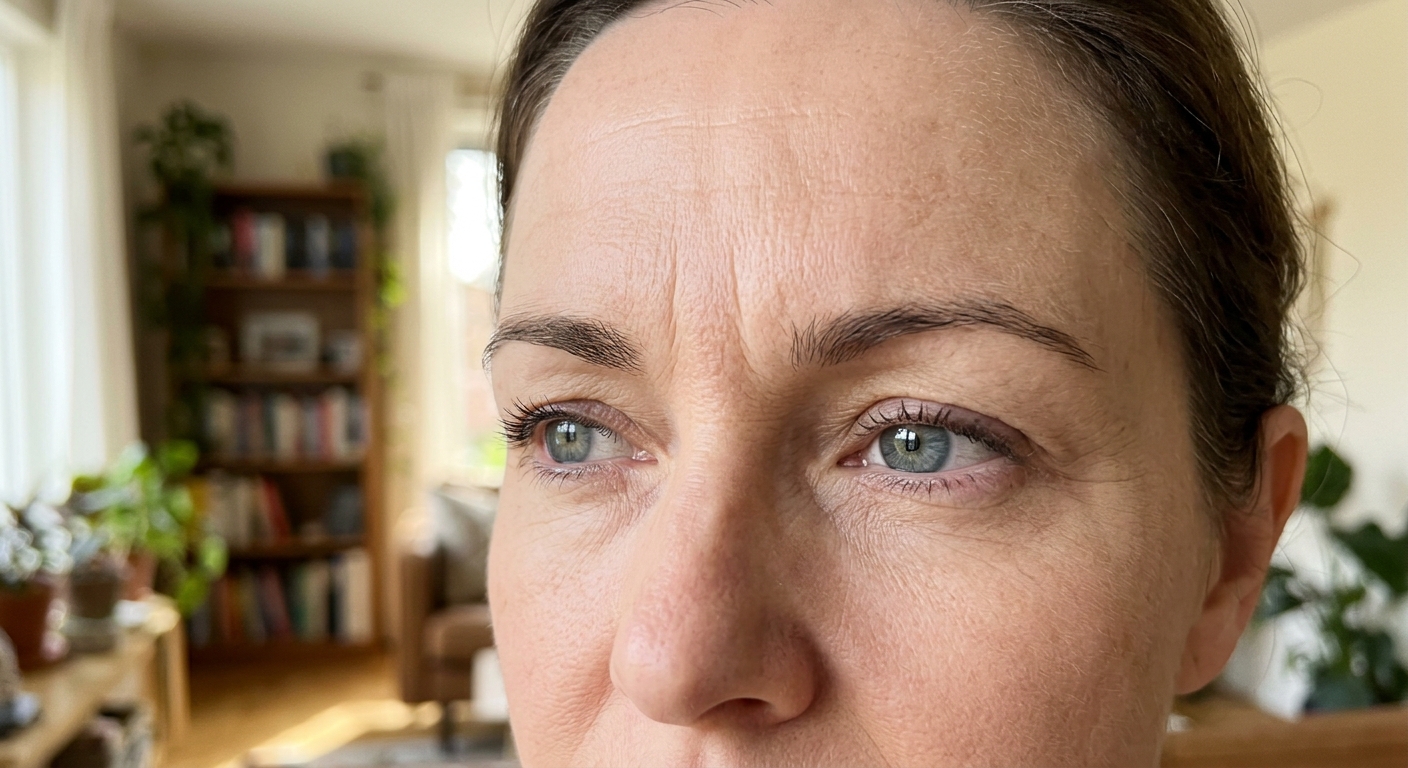
Here is where expectations quietly go wrong. Neurotoxins treat dynamic wrinkles — the ones caused by muscle movement, like frown lines, forehead lines, and crow’s feet. Freeze the muscle, and the fold it creates relaxes.
But not every line comes from a muscle. Static wrinkles — the ones etched into your skin that stay put even when your face is completely relaxed — come from something else entirely: the breakdown of collagen and elastin, sun damage, and the slow thinning of the skin over years. Xeomin does nothing for those. It also does nothing for crepey texture, dullness, enlarged pores, or the general loss of firmness that makes skin look older. Inject a neurotoxin into a deep, long-standing static line and you may soften it slightly by relaxing the muscle pulling on it, but the etched crease remains, because the problem is in the skin, not the muscle. Understanding the difference between the two kinds of lines is the single most useful thing you can know before treating your frown lines.
Skin collagen declines by roughly 1% per year throughout adult life , and as that structural scaffolding thins, the skin loses its ability to bounce back from folding.
Why static wrinkles keep forming
The engine behind static wrinkles is collagen loss. Skin collagen declines by roughly 1% per year throughout adult life [4], and as that structural scaffolding thins, the skin loses its ability to bounce back from folding. Repeated expressions carve lines that, over years, no longer smooth out on their own. A neurotoxin can slow the deepening of a movement-driven line by limiting the movement — that is the real logic behind starting early — but it cannot rebuild the collagen that is already gone, and it does nothing for lines that were never muscle-driven to begin with.
That rebuilding is a skincare job, and it runs on a completely different mechanism from anything in a syringe.
The other half of the plan
The most evidence-backed way to rebuild collagen in the skin is a retinoid. In a controlled study of naturally aged skin, topical retinol increased collagen and improved fine wrinkling by prompting the skin to produce more of its own structural protein [5] — precisely the static-wrinkle lever a neurotoxin can’t reach. This is why dermatologists so often pair the two: the injectable calms the movement that creates lines, while a retinoid works underneath to strengthen the skin and soften the lines already there. If you want the mechanism in depth, we cover whether and does retinol reduce wrinkles in its own article.
The long-standing obstacle with conventional retinol is delivery: traditional formulas partly break down the skin barrier to get in, which is why they so often burn, redden, and peel — and why many people quit before seeing results. Nanoretinol was engineered around that problem. It carries a stabilized 0.2% retinol inside biomimetic lipid nanoparticles that the skin recognizes as “self” and admits without barrier damage, so the active reaches the collagen-building cells gently. Because delivery efficiency rather than concentration is the true limiter, that low percentage outperforms harsher formulas: North Biomedical’s clinical study recorded 232% greater collagen recovery than conventional retinol, alongside markedly less cellular irritation.
So Xeomin and a well-delivered retinoid are not rivals — they solve different halves of the same face. The toxin relaxes the muscle; the retinoid rebuilds the skin.
The takeaway worth keeping
Xeomin is a legitimate, effective, impressively pure option in the neurotoxin category, and its protein-free design gives it a credible edge for anyone thinking in decades rather than months. Just go in clear-eyed about what it treats. It relaxes the lines your muscles make. It does nothing for the lines your skin makes on its own — and for those, the work happens not in the injector’s chair but in your nightly routine.
References
- Martin MU, Frevert J, Tay CM. “Complexing Protein-Free Botulinum Neurotoxin A Formulations: Implications of Excipients for Immunogenicity.” Toxins (Basel). 2024;16(2):101. doi:10.3390/toxins16020101
- Sattler G, Callander MJ, Grablowitz D, et al. “Noninferiority of incobotulinumtoxinA, free from complexing proteins, compared with another botulinum toxin type A in the treatment of glabellar frown lines.” Dermatologic Surgery. 2010;36(Suppl 4):2146-2154. doi:10.1111/j.1524-4725.2010.01706.x
- Kerscher M, Fabi S, Fischer T, et al. “IncobotulinumtoxinA Demonstrates Safety and Prolonged Duration of Effect in a Dose-Ranging Study for Glabellar Lines.” Journal of Drugs in Dermatology. 2020;19(10):985-991. doi:10.36849/JDD.2020.5454
- Shuster S, Black MM, McVitie E. “The influence of age and sex on skin thickness, skin collagen and density.” British Journal of Dermatology. 1975;93(6):639-643. doi:10.1111/j.1365-2133.1975.tb05113.x
- Kafi R, Kwak HS, Schumacher WE, et al. “Improvement of naturally aged skin with vitamin A (retinol).” Archives of Dermatology. 2007;143(5):606-612. doi:10.1001/archderm.143.5.606