Azelaic Acid vs Niacinamide: Which One Your Skin Actually Needs
Two gentle actives aimed at the same complaints, working from opposite ends of the same problem
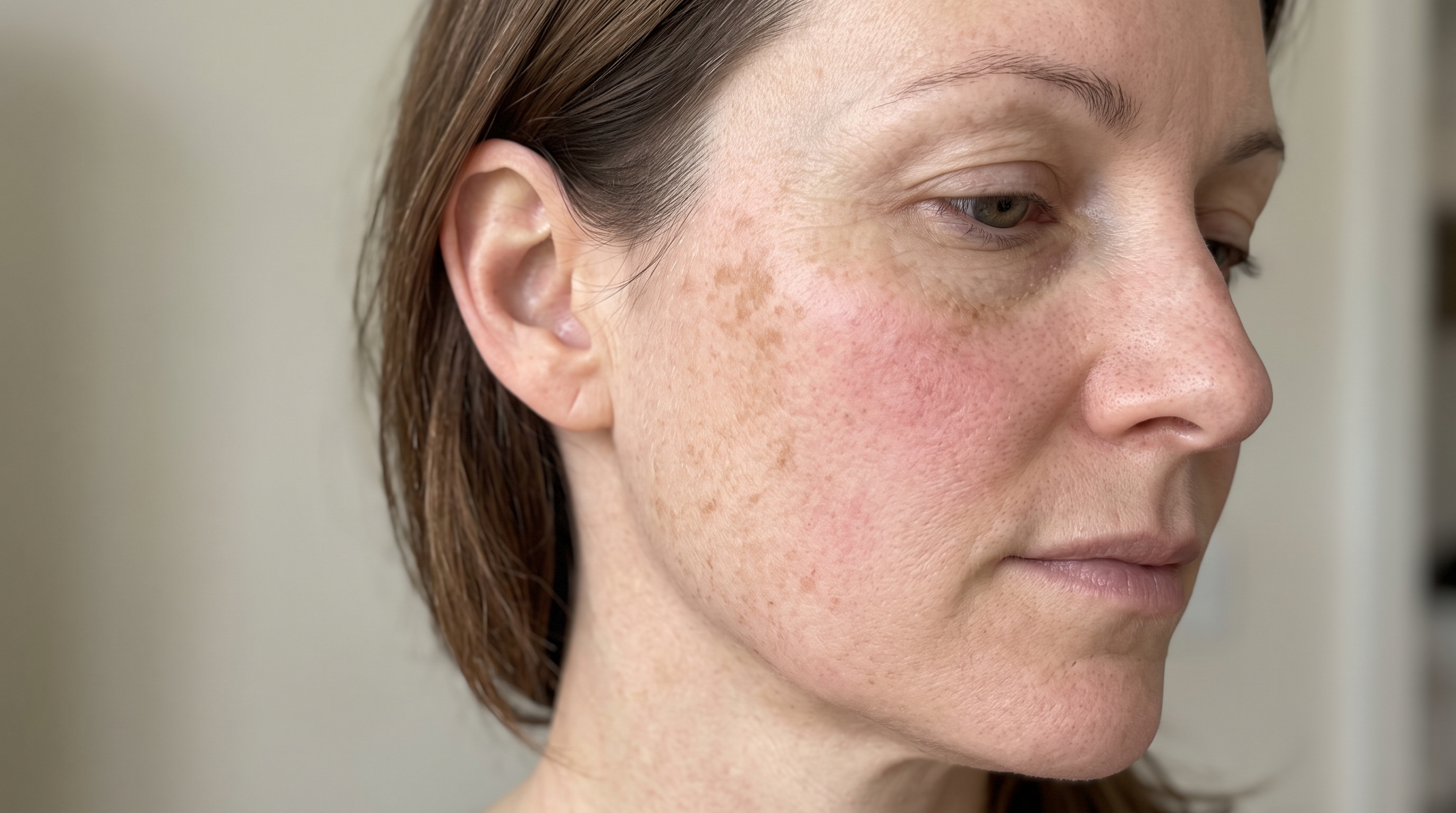
These two get recommended for the same three complaints — brown patches, persistent redness, and a complexion that reads uneven in daylight — which is why they end up compared. The comparison is useful, but not for the reason most articles suggest. They are not two versions of the same tool. They intervene at opposite ends of the same process, and once you see where each one cuts in, the question of which to buy mostly answers itself.
Pigment is a relay. A melanocyte manufactures melanin, packages it into melanosomes, and hands those packages off to the keratinocytes that will carry them up to the surface and make the discoloration visible. Azelaic acid interferes at the factory. Niacinamide interferes at the handoff.
Azelaic acid works upstream, on the melanocyte
Azelaic acid is a dicarboxylic acid that acts as a competitive inhibitor of tyrosinase, the rate-limiting enzyme in melanin synthesis. The more interesting part of its mechanism sits one level deeper: it is a far more potent inhibitor of thioredoxin reductase, an enzyme that regulates tyrosinase by feedback, with an inhibition constant roughly two hundred times lower than for tyrosinase itself [1].
That detail explains the behavior people find surprising in practice. Azelaic acid tends to act on hyperactive melanocytes and leave normally functioning ones alone, which is why it does not lighten surrounding skin the way a general bleaching agent does.
Azelaic acid does not lighten your whole face, because it acts on the melanocytes that are misbehaving and largely ignores the ones that are not.
The clinical record is solid. In a 24-week double-blind trial of 329 women with melasma, 20% azelaic acid produced good or excellent results in 65% of patients, with no significant difference from 4% hydroquinone and no sensitization or ochronosis [2]. That trial was run by the manufacturer, so treat it as supportive rather than independent. The stronger evidence is a vehicle-controlled study in Fitzpatrick types IV to VI, where 24 weeks of 20% azelaic acid beat vehicle on both investigator scoring and objective chromometer measurement, with mild burning and stinging as the trade-off [3].
Azelaic acid also does something niacinamide does not do at all. At 15%, it inhibits kallikrein-5 in keratinocytes and downregulates the KLK5, TLR-2 and cathelicidin signalling cascade [4]. That is a named molecular pathway for calming the inflammatory flush that sits behind persistent facial redness, and it is the reason azelaic acid appears in redness protocols while niacinamide mostly does not.
Niacinamide works downstream, on the delivery
Niacinamide takes a completely different route to the same visible result. It has no meaningful effect on tyrosinase and does not suppress melanin production. Instead it blocks the transfer of finished melanosomes from the melanocyte to the surrounding keratinocytes — measured at 35% to 68% inhibition — so pigment that has already been manufactured never reaches the cells that would display it [5].
Melanin that is never delivered looks exactly the same as melanin that was never made, which is why these two ingredients reach one result by opposite routes. The routes are not interchangeable, and that matters when one of them stops working for you.
In a split-face trial of 27 melasma patients, 4% niacinamide produced a 62% reduction in pigment scoring against 70% for 4% hydroquinone, with side effects in 18% of patients versus 29% [6]. That is a modest efficacy gap bought with a meaningful tolerability gain.
Niacinamide’s second job has no equivalent on the azelaic side. In cultured keratinocytes it raised ceramide biosynthesis four to five-fold and increased serine palmitoyltransferase, the rate-limiting enzyme in sphingolipid production, and applied topically it raised stratum corneum ceramide levels and reduced water loss [7]. It is a barrier-building ingredient that happens to also address pigment. And on appearance endpoints, vehicle-controlled facial studies at 5% showed reductions in hyperpigmented spots, fine lines, red blotchiness and sallowness [8].
Five percent is the number worth holding onto. It generated most of the controlled facial evidence, and the marketing climb toward 10% and beyond buys irritation risk faster than it buys proven benefit. Our full guide to niacinamide benefits covers the concentration question in more detail, as does our overview of azelaic acid for skin.
So which one
If your primary complaint is persistent redness or flushing, azelaic acid is the clear answer, because it has a documented anti-inflammatory mechanism and niacinamide does not.
If your primary complaint is stubborn brown patches — particularly melasma — both work, and the deciding factor is tolerability. Azelaic acid at 15% to 20% is the stronger pigment intervention and the more irritating one. Niacinamide at 5% is slower, gentler, and safe to use indefinitely.
If your barrier is already compromised, reactive, or recovering from something else, start with niacinamide regardless of what else is going on.
Start with niacinamide if your skin already reacts to everything, because building lipids first makes every active you add afterward easier to tolerate.
And if you are choosing between the two purely on cost and want the widest coverage, niacinamide does more jobs. Azelaic acid does one job better. The deeper treatment landscape for pigment sits in our guides to hyperpigmentation treatment and niacinamide vs retinol.
Using both
There is no formulation conflict here. They act on different cells through different enzymes, and the mechanisms are complementary rather than redundant: azelaic acid reduces how much pigment gets made, niacinamide reduces how much of it gets delivered. Blocking a relay at two points is genuinely additive in a way that stacking two tyrosinase inhibitors is not.
The practical constraint is irritation, not chemistry. Azelaic acid stings on application for many people, and adding a second active on day one makes it impossible to tell which product caused what. Introduce niacinamide first, give it two weeks, then add azelaic acid at night two or three times a week and build up.
The thing neither one is doing
Both of these ingredients work in and just below the epidermis. Neither instructs a fibroblast to produce collagen, and neither has a meaningful effect on the dermal scaffold whose slow thinning produces lines, laxity and loss of firmness. If your tone improves and your face still looks tired, that is why — you fixed the color of the surface, not the structure underneath it.
The evidence for actually rebuilding that structure sits with the retinoids, and it is not a close contest. Type I collagen formation is 56% lower in photodamaged skin than in protected skin, and topical tretinoin produced an 80% increase in collagen I formation against a 14% decrease on vehicle [9]. Over-the-counter retinol does the same kind of work on naturally aged skin, raising procollagen I and glycosaminoglycan expression in a randomized vehicle-controlled trial [10].
The reason so many people who use azelaic acid and niacinamide have quietly abandoned retinol is not that it failed. It is that conventional retinol formulations have to disrupt the skin barrier to push the molecule through, which produces exactly the burning and peeling those two ingredients were bought to calm. Spending on niacinamide to build ceramides while spending on a retinol that strips them is a contradiction a lot of routines are quietly carrying.
Nanoretinol was built to remove it. The 0.2% retinol is encapsulated in biomimetic lipid nanoparticles that are externally similar to skin cells, so the body recognizes them as “self” and permits passage through the epithelial barrier without compromising it. North Biomedical’s clinical study found it 232% more effective than conventional retinol in collagen recovery and 73% more effective in elastin recovery, with a 61% increase in firmness and a 56% increase in elasticity over 56 days. It is water-based, 99% natural ingredients, and suitable for sensitive skin, which makes it layerable with both of the ingredients this article is about.
Picking Your Starting Point
Redness points to azelaic acid. A damaged or reactive barrier points to niacinamide. Stubborn pigment points to either, decided by how much irritation you are willing to absorb. Lines and slackness point somewhere neither of them reaches. The common mistake is not choosing wrong between these two — it is expecting one of them to solve a problem that lives three layers down.
References
- Schallreuter KU, Wood JW. “A possible mechanism of action for azelaic acid in the human epidermis.” Archives of Dermatological Research. 1990;282(3):168-171. doi:10.1007/BF00372617
- Baliña LM, Graupe K. “The treatment of melasma. 20% azelaic acid versus 4% hydroquinone cream.” International Journal of Dermatology. 1991;30(12):893-895. doi:10.1111/j.1365-4362.1991.tb04362.x
- Lowe NJ, Rizk D, Grimes P, Billips M, Pincus S. “Azelaic acid 20% cream in the treatment of facial hyperpigmentation in darker-skinned patients.” Clinical Therapeutics. 1998;20(5):945-959. doi:10.1016/S0149-2918(98)80076-3
- Coda AB, Hata T, Miller J, Audish D, Kotol P, Two A, Shafiq F, Yamasaki K, Harper JC, Del Rosso JQ, Gallo RL. “Cathelicidin, kallikrein 5, and serine protease activity is inhibited during treatment of rosacea with azelaic acid 15% gel.” Journal of the American Academy of Dermatology. 2013;69(4):570-577. doi:10.1016/j.jaad.2013.05.019
- Hakozaki T, Minwalla L, Zhuang J, Chhoa M, Matsubara A, Miyamoto K, Greatens A, Hillebrand GG, Bissett DL, Boissy RE. “The effect of niacinamide on reducing cutaneous pigmentation and suppression of melanosome transfer.” British Journal of Dermatology. 2002;147(1):20-31. doi:10.1046/j.1365-2133.2002.04834.x
- Navarrete-Solís J, Castanedo-Cázares JP, Torres-Álvarez B, Oros-Ovalle C, Fuentes-Ahumada C, González FJ, Martínez-Ramírez JD, Moncada B. “A double-blind, randomized clinical trial of niacinamide 4% versus hydroquinone 4% in the treatment of melasma.” Dermatology Research and Practice. 2011;2011:379173. doi:10.1155/2011/379173
- Tanno O, Ota Y, Kitamura N, Katsube T, Inoue S. “Nicotinamide increases biosynthesis of ceramides as well as other stratum corneum lipids to improve the epidermal permeability barrier.” British Journal of Dermatology. 2000;143(3):524-531. doi:10.1111/j.1365-2133.2000.03705.x
- Bissett DL, Oblong JE, Berge CA. “Niacinamide: A B vitamin that improves aging facial skin appearance.” Dermatologic Surgery. 2005;31(7 Pt 2):860-865. PMID:16029679
- Griffiths CE, Russman AN, Majmudar G, Singer RS, Hamilton TA, Voorhees JJ. “Restoration of collagen formation in photodamaged human skin by tretinoin (retinoic acid).” New England Journal of Medicine. 1993;329(8):530-535. doi:10.1056/NEJM199308193290803
- Kafi R, Kwak HS, Schumacher WE, Cho S, Hanft VN, Hamilton TA, King AL, Neal JD, Varani J, Fisher GJ, Voorhees JJ, Kang S. “Improvement of naturally aged skin with vitamin A (retinol).” Archives of Dermatology. 2007;143(5):606-612. doi:10.1001/archderm.143.5.606