Best Tinted Moisturizer for Mature Skin: Why Less Coverage Reads as More
The optical reasons sheer tint flatters skin that full-coverage foundation exposes, and how to choose one
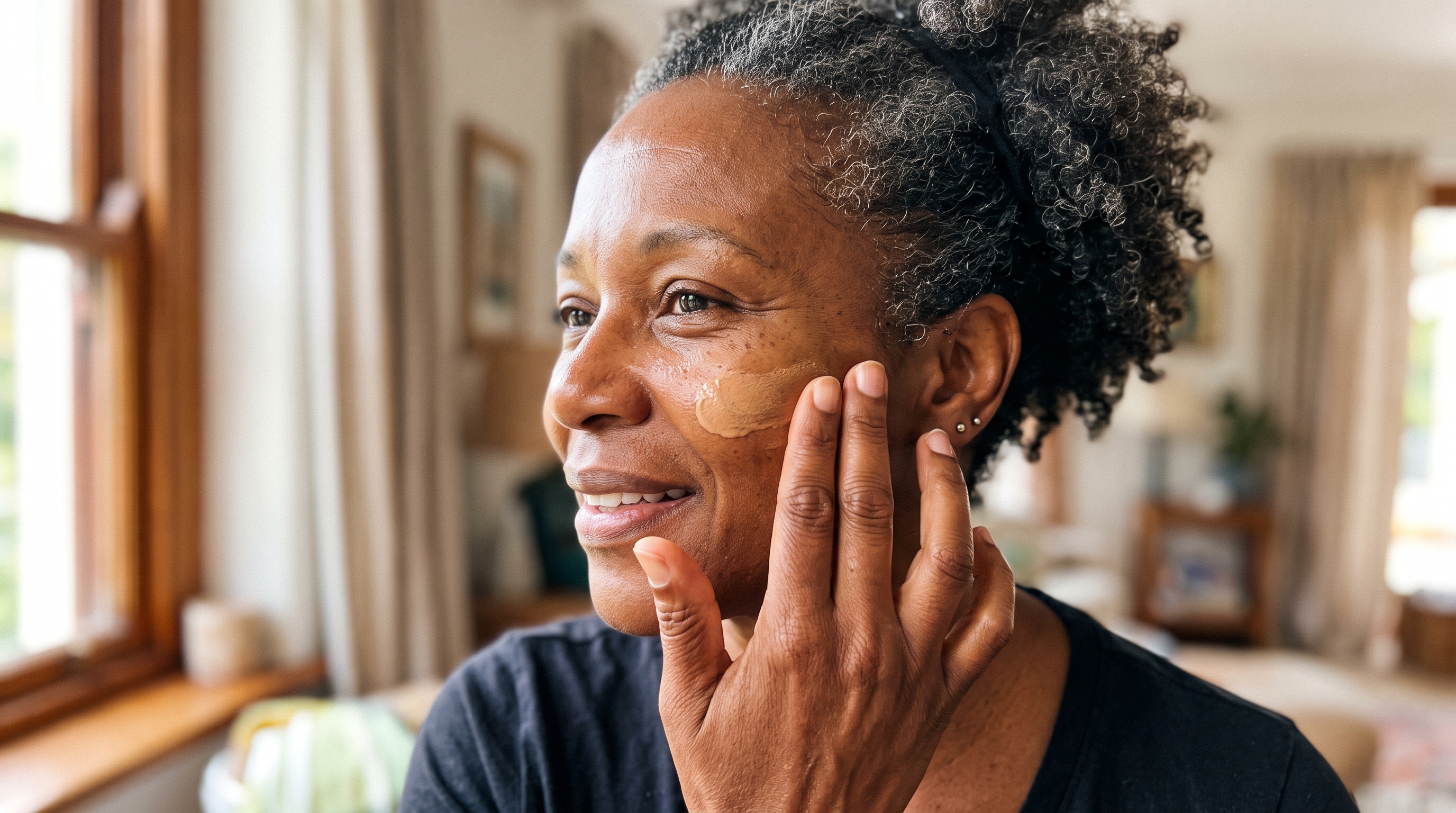
Somewhere in the mid-fifties, a lot of women notice that the foundation they have worn happily for a decade has turned on them. Same shade, same brand, same application. It now sits in the fine lines around the mouth by mid-morning and leaves a faint chalky cast in photographs that was never there before.
The usual response is to hunt for a better foundation. The more useful response is to ask what changed underneath it, because the honest answer points toward a different product category altogether.
Aging skin stopped reflecting light the way it used to
Skin has a microscopic surface texture, a network of fine intersecting furrows called the microrelief. It works like a diffuser. Light hits it, scatters in many directions at once, and the eye reads that even scatter as smoothness.
That network coarsens with time. Researchers measuring skin surface topography across age groups found that roughness parameters and the directional organization of the microrelief both changed significantly with age, with the developed surface area and the peak-to-trough amplitude increasing in older skin [1]. The furrows get deeper and less evenly distributed.
Deeper furrows cast small shadows. A heavily pigmented product laid over that surface fills some furrows and rides across others, and the result is the settled, uneven look that usually gets blamed on the formula.
Hydration is doing more optical work than pigment
There is a second variable that gets almost no attention on a product page. How much water sits in the stratum corneum changes how light behaves at the surface.
A study measuring the appearance effects of moisturization found that hydrating the stratum corneum reduced surface light scattering and increased light penetration and translucency into the skin [2]. Well-hydrated skin lets a little light in rather than bouncing all of it straight back. That is the physical basis of what everyone calls glow.
This is the entire argument for tinted moisturizer over foundation on mature skin. A tinted moisturizer is a hydrating base carrying a small pigment load, so it improves the optics of the skin itself while adding just enough color to even out tone. Foundation is mostly pigment suspended in a film, and it works by covering those optics rather than improving them.
A formula engineered for skin that produces more oil now has nothing to work with, so it sets harder and faster.
Menopause changed the surface it has to sit on
The third variable is oil, and it moves in the direction most people do not expect.
Researchers comparing postmenopausal women with and without hormone replacement found that sebum excretion declined significantly during the first decade after menopause in the untreated group, while women receiving replacement therapy were largely spared that drop [3].
Less surface oil means less of the natural emollience that used to keep a base flexible through the day. A formula engineered for skin that produces more oil now has nothing to work with, so it sets harder and faster. A hard film on a face that talks, smiles and squints will crack along the lines of movement every time.
That is why emollient ratio deserves more of your attention than shade range.
The protection nobody buys it for
There is one more reason tinted products earn their place, and it has nothing to do with appearance.
Sunscreen filters are built for ultraviolet. Visible light is a separate problem. In a clinical and histological study, exposure to blue-violet visible light near 415 nanometers produced more intense and more persistent pigmentation than UVB exposure did, with the pigmentation still detectable up to three months later [4].
Conventional sunscreen does very little about that. Iron oxides do. A controlled study in skin of color found that a tinted, iron-oxide-containing formulation protected against visible-light-induced pigmentation significantly better than a non-tinted sunscreen rated SPF 50 or higher [5]. Iron oxides are, for the most part, what makes a tinted product tinted.
Tinted moisturizers are almost never applied at the density their SPF rating was tested at.
A tinted moisturizer worn daily is therefore doing quiet pigmentation defense that an untinted product cannot, which matters a great deal if uneven tone is already on your list.
How to actually choose one
Test the emollient ratio on the back of your hand. Put a small amount down and leave it alone for ten minutes. If it turns matte and slightly tight, it is too film-forming for skin that no longer produces much oil. You want it still faintly movable under a fingertip.
Judge pigment load at the edges. Sheer a small amount down to nothing at its boundary. A well-built tint fades out invisibly. A poorly built one leaves a visible line, and that line is exactly what will appear at your jaw and hairline by lunchtime.
Take any SPF claim seriously but separately. Tinted moisturizers are almost never applied at the density their SPF rating was tested at. Treat the SPF in a tint as a bonus on top of a real sunscreen step rather than a replacement for one. Our guide to SPF under makeup covers the sequencing.
Do not chase coverage. If the thing you want covered is texture rather than tone, more pigment makes it worse, for the reason in the first section. If it genuinely is tone, foundation for mature skin is the more honest category for the job.
Apply it to skin that is already hydrated. Since hydration is doing part of the optical work, the same tint performs visibly better over a properly moisturized face than over bare skin. Order matters, and our mature skin care routine guide lays out the full sequence.
Step up a level if you need more than sheer. A beauty balm sits between a tinted moisturiser and a foundation, and our guide to the best BB cream for mature skin explains when that extra weight is worth it.
Where the makeup argument runs out
Every rule above manages a surface more gracefully. None of them change it.
The microrelief coarsens because the dermis beneath it is losing the collagen that keeps it taut and evenly tensioned. That is a structural problem, and topical retinol remains the most studied answer to it. In a randomized, double-blind, vehicle-controlled trial in naturally aged skin, topical retinol significantly improved fine wrinkles compared with vehicle and increased glycosaminoglycan and collagen production in the dermis [6].
The obstacle has always been delivery. Conventional retinol penetrates the epithelial barrier poorly, and many formulations rely on chemicals and petroleum derivatives that break that barrier down in order to get through. The redness and peeling people associate with retinol start there.
Nanoretinol was built around that obstacle. It encapsulates 0.2 percent retinol in biomimetic lipid nanoparticles that the skin recognizes as self and allows through intact, so nothing has to be damaged to deliver the active. In North Biomedical’s study it proved 232 percent more effective than conventional retinol at collagen recovery and 73 percent more effective at elastin recovery, with drastically reduced cytotoxicity. It is water-based, suits sensitive skin, and is safe to use on the eye contour.
Buying for the skin you have now
Pick the lightest coverage that resolves your actual complaint, and be honest with yourself about whether that complaint is tone or texture. Tone answers to pigment. Texture answers to what is happening several layers down, and no amount of coverage has ever settled that argument.
Then judge the product the way you will actually wear it. Not on the back of your hand in a bright shop, but at five in the afternoon, in indirect daylight, on a face that has been living all day.
References
- Lagarde JM, Rouvrais C, Black D. “Topography and Anisotropy of the Skin Surface with Ageing.” Skin Research and Technology. 2005;11(2):110-119. doi:10.1111/j.1600-0846.2005.00096.x
- Jiang ZX, DeLaCruz J. “Appearance Benefits of Skin Moisturization.” Skin Research and Technology. 2011;17(1):51-55. doi:10.1111/j.1600-0846.2010.00462.x
- Piérard-Franchimont C, Piérard GE. “Postmenopausal Aging of the Sebaceous Follicle: A Comparison between Women Receiving Hormone Replacement Therapy or Not.” Dermatology. 2002;204(1):17-22. doi:10.1159/000051804
- Duteil L, Cardot-Leccia N, Queille-Roussel C, Maubert Y, Harmelin Y, Boukari F, Ambrosetti D, Lacour JP, Passeron T. “Differences in Visible Light-Induced Pigmentation According to Wavelengths: A Clinical and Histological Study in Comparison with UVB Exposure.” Pigment Cell & Melanoma Research. 2014;27(5):822-826. doi:10.1111/pcmr.12273
- Dumbuya H, Grimes PE, Lynch S, Ji K, Brahmachary M, Zheng Q, Bouez C, Wangari-Talbot J. “Impact of Iron-Oxide Containing Formulations Against Visible Light-Induced Skin Pigmentation in Skin of Color Individuals.” Journal of Drugs in Dermatology. 2020;19(7):712-717. doi:10.36849/JDD.2020.5032
- Kafi R, Kwak HS, Schumacher WE, Cho S, Hanft VN, Hamilton TA, King AL, Neal JD, Varani J, Fisher GJ, Voorhees JJ, Kang S. “Improvement of Naturally Aged Skin with Vitamin A (Retinol).” Archives of Dermatology. 2007;143(5):606-612. doi:10.1001/archderm.143.5.606