Best Eye Cream for Hooded Eyes: What a Cream Can Actually Change
The honest line between the hooding a topical can improve and the hooding it cannot
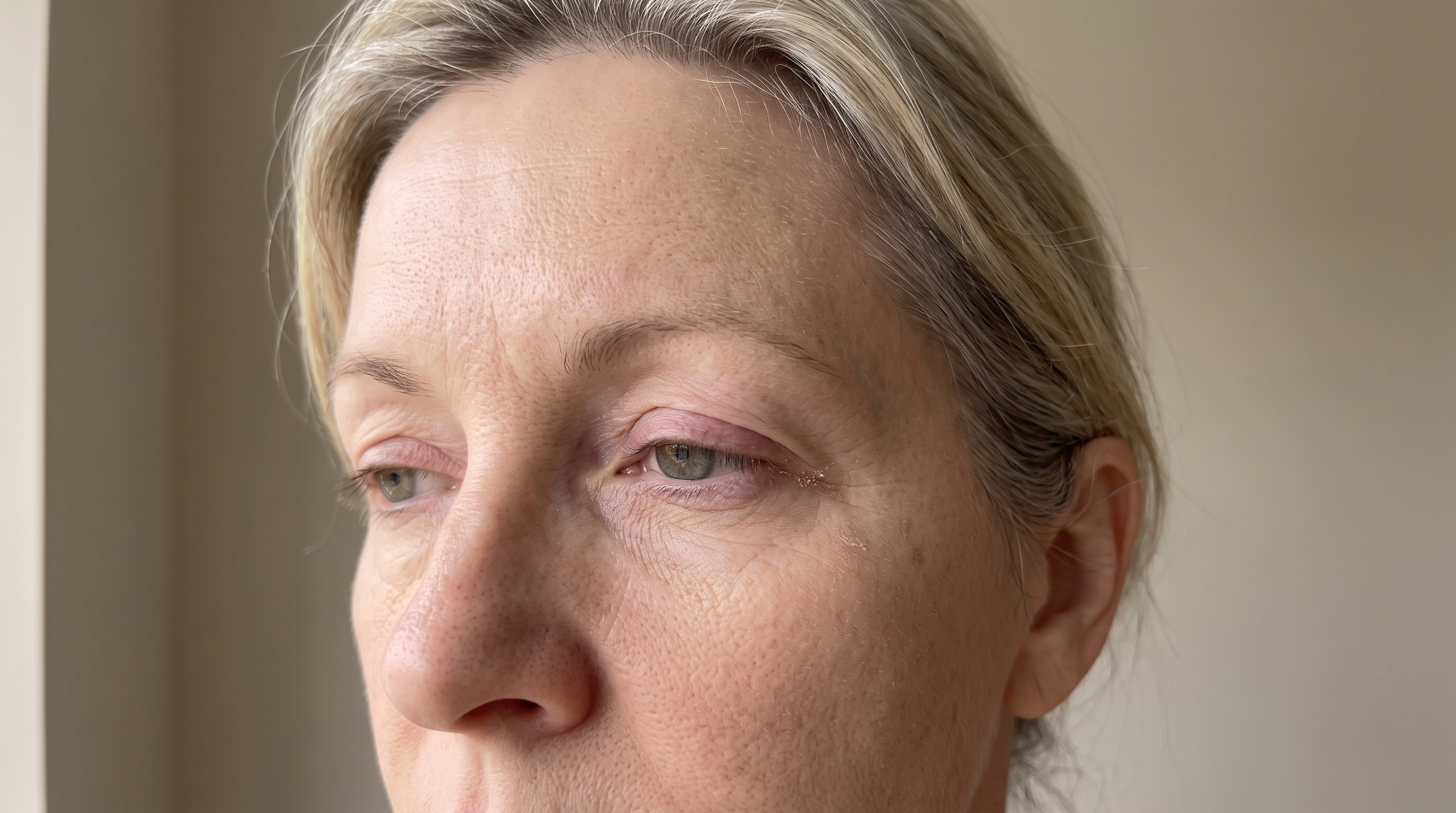
Search for an eye cream for hooded eyes and you will be shown a wall of products promising a lift. Some show a before and after where an eyelid has visibly retracted. Setting expectations honestly at the start saves a lot of money: no topical cream lifts a hooded lid, because a meaningful part of what you are looking at is bone and connective tissue rather than skin.
That is not an argument against buying anything. It is an argument for knowing exactly which part of the problem a cream can reach, then buying for that part and ignoring the rest of the marketing.
Two Problems Wearing the Same Name
“Hooding” describes an appearance, not a mechanism, and at least two separate processes produce it.
The first is structural. A three-dimensional CT study of sixty subjects found that the bony orbit itself remodels with age, with the orbital aperture widening and increasing in area and the rim receding asymmetrically [1]. As the bone that supports the eyelid changes shape, the brow descends and the soft tissue above the eye has further to fall. Add laxity in the orbital septum, which allows fat to shift forward, and you get a fold that rests on the lash line. Nothing applied to the skin surface reverses any of that.
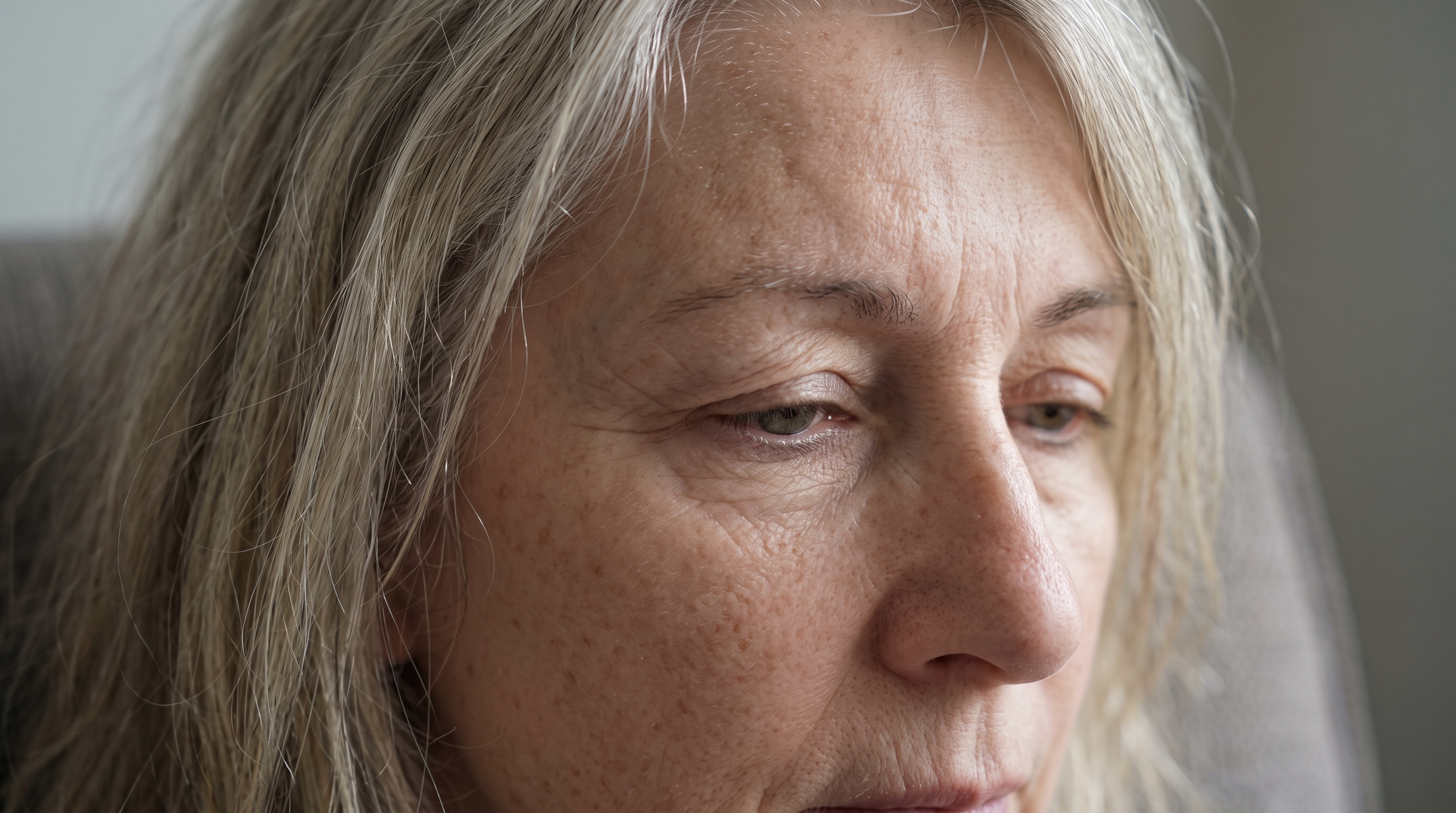
The second process is dermal. The skin of the upper lid thins, loses collagen and elastic support, and develops a fine crepe that catches light and reads as extra bulk and shadow. That part is skin quality, and skin quality does respond to topical treatment. Our broader guide to hooded eyes covers how the two combine as the face ages.
Ultraviolet exposure accelerates it: photodamaged skin has been measured producing 56% less type I collagen than sun-protected skin from the same individuals.
The useful question when you look in the mirror is whether the fold is still there when you gently lift your brow with a fingertip. If it mostly disappears, you are looking at brow descent and structure. If the skin still looks loose and finely lined at the lid margin, that is the part a cream has some purchase on.
The Thinnest Skin You Own
The eyelid is not merely thin in a figurative sense. When researchers biopsied thirty-nine facial subunits from ten cadaver heads, the upper medial eyelid returned the thinnest dermis on the entire face at 758.9 micrometres, against 1,969.2 micrometres at the thickest site, the lower nasal sidewall [2].
That measurement explains almost everything about periorbital skincare. A vehicle designed to push an active through the far thicker skin of the cheek is often too aggressive here, which is why people who tolerate an active elsewhere abandon it around the eyes within a fortnight. It also explains why lid skin shows collagen loss earlier and more visibly than anywhere else, since there is far less dermis to lose before the change becomes obvious.
What Is Actually Thinning
Skin collagen declines steadily from early adulthood. The classic quantitative study of skin thickness and collagen density across 148 adults established the age-linked decline that is usually summarised as roughly one percent a year [3]. Ultraviolet exposure accelerates it: photodamaged skin has been measured producing 56% less type I collagen than sun-protected skin from the same individuals [4].
On the upper lid, that loss has an outsized visual cost. Lose a proportion of a thin dermis and the surface stops sitting taut, the fine crosshatched lines deepen, and light that once reflected evenly now scatters. A lid that has lost tone reads as heavier even when the underlying anatomy has not moved. This is the same process behind ordinary eyelid wrinkles, just concentrated where it shows most.
Its 0.2% retinol travels inside biomimetic lipid nanoparticles that the skin reads as self and lets through the epithelial barrier intact, so nothing has to be stripped for the active to arrive.
What Each Ingredient Class Can Honestly Do
Retinoids have the strongest evidence by a wide margin. In the trial that established the mechanism, ten to twelve months of topical tretinoin produced an 80% increase in type I collagen formation in photodamaged skin, against a 14% decrease under vehicle alone [4]. That is a structural change in the dermis rather than a cosmetic one. A twelve-week trial of a retinoid eye cream formulated specifically for the periorbital region reported significant improvement in fine to moderate lines with acceptable tolerability [5], which is the important proof that the eye area is treatable when the formulation is built for it.
Peptides are real but smaller. Acetyl hexapeptide, marketed as Argireline, reduced wrinkle depth by up to 30% over thirty days in the study that launched it [6]. That is a genuine effect and a useful one, and it is a different order of magnitude from an 80% increase in collagen synthesis. Peptide-led eye creams are a reasonable choice for someone who cannot tolerate anything stronger, rather than a superior one.
Caffeine works on circulation. Reviews of its cosmetic use describe formulations around 3% increasing microcirculation in the skin [7], which can genuinely reduce morning puffiness. Puffiness reduction can make a lid look marginally less heavy for a few hours. It does not touch the dermis, and no vasoconstrictor has ever lifted anything.
How to Buy
Given all of that, a short list of what matters. Look for a retinoid as the primary active if your skin will accept one, since it is the only class with dermal remodelling evidence behind it. Prioritise the delivery system over the headline percentage, because on lid skin the vehicle decides whether you can keep using the product at all. Treat peptides and caffeine as sensible supporting players rather than the main event. And be sceptical of any product photographed with a visibly retracted lid, since that outcome belongs to a surgeon.
Set a twelve-week horizon. Collagen remodelling does not produce a visible result in a fortnight, and most people quit an eye product long before it has had a chance to work.
Where Nanoretinol Fits
The recurring failure in this category is tolerability. Conventional retinol formulations reach the living skin by disturbing the barrier with solvents and petroleum derivatives, and on skin under 800 micrometres thick that approach produces the stinging, redness, and flaking that ends most people’s attempt at a retinol eye routine. Our guide to using retinol around the eyes covers the usual workarounds.
Nanoretinol was built around the delivery problem rather than around the molecule. Its 0.2% retinol travels inside biomimetic lipid nanoparticles that the skin reads as self and lets through the epithelial barrier intact, so nothing has to be stripped for the active to arrive. In testing it proved 232% more effective than conventional retinol at collagen recovery and 73% more effective at elastin recovery, with drastically reduced cytotoxicity, and the water-based gel formula is suitable for the eye contour. For the dermal half of hooding, that combination is the whole argument: an active with real remodelling evidence, in a vehicle thin lid skin will actually accept night after night.
Setting Expectations
An eye cream for hooded eyes is worth buying if you understand what you are buying it for. Firmer, smoother, better-supported lid skin is achievable, and on a lid where the hood is largely a skin-quality problem it makes a visible difference over a few months. A structural hood driven by brow descent and orbital change is a different conversation, and no amount of cream will settle it. Knowing which one you have before you spend is the single most useful thing in this article.
References
- Kahn DM, Shaw RB Jr. “Aging of the Bony Orbit: A Three-Dimensional Computed Tomographic Study.” Aesthetic Surgery Journal. 2008;28(3):258-264. doi:10.1016/j.asj.2008.02.007
- Chopra K, Calva D, Sosin M, Tadisina KK, Banda A, De La Cruz C, Chaudhry MR, Legesse T, Drachenberg CB, Manson PN, Christy MR. “A Comprehensive Examination of Topographic Thickness of Skin in the Human Face.” Aesthetic Surgery Journal. 2015;35(8):1007-1013. doi:10.1093/asj/sjv079
- Shuster S, Black MM, McVitie E. “The Influence of Age and Sex on Skin Thickness, Skin Collagen and Density.” British Journal of Dermatology. 1975;93(6):639-643. doi:10.1111/j.1365-2133.1975.tb05113.x
- Griffiths CEM, Russman AN, Majmudar G, Singer RS, Hamilton TA, Voorhees JJ. “Restoration of Collagen Formation in Photodamaged Human Skin by Tretinoin (Retinoic Acid).” New England Journal of Medicine. 1993;329(8):530-535. doi:10.1056/NEJM199308193290803
- Kaufman J, Callender V, Young C, Jones P, Wortzman M, Nelson D. “Efficacy and Tolerability of a Retinoid Eye Cream for Fine to Moderate Wrinkles of the Periorbital Region.” Journal of Drugs in Dermatology. 2022;21(9):932-937. doi:10.36849/JDD.6815
- Blanes-Mira C, Clemente J, Jodas G, Gil A, Fernández-Ballester G, Ponsati B, Gutierrez L, Pérez-Payá E, Ferrer-Montiel A. “A Synthetic Hexapeptide (Argireline) with Antiwrinkle Activity.” International Journal of Cosmetic Science. 2002;24(5):303-310. doi:10.1046/j.1467-2494.2002.00153.x
- Herman A, Herman AP. “Caffeine’s Mechanisms of Action and Its Cosmetic Use.” Skin Pharmacology and Physiology. 2013;26(1):8-14. doi:10.1159/000343174