Hooded Eyes Makeup: How to Work With a Lid That Has Descended
Why the crease rule you were taught disappears on a hooded eye, and what to do instead
You spend ten minutes blending three shades across your eyelid. It looks beautiful in the mirror while you are looking down at yourself. Then you open your eyes and the entire thing has vanished, folded away under a flap of skin, leaving a smudge of colour on your brow bone and nothing where you wanted it.
This is the defining frustration of a hooded eye, and almost every tutorial makes it worse, because almost every tutorial was written for a lid that stays visible when the eye is open.
What a hood actually is
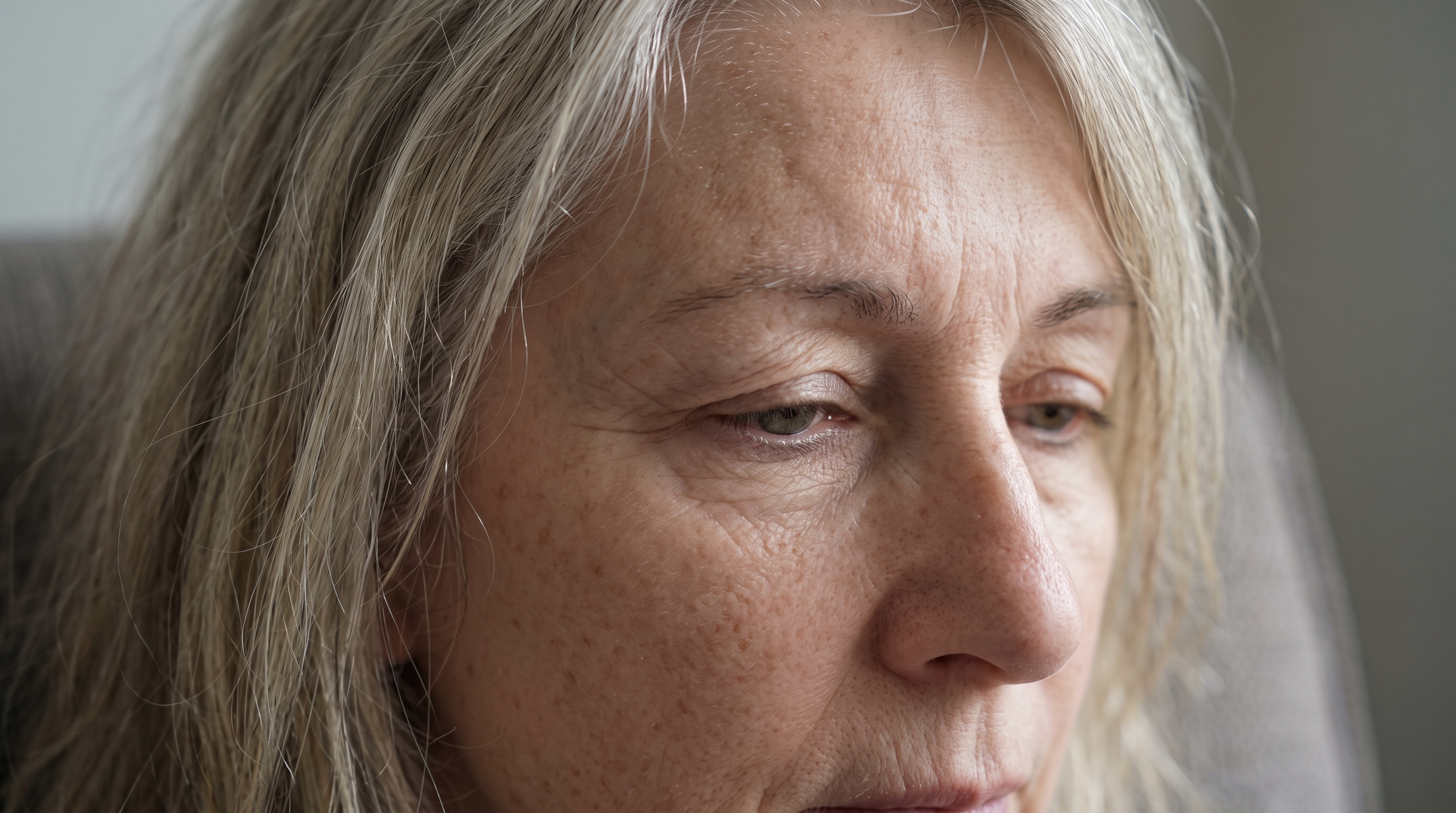
The upper eyelid crease is not a line drawn on skin. Fibres from the levator aponeurosis, the tendon that lifts the lid, insert into the skin of the eyelid, and that attachment is what folds the lid into a crease when the eye opens [1]. Everything above the crease is the fold. Everything below it is the mobile lid that shows when you look straight ahead.
A hood forms when the tissue above that attachment starts arriving on top of it. Eyelid ageing runs on several tracks at once: the skin itself becomes lax and redundant, the levator aponeurosis can thin or partly detach so the crease sits higher and softer, orbital fat shifts, and the brow descends from above [2]. The result is that the fold covers some or all of the mobile lid while your eyes are open.
Some people are born with this. Many acquire it in their forties and fifties. Our page on hooded eyes covers the anatomy and the firming side in depth.
The eyelid is not like the rest of your face
Eyelid skin ages faster and differently, and there is direct evidence for it. Researchers who reconstructed elastin fibre networks in three dimensions found the eyelid network in aged skin was markedly degraded compared with young eyelid skin, and the eyelid behaved differently from abdominal skin in the same subjects [3]. Elasticity measured across body sites by cutometry also declines with age and varies substantially by region [4]. The eyelid is thin, constantly mobile, and it loses its recoil early.
That matters for makeup for a mundane reason. A surface that is soft, mobile and slightly slack does not hold dry pigment in place, and it touches itself every time you blink.
Everything below it is the mobile lid that shows when you look straight ahead.
The rule that is working against you
Standard eyeshadow instruction says to place your transition shade in the socket crease. That advice assumes the crease will be visible when your eye is open, which is true for almond eyes and false for hooded ones.
On a hooded lid, colour placed in the actual anatomical crease is buried under the fold the moment you look up. Worse, the small band of it that does peek out reads as a dark shadow directly under the hood, which visually thickens the fold and makes the eye look smaller and more closed. You have carefully drawn a line emphasising the exact thing you were trying to soften.
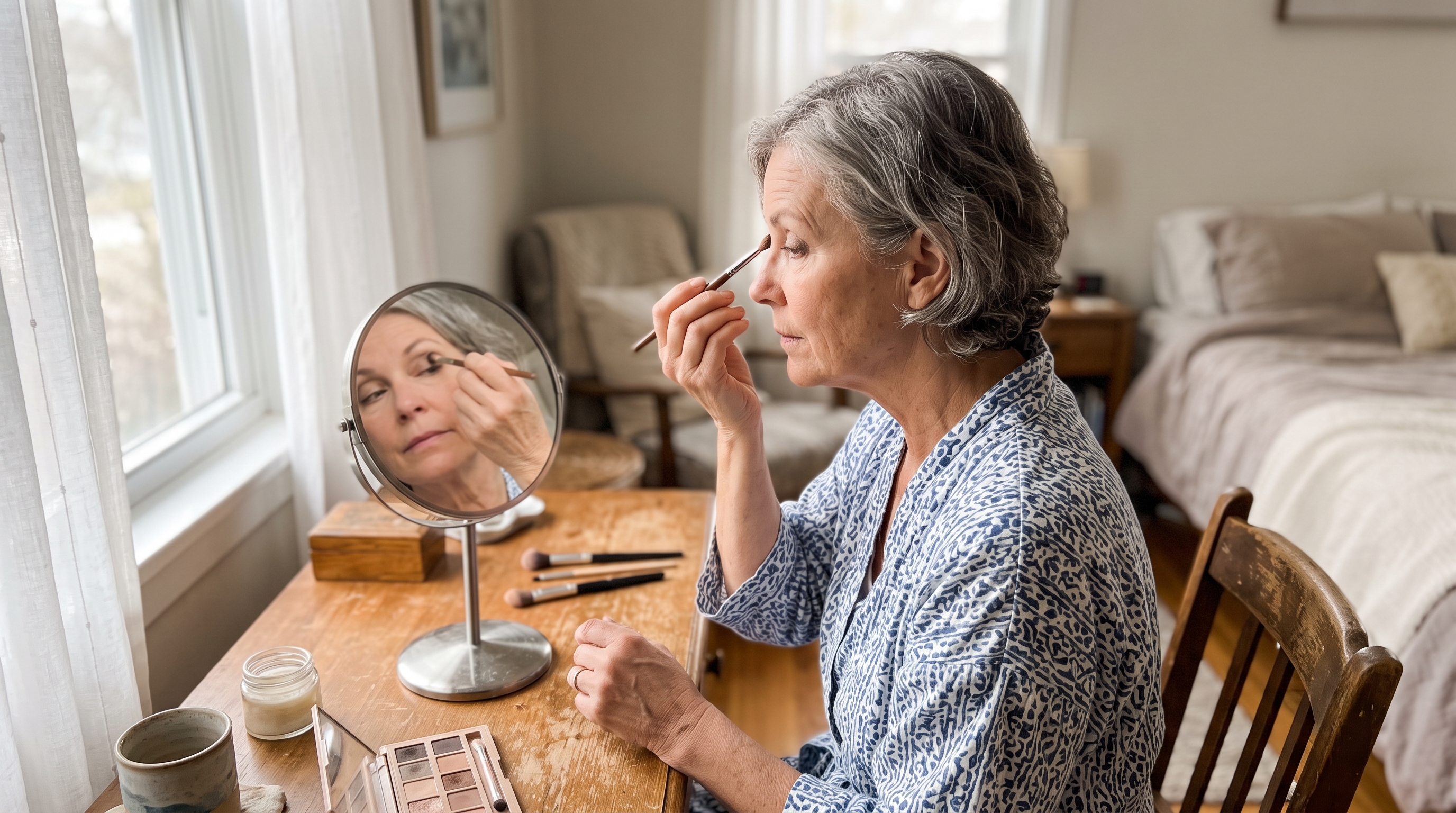
The fix is procedural. Work with your eyes open, or nearly open, and look straight into the mirror. Find the edge of the hood where it meets the visible lid. That edge, and not your anatomical crease, is the line you are designing around.
Where the colour goes
Place your transition and depth shades above the hood’s edge, in the small visible strip that remains when your eye is open. It will look absurdly high when you close your eye. That is the correct outcome, because the closed-eye view is a view nobody else ever gets.
Concentrate depth in the outer third and drift it slightly upward and outward toward the tail of the brow. This creates a diagonal lift. Keep the inner two thirds light. Darkness in the inner corner pulls the whole eye down and inward.
Finish matters as much as placement. Matte and satin textures recede, which is what you want along the hood. Heavy shimmer and glitter advance and catch light on every fold and crepe, and on lax lid skin those particles collect in the texture. If crepiness is your main complaint, crepey eyelids addresses that surface directly. A soft satin on the centre of the mobile lid, if any of it shows, is usually the only shimmer worth keeping.
Liner, on a lid that folds
A classic winged liner drawn along the lash line will disappear under the hood, or worse, transfer a mirror image of itself onto the fold above.
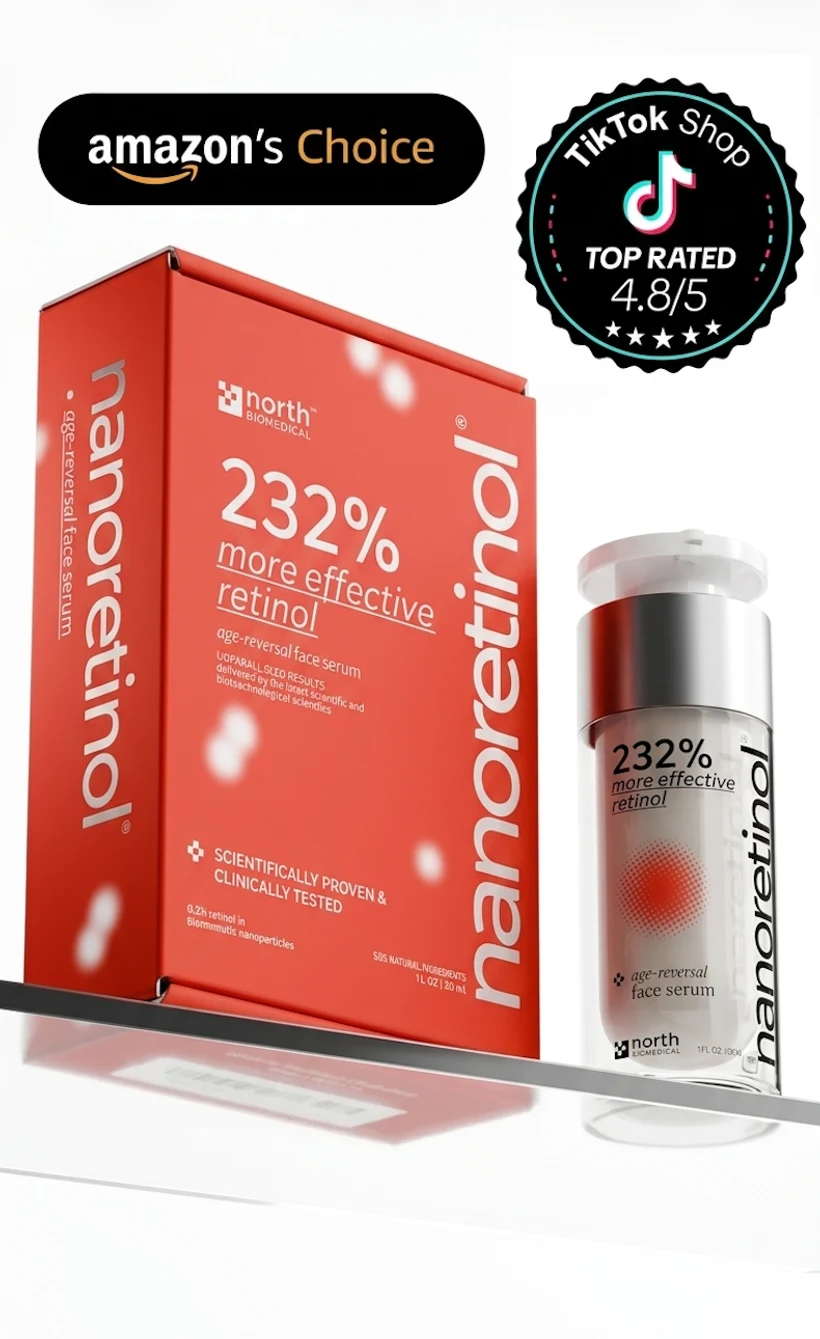
Its 0.2% retinol travels inside biomimetic lipid nanoparticles that the skin recognises as self and admits intact, with no need to damage the barrier to get through, in a water-based, 99% natural formulation that is safe for the eye contour.
Two approaches survive. The first is tightlining: pack liner into the upper lash line itself and along the waterline rather than on the skin above it. This defines the eye without consuming any of the little lid space you have. The second is a short, thin smudge of liner that stays close to the lashes and extends past the outer corner in a low, upward flick, drawn while your eye is open so you can see exactly where the hood will cut it.
Thick liner is the enemy. Every millimetre of liner subtracts a millimetre from the visible lid.
The transfer problem nobody explains
On a hooded eye, the fold rests against the mobile lid. Two surfaces in contact will exchange product, which is why hooded eyes get shadow transfer and mascara prints on the brow bone when other people do not.
That single fact should drive your formula choices. Use an eyeshadow primer, then set it, so nothing on the lid is tacky. Cream shadows are high risk unless they set genuinely dry to the touch, since anything that stays emollient will print onto the fold within the hour. For mascara, tubing formulas or waterproof types resist the same transfer, and curling the lashes first stops them pressing wet against the hood.
Curling lashes does more than most eyeshadow. It physically moves the lash line out from under the fold. Our guide to eye makeup for mature women covers the wider routine this sits inside.
What all of this is compensating for
Every technique above is choreography around a shortage of visible lid. None of it returns any.
That is a skin question, and the evidence about eye-area topicals is more mixed than the counter suggests. A review of popular eye cream ingredients found that the strongest supporting evidence sits with a small number of actives, retinoids among them, while much of the category rests on thinner data [5]. Retinoids earn their place: topical tretinoin significantly improved photoaged skin including fine wrinkling in a double-blind vehicle-controlled trial [6], and a randomised controlled trial of a photostable retinoid derivative showed significant wrinkle improvement against control [7].
The problem is the tissue you have to apply it to. Conventional retinol reaches the dermis by chemically disrupting the skin barrier, and the eyelid is the thinnest and most reactive skin on the body. That is why so many people abandon retinoids around the eye after two weeks of stinging and flaking, and why retinol around the eyes needs a different approach from retinol anywhere else.
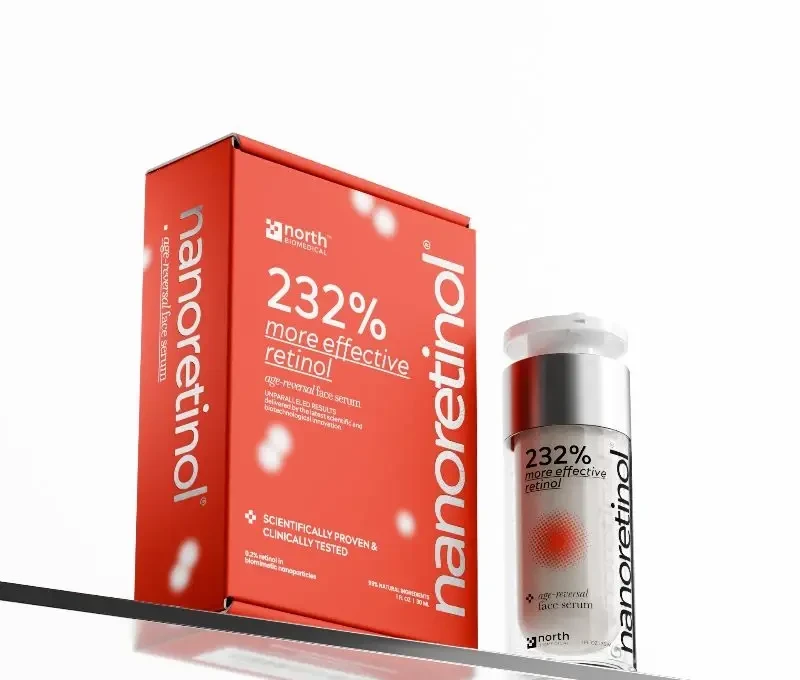
Nanoretinol was built for that constraint. Its 0.2% retinol travels inside biomimetic lipid nanoparticles that the skin recognises as self and admits intact, with no need to damage the barrier to get through, in a water-based, 99% natural formulation that is safe for the eye contour. Against conventional retinol it delivered 232% greater collagen recovery and 73% greater elastin recovery with drastically reduced cytotoxicity, and across 56 days produced a 61% increase in firmness and a 56% increase in elasticity. Given that degraded elastin in the eyelid is a measured feature of the ageing lid, firmness is the relevant currency.
None of this replaces a blepharoplasty if your hood is severe, and it is worth saying plainly that surgery is the only intervention that removes redundant skin. Topicals work on the quality of what remains.
Start with the mirror open
If you change one habit, change this one. Do your eye makeup looking straight ahead with your eyes open, and judge every step by what is visible in that position. Place depth high and out, keep the inner corner light, tightline instead of winging, prime against transfer, and curl the lashes before anything else.
Then treat the lid as a slower project than the makeup sitting on it. Techniques hide a hood. Firmer skin gives you back a little of the lid the hood took.
References
- Hwang K. “Surgical Anatomy of the Upper Eyelid Relating to Upper Blepharoplasty or Blepharoptosis Surgery.” Anatomy & Cell Biology. 2013;46(2):93-100. doi:10.5115/acb.2013.46.2.93
- Damasceno RW, Avgitidou G, Belfort R Jr, Dantas PEC, Holbach LM, Heindl LM. “Eyelid Aging: Pathophysiology and Clinical Management.” Arquivos Brasileiros de Oftalmologia. 2015;78(5):328-331. doi:10.5935/0004-2749.20150087
- Tohgasaki T, Kondo S, Nishizawa S, Ishiwatari S, Sakurai T, Ishikawa S, Takeda A. “Evaluation of Elastin Fibres in Young and Aged Eyelids and Abdominal Skin Using Computational 3D Structural Analysis.” Skin Health and Disease. 2021;1(4):e58. doi:10.1002/ski2.58
- Ryu HS, Joo YH, Kim SO, Park KC, Youn SW. “Influence of Age and Regional Differences on Skin Elasticity as Measured by the Cutometer.” Skin Research and Technology. 2008;14(3):354-358. doi:10.1111/j.1600-0846.2008.00302.x
- Hamie H, Yassine R, Shoukfeh R, Turk D, Huq F, Moossavi M. “A Review of the Efficacy of Popular Eye Cream Ingredients.” International Journal of Women’s Dermatology. 2024;10(2):e156. PMID: 38873621
- Weiss JS, Ellis CN, Headington JT, Tincoff T, Hamilton TA, Voorhees JJ. “Topical Tretinoin Improves Photoaged Skin: A Double-Blind Vehicle-Controlled Study.” JAMA. 1988;259(4):527-532. doi:10.1001/jama.1988.03720040019020
- Kim H, Kim N, Jung S, Mun J, Kim J, Kim B, Lee J, Ryoo H, Jung H. “Improvement in Skin Wrinkles from the Use of Photostable Retinyl Retinoate: A Randomized Controlled Trial.” British Journal of Dermatology. 2010;162(3):497-502. doi:10.1111/j.1365-2133.2009.09483.x