Best Eye Cream for Sensitive Skin: What Actually Calms Reactive Eyes
Why the eye area stings so easily, which ingredients are the real culprits, and how to pick a cream that treats without provoking
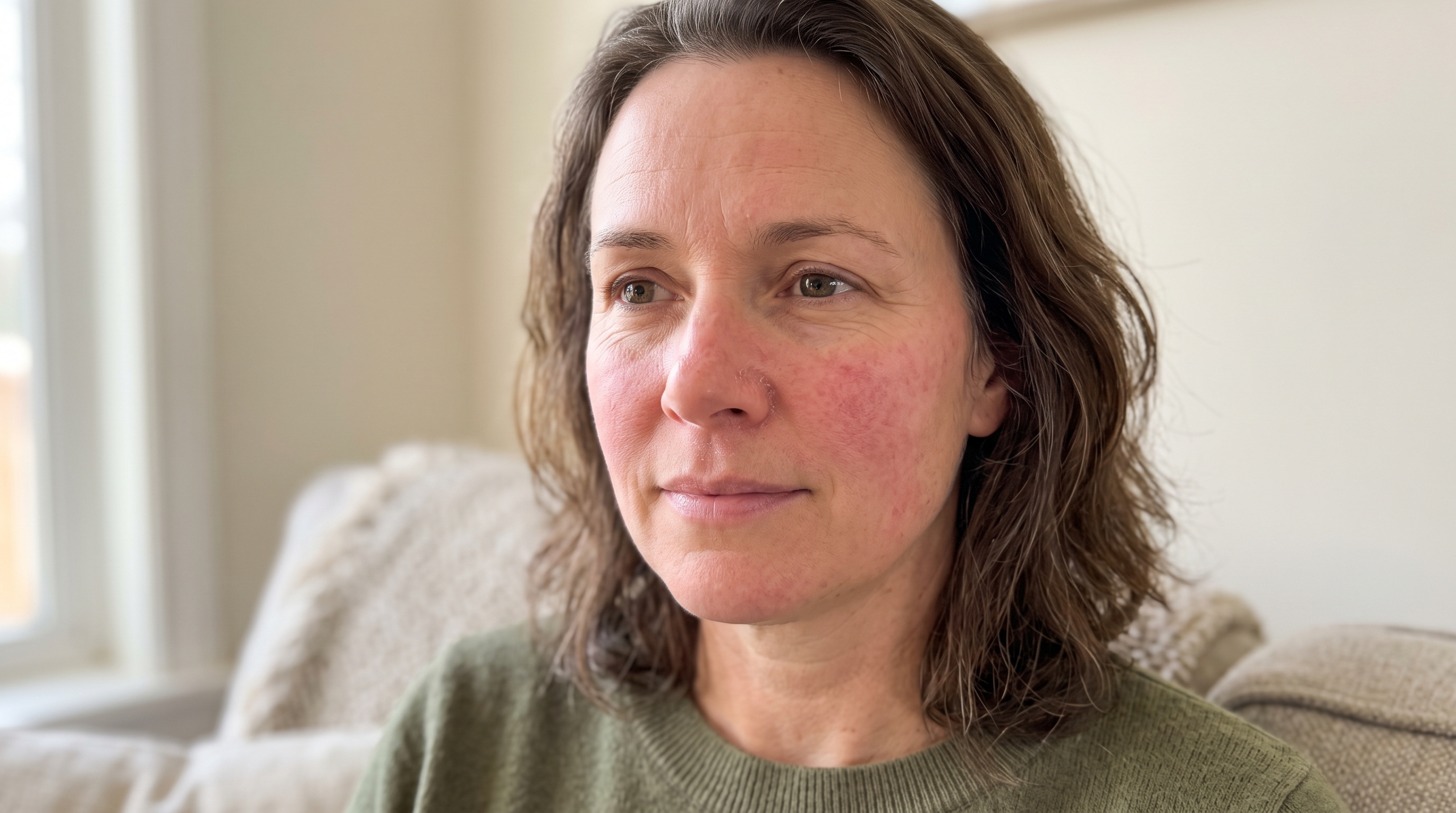
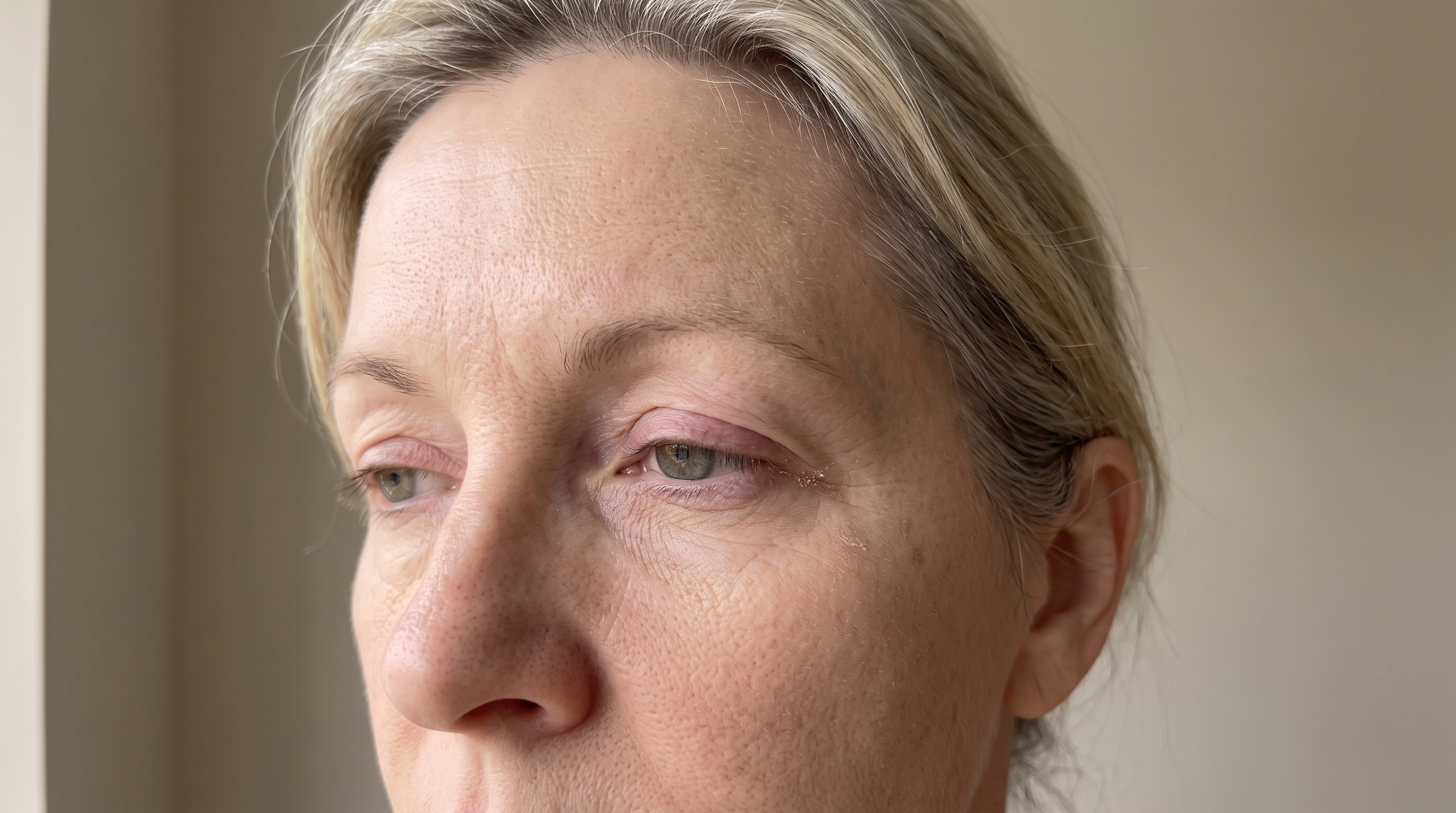
Most people who describe their eye area as sensitive are not describing an allergy. They are describing a pattern: a cream that felt fine on the cheeks produced a hot, prickling sting under the eyes within ninety seconds, and by the next morning the lid looked faintly pink and felt tight. Nothing swelled. Nothing blistered. The product simply had to go in the bin, and the search started again.
That pattern is worth taking seriously, because it points at a real anatomical fact rather than a character flaw in your skin. The eye area is not a smaller version of the face. It is a different tissue operating with a much thinner margin of safety, and a cream designed for the cheek is being asked to work in conditions it was never tested against.
The Eyelid Is Built to a Different Specification
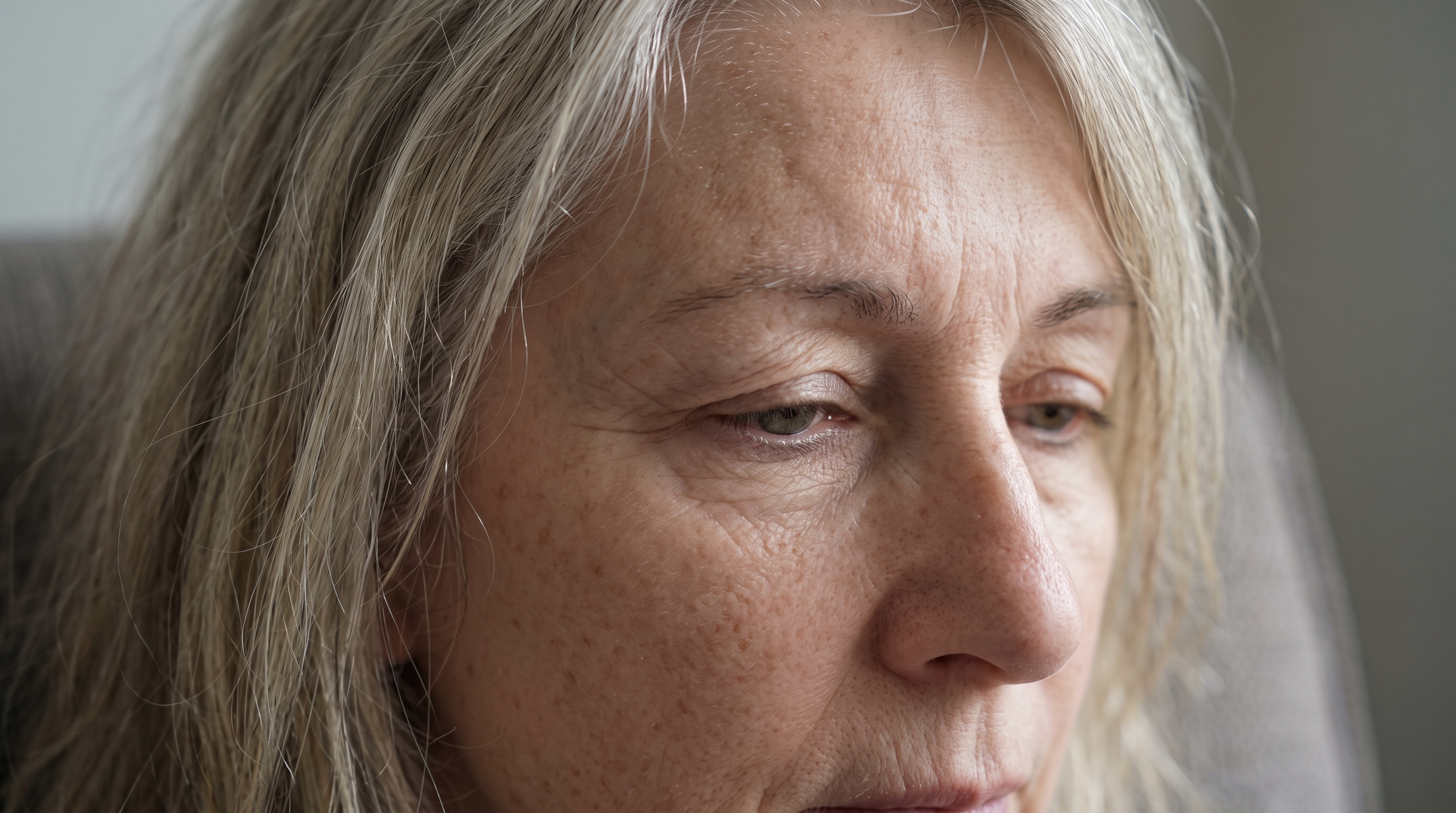
Measured directly, upper eyelid skin ranges from about 320 micrometres thick near the lash line to roughly 1,127 micrometres just below the eyebrow — more than a threefold difference within a single eyelid [1]. Near the lash margin, the epidermis accounts for 11.2% of total skin thickness, compared with only 4.2% to 5.5% further up the lid [1]. That is proportionally more living, reactive epidermis sitting behind proportionally less protection.
The protective layer itself is also weaker there. Facial and eyelid stratum corneum has fewer corneocyte layers and a poorer surface lipid film than skin on the trunk or limbs, which is why the eye area can feel well hydrated at the surface while performing badly as a barrier [2]. Add a tissue that flexes with every blink and sits on loose connective tissue that holds fluid readily, and you have a site where a marginal formula stops being marginal.
The eye area can feel well hydrated at the surface while performing badly as a barrier, which is exactly why a cream that suits the cheek can sting on the lid.
This also explains why the standard advice to patch test on your inner forearm is close to useless here. Forearm skin is thicker, better lipid-protected, and far less permeable. Passing a forearm test tells you almost nothing about how the same formula will behave on a 320-micrometre lid margin.
”Sensitive” Covers Two Different Problems
The expert position paper that defines sensitive skin describes it as unpleasant sensations — stinging, burning, tightness — in response to stimuli that should not provoke them, with no visible lesion required [3]. That last part matters. A sensation-only reaction is a sensory nerve response, not necessarily an immune one, and it does not mean you have become allergic to anything.
Testing reflects the same split. The lactic acid stinging test, applied to 298 women, produced stinging responses that tracked measurable barrier parameters such as water loss, hydration and surface pH [4]. But the same test has been shown not to distinguish facial from generalised barrier impairment in patients with atopic dermatitis or rosacea [5]. It is a useful screen for susceptibility and a poor diagnostic tool.
The clinical picture is more surprising still. In a ten-year retrospective analysis of 1,215 patients, only 105 presented with eyelid dermatitis — and of those, 43.8% had genuine allergic contact dermatitis while 36.2% turned out to have seborrhoeic dermatitis instead [6]. So among people whose eyelids visibly react, the cause splits roughly evenly between a true allergy and an entirely different condition being mistaken for one.
The practical upshot: if your eyes sting but never redden or scale, you are most likely dealing with sensory irritation and a leaky barrier, and the fix is formulation. If your lids are persistently flaky, red and itchy, that deserves a dermatologist and a patch test rather than a seventh eye cream.
The Ingredients Worth Suspecting First
Fragrance materials, preservatives and metals dominate the culprit lists in eyelid allergic contact dermatitis [6]. For sensory stinging without visible reaction, the usual suspects are different: high-percentage alcohol, propylene glycol at meaningful concentrations, strong surfactants carried over from a cleansing base, and low-pH exfoliating acids that are perfectly reasonable on a cheek and simply too aggressive on a lid.
Notice what is absent from both lists. Neither implicates most active ingredients as a class. What provokes the eye area is usually the vehicle — the solvents, emulsifiers and preservatives an active is dissolved in — rather than the active itself. That distinction is the single most useful thing to carry into a purchase decision, because it means “gentle” is a property of the whole formula, not of a hero ingredient on the front of the box.
What Actually Belongs in the Jar
Barrier lipids, first and non-negotiable. A topical emulsion supplying physiological lipids reduced transepidermal water loss after barrier disruption from 38.02 to 29.79 grams per square metre per hour, and raised the key ceramide species NP(18) and AP(18) by 24% and 19% — against non-significant 9% and 6% changes from a conventional emulsion [7]. A better barrier is not a soothing gesture; it is what stops the next product from stinging. Our guide to repairing a compromised skin barrier covers the mechanism in more depth.
Niacinamide, for tolerance rather than glamour. In a four-week study of 50 subjects, a niacinamide-containing moisturiser improved measured stratum corneum barrier function and clinical signs in rosacea — a population defined by reactivity [9]. It is one of the few actives that makes skin harder to irritate rather than easier.
Humectants and occlusives sized for the site. Persistent dryness and flaking around the eyes has its own causes and its own fixes, which we cover separately in dry skin around the eyes.
A better barrier is not a soothing gesture; it is what stops the next product from stinging.
And retinoids — carefully, not never. This is where most sensitive-skin advice goes wrong by advising avoidance. In a twelve-week trial of a retinoid eye cream in 26 subjects, lines and wrinkles fell by 33%, dryness improved by 94%, puffiness by 55% and under-eye darkness by 41%, with no treatment-related adverse events reported [8]. Retinoids are the best-evidenced topical for periorbital ageing, and they can be tolerated around the eyes when the formula is built for it. The practical detail of how to do that is covered in using retinol around the eyes, and if wrinkles rather than reactivity are your main concern, our eye creams for wrinkles comparison ranks on efficacy instead.
How to Choose, in Order
Work through it as a sequence rather than a wish list. Pick a formula whose base is water or physiological lipids rather than alcohol or heavy petrolatum derivatives. Check that the barrier ingredients appear high in the list, not as a trace flourish at the end. Prefer a short, legible ingredient list, because every additional excipient is another thing your lid can object to. Introduce one product at a time, applied to the orbital bone rather than the lid itself, two nights out of seven for the first fortnight. And test on the outer eye corner, never the forearm.
If a formula stings on first application but the sting fades within a minute and leaves nothing behind, that is sensory irritation and often settles with continued use on a recovering barrier. If it stings and the skin is still pink an hour later, stop.
Where Delivery Changes the Calculation
The reason retinoids have a difficult reputation around the eyes is rarely the retinol molecule. Conventional retinol formulations struggle to cross the skin barrier, so they are built with solvents and penetration enhancers that get the active through by disrupting the barrier’s lipid structure — which is precisely the mechanism you least want operating on a 320-micrometre eyelid.
Nanoretinol was designed around that problem. Its retinol is encapsulated in biomimetic lipid nanoparticles that the skin recognises as self and allows through the epithelial barrier intact, so the formula does not need to damage the barrier to deliver its active. The measured result is 232% greater effectiveness in collagen recovery and 73% in elastin recovery than conventional retinol, alongside drastically reduced cytotoxicity in cellular assays. At 0.2% retinol in a 99% natural, water-based gel — the only water-based retinol on the market with that claim — it is suitable for sensitive skin and safe for the eye contour, which is an unusual combination to be able to state at all.
Getting It Right the First Time
The best eye cream for sensitive skin is not the one making the loudest soothing claims. It is the one whose base does not attack a barrier that is already thin, whose ingredient list is short enough to audit, and which repairs the barrier before asking it to tolerate anything else. Once the barrier holds, the actives you were told to avoid usually become available again — and that, rather than permanent avoidance, is what progress around the eyes actually looks like.
References
- Hwang K, Kim DJ, Hwang SH. “Thickness of Korean upper eyelid skin at different levels.” Journal of Craniofacial Surgery. 2006;17(1):54-56. doi:10.1097/01.scs.0000188347.06365.a0
- Tagami H. “Location-related differences in structure and function of the stratum corneum with special emphasis on those of the facial skin.” International Journal of Cosmetic Science. 2008;30(6):413-434. doi:10.1111/j.1468-2494.2008.00459.x
- Misery L, Ständer S, Szepietowski JC, et al. “Definition of Sensitive Skin: An Expert Position Paper from the Special Interest Group on Sensitive Skin of the International Forum for the Study of Itch.” Acta Dermato-Venereologica. 2017;97(1):4-6. doi:10.2340/00015555-2397
- An S, Lee E, Kim S, et al. “Comparison and correlation between stinging responses to lactic acid and bioengineering parameters.” Contact Dermatitis. 2007;57(3):158-162. doi:10.1111/j.1600-0536.2007.01182.x
- Darlenski R, Kazandjieva J, Fluhr JW, et al. “Lactic acid sting test does not differentiate between facial and generalized skin functional impairment in sensitive skin in atopic dermatitis and rosacea.” Journal of Dermatological Science. 2014;76(2):151-153. doi:10.1016/j.jdermsci.2014.08.014
- Amin KA, Belsito DV. “The aetiology of eyelid dermatitis: a 10-year retrospective analysis.” Contact Dermatitis. 2006;55(5):280-285. doi:10.1111/j.1600-0536.2006.00927.x
- Andrew PV, Williams SF, Brown K, et al. “Topical supplementation with physiological lipids rebalances the stratum corneum ceramide profile and strengthens skin barrier function in adults predisposed to atopic dermatitis.” British Journal of Dermatology. 2025;193(4):729-740. doi:10.1093/bjd/ljaf200
- Kaufman J, Callender V, Young C, et al. “Efficacy and Tolerability of a Retinoid Eye Cream for Fine to Moderate Wrinkles of the Periorbital Region.” Journal of Drugs in Dermatology. 2022;21(9):932-937. doi:10.36849/JDD.6815
- Draelos ZD, Ertel K, Berge C. “Niacinamide-containing facial moisturizer improves skin barrier and benefits subjects with rosacea.” Cutis. 2005;76(2):135-141. PMID:16209160