Best Eye Cream for Men: Which Under-Eye Problem Do You Actually Have?
Three different complaints hide under the same phrase, and only one of them responds to a cream
Most men buy an eye cream once, use it for six weeks, decide it did nothing, and never buy another. That reaction is usually correct and almost always misdiagnosed. The cream did not fail because eye creams are a scam. It failed because it was bought for the wrong problem.
“Tired eyes” is one phrase covering at least three physically distinct conditions. They have different causes, they sit at different depths, and only one of them is something any topical product can address.
Why this area behaves differently
The skin around the eyes is not merely delicate by reputation. When researchers took punch biopsies across 39 separate facial subunits from cadaveric heads and measured them, the upper medial eyelid returned both the least dermal thickness and the least total skin thickness of any region on the face, at roughly 759 micrometres of dermis against nearly 1,970 in thicker areas such as the lower nasal sidewall [1].
Thin skin means less collagen scaffolding, less light scattering, and far less margin for error. It is also why anything sitting beneath the skin, whether that is blood vessels, fat or bone, shows through here and nowhere else.
The three problems, separated
A clinical study that classified dark eye circles in 65 subjects using Wood’s lamp examination and ultrasonography found four categories: pigmented at 5%, vascular at 14%, structural at 3%, and mixed at 78% [2]. The overwhelming majority of people have more than one thing happening at once, which is precisely why single-cause explanations disappoint.
If a bright overhead light makes your under-eyes look worse and lying down makes them look better, you are looking at shadow.
Shadow, not colour
The first problem is architectural. A groove runs from the inner corner of the eye diagonally outwards, and it casts a shadow. Cadaveric dissection has shown that this tear trough overlies the junction between the palpebral and orbital portions of the orbicularis oculi muscle and the upper border of the malar fat pad, which explains why the groove deepens as the midface descends and its fat atrophies [3]. Reviews of infraorbital darkening identify the same trio of contributors: skeletal and ligamentous anatomy, midface volume loss, and skin quality [4].
If a bright overhead light makes your under-eyes look worse and lying down makes them look better, you are looking at shadow. No cream fills a groove. That is a volume problem, and it belongs in the same conversation as tear trough hollows rather than in a jar.
Pigment and blood
The second problem is colour. It is either melanin sitting in the skin, or the blue-purple of vascular congestion showing through tissue that is too thin to hide it. Pigment responds slowly to brightening actives. Vascular darkening responds mainly to sleep, sodium, allergy control and time, and barely at all to skincare. Our guide to the best eye cream for dark circles breaks down which ingredients have evidence behind them for the pigmented type.
Crepiness, which is the one creams can fix
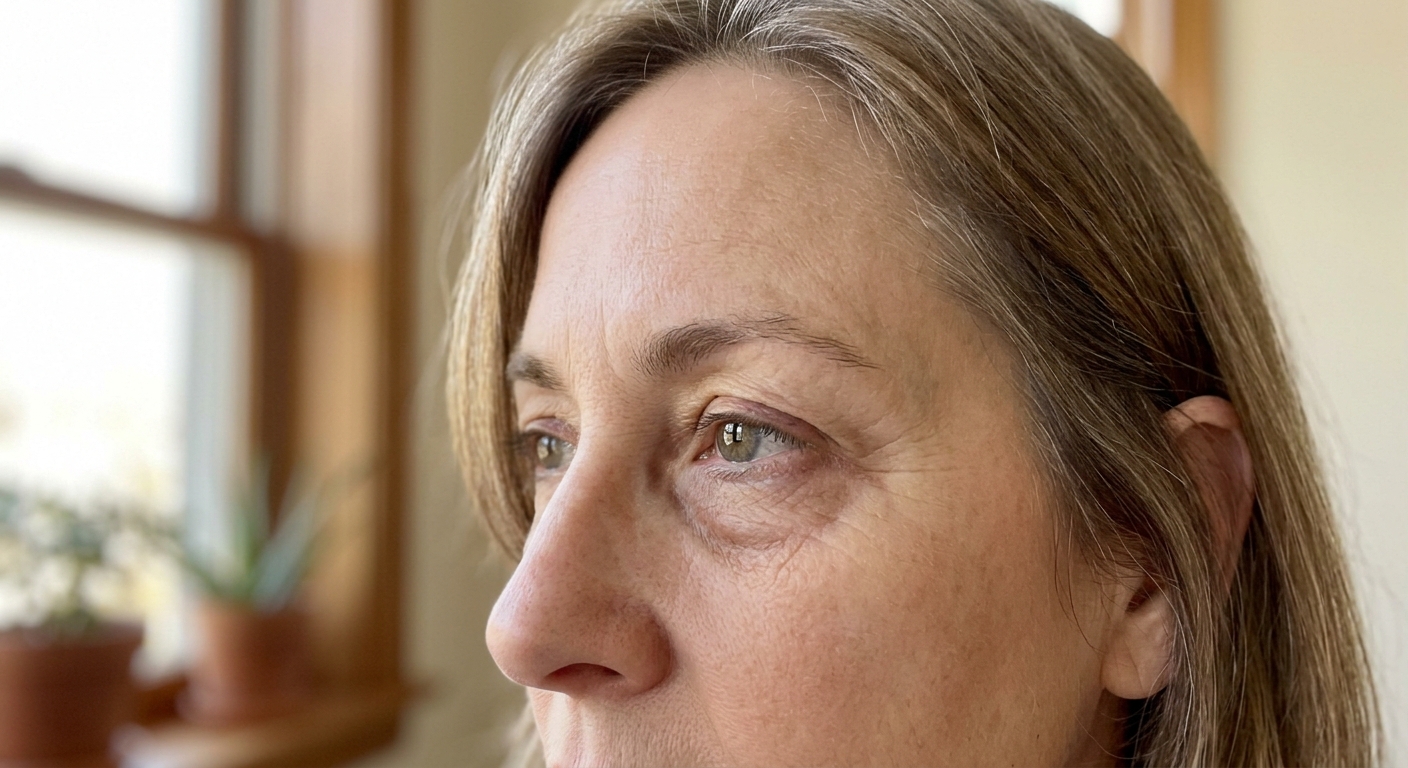
The third problem is texture. Fine crosshatched lines, skin that looks slack and papery, a surface that creases and stays creased. This is collagen loss in the thinnest dermis on the body, and it is the only one of the three that a topical active reliably improves.
What actually works on the third problem
Retinoids, and essentially nothing else with a comparable evidence base.
Its 0.2% retinol is encapsulated in biomimetic lipid nanoparticles that the skin recognises as its own and permits through the epithelial barrier, so nothing has to be broken down to deliver it.
In a study of 36 elderly subjects applying 0.4% retinol lotion up to three times a week for 24 weeks against a vehicle control, retinol significantly improved fine wrinkles and increased glycosaminoglycan and procollagen expression on biopsy, which is molecular evidence of rebuilding rather than a cosmetic surface effect [5]. A separate vehicle-controlled, double-blind trial found nightly topical retinol significantly improved fine wrinkles and photoaging signs [6].
For this specific region the evidence gets more direct still. Two split-face randomised controlled trials in 46 women with periorbital wrinkles found a photostable retinoid derivative significantly outperformed both placebo over 12 weeks and 0.075% retinol over 8 weeks at reducing periorbital wrinkles, without severe adverse effects [7]. Around the eye, a retinoid works, and the formulation it comes in changes how well.
That formulation question is the whole difficulty. The thinnest skin on the face is also the least tolerant of the delivery method conventional retinol uses. Standard formulations rely on chemicals and petroleum derivatives that break down the epithelial barrier to push retinol through it, and doing that to periorbital skin produces exactly the stinging, flaking and redness that sends men back to the drawer. Our guide to using retinol around the eyes covers how to introduce one slowly.
Nanoretinol takes a different route. Its 0.2% retinol is encapsulated in biomimetic lipid nanoparticles that the skin recognises as its own and permits through the epithelial barrier, so nothing has to be broken down to deliver it. That is why the formula is suitable for all skin types and safe for the eye contour, though as with any retinoid you still keep it out of the eyes themselves. It is water-based and absorbs to a matte finish rather than sitting greasy on the lids, it proved 232% more effective in collagen recovery than conventional retinol, and it showed drastically reduced cytotoxicity in cellular testing. On the thinnest skin you own, gentleness is not a soft benefit, it is the thing that determines whether you are still using it in month three.
Setting an honest expectation
Before you buy anything, do the light test. Stand in front of a mirror under a bright overhead light, then hold a small light source at chin level pointing up. If the darkness largely disappears when lit from below, it is shadow and no cream will touch it. If it persists under all lighting, it is pigment or vascular. If the surface looks finely lined and papery regardless of light, that is collagen, and a retinoid is your answer.
Apply along the orbital bone rather than right up to the lash line, since product migrates upwards overnight. Start twice a week and build. Anything that stings persistently is telling you something, and it is not that it is working. Give it twelve weeks, because that is the timescale the periorbital trials used [7], and photograph yourself at the start under fixed lighting, since gradual change is invisible day to day. Broader context on the whole region sits in our guide to under-eye wrinkles.
Where that leaves you
The reason most men’s eye creams are judged failures is that they were bought to fix a shadow or a vein, which they were never capable of doing. Sort out which of the three problems you actually have first. If the answer is crepey, thinning, finely lined skin, then a well-delivered retinoid is one of the few genuinely evidenced answers in skincare, and it will work on the thinnest skin on your face if the formulation lets it.
References
- Chopra K, Calva D, Sosin M, et al. “A comprehensive examination of topographic thickness of skin in the human face.” Aesthetic Surgery Journal. 2015;35(8):1007-1013. doi:10.1093/asj/sjv079
- Huang YL, Chang SL, Ma L, Lee MC, Hu S. “Clinical analysis and classification of dark eye circle.” International Journal of Dermatology. 2014;53(2):164-170. doi:10.1111/j.1365-4632.2012.05701.x
- Haddock NT, Saadeh PB, Boutros S, Thorne CH. “The tear trough and lid/cheek junction: anatomy and implications for surgical correction.” Plastic and Reconstructive Surgery. 2009;123(4):1332-1340. doi:10.1097/PRS.0b013e31819f2b36
- Vrcek I, Ozgur O, Nakra T. “Infraorbital dark circles: a review of the pathogenesis, evaluation and treatment.” Journal of Cutaneous and Aesthetic Surgery. 2016;9(2):65-72. doi:10.4103/0974-2077.184046
- Kafi R, Kwak HS, Schumacher WE, et al. “Improvement of naturally aged skin with vitamin A (retinol).” Archives of Dermatology. 2007;143(5):606-612. doi:10.1001/archderm.143.5.606
- Kikuchi K, Suetake T, Kumasaka N, Tagami H. “Improvement of photoaged facial skin in middle-aged Japanese females by topical retinol (vitamin A alcohol): a vehicle-controlled, double-blind study.” Journal of Dermatological Treatment. 2009;20(5):276-281. doi:10.1080/09546630902973987
- Kim H, Kim N, Jung S, et al. “Improvement in skin wrinkles from the use of photostable retinyl retinoate: a randomized controlled trial.” British Journal of Dermatology. 2010;162(3):497-502. doi:10.1111/j.1365-2133.2009.09483.x