
Best Eyeliner for Older Women: Matching the Formula to How Your Lid Actually Fails
Liner drags, migrates or vanishes for three different mechanical reasons, and each one has a different fix
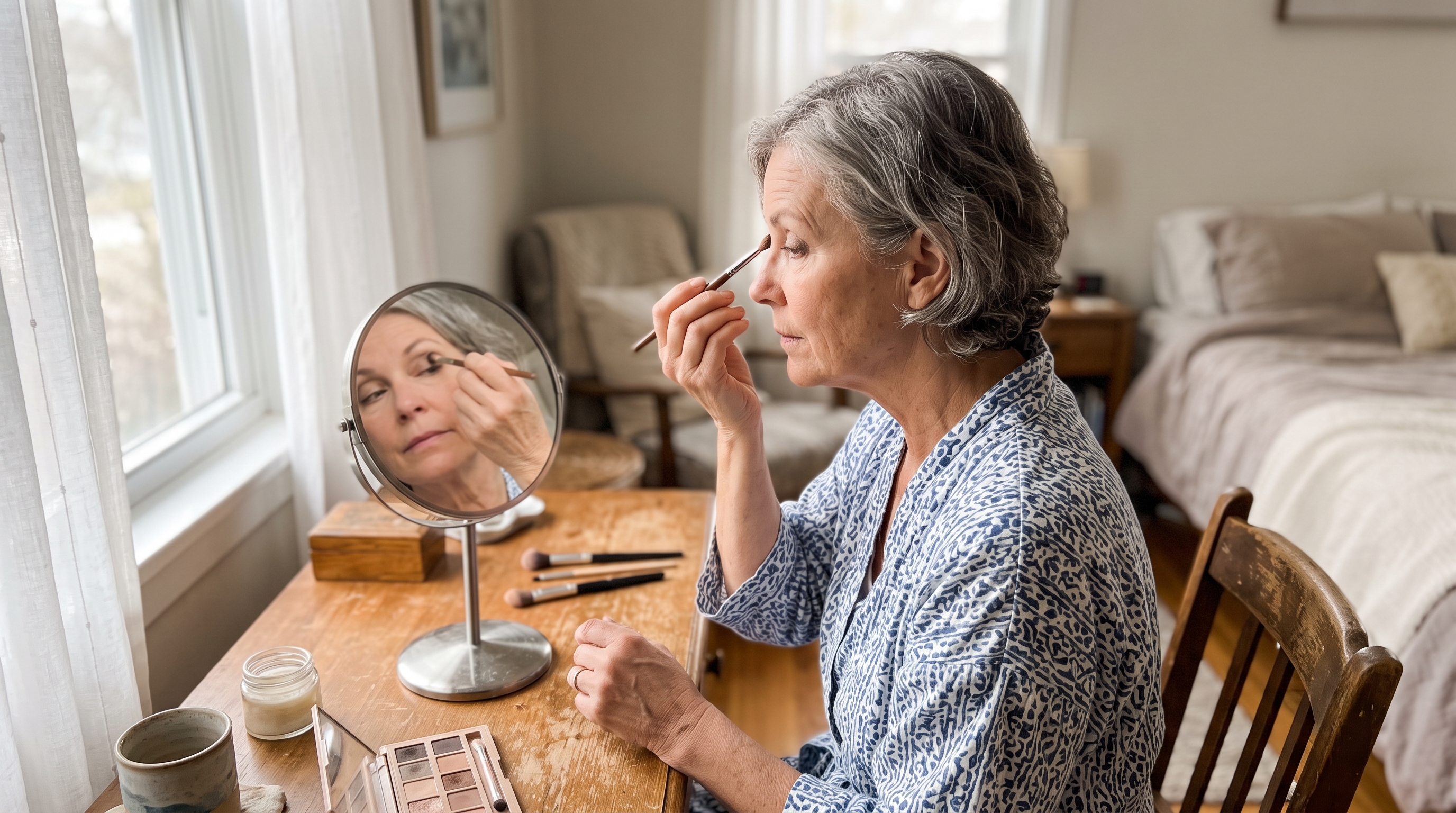
There is a specific moment that sends women looking for a new eyeliner. The pencil that used to lay down one clean stroke now catches, skips a section, and needs a second pass. Or the line goes on beautifully and by two in the afternoon a grey shadow has printed itself into the crease above it.
Both are usually blamed on the product. Both are actually the lid telling you something, and they are not the same message. Buying well means working out which failure you have, because the three common ones want three different formulas.
The surface you are drawing on is the thinnest skin you own
Start with the material. A cadaveric study measuring full-thickness skin across 39 separate facial subunits found the upper medial eyelid had the least dermal thickness anywhere on the face, at 758.9 micrometers, against 1,969.2 micrometers at the thickest region measured [1]. There is very little between the surface and everything underneath it.
Thin skin is also mobile skin, and it changes texture with time. An in vivo imaging study across children, younger adults and older adults found measured surface roughness parameters rose with age, while the count of fine closed micro-topographic polygons per square millimeter fell [2]. The skin’s fine, orderly surface network becomes coarser and less organized.
That is the mechanism behind drag. A pencil tip needs a reasonably smooth, slightly yielding surface to deposit an even line. On a coarser, drier surface it catches on the high points and skips the low ones, which is exactly what a broken line looks like.
The lid also moved
The second failure is migration, and it has nothing to do with texture.
A longitudinal study photographed 80 people at ages 20, 40 and 60 and tracked periorbital change. Upper eyelid dermatochalasis, the loose lid drape produced by loss of elastic tissue, was present in 55.0 percent of subjects at 40 and 67.5 percent by 60 [3].
When the upper lid loses tone it rests lower and folds closer to the lash line. Skin that used to sit clear of your liner now makes contact with it, repeatedly, every blink. The line does not smudge outward so much as get printed upward into the fold. No setting spray addresses this, because it is contact transfer rather than melting.
Both are actually the lid telling you something, and they are not the same message.
The third failure, a line that simply disappears, is usually the same thing seen from underneath: the liner is still there, hidden by a fold of lid resting over it.
Matching formula to failure
If your problem is drag and skipping, you want a gel or a cream formula, applied with a small angled brush rather than dragged from a stick. A brush floats over the high points instead of catching on them, and gel deposits pigment with far less downward pressure. A soft kohl pencil warmed briefly between your fingers is the low-effort version of the same idea. Hard pencils are the worst choice on a coarse surface, because they need pressure, and pressure on a lid this thin is what stretches it.
If your problem is migration into the crease, you want a fast-setting liquid or a felt-tip that dries down to a film and stops transferring. Gel and pencil stay pliable, which is precisely why they print. Keep the line thin and tight to the lash base, where the fold is least likely to reach it.
If your problem is a line that vanishes, stop trying to draw a line at all. Tightlining, pressing pigment into the base of the lashes rather than above them, gives definition that a lid fold cannot cover. A waterproof gel is the right tool here, and it is one of the few genuine cases for waterproof around the eye.
The formula question everyone skips
Eyelid skin is not just thin mechanically. It is thin immunologically.
A 25-year retrospective study of 7,955 patch-tested patients identified eyelid allergic contact dermatitis in 4.6 percent of the population, with women accounting for 88.6 percent of cases. Nickel sulfate led the allergens at 54 percent, followed by cobalt chloride at 13.4 percent and thimerosal at 12.6 percent [4].
Two practical consequences. Nickel and cobalt turn up as trace contaminants in colored pigments, which is a reason to be cautious with intensely pigmented metallic and jewel-toned liners specifically rather than liners in general. And if your eyes have started reacting to something they tolerated for years, the change is plausible rather than imagined, and simplifying the formula is a reasonable first move.
Nickel sulfate led the allergens at 54 percent, followed by cobalt chloride at 13.4 percent and thimerosal at 12.6 percent.
If you are reconsidering the whole eye, our guide to eye makeup for mature women covers placement, while the best eyeshadow for older women matches cream, powder and stick formulas to the same texture and transfer failures. Mascara for older women deals with the removal problem that does the most lash damage.
Technique that costs nothing
Set the lid before you draw. A trace of powder over a lightly moisturized lid gives a pencil something to grip and reduces drag noticeably.
Do not stretch the eye taut to draw. It feels like it helps, and it produces a line that concertinas the moment you let go, sitting in the folds it was drawn across. Instead, look down into a hand mirror held below eye level, which opens the lash line without pulling anything.
Work in short connected dashes rather than one long sweep. Fewer passes, less pressure, and a broken segment is easier to fix than a wobbling full-length line.
The variable underneath all three
Every fix above manages a surface. None of them change what the surface is made of.
Drag, drape and fold all trace back to a dermis with less collagen holding less tension. That loss is measurable at the cellular level: dermal fibroblasts taken from adults aged 80 and over produced significantly less type I procollagen in culture than fibroblasts from adults aged 18 to 29, 56 nanograms per milliliter against 82 [5]. The cells themselves make less.
Topical retinol is the most studied answer to that. In a 24-week randomized, double-blind, vehicle-controlled trial in elderly subjects, topical retinol significantly reduced fine wrinkling scores against vehicle and significantly increased procollagen I immunostaining in the skin [6]. If crepey lid texture is your starting complaint, our guide to crepey eyelids goes deeper on the mechanism.
The obstacle around the eye has always been that retinol is hard to deliver and easy to overdo. Conventional retinol penetrates the epithelial barrier poorly, and many formulations use chemicals and petroleum derivatives that break the barrier down in order to get through, which is where the stinging and flaking on eyelid skin comes from.
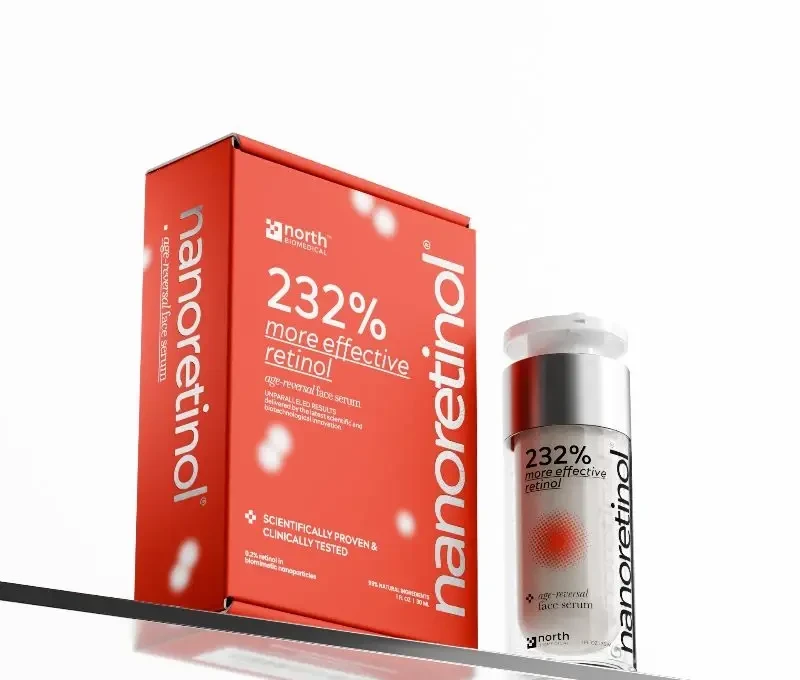
Nanoretinol takes a different route. It encapsulates 0.2 percent retinol in biomimetic lipid nanoparticles the skin recognizes as self and admits intact, so nothing has to be damaged to deliver the active. In North Biomedical’s study it proved 232 percent more effective than conventional retinol at collagen recovery and 73 percent more effective at elastin recovery, with drastically reduced cytotoxicity. It is water-based, gentle enough for sensitive skin, and safe to use on the eye contour, which is not true of most retinol products.
Diagnosing before you buy
Before ordering anything, wear your current liner on an ordinary day and photograph the eye area in indirect daylight at midday and again at five.
If the line is broken from the start, you have a texture problem and want gel plus a brush. If it is clean at midday and printed into the crease by five, you have a contact problem and want a fast-setting liquid. If it has quietly vanished, you have a drape problem and want to tightline instead.
Three photographs will tell you more than any ranked list, because the answer depends on your lid rather than on the product.
References
- Chopra K, Calva D, Sosin M, Tadisina KK, Banda A, De La Cruz C, Chaudhry MR, Legesse T, Drachenberg CB, Manson PN, Christy MR. “A Comprehensive Examination of Topographic Thickness of Skin in the Human Face.” Aesthetic Surgery Journal. 2015;35(8):1007-1013. doi:10.1093/asj/sjv079
- Trojahn C, Dobos G, Schario M, Ludriksone L, Blume-Peytavi U, Kottner J. “Relation between Skin Micro-Topography, Roughness, and Skin Age.” Skin Research and Technology. 2015;21(1):69-75. doi:10.1111/srt.12158
- De Biasio F, Miotti G, Zingaretti N, Castriotta L, Parodi PC. “Study on the Aging Dynamics of the Periorbital Region: From Observation to Knowledge of Physiopathology.” Ophthalmic Plastic and Reconstructive Surgery. 2019;35(4):333-341. doi:10.1097/IOP.0000000000001247
- Rubegni G, Padula T, Calabrese L, D’Onghia M, Tognetti L, Cinotti E, Lazzeri L, Ermini G, Cartocci A, Tosi GM. “Eyelid Contact Dermatitis: 25-Year Single-Center Retrospective Study.” Journal of Clinical Medicine. 2025;14(3):823. doi:10.3390/jcm14030823
- Varani J, Dame MK, Rittie L, Fligiel SE, Kang S, Fisher GJ, Voorhees JJ. “Decreased Collagen Production in Chronologically Aged Skin: Roles of Age-Dependent Alteration in Fibroblast Function and Defective Mechanical Stimulation.” American Journal of Pathology. 2006;168(6):1861-1868. doi:10.2353/ajpath.2006.051302
- Kafi R, Kwak HS, Schumacher WE, Cho S, Hanft VN, Hamilton TA, King AL, Neal JD, Varani J, Fisher GJ, Voorhees JJ, Kang S. “Improvement of Naturally Aged Skin with Vitamin A (Retinol).” Archives of Dermatology. 2007;143(5):606-612. doi:10.1001/archderm.143.5.606