Best Mascara for Older Women: What Works on Thinning Lashes and Thinning Lids
Why the formula that worked at forty behaves differently at sixty, and the selection rules that hold up
There is a particular drawer most women over fifty end up with. Four or five mascaras, each bought to solve the problem the last one caused. One smudged under the eye by two in the afternoon. One flaked black specks onto the cheekbone. One went on beautifully and took three minutes of rubbing to get off.
The instinct is to keep hunting for a better tube. The more useful move is to notice that two things changed underneath the makeup, and that a mascara chosen for those two changes behaves very differently from one chosen at thirty.
The lid is the variable nobody mentions
Mascara does not sit on your lashes in isolation. It sits on lashes attached to a lid, and it transfers onto that lid every time you blink. Which means the surface underneath matters as much as the formula.
That surface is the thinnest skin you have. A cadaveric study measuring 39 separate facial subunits found the upper medial eyelid had the least dermal thickness of anywhere on the face, at 758.9 micrometers, and the authors concluded directly that eyelid skin is the thinnest in the face [1]. Everywhere else has more structure beneath it.
That thin starting point also loses its scaffolding. A review of eyelid aging documents progressive loss of elastic fibers, ultrastructural abnormalities in the fibers that remain, and overexpression of the enzymes that degrade elastin, producing the laxity and lid drape that dermatology calls dermatochalasis [2]. A lax upper lid rests lower and closer to the lash line, so the lid now makes contact with wet mascara where it never used to. That contact is the whole mechanism behind the mid-afternoon smudge under the eye, and no amount of setting powder addresses it.
Your lashes changed too
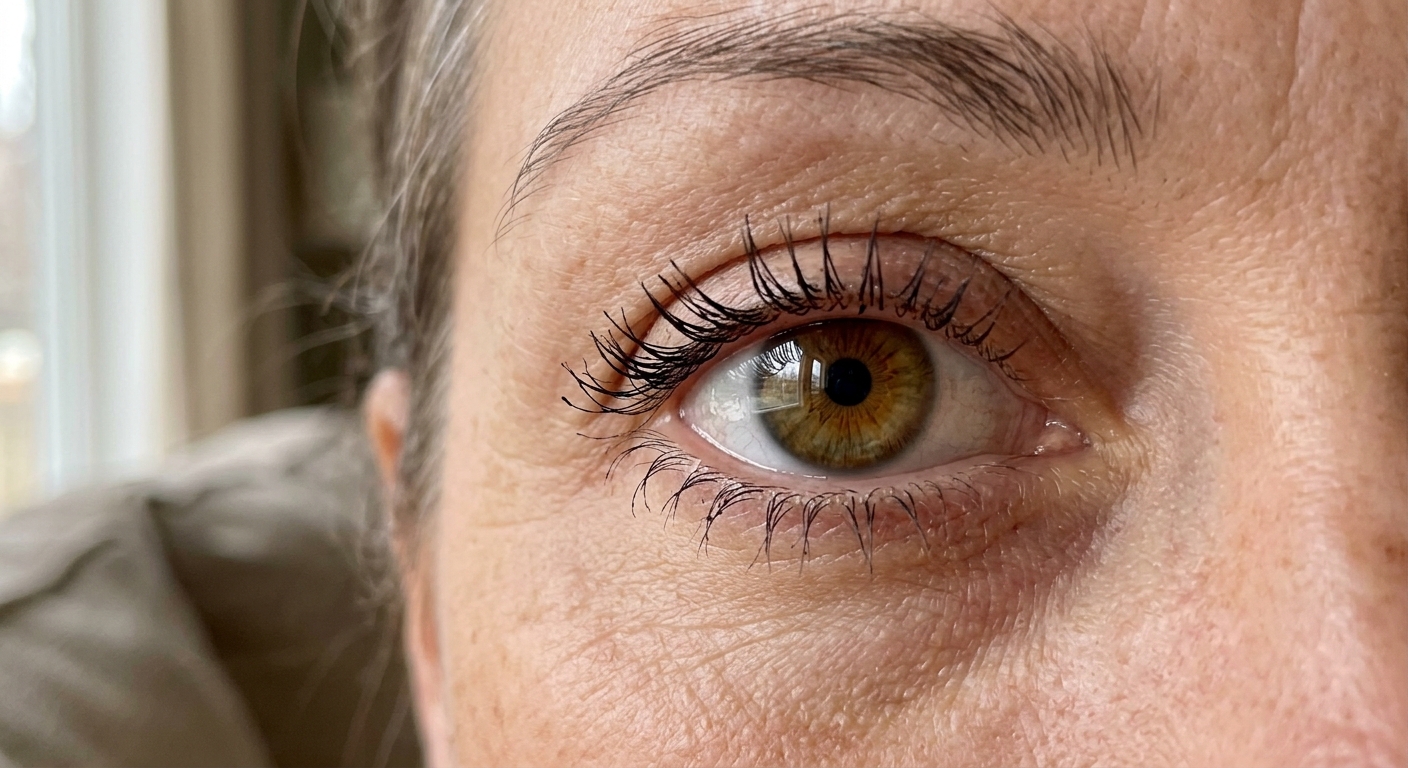
The second variable is the lashes themselves. Researchers photographed and digitally measured the upper lashes of 179 healthy women and found that length, thickness, and darkness all declined significantly with age. Mean lash length ran around 7.98 millimeters in women aged 22 to 29 and around 6.39 millimeters in women aged 50 to 65 [3].
Shorter, finer, paler lashes are also mechanically weaker. That matters because most of what a mascara does to a lash is load it. Pigment, wax, and polymer add weight, and the brush adds drag on every pass. A lash that could carry that load at thirty is being asked to carry the same load with less cross-sectional area.
On a lid that has lost tone and now sits closer to the lash line, a formula that never fully sets migrates.
Three formulas that stop working, and why
Fiber mascaras. These promise length by depositing nylon or rayon filaments that extend past the natural lash tip. They add the most weight per lash of any category, and they need the most passes to distribute. On a brittle, thinning lash line they are the highest-risk choice, and the length they add is exactly the length that snaps off in the shower.
Classic oil and wax emulsions. These stay slightly pliable rather than setting hard, which is what made them comfortable. On a lid that has lost tone and now sits closer to the lash line, a formula that never fully sets migrates. This is the smudger.
Waterproof anything. Waterproof films are engineered to resist water, so water will not take them off. What takes them off is friction, solvent, or both. A cross-sectional study of 128 mascara users found a significant association between long-term mascara use and eyelash fall, with more lash loss among women who tried to remove waterproof mascara using water. Those who did reported lash fall at 27 percent, and women who experienced lash loss had used mascara for a mean of 5.17 years versus 3.19 years in those who did not [4].
That last finding is the one worth sitting with. The damage in that study was not caused by the mascara going on. It was caused by getting it off.
What to actually look for
Tubing formulas first. Tubing mascaras coat each lash in a flexible polymer sleeve rather than a wax film. Two things follow. They do not flake, because the tube stays intact instead of fracturing into specks. And they come off with warm water and gentle pressure, with the tubes sliding off whole. On a lash line that is already thinning, a formula that removes without solvent or scrubbing is the single highest-value feature available.
A smaller brush than you think you need. Brush diameter decides how close you can work to the lash root without stamping product onto the lid. A slim brush, roughly the width of a pencil lead, reaches sparse inner lashes and lets you deposit at the base where thickness reads most. Large spherical brushes were designed for dense lash lines and load the lid on mature eyes.
If you are also rethinking shadow, liner and placement, our guide to eye makeup for mature women covers the rest of the eye.
Moderate build, not maximum volume. Two thin coats outperform one heavy one on fine lashes, because each coat adds less weight and dries faster before the lid can make contact.
Check the removal method before you buy. If a product requires a dedicated remover and thirty seconds of rubbing, price that in. It is a recurring cost paid in lash retention and lid friction.
The part that touches your eye, not just your skin
Anything applied along the lash line has a second destination. A controlled study of 42 women found that regular use of eyeliner, applied at the lash line, significantly shortened tear breakup time, at 3.0 seconds versus 5.8 seconds in non-users, and worsened meibomian gland grading [5]. That study tested eyeliner rather than mascara, so treat it as evidence about cosmetics worn at the lash margin generally. The practical translation is the same either way: keep product on the lashes rather than pressed into the waterline, and take it off every night rather than sleeping in it.
If you are also rethinking shadow, liner and placement, our guide to eye makeup for mature women covers the rest of the eye. And if lash density itself is the concern, the evidence on lash growth serums is more mixed than the marketing suggests.
Where makeup runs out of road
Every rule above manages a surface. None of them change it.
The reason the lid drapes, creases and smudges is structural, and the timeline is well documented. A study of postmenopausal women found that skin collagen content and skin thickness decline in tandem after menopause, and that the decline was prevented in women receiving hormone replacement [6]. Losing collagen means losing the tension that holds a lid taut and keeps crepey eyelids and fine lines under the eye from catching product.
That is a rebuilding problem, and topical retinol is the most studied answer to it. The obstacle has always been delivery, because conventional retinol formulations penetrate the epithelial barrier poorly and often use chemicals and petroleum derivatives that break the barrier down to get through, which is how the burning and peeling around the eyes starts.
Nanoretinol takes a different route. It encapsulates 0.2 percent retinol in biomimetic lipid nanoparticles that the body recognizes as self and allows through the barrier intact, so nothing has to be damaged to deliver the active. In North Biomedical’s study it proved 232 percent more effective than conventional retinol at collagen recovery and 73 percent more effective at elastin recovery, with drastically reduced cytotoxicity. It is water-based, gentle enough for sensitive skin, and safe to use on the eye contour, which is not true of most retinol products.
Choosing for the eye you have now
Buy one tubing mascara with a slim brush. Wear it on an ordinary day and photograph the under-eye area in indirect daylight at midday and again at five. Then remove it with warm water and count how many passes it takes.
Those three observations tell you more than any ranked list, because the variables that decide the answer are the thickness of your lid, the density of your lashes, and how much friction your eye area can afford. All three are yours.
References
- Chopra K, Calva D, Sosin M, Tadisina KK, Banda A, De La Cruz C, Chaudhry MR, Legesse T, Drachenberg CB, Manson PN, Christy MR. “A Comprehensive Examination of Topographic Thickness of Skin in the Human Face.” Aesthetic Surgery Journal. 2015;35(8):1007-1013. PMID: 26508650
- Damasceno RW, Avgitidou G, Belfort R Jr, Dantas PE, Holbach LM, Heindl LM. “Eyelid Aging: Pathophysiology and Clinical Management.” Arquivos Brasileiros de Oftalmologia. 2015;78(5):328-331. PMID: 26466237
- Glaser DA, Jones D, Carruthers J, Campo A, Moench S, Tardie G, Largent J, Caulkins C. “Epidemiologic Analysis of Change in Eyelash Characteristics With Increasing Age in a Population of Healthy Women.” Dermatologic Surgery. 2014;40(11):1208-1213. PMID: 25347452
- Kadri R, Achar A, Tantry TP, Parameshwar D, Kudva A, Hegde S. “Mascara Induced Milphosis, an Etiological Evaluation.” International Journal of Trichology. 2013;5(3):144-147. PMID: 24574694
- Prabhasawat P, Chirapapaisan C, Chitkornkijsin C, Pinitpuwadol W, Saiman M, Veeraburinon A. “Eyeliner Induces Tear Film Instability and Meibomian Gland Dysfunction.” Cornea. 2020;39(4):473-478. PMID: 31724986
- Brincat M, Kabalan S, Studd JW, Moniz CF, de Trafford J, Montgomery J. “A Study of the Decrease of Skin Collagen Content, Skin Thickness, and Bone Mass in the Postmenopausal Woman.” Obstetrics & Gynecology. 1987;70(6):840-845. PMID: 3120067