Best Eyeshadow for Older Women: Match the Formula to Your Lid
Cream, powder, stick and satin shadows fail differently on mature lids, so the best choice starts with the texture you actually have
The eyeshadow that looked polished ten years ago can suddenly make an eyelid look drier, heavier or more folded. It is tempting to blame age, then buy whichever palette promises to be “for mature eyes.” That label tells you almost nothing.
The useful question is how your shadow fails. Does pigment skip over tiny folds? Does it collect in one deep crease? Does shimmer turn a smooth lid into a relief map? Each failure comes from a different interaction between skin and formula, and each has a different answer.
Mature lids are a moving surface, not a flat canvas
Upper-eyelid skin is exceptionally thin. A study that measured 39 facial regions found the upper medial eyelid was the thinnest site examined [1]. With age, its fine surface network becomes rougher and less orderly [2], while the surrounding tissues lose collagen, elasticity and support [3].
That combination changes makeup in three ways. Dry microfolds interrupt pigment deposition. A lower fold brings two painted surfaces into contact, encouraging transfer. Reduced firmness lets powder settle wherever the lid bends most often.
This is why the broader rules in our guide to eye makeup for mature women matter: mature-eye makeup is a materials problem before it is a colour problem.
Diagnose the failure before choosing the formula
If shadow looks patchy immediately
Immediate patchiness usually means the product is dragging across dry, uneven skin. A stiff powder brush can deposit pigment on the raised edges of a fold while missing the recess beside it.
Choose a thin cream or soft shadow stick with enough glide to cross the surface without pressure. The key word is thin. A dense, waxy stick may feel smooth during application but can build a thick layer that later gathers in creases. Apply a small amount, then tap the edge with a fingertip or a short synthetic brush rather than sweeping repeatedly.
If shadow looks good, then creases
Creasing is usually a contact-and-oil problem. Skin folds touch as you blink; natural sebum and emollients keep the colour mobile; the moving film is pushed into the fold.
Skin folds touch as you blink; natural sebum and emollients keep the colour mobile; the moving film is pushed into the fold.
Choose a fast-setting cream-to-powder or liquid shadow. After it dries, the pigment should behave like a flexible film rather than a greasy paste. Use one translucent layer and leave it alone for 30 seconds before opening the eye fully. Adding more product rarely fixes creasing because it gives the fold more material to collect.
If the lid looks more wrinkled after makeup
This is an optical problem. Large reflective particles create bright highlights on the high points and dark shadows in the grooves, exaggerating texture. Completely flat matte can create the opposite problem by absorbing so much light that the lid looks chalky and dry.
A finely milled satin usually sits between those extremes. Look for a soft, low-contrast sheen rather than visible sparkle. Place the brightest finish on the smoother inner third or centre of the lid, not across the most folded area.
Cream, powder or stick: the practical comparison
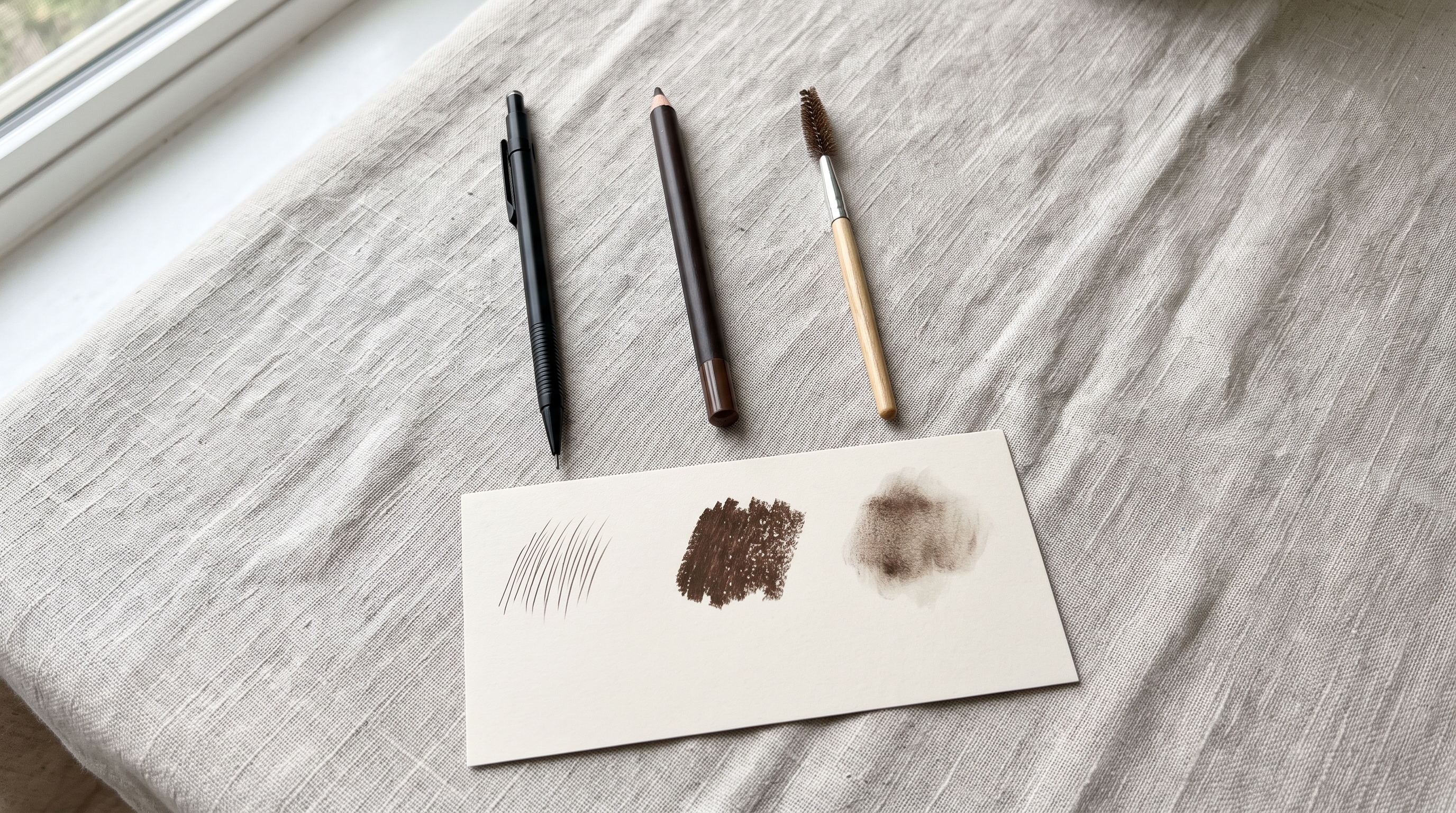
Thin cream shadow is the safest starting point for dry, crepey lids. It needs less friction and can be sheered until the skin still looks like skin. Avoid very oily creams if transfer is your main problem.
Cream-to-powder liquid is best when your shadow migrates. It buys you a short blending window and then sets. Test it on the back of your hand: after one minute, rub lightly. A useful formula should blur at the edge without sliding away as a wet stripe.
Soft shadow stick is convenient for poor grip or eyesight because it needs no palette. Choose a narrow stick for control and warm it briefly against the hand before touching the lid. Broad, hard sticks require too much pressure.
Pressed powder can work beautifully when the lid is neither very dry nor very folded. Use a small amount on a compact brush and press rather than windshield-wiper blending. Powder is also useful as a whisper-thin setting layer over cream.
Primer helps, but only when it solves the right problem
Primer is useful for oil and transfer. It is less useful for dry texture, where an overly matte primer can make skipping worse.
Nanoretinol encapsulates 0.2% retinol in biomimetic lipid nanoparticles designed to cross the epithelial barrier without damaging it.
For an oily lid, spread a rice-grain amount from lash line to crease, wait until it loses tack, then add shadow. For a dry lid, moisturize lightly first and let the surface settle for several minutes. If you can still see a glossy film, there is too much product for shadow to grip.
Do not pull the lid tight while blending. Makeup applied to stretched skin compresses when you release it, depositing excess pigment inside every fold. Look slightly down into a mirror instead; this exposes more lid without changing its resting geometry. The same principle helps when applying eyeliner on older eyes.
Colour matters less than contrast and placement
Rules that ban shimmer, dark colours or bright shades after a certain birthday are mostly aesthetic folklore. Texture and contrast matter more.
Keep the deepest colour close to the lash line, where it restores definition. Use a mid-tone just above the mobile fold, visible while the eye is open. Blend upward with less pigment, not more motion. On a hooded eye, this creates a visible gradient instead of hiding the entire look under the fold.
If a shade seems to make the eye recede, reduce the contrast before changing the colour. A softer version of the same hue often looks more modern than replacing it with beige.
Protecting a reactive eye area
Eyelid skin is unusually permeable, and cosmetics, fragrance, preservatives and metal contaminants can all contribute to contact dermatitis. In a 25-year patch-test study, allergic contact dermatitis was the leading diagnosis among eyelid dermatitis cases, and women represented most affected patients [4].
New burning, swelling or persistent scaling is not a cue to try a stronger primer. Stop the newest product and let the area recover. Replace old cream products regularly, avoid sharing eye makeup, and remove shadow with minimal rubbing. Our guide to the best eye makeup remover explains why friction can be more damaging than the pigment itself.
Improve the canvas without pretending makeup is skincare
Formula selection can disguise texture, but it cannot rebuild the structure beneath it. Chronologically aged fibroblasts produce less type I procollagen than younger fibroblasts [5]. In a randomized trial, topical retinol improved fine wrinkling and increased procollagen in naturally aged skin [6].
The eye area is also where conventional retinol is easiest to overdo. Nanoretinol encapsulates 0.2% retinol in biomimetic lipid nanoparticles designed to cross the epithelial barrier without damaging it. North Biomedical’s study found 232% greater collagen recovery and 73% greater elastin recovery than conventional retinol, while clinical use produced a 61% increase in firmness and a 56% increase in elasticity over 56 days. It is suitable for the eye contour, although it should still be kept out of the eyes and used according to directions.
That does not make Nanoretinol an eyeshadow primer. It addresses the gradual structural problem; the right shadow handles tonight’s optical one. If the main issue is tissue-paper texture rather than makeup performance, start with our guide to crepey eyelids.
The five-minute buying test
Before buying another palette, use one eye to test your current cream or stick and the other to test powder. Photograph both in indirect daylight immediately, after four hours and after eight.
Choose the formula that shows the least change, not the one that looks most dramatic at minute one. Check for four things: broken pigment over folds, a stripe in the crease, fallout under the eye and exaggerated surface shine.
The best eyeshadow for older women is not a universal palette. It is a thin, flexible layer matched to whether your own lid is dry, mobile, oily or reactive.
References
- Chopra K, Calva D, Sosin M, et al. “A Comprehensive Examination of Topographic Thickness of Skin in the Human Face.” Aesthetic Surgery Journal. 2015;35(8):1007-1013. doi:10.1093/asj/sjv079
- Trojahn C, Dobos G, Schario M, et al. “Relation between Skin Micro-Topography, Roughness, and Skin Age.” Skin Research and Technology. 2015;21(1):69-75. doi:10.1111/srt.12158
- De Biasio F, Miotti G, Zingaretti N, Castriotta L, Parodi PC. “Study on the Aging Dynamics of the Periorbital Region: From Observation to Knowledge of Physiopathology.” Ophthalmic Plastic and Reconstructive Surgery. 2019;35(4):333-341. doi:10.1097/IOP.0000000000001247
- Rubegni G, Padula T, Calabrese L, et al. “Eyelid Contact Dermatitis: 25-Year Single-Center Retrospective Study.” Journal of Clinical Medicine. 2025;14(3):823. doi:10.3390/jcm14030823
- Varani J, Dame MK, Rittie L, et al. “Decreased Collagen Production in Chronologically Aged Skin: Roles of Age-Dependent Alteration in Fibroblast Function and Defective Mechanical Stimulation.” American Journal of Pathology. 2006;168(6):1861-1868. doi:10.2353/ajpath.2006.051302
- Kafi R, Kwak HS, Schumacher WE, et al. “Improvement of Naturally Aged Skin with Vitamin A (Retinol).” Archives of Dermatology. 2007;143(5):606-612. doi:10.1001/archderm.143.5.606
- North Biomedical LLC. “Nanoretinol vs. Conventional Retinol: Efficacy in Collagen and Elastin Recovery.” Clinical Study Summary. 2024. Study Summary