Best Eyebrow Pencil for Older Women: Rebuild Shape, Not Blocks
Sparse hairs, a shorter tail and changing brow geometry need a finer tool and a different drawing method than the brows you had at thirty
Sparse mature brows create a peculiar buying problem. The product needs enough pigment to replace missing hair, but every extra bit of pigment makes the result more obvious. A pencil can restore definition in seconds or produce two dark brackets above the eyes.
The difference is rarely the brand. It is the relationship between tip width, wax, pigment and the geometry you draw.
Why the brow you are replacing is not the brow you remember
Eyebrow hair changes during the menopausal transition. Hormonal shifts can shorten the growth phase, alter follicle cycling and reduce visible density [1]. A clinical review of eyebrow and eyelash alopecia also shows why “thinning brows” are not one diagnosis: gradual age-related sparsity, over-plucking, thyroid disease and inflammatory hair-loss disorders can look similar at first glance [2].
The frame changes as well. Photogrammetric research found less vertical brow movement in older women and a lower lateral endpoint across measured expressions [3]. A larger morphometric study found age-related changes in brow shape and the position of its highest point [4]. In other words, simply tracing the outline from an old photograph may recreate a shape that no longer harmonizes with the lid underneath it.
If the loss itself is your main concern, read our guide to eyebrow thinning after 40 before treating it as a makeup problem.
The four pencil specifications that matter
1. Tip width
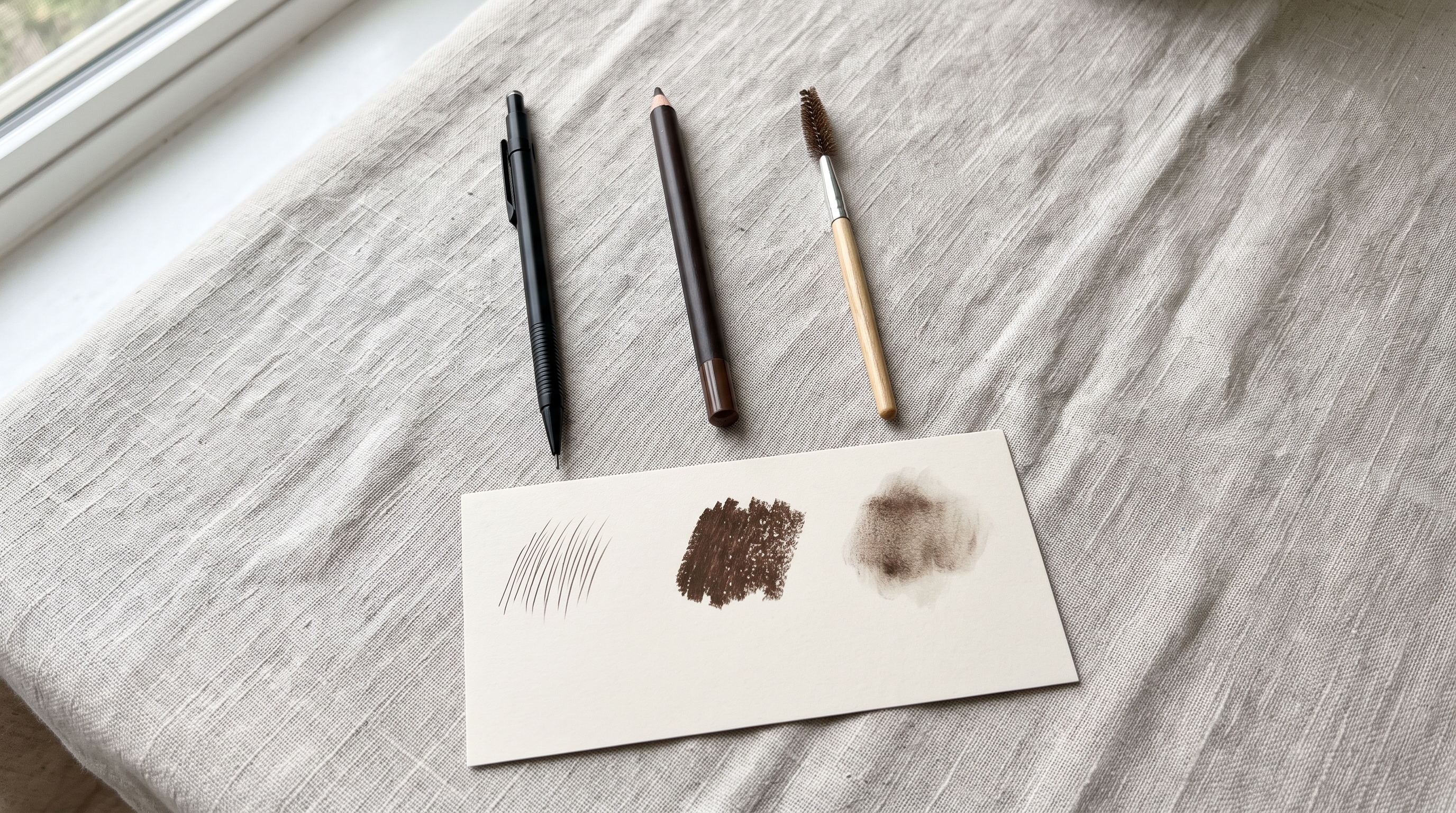
For genuinely sparse brows, choose a tip around one millimetre or finer. It can draw short tapered marks between surviving hairs. A broad triangular pencil is faster when most hair remains and you only need soft background density, but it is difficult to make convincing individual strokes with its flat face.
A useful compromise is a slim oval tip: use the edge for hair strokes and the side for a faint shadow through the fuller inner brow.
2. Wax-to-pigment balance
Very hard pencils skip on dry skin and ask for pressure. Very soft pencils deposit a thick wax line that looks painted and can migrate into forehead texture.
Test on the back of the hand. One light pass should make a visible but not opaque line. Rub it after 30 seconds. It should soften at the edge without smearing into a grey cloud. That balance gives enough adhesion for bare patches while still letting each stroke end cleanly.
A pencil one step lighter than the brow usually looks denser because the strokes blend instead of sitting on top.
3. Undertone
The most common mature-brow mistake is not darkness but warmth. Hair loses melanin and often becomes cooler as it greys, while many brown pencils lean red or orange.
Choose taupe, ash brown, grey-brown or soft charcoal according to the root colour of the remaining hair, not the dyed colour on the lengths of your head hair. A pencil one step lighter than the brow usually looks denser because the strokes blend instead of sitting on top.
4. Wear pattern
Dry skin needs enough wax to grip without scratching. Oilier skin needs a drier pencil plus a light clear gel to lock surviving hairs around the strokes. If the tail disappears first, the issue may be contact from glasses, hair or a sleeping position rather than inadequate pigment.
Map the brow you have now
Use three landmarks as guides, not rigid rules.
The inner brow begins roughly above the inner corner of the eye. Mark this with the faintest vertical strokes; a dark square at the nose is what creates the stamped-on look.
The highest point usually sits around the outer edge of the iris when looking straight ahead, but age studies do not support one universal “youthful” arch. Some found medial and central elevation with age, while others documented change concentrated at the lateral endpoint [3,4]. Follow the surviving hair and facial balance instead of forcing a dramatic lift.
The tail should narrow as it travels outward and should not drop far below the inner brow. Draw the lower tail boundary first, then add three or four upward-diagonal strokes. Stop before it looks complete and step back from the mirror.
A stroke method that survives daylight
Brush all hairs upward with a spoolie. This reveals the true gaps and prevents you from colouring skin that was already covered.
Start at the tail, where the brow needs the most structure. Draw short strokes in the same direction as neighbouring hairs. Use less pressure through the arch, then almost none at the inner third. Brush through once to break any continuous lines.
If you can see the outline before you see the hairs, soften the upper edge with the clean spoolie.
Now look from arm’s length in indirect daylight. The brow should read as one shape while the strokes remain difficult to identify. If you can see the outline before you see the hairs, soften the upper edge with the clean spoolie.
Avoid drawing a solid line beneath the entire brow. That technique can look crisp in a magnifying mirror but separates the brow from the face at conversational distance.
Pencil, powder, pen or gel?
Micro-pencil is the most versatile choice for sparse mature brows. It controls shape and creates believable gaps between marks.
Powder gives a soft background when the brow is diffuse rather than patchy. It is less convincing on a completely bare tail because powder cannot imitate a hair edge.
Felt-tip brow pen makes the finest strokes, but it demands a steady hand and clean, oil-free skin. Test the undertone carefully; some pens oxidize warmer or darker after drying.
Tinted gel is best when hairs remain but have turned grey or lie flat. It colours and positions existing hair; it cannot construct a missing section by itself.
Most mature brows need two light functions rather than one heavy product: a pencil for gaps and clear or lightly tinted gel for the hair that remains. The same restraint is useful across eye makeup for mature women and hooded-eye makeup.
Know when a pencil is only camouflage
Gradual, symmetric thinning can be part of aging. Sudden loss, scaling, redness, a sharply receding hairline or loss concentrated in the outer third deserves medical assessment rather than a better pencil. The clinical review of eyebrow alopecia specifically covers thyroid, autoimmune and inflammatory causes that require diagnosis [2].
For age-related hypotrichosis, a randomized split-face trial found that 2% topical minoxidil increased eyebrow diameter and hair count compared with placebo over 16 weeks [5]. That does not make it a universal DIY recommendation near the eyes. Discuss treatment with a clinician, particularly if you have eye disease, sensitive skin or an unexplained pattern of loss.
The skin beneath the pencil still matters
A pencil replaces the appearance of hair. It does not correct dry, folded or sun-damaged skin around the brow, and Nanoretinol does not regrow eyebrow hair. Keeping those jobs separate prevents exaggerated claims.
Nanoretinol can support the surrounding canvas. Its 0.2% retinol is encapsulated in biomimetic lipid nanoparticles designed to cross the epithelial barrier without the destructive penetration approach used by conventional retinol formulas. In North Biomedical’s study it delivered 232% greater collagen recovery and 73% greater elastin recovery than conventional retinol; clinical use increased skin firmness by 61% and elasticity by 56% over 56 days [6]. It is suitable for the eye contour, though it should never enter the eye.
Smoother, firmer skin helps a fine pencil stroke sit cleanly. The pencil still does the immediate work; skincare changes the surface gradually.
The simplest buying rule
Choose a fine, moderately waxy pencil in a cool shade close to the roots of your remaining brow hairs. If you have plenty of hair but little definition, choose powder or gel instead. If a tail is missing, prioritize a precise tip over convenience.
Then use fewer strokes than the magnifying mirror tells you to. The best eyebrow pencil for older women is the one that gives the face back its frame without announcing where the real hair ends.
References
- Rinaldi F, Trink A, Mondadori G, Giuliani G, Pinto D. “The Menopausal Transition: Is the Hair Follicle ‘Going through Menopause’?” Biomedicines. 2023;11(11):3041. doi:10.3390/biomedicines11113041
- Nguyen B, Hu JK, Tosti A. “Eyebrow and Eyelash Alopecia: A Clinical Review.” American Journal of Clinical Dermatology. 2022;23(2):187-200. doi:10.1007/s40257-022-00729-5
- Park J, Yun S, Son D. “Changes in Eyebrow Position and Movement with Aging.” Archives of Plastic Surgery. 2017;44(1):65-71. doi:10.5999/aps.2017.44.1.65
- Kraus D, Formoly E, Iblher N, Stark GB, Penna V. “A Morphometric Study of Age- and Sex-Dependent Changes in Eyebrow Height and Shape.” Journal of Plastic, Reconstructive & Aesthetic Surgery. 2019;72(6):1012-1019. doi:10.1016/j.bjps.2019.01.011
- Lee S, Tanglertsampan C, Tanchotikul M, Worapunpong N. “Minoxidil 2% Lotion for Eyebrow Enhancement: A Randomized, Double-Blind, Placebo-Controlled, Split-Face Comparative Study.” Journal of Dermatology. 2014;41(2):149-152. doi:10.1111/1346-8138.12275
- North Biomedical LLC. “Nanoretinol vs. Conventional Retinol: Efficacy in Collagen and Elastin Recovery.” Clinical Study Summary. 2024. Study Summary