Best Moisturizer for Dry Menopausal Skin: What Hormonal Dryness Actually Needs
Why the cream that worked at 40 stops working at 52, and what to look for instead
The complaint is almost always phrased the same way: the moisturizer stopped working. Not “I need a richer cream” — the jar that was perfect for a decade now vanishes in ninety seconds and leaves the skin feeling tight by mid-morning.
The moisturizer did not change. The wall it was applied to did. And the reason most “menopause moisturizer” shopping goes wrong is that two different losses are happening at once, and a cream can only reach one of them.
The two things menopausal skin loses
The first loss is at the surface. Falling estrogen reduces sebum output and changes the composition of the intercellular lipids that seal the stratum corneum. A 2005 review of estrogen and skin documents the full picture — epidermal thinning, declining dermal collagen, diminished moisture, and reduced laxity, all mediated through estrogen receptors present on keratinocytes and fibroblasts themselves [1]. Your skin is not merely getting older. It is an estrogen-responsive organ that has lost its signal.
That the mechanism is hormonal rather than environmental shows up clearly in intervention data. In a study of perimenopausal women, transdermal estrogen therapy significantly increased the water-holding capacity of the stratum corneum at a stressed skin site compared with untreated controls [2]. The ability to hold water tracked the hormone.
The second loss is structural and deeper. Thigh skin collagen content in 69 untreated postmenopausal women declined significantly with years since menopause — and in 37 women on hormone implants for two to ten years, that decline did not happen [3]. The important detail is the clock being used. The decline tracked years since menopause rather than chronological age, which is why two women the same age can have visibly different skin firmness.
No moisturizer reaches that second layer. Accepting that upfront is what makes the rest of the decision rational.
Our guide to menopause skin dryness covers the barrier chemistry in more depth, and damaged skin barrier explains what repair actually looks like in practice.
Buy for the lipid classes, not the label
Generic dry-skin formulas are built for a barrier that is depleted. Menopausal skin has a barrier that has been restructured. When tape-stripped stratum corneum from women of different ages was analysed, every major lipid class was significantly reduced with increasing age — ceramides most of all — and the remaining ceramides carried a shifted profile that packs less tightly [4]. The same study found lipid levels dropped further in winter than in spring or summer, which is the physiological basis for a complaint that gets dismissed as seasonal grumbling.
This gives you a concrete buying filter. The useful product replaces what is missing in something close to its physiological ratio: ceramides with cholesterol and free fatty acids alongside them, not ceramides as a single name on the front of a box. Cholesterol is not optional — lay down brick without enough mortar and the wall is still leaky. Our guide to menopause skin dryness covers the barrier chemistry in more depth, and damaged skin barrier explains what repair actually looks like in practice.
A second filter: fatty-acid profile. Skin that has lost sebum output needs emollient lipids that sit in the barrier, not just an occlusive film over the top of it. A heavy petrolatum layer will stop water escaping tonight and contribute nothing to rebuilding the mortar.
Why the humectant can work against you
The ingredient most people reach for when skin feels tight is a humectant, and in a dry room it can make things worse. Humectants draw water by a concentration gradient, and when ambient humidity is low enough, a surface film of pure humectant pulls moisture from the deeper layers of the skin toward the air instead of the other way round.
Glycerol is the instructive exception, and the reason is mechanistic rather than marketing. A review of glycerol in skin describes a pathway that does not depend on atmospheric water uptake at all: endogenous glycerol is delivered from the dermis into the epidermis through the aquaporin-3 channel, and its contribution to hydration, elasticity, and barrier repair is tied to lipid-phase behaviour rather than surface hygroscopicity [5]. That is why glycerin holds up in a dry winter bedroom where a humectant-dominant serum leaves skin tighter than before.
A product can be genuinely good and still have never been tested on the physiology you are buying it for.
Practical consequence: in menopausal skin, the humectant belongs underneath a lipid layer that holds it in place, not on its own. The order matters more than the price of either step.
What the marketing will not tell you
Most products sold for menopausal dryness were trialled on xerosis — ordinary dry skin — in a mixed-age population. Being effective in that trial says nothing about performance on a barrier whose ceramide chain lengths have shifted and whose sebum output has fallen. A product can be genuinely good and still have never been tested on the physiology you are buying it for.
So when a jar carries the word menopause on the front, the question worth asking is whether anything inside it is different from the brand’s standard dry-skin cream. Often the answer is the label.
The half a cream cannot do
Comfort and firmness are different problems, and conflating them is how people end up with six jars and the same slack, papery skin. A well-built barrier cream will fix tightness, flaking, and that stripped feeling after cleansing. It will not put collagen back into the dermis, because the dermis is not where it lands. Menopause skin care as a whole has to cover both layers, and estrogen and skin explains why hydration behaves differently once the hormonal signal falls away.
For the structural half there is one topical with direct human evidence in chronologically aged skin rather than sun-damaged skin, which is the relevant distinction here. In a randomised, double-blind, vehicle-controlled trial in 36 elderly subjects, 0.4% retinol applied up to three times a week for 24 weeks produced significant improvement in fine wrinkling against vehicle, with increased glycosaminoglycan expression and increased procollagen I synthesis in the treated skin [6]. That is new matrix being built, measured in biopsies, in skin aged by time rather than by sun.
The obstacle has always been tolerance. Conventional retinol formulations rely on solvents and petroleum derivatives that disrupt the epithelial barrier in order to get the active through it — a destructive mechanism, and precisely the wrong thing to do to skin that is already lipid-poor. This is the reason menopausal skin has the highest retinoid abandonment rate of any group.
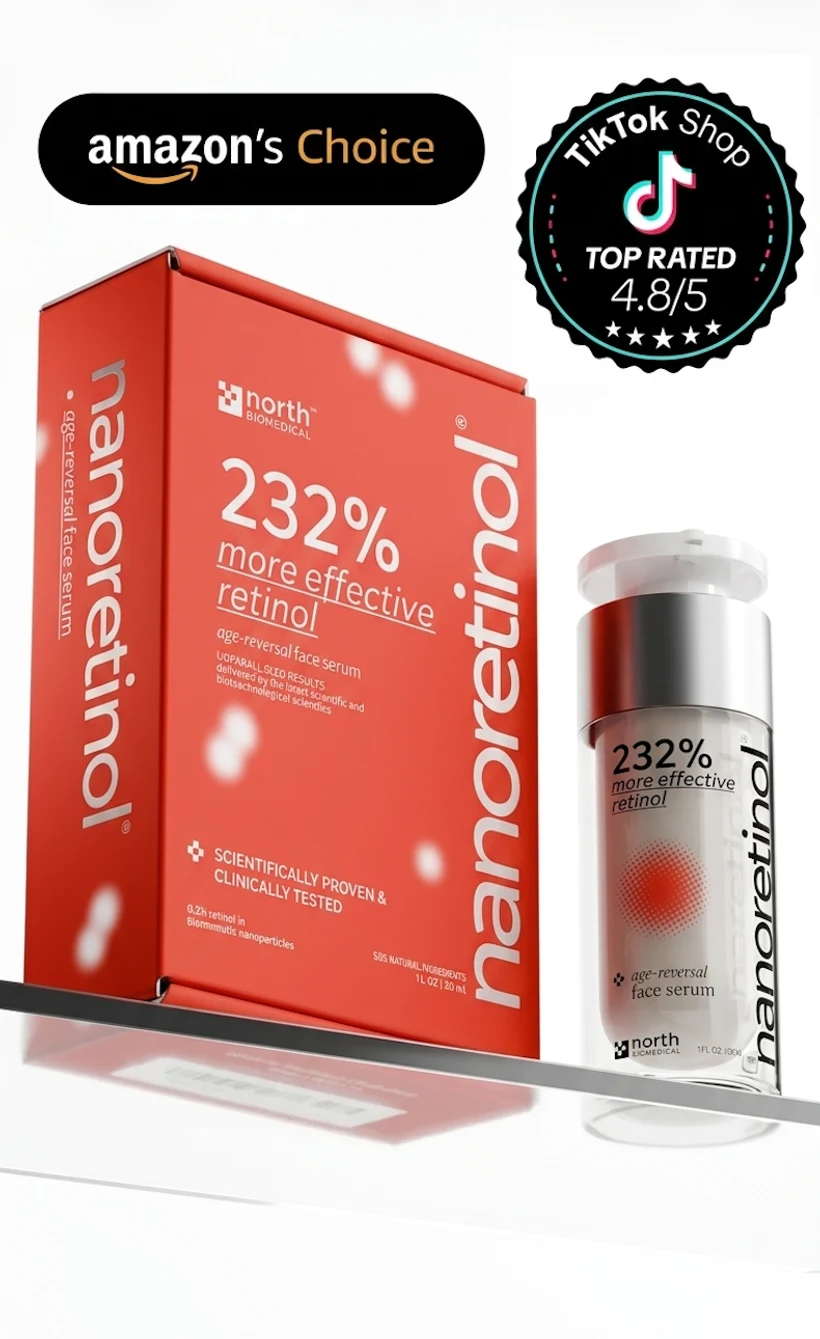
Nanoretinol was built around that problem. Its retinol sits inside biomimetic lipid nanoparticles that are externally similar enough to skin cells that the body recognises them as “self” and permits passage through the epithelial barrier, so nothing has to be stripped to let the active in. The formulation is water-based, gel-like, 99% natural ingredients, and suitable for sensitive skin. In North Biomedical’s clinical study it was 232% more effective than conventional retinol in collagen recovery and 73% more effective in elastin recovery, with a 61% increase in skin firmness and a 56% increase in elasticity over 56 days. Used at night under the barrier cream, it addresses the layer the cream was never going to reach.
Putting It Together
Choose the moisturizer for what the barrier has actually lost: ceramides in physiological ratio with cholesterol and fatty acids, emollient lipids rather than a bare occlusive film, and glycerin doing the humectant work underneath rather than a light humectant serum on its own. Expect that product to restore comfort within a couple of weeks, and expect it to do nothing for firmness — that is a separate job, handled nightly, by something built to survive a compromised barrier rather than breach it.
References
- Hall G, Phillips TJ. “Estrogen and skin: the effects of estrogen, menopause, and hormone replacement therapy on the skin.” Journal of the American Academy of Dermatology. 2005;53(4):555-568. doi:10.1016/j.jaad.2004.08.039
- Piérard-Franchimont C, Letawe C, Goffin V, Piérard GE. “Skin water-holding capacity and transdermal estrogen therapy for menopause: a pilot study.” Maturitas. 1995;22(2):151-154. doi:10.1016/0378-5122(95)00924-A
- Brincat M, Moniz CF, Kabalan S, Versi E, O’Dowd T, Magos AL, Montgomery J, Studd JW. “Decline in skin collagen content and metacarpal index after the menopause and its prevention with sex hormone replacement.” British Journal of Obstetrics and Gynaecology. 1987;94(2):126-129. doi:10.1111/j.1471-0528.1987.tb02338.x
- Rogers J, Harding C, Mayo A, Banks J, Rawlings A. “Stratum corneum lipids: the effect of ageing and the seasons.” Archives of Dermatological Research. 1996;288(12):765-770. doi:10.1007/BF02505294
- Fluhr JW, Darlenski R, Surber C. “Glycerol and the skin: holistic approach to its origin and functions.” British Journal of Dermatology. 2008;159(1):23-34. doi:10.1111/j.1365-2133.2008.08643.x
- Kafi R, Kwak HS, Schumacher WE, Cho S, Hanft VN, Hamilton TA, King AL, Neal JD, Varani J, Fisher GJ, Voorhees JJ, Kang S. “Improvement of naturally aged skin with vitamin A (retinol).” Archives of Dermatology. 2007;143(5):606-612. doi:10.1001/archderm.143.5.606