
Anti-Wrinkle Serum for Sensitive Skin: Why the Vehicle Decides
Most people who react to an anti-aging serum are reacting to something other than the ingredient on the front of the bottle.
There is a specific kind of skincare history behind this search. Someone bought a well-reviewed anti-aging serum, used it for four or five nights, and ended up with a face that stung, flushed and flaked. They stopped. They concluded that anti-aging actives are not for them, and they have been using gentle products with no measurable effect on wrinkles ever since.
That conclusion is usually wrong, and it is wrong for a reason that almost never appears on a product label.
Sensitive skin is a real, measurable thing
It is worth establishing that this is not imagination or low pain tolerance. Sensitive skin has been characterised in the clinical literature for decades, and reviews of the condition describe a consistent picture: heightened neurosensory response, a barrier that is more permeable than average, and symptoms of stinging, burning and tightness triggered by products that most people tolerate without comment [1].
It is also more common than the labelling on the shelf would suggest. Work comparing self-reported sensitivity against the lactic acid sting test, the standard provocation assay, found the two measures capture overlapping but genuinely different populations [2]. Some people who report sensitivity do not sting on testing, and some people who sting have never described themselves as sensitive. The practical implication is that you cannot rule yourself in or out by intuition, and a product that stings you is giving you real information regardless of what any label promises.
The active gets blamed for the vehicle’s work
Here is the misattribution at the centre of the problem. When a serum causes a reaction, people name the headline ingredient. In a large share of cases the culprit is somewhere else in the formula.
Fragrance and preservatives are the two most consistently implicated groups in cosmetic contact reactions, and clinical reviews of allergic contact dermatitis to cosmetics place them at the top of the list year after year [3]. Beyond true allergy, there is straightforward irritation from formulation choices: high loads of denatured alcohol used to make a serum feel light and fast-drying, essential oils added for scent, penetration enhancers included to push an active through a barrier that in your case is already permeable, and low-pH systems formulated for average skin.
None of these appear in the product name. All of them can produce the burning that gets recorded in memory as “I cannot use retinol.”
Some people who report sensitivity do not sting on testing, and some people who sting have never described themselves as sensitive.
So the first question worth asking about any serum is what else is in there alongside the active. A short ingredient list is a genuine advantage for reactive skin, because every additional component is another thing that might be the problem, and one you would have no way to identify.
Retinoid irritation has a specific mechanism
Retinoids deserve separate treatment, because their irritation is not an allergy and does not behave like one.
Research into the mechanism of retinol-induced irritation shows it as a direct cellular effect of the molecule on the epidermis, distinguishable from allergic sensitisation, and one that anti-irritant strategies can be developed against [4]. In plain terms, the retinoid produces a period of disturbance as it changes how the epidermis behaves. On robust skin that period passes in a few weeks. On skin with an already-permeable barrier, more of the molecule arrives faster and the disturbance is proportionally worse.
Conventional retinol formulations make this considerably harder than it needs to be, because they solve delivery by disrupting the skin barrier to get the molecule through. That is a reasonable engineering choice on average skin and a poor one on a barrier that is the underlying problem. The full picture of that trade-off is in our guide to retinol for sensitive skin.
Ranking the actives by what they cost you
Given all of that, the sensible way to choose is by the ratio of evidence to irritation.
Niacinamide sits at the top for tolerance. It is one of the few actives that improves the barrier while it works, and controlled work showed nicotinamide increasing ceramide and other stratum corneum lipid biosynthesis, with a measurable improvement in epidermal permeability barrier function [5]. Its anti-wrinkle effect is modest next to a retinoid. Its cost in irritation is close to zero, and it makes everything applied afterwards more tolerable, as our niacinamide guide explains.
Clinical testing over 56 days recorded a 61% increase in skin firmness and a 56% increase in skin elasticity.
Peptides are the other well-tolerated option. A controlled clinical study of topical palmitoyl pentapeptide in photoaged facial skin demonstrated measurable improvement against vehicle [6]. Peptides essentially do not sting. The effect is real and it is smaller than a retinoid’s.
Retinoids carry by far the strongest evidence. The foundational work here found that tretinoin applied to photodamaged skin restored collagen formation in the dermis, measured directly rather than judged by appearance [7]. Nothing in the tolerable tier matches that. This is the whole dilemma in one line: the active with the best evidence is the one your skin has already rejected once.
Acids and high-strength vitamin C are where reactive skin most often comes unstuck, and they are the easiest to defer. Neither is required for a wrinkle result.
Repair before you treat
There is a sequencing rule that saves more attempts than any product choice. If your barrier is currently compromised, no active will be tolerated, and starting one will simply reproduce the failure that brought you here.
Two to four weeks of a plain, fragrance-free routine first: a non-foaming cleanser, a moisturiser containing ceramides or cholesterol, and sunscreen. Nothing exfoliating, nothing brightening, nothing active. You are aiming for skin that no longer stings when you apply a basic moisturiser, and our guide to a damaged skin barrier covers the signs that you are there.
Only then introduce one active. Twice a week for a fortnight, then three times, then nightly if it holds. One product at a time, so that if something goes wrong you know what it was.
Where the delivery problem gets solved
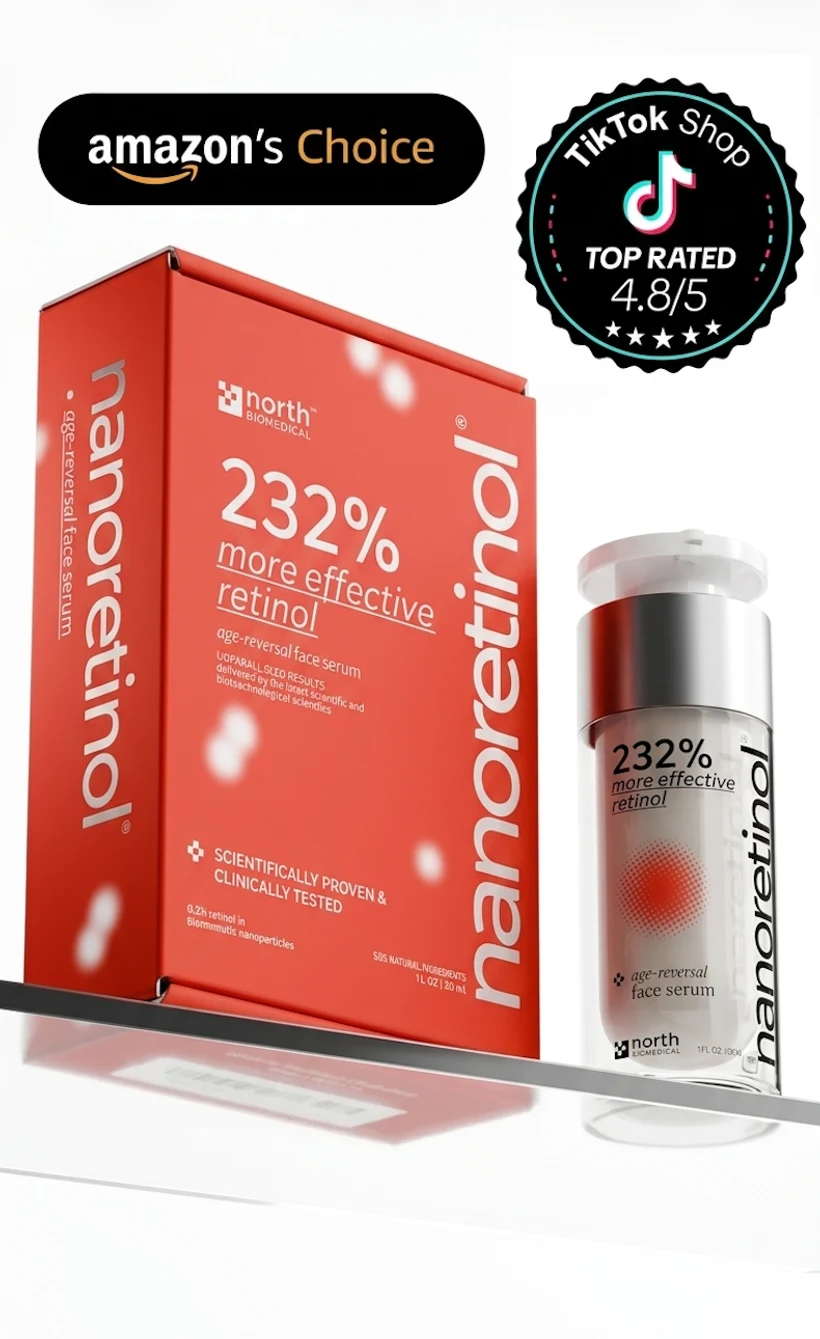
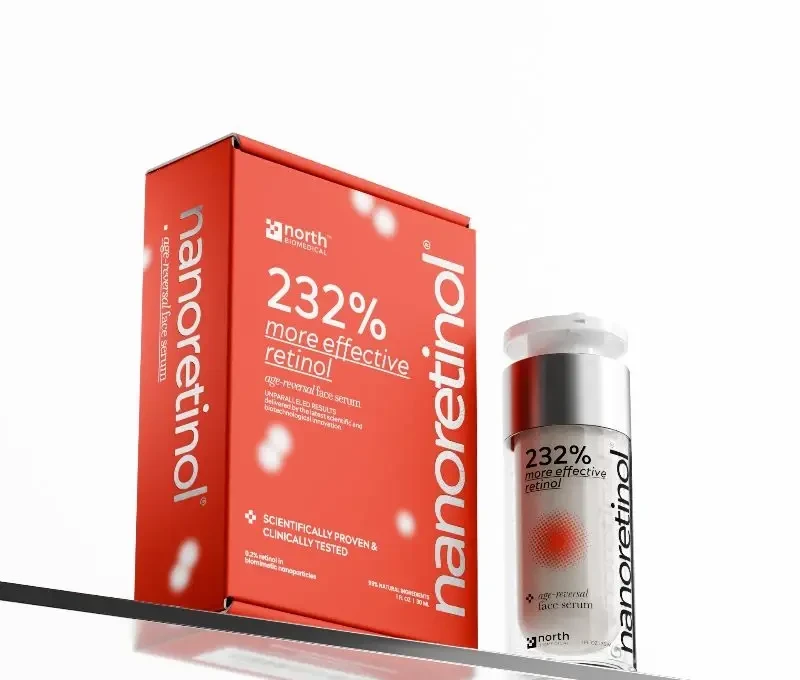
The reason a retinoid irritates reactive skin is a delivery problem rather than a property of retinol itself. Nanoretinol was built on that premise. It carries retinol inside biomimetic lipid nanoparticles that the skin recognises as “self” and allows through the epithelial barrier, so the molecule reaches the living layers without the formulation having to break the barrier down to get it there.
In North Biomedical’s clinical study, the system proved 232% more effective than conventional retinol in collagen recovery and 73% more effective in elastin recovery at a concentration of only 0.2%, with drastically reduced cytotoxicity demonstrated in cellular assays [8]. Clinical testing over 56 days recorded a 61% increase in skin firmness and a 56% increase in skin elasticity. It is water-based rather than oil-based, 99% natural, and suitable for sensitive skin and the eye contour. For a reader whose entire obstacle has been tolerating the delivery rather than tolerating the active, that is the relevant part, and it is worth reading alongside the broader anti-aging serum comparison.
Shopping for one in practice
Read the ingredient list before the claims. Confirm fragrance-free on the packaging. Check the first six ingredients for denatured alcohol and put the bottle back if it is high in the list. Prefer a short formula. Buy one product rather than a system, and give it six weeks before forming a view, because both the irritation and the benefit take longer to declare themselves than most people allow.
The reason gentle routines have not moved your wrinkles is that they contained nothing capable of moving them. The goal is an effective active your skin can actually keep, and the way to get there is to fix the barrier first and then choose the formulation that respects it.
References
- Berardesca E, Farage M, Maibach H. “Sensitive Skin: An Overview.” International Journal of Cosmetic Science. 2013;35(1):2-8. PMID: 22928591
- Pan Y, Ma X, Song Y, Zhao J, Yan S. “Questionnaire and Lactic Acid Sting Test Play Different Role on the Assessment of Sensitive Skin: A Cross-Sectional Study.” Clinical, Cosmetic and Investigational Dermatology. 2021;14:1215-1225. doi:10.2147/CCID.S325166
- Hamilton T, de Gannes GC. “Allergic Contact Dermatitis to Preservatives and Fragrances in Cosmetics.” Skin Therapy Letter. 2011;16(4):1-4. PMID: 21611680
- Kim BH, Lee YS, Kang KS. “The Mechanism of Retinol-Induced Irritation and Its Application to Anti-Irritant Development.” Toxicology Letters. 2003;146(1):65-73. PMID: 14615068
- Tanno O, Ota Y, Kitamura N, Katsube T, Inoue S. “Nicotinamide Increases Biosynthesis of Ceramides as Well as Other Stratum Corneum Lipids to Improve the Epidermal Permeability Barrier.” British Journal of Dermatology. 2000;143(3):524-531. PMID: 10971324
- Robinson LR, Fitzgerald NC, Doughty DG, Dawes NC, Berge CA, Bissett DL. “Topical Palmitoyl Pentapeptide Provides Improvement in Photoaged Human Facial Skin.” International Journal of Cosmetic Science. 2005;27(3):155-160. doi:10.1111/j.1467-2494.2005.00261.x
- Griffiths CE, Russman AN, Majmudar G, Singer RS, Hamilton TA, Voorhees JJ. “Restoration of Collagen Formation in Photodamaged Human Skin by Tretinoin (Retinoic Acid).” New England Journal of Medicine. 1993;329(8):530-535. PMID: 8336752
- North Biomedical LLC. “Nanoretinol vs. Conventional Retinol: Efficacy in Collagen and Elastin Recovery.” Clinical Study Summary, 2024. Study summary