Skin pH: The Number That Quietly Decides Whether Your Skincare Works
Why your face sits at 4.7, what pushes it upward, and how a single alkaline cleanser can undo the rest of your routine
Most skincare advice is about what you put on your face. This one is about a property your face already has, which almost nothing on a label mentions, and which quietly determines whether everything else you apply does its job.
Healthy facial skin is acidic. When researchers measured surface pH on skin left untreated for 24 hours — no cleanser, no product, no tap water — the average landed at 4.7, materially lower than the 5.5 figure the industry had repeated for decades [1]. That single number, and the narrow band around it, is what dermatologists mean by the acid mantle.
For a long time the acid mantle was treated as a curiosity: a side effect of sweat, sebum and skin flora, pleasant enough but not load-bearing. That view is obsolete. Reviews of surface pH and barrier function now place acidity upstream of barrier competence rather than downstream of it [6]. Surface acidity is not a by-product of a healthy barrier. It is one of the mechanisms that builds one.
The enzymes that only work in acid
The stratum corneum is often described as bricks and mortar — flattened corneocytes held in a lipid matrix. The mortar is not applied ready-made. It is assembled on site by enzymes, and those enzymes are pH-sensitive in a way that turns out to be decisive.
A landmark experiment neutralised the surface of otherwise normal skin and watched what happened. Barrier recovery slowed and stratum corneum cohesion fell apart, and the researchers traced both failures to the same cause: at neutral pH, the lipid-processing enzymes beta-glucocerebrosidase and acid sphingomyelinase lost catalytic activity, while serine proteases — which are most active at neutral to alkaline pH — ran unchecked and degraded the corneodesmosomes holding cells together [2].
Read as a single sentence, that is the whole argument. Your skin manufactures ceramides using acid-dependent machinery, and it prevents its own dismantling by keeping the alkaline-preferring machinery idle. Move the surface a full pH unit upward and you have reversed both. It is not a slow drift toward dryness; it is two opposing processes flipping direction together. Our guide to a damaged skin barrier covers what that feels like from the outside.
Your skin manufactures ceramides using acid-dependent machinery, and it prevents its own dismantling by keeping the alkaline-preferring machinery idle.
What pushes your skin alkaline
Overwhelmingly, cleansing. Traditional soap is alkaline by chemistry — it is made by saponification and typically sits between pH 9 and 10. Reviews of skin pH in clinical practice describe the consequences of washing with it: an elevated surface pH that persists for a period afterwards, shifts in the resident microbial community, and increased susceptibility to irritation [3].
The persistence is the part worth internalising. Skin does re-acidify itself, but not instantly. Wash with something alkaline morning and night and you may be spending a meaningful share of each day outside the band where your barrier enzymes function properly. The tight, squeaky feeling people associate with a thorough cleanse is not cleanliness. It is a stripped acid mantle announcing itself.
Hard water contributes for the same reason — it is mildly alkaline and leaves residue behind. So do some leave-on products formulated well above skin pH.
The age problem nobody warns you about
Here is where this becomes an anti-aging topic rather than a general skincare one.
Surface acidification is not maintained equally across a lifetime. In a study of moderately aged human and murine skin, researchers found stratum corneum acidification is impaired with age — the surface sits at a higher pH than young skin does, and that shift was accompanied by the barrier abnormalities you would predict from the enzyme mechanism [4].
This reframes a lot of what people describe as mature skin. Slower barrier recovery, a lower threshold for stinging, more persistent dryness, less tolerance for the actives that used to be fine — these are the documented downstream effects of a rising surface pH, layered on top of the dermal collagen loss everyone already knows about. Two separate clocks, running at once.
If your face feels tight for more than a minute after washing, that is your answer.
What to actually change
The practical implications are narrower than the biology suggests, which is good news.
Fix the cleanser first. It is the single largest pH lever in any routine, and the easiest to change. Syndet and low-pH formulations are engineered to clean at or near skin’s own acidity. If your face feels tight for more than a minute after washing, that is your answer. This matters more than the order of anything else in your routine.
Do not over-cleanse. Frequency multiplies the effect. Two thorough washes a day with an alkaline product is a different exposure from one.
Understand that acids are different from alkalinity. A glycolic or salicylic product sits well below skin pH, not above it, and it is formulated that way deliberately — exfoliating acids need a low pH to remain in their active, uncharged form. The relevant risk with AHAs and BHAs is over-exfoliation and cumulative barrier disruption, not alkalinity. They are a separate problem with a separate solution.
Rebuild the mortar directly. If acid-dependent enzymes have been underperforming, applying the end product they were supposed to make is a reasonable shortcut. Ceramides are the most direct version of that.
Where retinol sits in this picture
Retinol occupies an awkward position in a pH-aware routine, and it is worth being honest about why.
Retinol has to get through the stratum corneum to work, and conventional formulations achieve that using solvents and penetration enhancers that increase lipid mobility in the barrier — they loosen the mortar to let the active through. That is a deliberate compromise, and it lands squarely on the structure that surface acidity exists to protect. It also explains the familiar pattern where retinol irritation is worst in people whose barrier was already compromised, and worst again on skin that is already acidifying poorly with age. Our article on retinol and the skin barrier covers that interaction in detail.
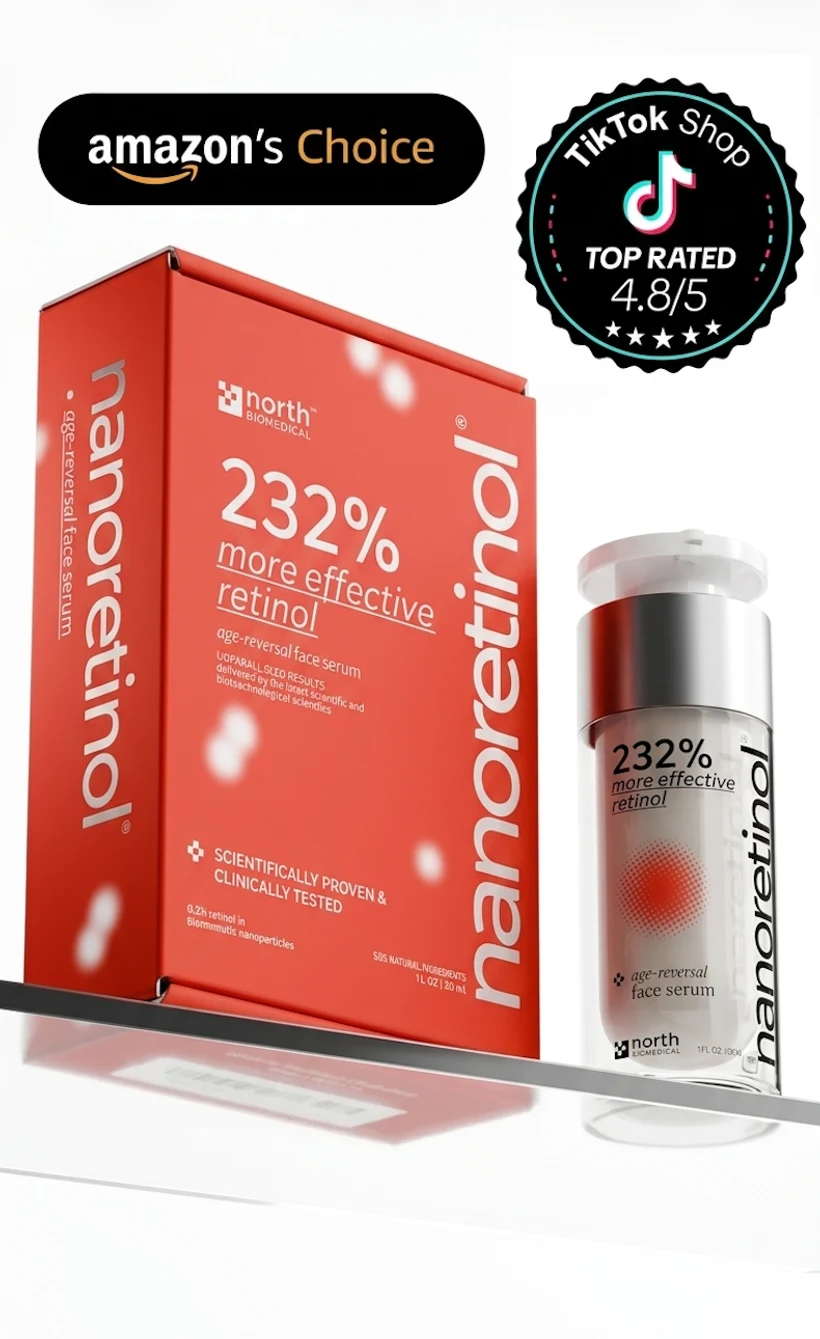
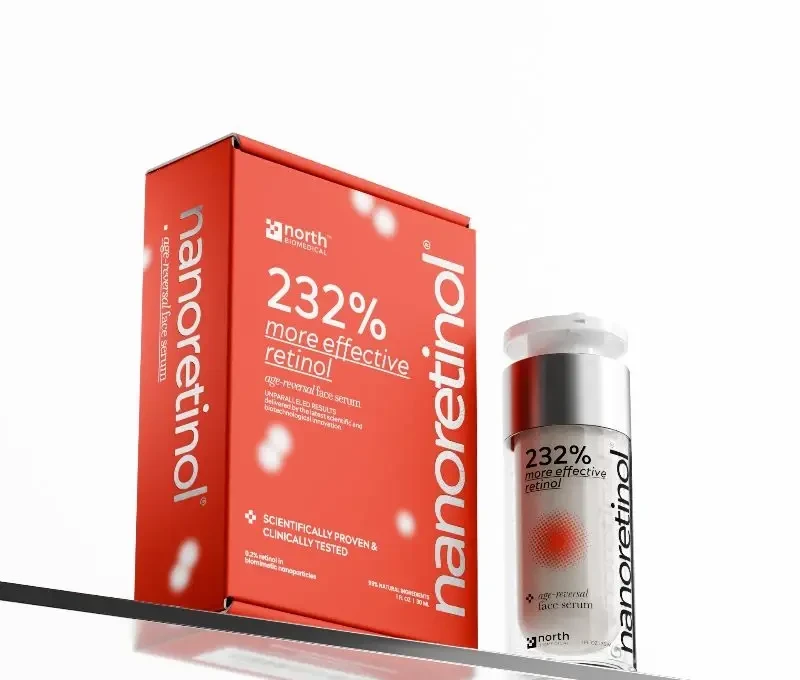
Nanoretinol was built to avoid the compromise rather than manage it. The retinol is carried inside biomimetic lipid nanoparticles that are externally similar to skin cells, so the body recognises them as “self” and permits passage through the epithelial barrier — no chemical loosening, no lipid-mobility trade-off against the mantle you are trying to preserve. In North Biomedical’s clinical study summary, that route delivered 232% greater collagen recovery and 73% greater elastin recovery than conventional retinol, alongside a 61% increase in skin firmness and a 56% increase in elasticity over 56 days of use [5]. The assays also showed drastically reduced cytotoxicity relative to conventional retinol, and trials reported minimal side effects that were milder than conventional retinol’s when they appeared. For skin whose acidification is already slipping, not having to trade barrier integrity for penetration is the entire point.
The short version
You cannot measure your skin’s pH at home and you do not need to. What you need is the rule the measurements point to: keep the surface acidic, and treat anything that pushes it upward — chiefly your cleanser — as the highest-leverage change in your routine. Everything else you apply is working in the environment that decision creates.
References
- Lambers H, Piessens S, Bloem A, Pronk H, Finkel P. “Natural skin surface pH is on average below 5, which is beneficial for its resident flora.” International Journal of Cosmetic Science. 2006;28(5):359-370. doi:10.1111/j.1467-2494.2006.00344.x
- Hachem JP, Crumrine D, Fluhr J, Brown BE, Feingold KR, Elias PM. “pH Directly Regulates Epidermal Permeability Barrier Homeostasis, and Stratum Corneum Integrity/Cohesion.” Journal of Investigative Dermatology. 2003;121(2):345-353. doi:10.1046/j.1523-1747.2003.12365.x
- Ali SM, Yosipovitch G. “Skin pH: From Basic Science to Basic Skin Care.” Acta Dermato-Venereologica. 2013;93(3):261-267. doi:10.2340/00015555-1531
- Choi EH, Man MQ, Xu P, Xin S, Liu Z, et al. “Stratum Corneum Acidification Is Impaired in Moderately Aged Human and Murine Skin.” Journal of Investigative Dermatology. 2007;127(12):2847-2856. doi:10.1038/sj.jid.5700913
- North Biomedical LLC. “Nanoretinol vs. Conventional Retinol: Efficacy in Collagen and Elastin Recovery.” Clinical Study Summary, 2024. northbiomedical.com/documents/Nanoretinol-Study_Summary.pdf
- Schmid-Wendtner MH, Korting HC. “The pH of the Skin Surface and Its Impact on the Barrier Function.” Skin Pharmacology and Physiology. 2006;19(6):296-302. doi:10.1159/000094670