Best Stretch Mark Cream: What the Clinical Evidence Actually Supports
The color of the mark decides which cream can help. Almost no product page tells you that.
There is one question that decides whether a stretch mark cream can do anything for you, and it is not which brand you buy. It is what color your marks are right now.
Red or purple marks and silvery white marks are the same condition at two different stages, and they respond to topical treatment so differently that a product which produces measurable results on one will do essentially nothing for the other. Most packaging ignores this entirely and sells you the same jar either way.
Red marks and white marks are structurally different
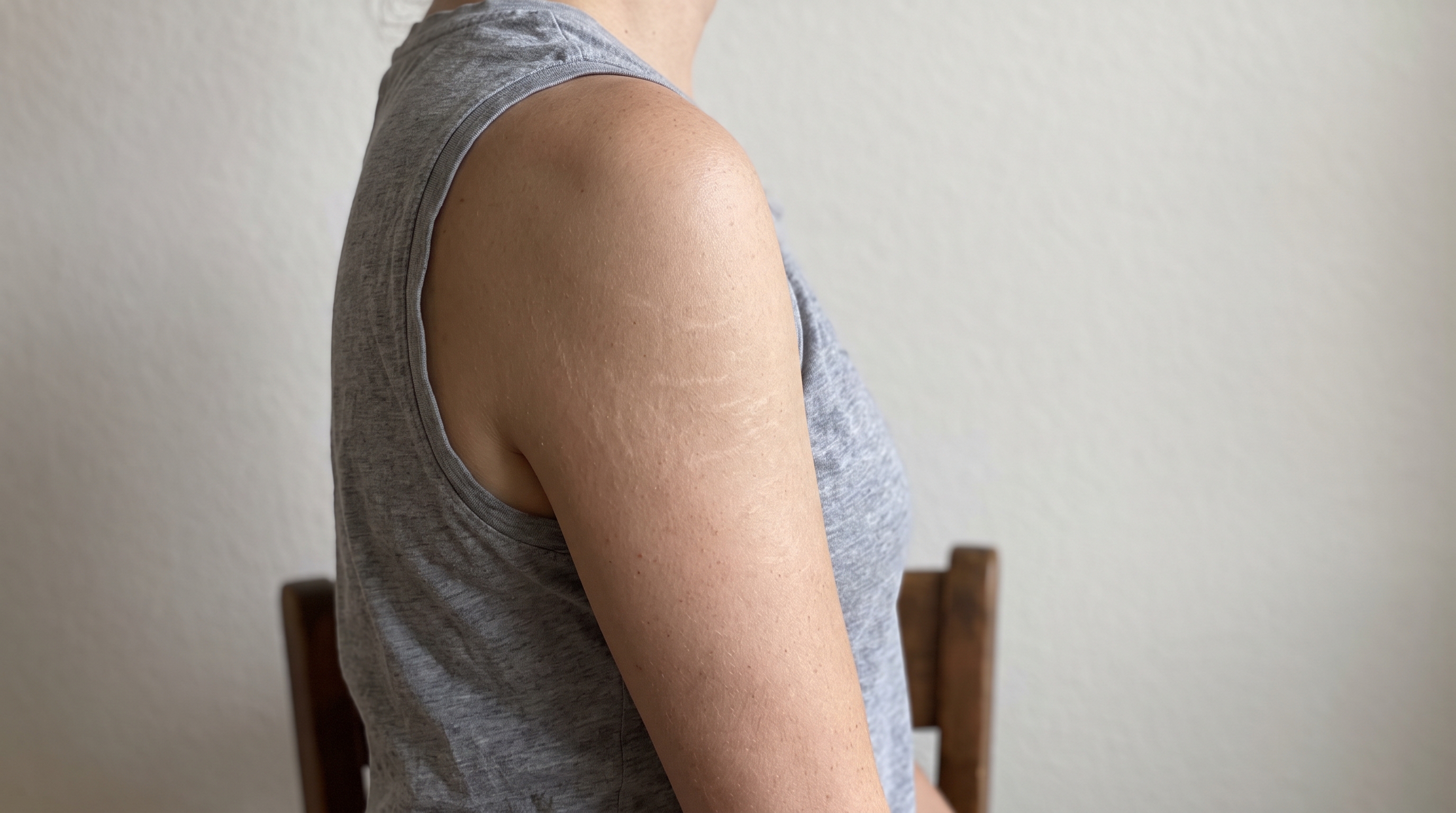
Stretch marks begin as striae rubrae. The skin is inflamed, the capillaries underneath are visible, and the dermal matrix is actively breaking down. Over months to years they mature into striae albae: flat, pale, slightly depressed, and structurally closer to a settled scar.
The difference is visible under a microscope. Skin showing striae has significantly reduced fibrillin microfibrils and depleted elastin in the papillary dermis compared to adjacent normal skin [1]. In the red phase that damage is still in motion. In the white phase the remodeling has largely finished and what remains is an atrophic dermis with a reorganized collagen architecture.
If you want the full picture of every option including the in-office ones, the broader guide to stretch mark treatments covers the devices too. This piece is about what you can buy in a tube.
The strongest topical evidence is retinoid evidence
The best-documented result in this category is old and still unmatched. In a six-month double-blind randomized trial, 0.1% topical tretinoin produced definite or marked improvement in 80% of patients compared with 8% on vehicle. Treated marks measurably shrank, decreasing about 14% in length and 8% in width, while the vehicle group’s marks continued to worsen [2].
Stretch marks developed in 34% of the treated group against 56% on placebo, and severity scores came in lower as well.
That is a large effect for a topical, and it is specific to early marks. The trial studied striae rubrae, and the mechanism explains why: retinoids drive fibroblast activity and new collagen deposition, which is useful while the dermis is still actively remodeling.
A network meta-analysis of striae treatments later ranked topical tretinoin combined with bipolar radiofrequency at the top for both clinical effectiveness and patient satisfaction across the reviewed therapies [3]. Retinoid chemistry keeps showing up at the top of these rankings.
Two other actives with real trial data
Centella asiatica. A double-blind trial in 80 pregnant women tested a cream containing Centella asiatica extract with alpha-tocopherol and collagen-elastin hydrolysates. Stretch marks developed in 34% of the treated group against 56% on placebo, and severity scores came in lower as well [4]. This is prevention data rather than treatment data, which is a meaningful distinction, but it is one of the few positive controlled results in the category.
Hyaluronic acid. In a 12-week randomized trial on striae rubrae, a 0.1% hyaluronic acid gel outperformed both vitamin E oil and no treatment on color, atrophy, and overall severity [5]. Again the population was red marks, not white ones.
What the trials rule out
Cocoa butter is the clearest negative result available. A double-blind placebo-controlled trial randomized 210 pregnant women to cocoa butter lotion or placebo. Stretch marks appeared in 45.1% of the cocoa butter group and 48.8% of the placebo group, a difference that did not approach significance [6].
That does not make it a bad moisturizer. It makes it an ineffective stretch mark treatment, and it is the single most heavily marketed ingredient in the category.
Stretch marks appeared in 45.1% of the cocoa butter group and 48.8% of the placebo group, a difference that did not approach significance.
If your marks are already white
Be honest with yourself about the ceiling here. Once marks turn pale and atrophic, topicals have very little published success, and the evidence shifts toward procedures that create controlled injury. In a randomized study of striae alba, five monthly microneedling sessions significantly increased dermal collagen and elastic fibers, performing on par with non-ablative fractional laser [7].
A cream still has a supporting role. Keeping the area well hydrated and consistently treated with a retinoid can improve texture and tone at the margins. It will not refill an atrophic dermis on its own.
The pregnancy split people get wrong
This is where the category gets genuinely confusing, because the highest-evidence ingredient is off the table for a large share of the people shopping.
Retinoids are not used during pregnancy or breastfeeding. So the pregnancy shelf and the retinoid shelf are two different shelves. During pregnancy, the defensible options are the Centella-type formulations with prevention data and simple consistent hydration. The retinoid conversation belongs to the period after, when marks are frequently still in the red phase and most responsive.
Timing matters more than product choice. The people who see the best results are the ones who start while the marks are still discolored, not the ones who wait until the marks settle and then go looking for a miracle.
Where delivery becomes the limiting factor
Body skin is the practical problem with retinoids for striae. Marks usually cover the abdomen, hips, thighs, or breasts, which is a large surface area, and the conventional prescription-strength approach produces irritation that many people cannot sustain nightly across that much skin. Treatment stops, and the window closes.
This is a delivery problem rather than a molecule problem. Nanoretinol encapsulates retinol in biomimetic lipid nanoparticles that pass through the epithelial barrier because the body recognizes them as “self,” instead of penetrating by breaking that barrier down the way conventional formulations do. North Biomedical’s clinical study found the system 232% more effective than conventional retinol in collagen recovery and 73% more effective in elastin recovery at a concentration of just 0.2% [8], and the encapsulation makes it significantly gentler on skin cells, with clinical trials confirming minimal and milder side effects. Collagen and elastin recovery is precisely the axis striae sit on.
It is water-based and absorbs completely, which matters when you are covering a hip or an abdomen rather than a face. It is not for use during pregnancy or breastfeeding, and applying it to broad body areas is the same commitment described in the guide to retinol below the neck.
How to actually choose
Look at your marks in daylight. If there is any red, pink, or purple in them, you are in the window where topicals have published results, and a retinoid is the evidence-backed choice unless you are pregnant or nursing. If you are, use a Centella-based formulation and keep the area hydrated. If your marks are white and have been for years, spend your money on a procedure consultation and use the cream to support it.
Whatever you pick, give it six months. Every trial that produced a real result ran that long, and there is no version of this where collagen rebuilds in three weeks. The same patience applies to rebuilding collagen anywhere and to the skin changes that follow significant weight loss.
References
- Watson RE, Parry EJ, Humphries JD, Jones CJ, Polson DW, Kielty CM, Griffiths CE. “Fibrillin Microfibrils Are Reduced in Skin Exhibiting Striae Distensae.” British Journal of Dermatology. 1998;138(6):931-937. doi:10.1046/j.1365-2133.1998.02257.x
- Kang S, Kim KJ, Griffiths CE, Wong TY, Talwar HS, Fisher GJ, Gordon D, Hamilton TA, Ellis CN, Voorhees JJ. “Topical Tretinoin (Retinoic Acid) Improves Early Stretch Marks.” Archives of Dermatology. 1996;132(5):519-526. doi:10.1001/archderm.1996.03890290053007
- Lu H, Guo J, Hong X, Chen A, Zhang X, Shen S. “Comparative Effectiveness of Different Therapies for Treating Striae Distensae: A Systematic Review and Network Meta-Analysis.” Medicine (Baltimore). 2020;99(39):e22256. doi:10.1097/MD.0000000000022256
- Mallol J, Belda MA, Costa D, Noval A, Sola M. “Prophylaxis of Striae Gravidarum with a Topical Formulation: A Double Blind Trial.” International Journal of Cosmetic Science. 1991;13(1):51-57. doi:10.1111/j.1467-2494.1991.tb00547.x
- Ud-Din S, McAnelly SL, Bowring A, Whiteside S, Morris J, Chaudhry I, Bayat A. “A Double-Blind Controlled Clinical Trial Assessing the Effect of Topical Gels on Striae Distensae (Stretch Marks): A Non-Invasive Imaging, Morphological and Immunohistochemical Study.” Archives of Dermatological Research. 2013;305(7):603-617. doi:10.1007/s00403-013-1336-7
- Osman H, Usta IM, Rubeiz N, Abu-Rustum R, Charara I, Nassar AH. “Cocoa Butter Lotion for Prevention of Striae Gravidarum: A Double-Blind, Randomised and Placebo-Controlled Trial.” BJOG: An International Journal of Obstetrics & Gynaecology. 2008;115(9):1138-1142. doi:10.1111/j.1471-0528.2008.01796.x
- Naspolini AP, Boza JC, da Silva VD, Cestari TF. “Efficacy of Microneedling Versus Fractional Non-ablative Laser to Treat Striae Alba: A Randomized Study.” American Journal of Clinical Dermatology. 2019;20(2):277-287. doi:10.1007/s40257-018-0415-0
- North Biomedical LLC. “Nanoretinol vs. Conventional Retinol: Efficacy in Collagen and Elastin Recovery.” Clinical Study Summary, 2024. Study summary