How Long Does It Take for Tretinoin to Work? The Clinical Timeline
What the trial data says about weeks 4, 12 and 24, and why a higher strength does not buy you speed
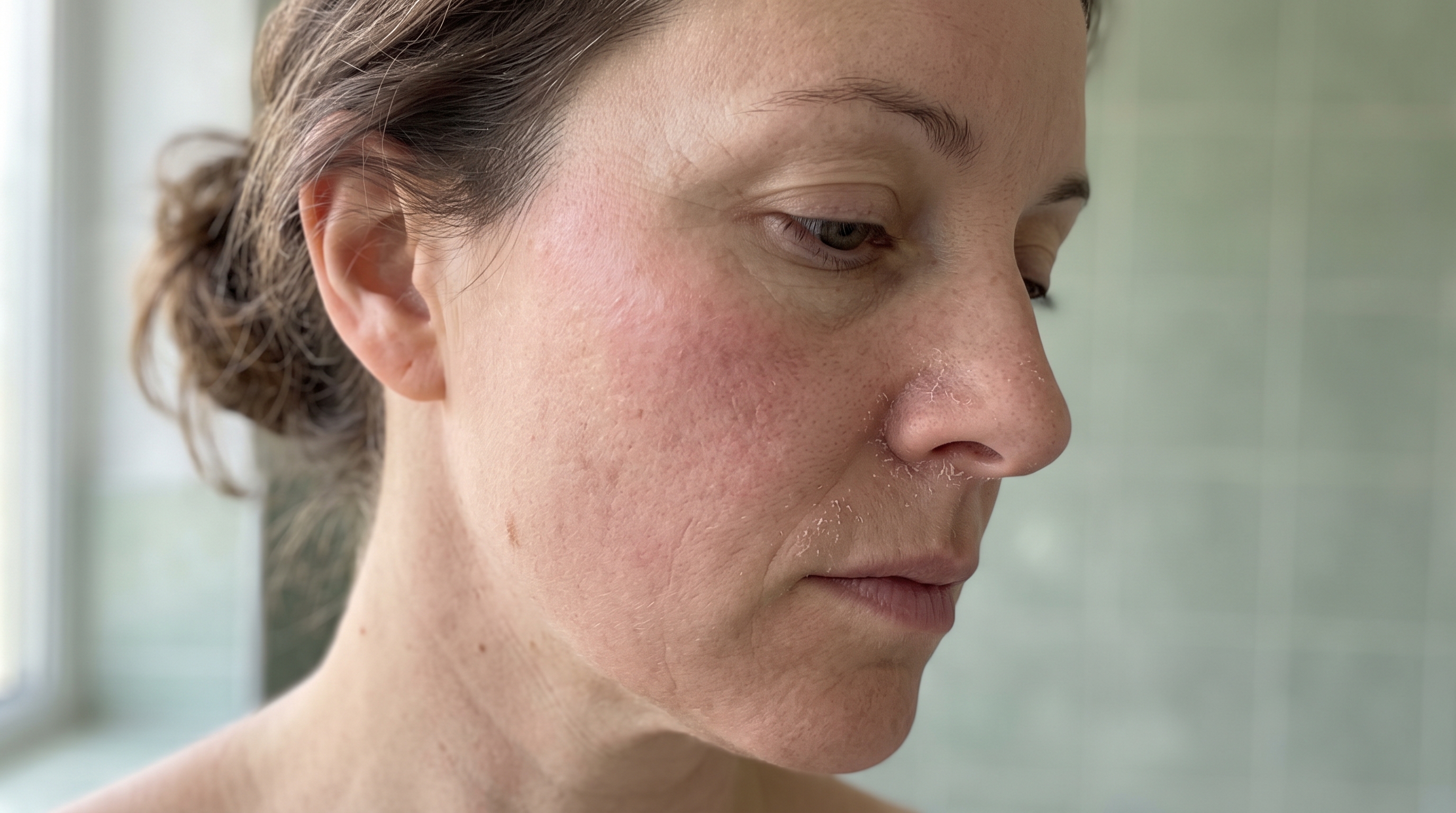
Six weeks in, your skin is flaking at the sides of your nose, you have two new spots along your jaw, and the fine lines you filled the prescription for look exactly as they did in July. That is the week most people start searching for how long it takes for tretinoin to work.
The usual answer, “give it 12 weeks,” is not wrong so much as unfinished. Tretinoin does at least four different jobs on four different clocks, and the 12-week figure belongs to only one of them. The trial data going back to 1986 is unusually specific about which change arrives when, which means you can stop guessing whether your tube is working and start checking it against a calendar.
What “Working” Means Changes the Answer
Tretinoin is retinoic acid itself, the active form your skin has to manufacture when you apply an over-the-counter retinol. Because it needs no conversion, it binds nuclear retinoic acid receptors directly and changes gene expression in keratinocytes and fibroblasts from the first application [9].
What follows happens in a fixed order, and the order is the reason people misjudge the timeline. Faster epidermal turnover comes first. Pigment redistribution comes next. New dermal collagen, the change that actually alters how a wrinkle sits, comes last and takes the better part of a year [4]. Judging a 12-week result by a 12-month endpoint is the most common way to conclude that a working prescription has failed.
Weeks 1 to 4: The Retinization Tax
Nothing you want is visible yet. What is visible is retinoid dermatitis: dryness, fine flaking around the nose and mouth, a tight or stinging feeling, sometimes mild redness. In the melasma trials, this affected 67% of the tretinoin group [7]. It is expected, it is dose-dependent, and it is not damage.
If you break out during this window, that is the accelerated turnover pushing existing microcomedones to the surface, the same phenomenon described in more detail in our guide to the retinol purge. Both the purge and the flaking settle as the epidermis adapts to a faster turnover rate.
Almost nobody quits tretinoin because it failed; they quit during the weeks when it is working invisibly and feeling terrible.
The practical move here is not to push through at full frequency. It is to drop to alternate nights, buffer with a plain moisturizer, and keep the tube in the routine. Adherence during weeks 1 to 8 is the single largest predictor of whether you will ever see the 6-month result.
Weeks 8 to 12: The First Honest Signal
This is where measurable change starts showing up in controlled studies. Kligman’s original photoaging work and the 16-week randomized trial that followed both found statistically significant improvement in photoaging by the end of week 16, with histologic changes in treated skin that were absent in vehicle-treated skin [1] [2].
What you should be able to see by week 12: skin that reflects light more evenly, a smoother feel under the fingertips, small rough patches resolving, and early fading of the most superficial pigment. What you should not expect: any change in an established wrinkle.
Weeks 16 to 24: Fine Lines and Tone
The 24-week multicenter trial of 296 people with photodamaged facial skin is the cleanest read on this phase. At the end of 24 weeks, 68% of the 0.05% tretinoin group had improved versus 43% on vehicle, with fine wrinkling, mottled hyperpigmentation and roughness all significantly better than control [3].
Two details in that study matter for expectation setting. Only 26% of the treated group were rated an excellent or good response, so “improved” usually means visibly better rather than transformed. And the 0.01% and 0.001% concentrations were statistically indistinguishable from vehicle, which tells you there is a floor below which tretinoin simply does not do the job.
Doubling the strength of your tretinoin does not halve the wait, but it reliably doubles the reason you will stop using it.
Months 10 to 12: The Collagen Payoff
The change worth waiting for is structural. Photodamaged skin contains 56% less newly formed collagen I in the papillary dermis than sun-protected skin from the same person. After 10 to 12 months of daily 0.1% tretinoin, collagen I formation rose by 80%, while vehicle-treated skin lost 14% [4].
That is the mechanism behind every before-and-after photo worth looking at, and it is why the honest answer to the timeline question is measured in seasons. A parallel version of this arc for over-the-counter strengths is laid out in our retinol timeline.
Strength Does Not Buy Speed
The assumption that 0.1% works roughly four times faster than 0.025% has been tested directly. In a 48-week double-blind comparison, 99 people used 0.1% tretinoin, 0.025% tretinoin or vehicle. Both concentrations produced significant overall improvement in facial photoaging, and there were no clinically or statistically significant differences in efficacy between them. Epidermal thickening was 30% and 28% respectively. What did differ was irritation [5].
So the strength question resolves the other way around than most people assume: pick the concentration you can actually apply five nights a week for a year. The differences between tretinoin and retinol work the same way, trading potency against the tolerability that determines adherence.
Your Clock Depends on Your Target
Acne. The fastest of the three. Clinical guidelines treat topical retinoids as first-line comedonal therapy and expect a meaningful response at roughly 12 weeks, with the first 4 to 6 weeks often looking worse [8].
Melasma and stubborn pigment. The slowest. In the vehicle-controlled melasma trials, the measurable win landed at 40 weeks: a 32% improvement in Melasma Area and Severity Index versus 10% on vehicle, with histologic reduction in epidermal pigment [6] [7].
Fine lines and photoaging. Week 16 for the first signal, week 24 for a convincing one, month 12 for the collagen [2] [3] [4].
The Real Reason Timelines Fail
Nothing in the data above happens to skin that stopped applying the product in week 5. The limiting factor in tretinoin outcomes is almost never the molecule; it is the fact that a drug delivered by disrupting the barrier produces the irritation that ends the course. Practical dosing and buffering strategies for that problem are covered in our guide to tretinoin cream.
Delivery Is the Variable Nobody Adjusts
Most people respond to irritation by changing the dose or the frequency. The other available lever is how the retinoid gets in. Nanoretinol encapsulates 0.2% retinol in biomimetic lipid nanoparticles that the skin reads as its own material and admits through the epithelial barrier without that barrier being broken down, which is the step conventional formulations rely on. In North Biomedical’s clinical study summary, Nanoretinol vs. Conventional Retinol: Efficacy in Collagen and Elastin Recovery (2024), that route produced 232% greater collagen recovery and 73% greater elastin recovery than conventional retinol, with a 61% increase in skin firmness over 56 days and drastically reduced cytotoxicity in cellular assays. For anyone whose tretinoin timeline keeps resetting because week 4 is unbearable, the variable worth changing is the delivery system.
What to Hold Yourself To
Mark three dates on the calendar rather than one. At week 12, you are checking texture and tone. At week 24, fine lines and pigment. At month 12, the structural change. If nothing has moved on texture by week 16 at an adequate concentration applied consistently, that is a conversation with your prescriber. If you are only at week 6 and miserable, you are exactly where the trial participants were, and the data says the next 18 weeks are the ones that pay.
References
- Kligman AM, Grove GL, Hirose R, Leyden JJ. “Topical tretinoin for photoaged skin.” Journal of the American Academy of Dermatology. 1986;15(4):836-859. doi:10.1016/S0190-9622(86)70242-9
- Weiss JS, Ellis CN, Headington JT, Tincoff T, Hamilton TA, Voorhees JJ. “Topical tretinoin improves photoaged skin. A double-blind vehicle-controlled study.” JAMA. 1988;259(4):527-532. PMID: 3336176
- Olsen EA, Katz HI, Levine N, Shupack J, Billys MM, Prawer S, Gold J, Stiller M, Lufrano L, Thorne EG. “Tretinoin emollient cream: a new therapy for photodamaged skin.” Journal of the American Academy of Dermatology. 1992;26(2):215-224. doi:10.1016/0190-9622(92)70030-J
- Griffiths CE, Russman AN, Majmudar G, Singer RS, Hamilton TA, Voorhees JJ. “Restoration of collagen formation in photodamaged human skin by tretinoin (retinoic acid).” New England Journal of Medicine. 1993;329(8):530-535. doi:10.1056/NEJM199308193290803
- Griffiths CE, Kang S, Ellis CN, Kim KJ, Finkel LJ, Ortiz-Ferrer LC, White GM, Hamilton TA, Voorhees JJ. “Two concentrations of topical tretinoin (retinoic acid) cause similar improvement of photoaging but different degrees of irritation. A double-blind, vehicle-controlled comparison of 0.1% and 0.025% tretinoin creams.” Archives of Dermatology. 1995;131(9):1037-1044. PMID: 7544967
- Griffiths CE, Finkel LJ, Ditre CM, Hamilton TA, Ellis CN, Voorhees JJ. “Topical tretinoin (retinoic acid) improves melasma. A vehicle-controlled, clinical trial.” British Journal of Dermatology. 1993;129(4):415-421. doi:10.1111/j.1365-2133.1993.tb03169.x
- Kimbrough-Green CK, Griffiths CE, Finkel LJ, Hamilton TA, Bulengo-Ransby SM, Ellis CN, Voorhees JJ. “Topical retinoic acid (tretinoin) for melasma in black patients. A vehicle-controlled clinical trial.” Archives of Dermatology. 1994;130(6):727-733. PMID: 8002642
- Zaenglein AL, Pathy AL, Schlosser BJ, Alikhan A, Baldwin HE, Berson DS, Bowe WP, Graber EM, Harper JC, Kang S, Keri JE, Leyden JJ, Reynolds RV, Silverberg NB, Stein Gold LF, Tollefson MM, Weiss JS, Dolan NC, Sagan AA, Stern M, Boyer KM, Bhushan R. “Guidelines of care for the management of acne vulgaris.” Journal of the American Academy of Dermatology. 2016;74(5):945-973. doi:10.1016/j.jaad.2015.12.037
- Mukherjee S, Date A, Patravale V, Korting HC, Roeder A, Weindl G. “Retinoids in the treatment of skin aging: an overview of clinical efficacy and safety.” Clinical Interventions in Aging. 2006;1(4):327-348. doi:10.2147/ciia.2006.1.4.327