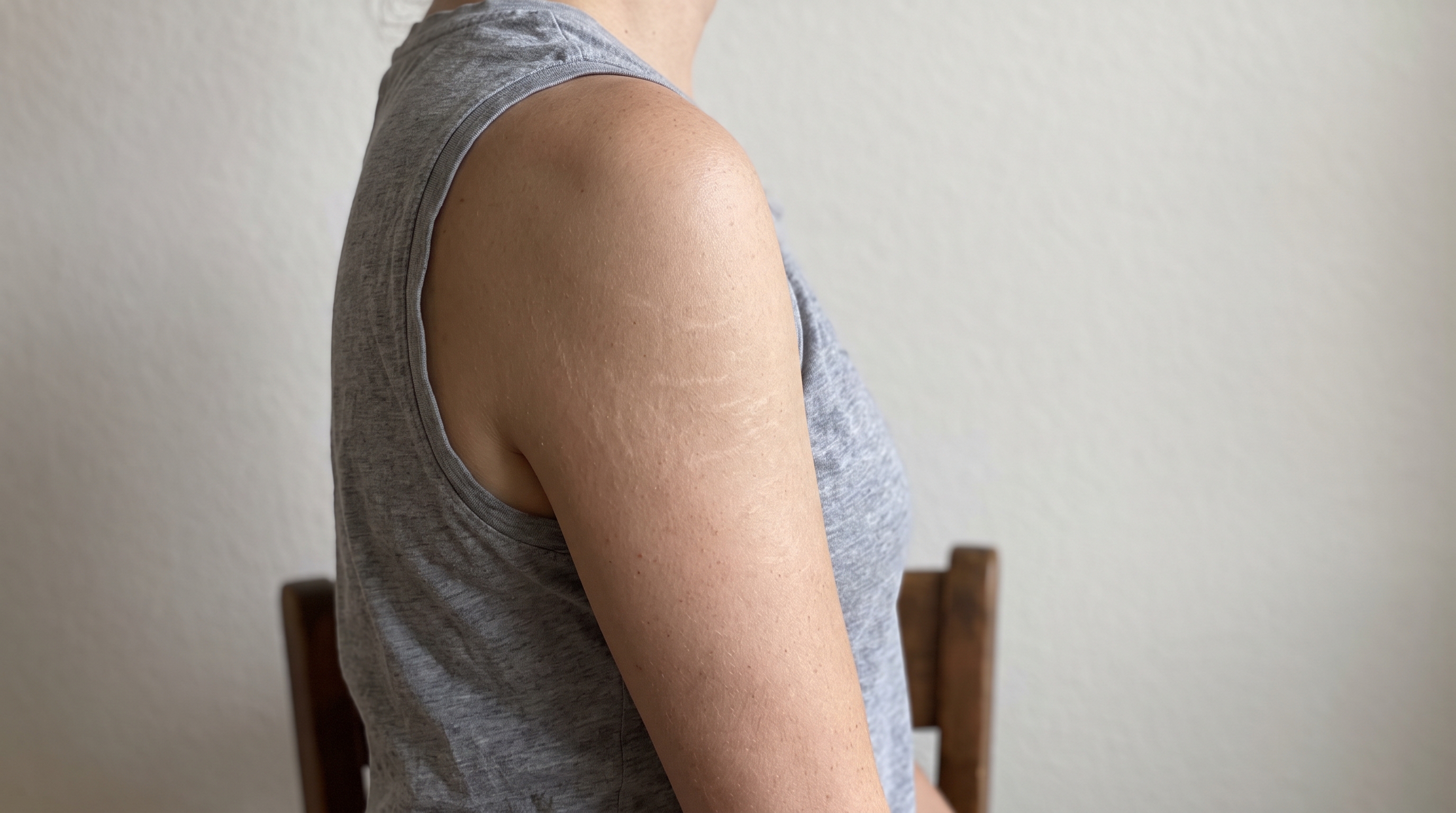
How to Get Rid of Stretch Marks: Treatments That Actually Work
Science-backed strategies for fading striae — from retinoids and microneedling to laser therapy
Stretch marks — known medically as striae distensae — affect roughly 56% of the general population, with rates as high as 90% in pregnant women [1]. Despite being completely harmless, they’re one of the most common cosmetic concerns people bring to dermatologists. And if you’ve tried cocoa butter or Bio-Oil without results, you’re not alone — most over-the-counter products have minimal clinical evidence behind them.
The reality is more nuanced than “nothing works.” Several treatments show genuine promise in clinical trials, particularly when started early. Here’s what the science actually says.
What Causes Stretch Marks?
Stretch marks form when skin stretches faster than its structural proteins can adapt. The rapid expansion causes collagen and elastin fibers in the dermis to rupture, leaving behind visible linear scars [1].
Common triggers include:
- Pregnancy — especially during the third trimester
- Rapid weight gain or loss
- Growth spurts during puberty
- Muscle building — particularly in bodybuilders
- Corticosteroid use — topical or systemic
- Hormonal changes — including Cushing’s syndrome
The Two Stages of Stretch Marks
Understanding which stage you’re in matters for treatment selection [2]:
- Striae rubrae (red/purple stretch marks) — The early inflammatory phase. Marks are raised, red or purple, and sometimes itchy. This is the optimal treatment window.
- Striae albae (white stretch marks) — The mature phase. Marks have flattened, faded to white or silver, and the skin appears atrophic. These are harder to treat but not impossible.
The key takeaway: early intervention yields significantly better results. If you notice new stretch marks forming, that’s the time to act.
Topical Retinoids: The First-Line Treatment
Tretinoin (prescription-strength vitamin A) is the most studied topical treatment for stretch marks, and one of the few with solid clinical evidence.
In a landmark study, Kang et al. demonstrated that 0.1% tretinoin cream applied daily for just two months produced statistically significant improvements in the appearance of early stretch marks compared to placebo [3]. The mechanism is straightforward: retinoids stimulate collagen production, increase fibroblast activity, and promote angiogenesis — all processes that help rebuild damaged dermal tissue.
The key is finding a formulation that penetrates deeply enough to reach the dermis where the damage actually occurs.
Key findings from the research [2, 4]:
- Most effective on striae rubrae (early, red marks)
- 0.1% tretinoin shows the strongest results in clinical trials
- Improvements in both length and width of stretch marks
- Common side effects include mild redness and peeling (typically temporary)
- Not safe during pregnancy — retinoids are contraindicated in pregnant women
For those who can’t tolerate prescription tretinoin, over-the-counter retinol offers a gentler alternative. While less potent, consistent retinol use still supports the collagen remodeling process that’s essential for fading stretch marks. The key is finding a formulation that penetrates deeply enough to reach the dermis where the damage actually occurs. For choosing between the products themselves, our guide to the best stretch mark cream sorts the aisle by whether your marks are still red or already white.
Microneedling: Stimulating Repair
Microneedling has emerged as one of the most promising treatments for stretch marks across all skin types. A 2024 systematic review and meta-analysis published in Aesthetic Plastic Surgery confirmed that microneedling produces statistically significant improvements in striae distensae, both as a standalone treatment and in combination with other therapies [5].
How it works for stretch marks:
- Creates thousands of microscopic punctures in the skin
- Triggers the wound-healing cascade
- Stimulates new collagen and elastin production
- Remodels the atrophic tissue characteristic of stretch marks
Microneedling is particularly attractive because it’s:
- Safe for all skin tones — unlike some laser treatments, the risk of hyperpigmentation is low
- Effective on both striae rubrae and albae
- Combinable with topical treatments like retinoids or PRP for enhanced results
A typical treatment plan involves 3–6 sessions, spaced 4–6 weeks apart. Many patients see continued improvement for several months after their final session as collagen remodeling continues beneath the surface.
Laser Therapy: Precision Approaches
Laser treatments target stretch marks through different mechanisms depending on the type:
Creates thousands of microscopic punctures in the skin Triggers the wound-healing cascade Stimulates new collagen and elastin production Remodels the atrophic tissue characteristic of stretch marks
For Striae Rubrae (Red Marks)
Pulsed dye lasers (PDL) target the vascular component of early stretch marks. By selectively destroying dilated blood vessels, PDL reduces the redness and inflammation of new marks. Several studies have demonstrated significant improvement in color, texture, and overall appearance [2].
For Striae Albae (White Marks)
Fractional lasers (both ablative CO₂ and non-ablative types like 1550 nm erbium-glass) create microscopic treatment zones that stimulate collagen remodeling in the deeper dermis. A 2023 study found that 675 nm laser therapy significantly improved the Manchester Scar Scale scores for stretch marks on the abdomen, thighs, buttocks, and breasts [6].
Radiofrequency
Bipolar radiofrequency delivers controlled thermal energy to the dermis, stimulating collagen contraction and new collagen formation. A network meta-analysis of 14 treatment modalities found that bipolar radiofrequency combined with topical tretinoin had the highest probability of producing the best clinical outcomes [7].
What About Home Remedies?
Let’s address the popular home remedies honestly:
- Cocoa butter — Multiple clinical trials show no significant benefit for stretch mark prevention or treatment [4]
- Olive oil — Similarly, no strong evidence of efficacy in controlled studies [4]
- Aloe vera — Limited evidence; may help with hydration but no proven effect on collagen remodeling
- Centella asiatica (cica) — Actually has some promising data. Products containing Centella extract showed a 60% reduction in stretch mark appearance in one study, likely through its ability to stimulate collagen synthesis [2]
The ingredient with the strongest evidence for at-home use remains retinoids — they’re the only topical class with replicated clinical trial data showing real structural improvement in stretch marks.
Building a Stretch Mark Treatment Strategy
Based on the current evidence, here’s a practical approach:
For New (Red/Purple) Stretch Marks
- Start a topical retinoid immediately — this is your window of maximum effectiveness
- Consider microneedling if marks are significant — 3–6 professional sessions
- Pulsed dye laser can rapidly improve the redness and discomfort
- Maintain consistency — collagen remodeling takes 3–6 months minimum
For Old (White/Silver) Stretch Marks
- Fractional laser therapy offers the best results for mature marks
- Microneedling (with or without PRP) as an alternative or complement
- Topical retinoid maintenance to support ongoing collagen production
- Manage expectations — significant improvement is possible, but complete elimination is unlikely
Daily Care Tips
- Keep skin well-hydrated to improve elasticity
- Use niacinamide-based products to strengthen the skin barrier
- Apply SPF daily — UV exposure can darken stretch marks
- Support your skin’s collagen production with proper nutrition and antioxidants
Why Retinol Delivery Matters for Stretch Marks
The challenge with treating stretch marks isn’t just choosing the right ingredient — it’s getting it where it needs to go. Stretch mark damage occurs in the dermis, beneath the epidermis. Traditional retinol products often concentrate their effects at the surface, causing irritation without reaching the deeper tissue that needs repair.
Nanoretinol® by North Biomedical® was engineered to solve exactly this problem. Using advanced nanotechnology, it delivers retinol past the epidermal barrier and directly to dermal cells — the fibroblasts responsible for producing the collagen and elastin your stretch marks need to heal.
This isn’t about replacing professional treatments. It’s about having a daily foundation that actually reaches the right cells, supporting the collagen remodeling process between and after professional sessions.
References
-
Al-Himdani S, Ud-Din S, Gilmore S, Bayat A. “Striae distensae: a comprehensive review and evidence-based evaluation of prophylaxis and treatment.” British Journal of Dermatology. 2014;170(3):527-547. doi:10.1111/bjd.12681
-
Ud-Din S, McGeorge D, Bayat A. “Topical management of striae distensae (stretch marks): Prevention and therapy of striae rubrae and albae.” Journal of the European Academy of Dermatology and Venereology. 2016;30(2):211-222. doi:10.1111/jdv.13223. PMID:26486318
-
Kang S, Kim KJ, Griffiths CE, et al. “Topical tretinoin (retinoic acid) improves early stretch marks.” Archives of Dermatology. 1996;132(5):519-526. PMID:8624148
-
Elsaie ML, Baumann LS, Elsaaiee LT. “Striae distensae (stretch marks) and different modalities of therapy: an update.” Dermatologic Surgery. 2009;35(4):563-573. doi:10.1111/j.1524-4725.2009.01094.x. PMID:19400881
-
La Padula S, et al. “Microneedling Therapy for Striae Distensae: Systematic Review and Meta-Analysis.” Aesthetic Plastic Surgery. 2024;48:1-12. PMID:38509316
-
Marini L, et al. “Striae Distensae: Clinical Results and Evidence-Based Evaluation of 675 nm Laser Treatment.” Medicina. 2023;59(5):956. PMC:10222465
-
Guo J, et al. “Comparative effectiveness of different therapies for treating striae distensae: A systematic review and network meta-analysis.” Medicine. 2020;99(42):e22554. PMC:7523784