Best SPF for Under Makeup: What Actually Survives a Foundation Layer
Choosing a sunscreen for the one job most sunscreens are never tested on
Most sunscreen reviews are written as though the sunscreen is the last thing to touch your face. For anyone who wears foundation, it is the first of three or four layers, and it has to survive everything that comes after it.
That changes what “best” means. A sunscreen can have an elegant finish, a beautiful filter system and a high SPF, and still be the wrong product if it rolls into grey threads the moment a sponge passes over it, or if half of it ends up on the sponge rather than on you.
The three jobs, in order
An SPF worn under makeup has to do three things, and the order matters.
It has to filter ultraviolet light at the dose you actually apply. It has to set into a film that a second product can be laid over without disturbing. And it has to leave a surface that foundation grips rather than slides across.
Most products on the shelf were formulated and tested for the first job alone. The second and third are what separate the ones that work in a real morning routine from the ones that get abandoned after a week.
The dose problem you inherit before makeup even starts
Every SPF number printed on every sunscreen sold is generated under one condition: the product is applied at 2 milligrams per square centimetre of skin. That is a thick, visible layer, and almost nobody applies it.
The shortfall would not matter much if protection fell away proportionally. It does not. Measuring sun protection factor against applied thickness in living skin produces an exponential curve rather than a straight line, so applying half the tested amount leaves roughly the square root of the labelled figure [1]. An SPF 50 applied at half dose behaves more like an SPF 7.
Now add makeup. Every pass of a sponge, brush or fingertip over a sunscreen film moves some of it, thins it and redistributes it away from the high points of the face that get the most sun. You start below the tested dose and then work against what is left.
Most sunscreen reviews are written as though the sunscreen is the last thing to touch your face.
This is the single strongest argument for choosing a sunscreen you are willing to apply generously. Roughly a quarter of a teaspoon for the face and a little more for the neck is the target, and a product that feels heavy at that amount will quietly be applied at less.
Your foundation’s SPF is not a second sunscreen
The most common workaround is to let a foundation labelled SPF 15 or 20 carry the load, or at least to assume it tops up whatever the sunscreen missed.
The evidence does not support it. When cosmetic products carrying an SPF claim were assessed against the realistic quantities people apply, protection fell well short of what the label implied, and researchers concluded they were not appropriate as a stand-alone daily photoprotection strategy [2]. The problem is not that the filters are fake. It is that nobody applies foundation at 2 milligrams per square centimetre, because a face wearing that much foundation looks like a mask.
Treat any SPF in your makeup as a rounding error in your favour, and let the sunscreen underneath do the work. Our guide to choosing a sunscreen for mature skin covers the filter side of that decision in detail.
Why it pills, and how to stop it
Pilling is the failure everyone remembers, and it is a compatibility problem rather than a quality problem.
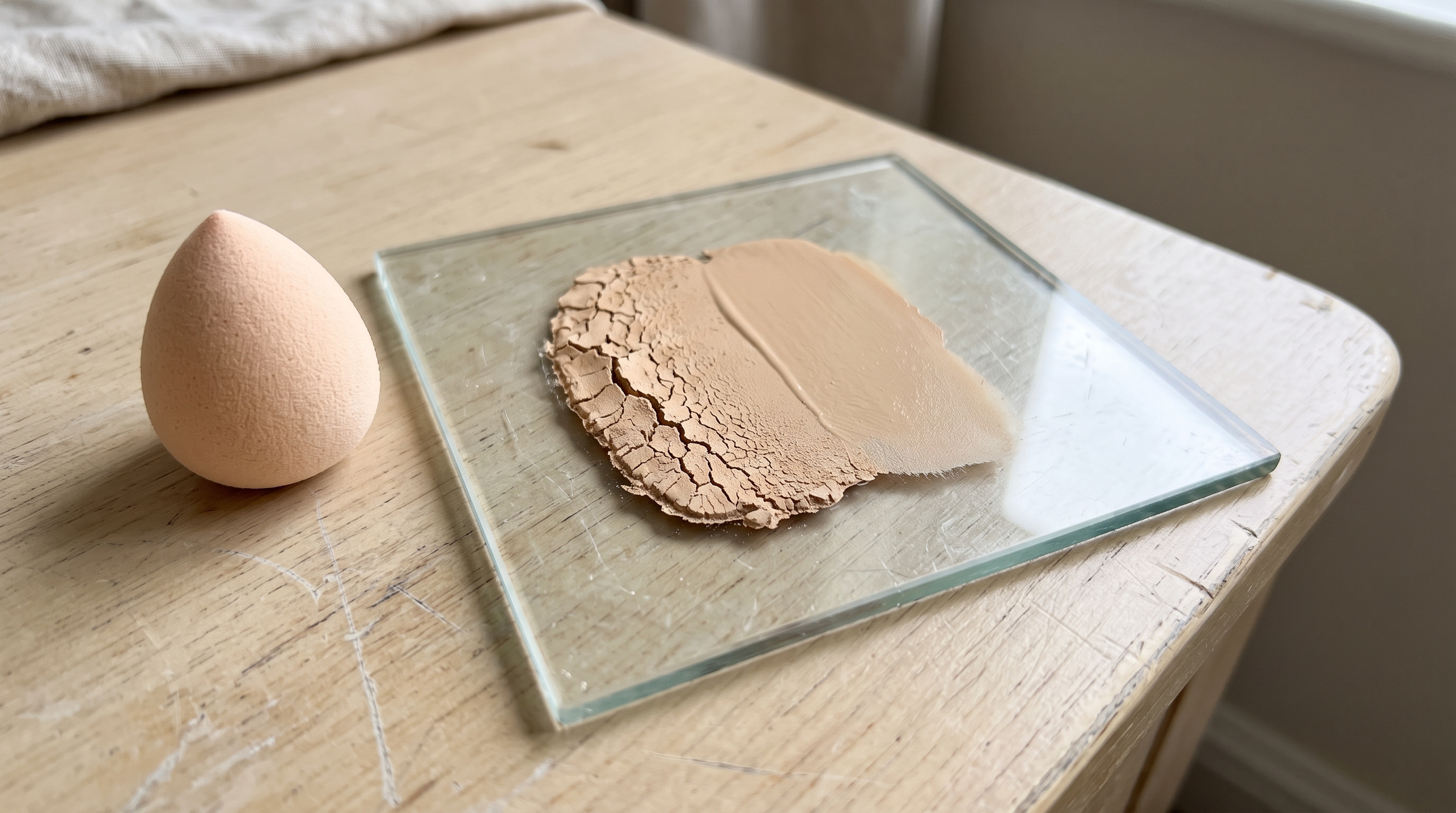
Sunscreens build their film from polymers. Many use anionic film formers that hold the filters in an even layer and resist water. Silicone elastomers, the ingredients that give primers and many foundations their blurring slip, behave very differently on the surface. When a wet layer of one is dragged across a not-quite-set layer of the other, the two roll up together and lift off as small grey threads, carrying your sun protection with them.
Three habits fix almost all of it.
Give the sunscreen a genuine dry-down. Two to three minutes of doing something else is usually enough, and it is the single most effective change.
Press rather than sweep. A damp sponge stippled straight down, or fingertips pressing foundation into place, moves far less of the film than a brush worked in circles.
Treat any SPF in your makeup as a rounding error in your favour, and let the sunscreen underneath do the work.
Keep the layers in the same family where you can. A silicone-heavy primer over a water-based sunscreen is the classic pilling combination. If you use a primer, our page on primers for mature skin explains which formats sit comfortably over an SPF layer.
What to actually look for
For a sunscreen that lives under makeup, the useful selection criteria are unglamorous.
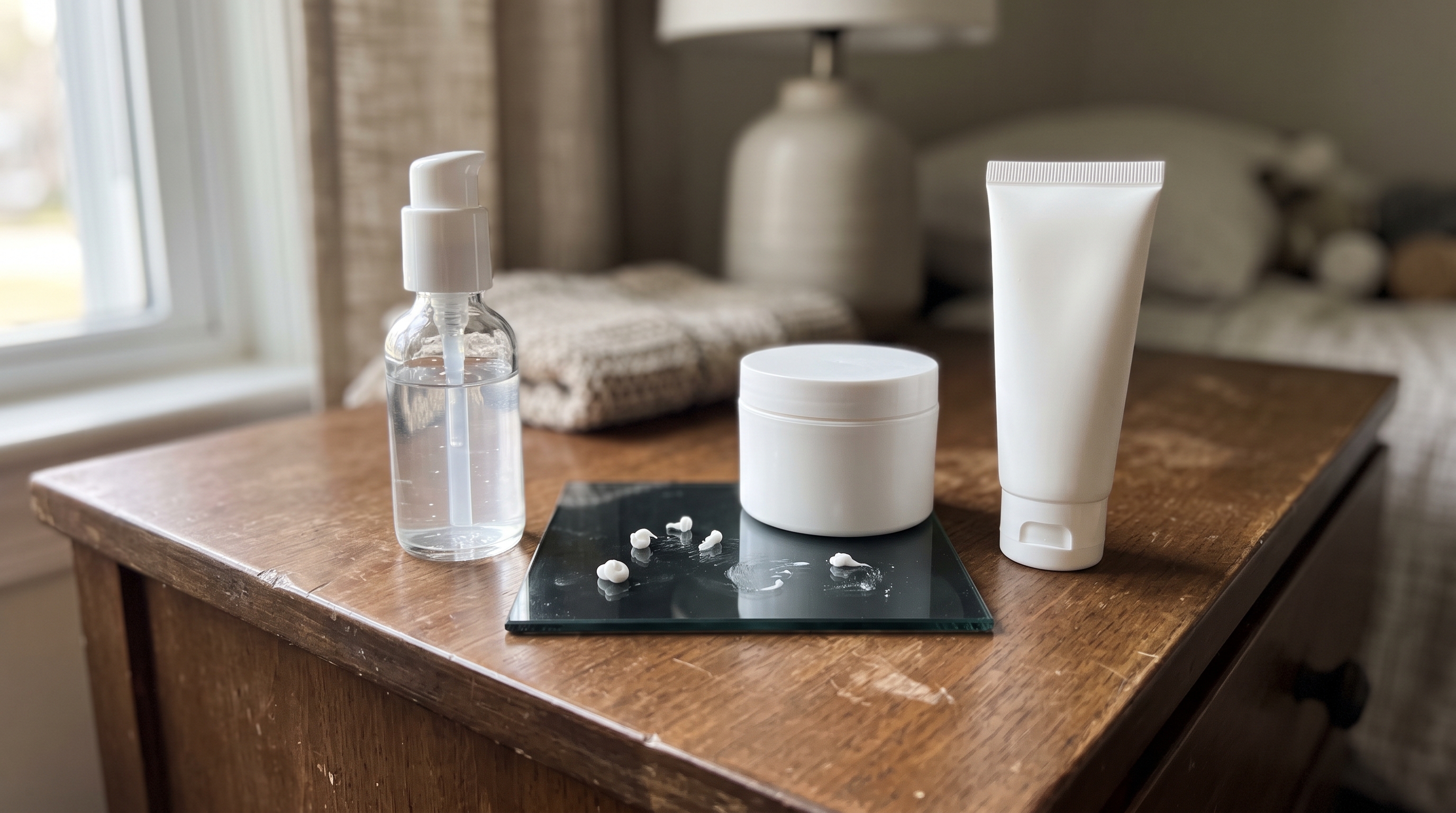
A fluid or lightweight lotion texture, because you need to apply a lot of it without the face feeling loaded. A matte or satin dry-down rather than a dewy one, since dewy finishes stay tacky and grab at foundation. A tint, if you have pigmentation to manage, because iron oxides add protection against visible light that clear formulas leave untouched, and visible light drives pigmentation in ways UV filters alone do not address [5]. And an SPF 30 or higher, chosen on texture rather than on the gap between 30 and 50, because the dose you apply moves the number far more than the label does.
Skip anything sold specifically as a makeup-gripping primer with SPF. Those tend to be applied in primer quantities, which is to say almost none.
If your foundation itself is the problem layer, foundation for mature skin covers the formats that sit best over a sunscreen film.
The midday question
Sunscreen degrades and moves. Reapplication matters, and it matters earlier than most people expect: modelling of cumulative UV exposure found that a top-up around twenty minutes after the first application, rather than at the conventional two-hour mark, meaningfully reduced total dose received, because it compensates for the thin initial layer [3].
Over finished makeup, a cream is impractical and a powder sunscreen is the format most people will realistically use, with the caveat that a brush deposits a fraction of the tested dose. It is a top-up, not a base layer.
What the daily habit is actually buying
The case for all of this is not theoretical. In a randomised trial in Nambour, Australia, adults assigned to daily sunscreen use showed 24% less skin aging over four and a half years than the group who used it at their discretion [4]. Daily beats occasional by a wide margin, and the mechanism is simply the accumulated dose of ordinary days.
Prevention, though, is the entire scope of what a sunscreen offers. It stops the next increment of collagen loss. It does nothing about the collagen already gone, which is what the foundation is being asked to cover in the first place.
Rebuilding is a separate job. Topical retinoids remain the most evidence-backed way to do it: tretinoin applied to photodamaged skin restored collagen formation in biopsied tissue rather than merely improving its appearance [6]. The obstacle has always been tolerance, not efficacy, because conventional retinol crosses the skin barrier by disrupting it, and the burning and flaking that follows ends most attempts within a month.
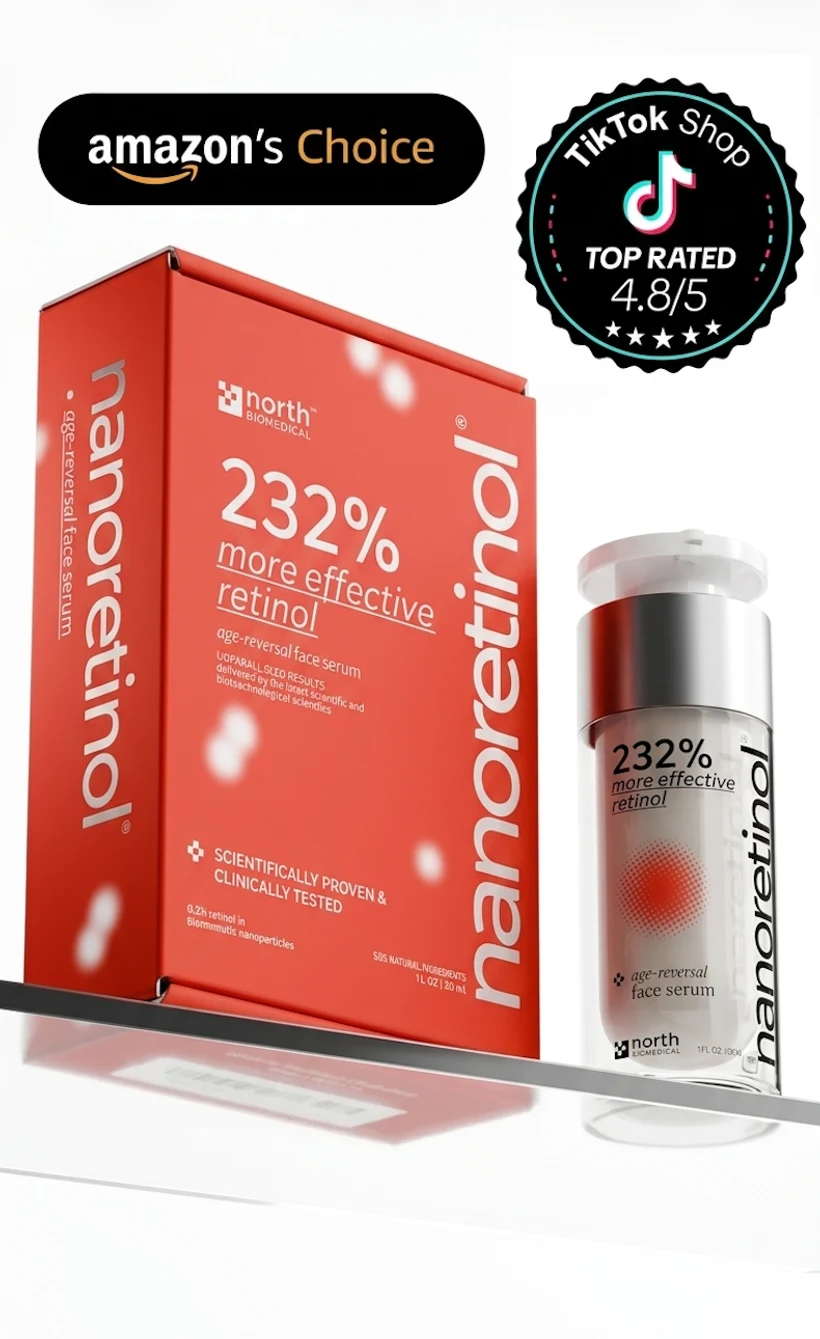
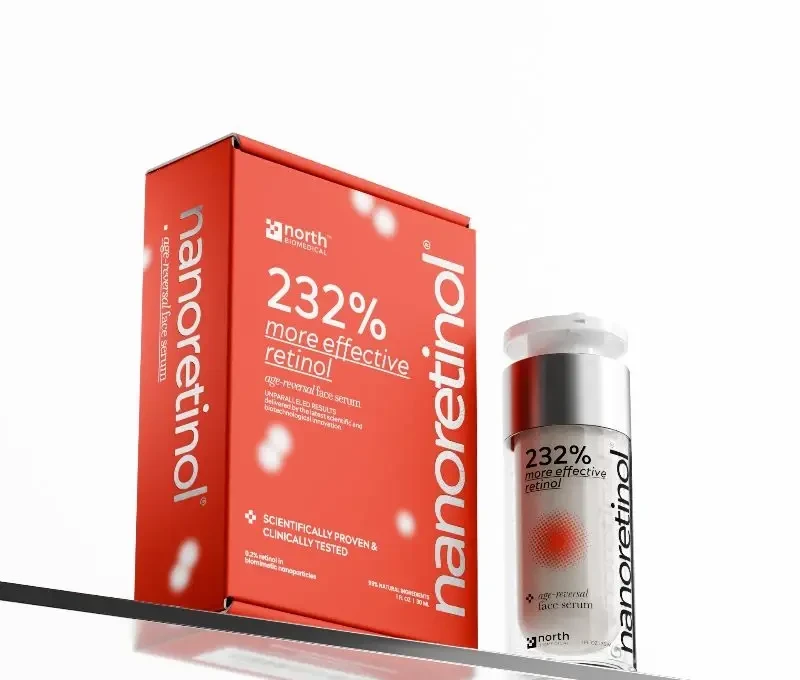
Nanoretinol changes the delivery instead of the dose. Its 0.2% retinol travels inside biomimetic lipid nanoparticles that the skin recognises as self and admits intact, in a water-based, 99% natural formulation suitable for all skin types including sensitive. Against conventional retinol it achieved 232% greater collagen recovery and 73% greater elastin recovery with drastically reduced cytotoxicity, and across 56 days produced a 61% increase in firmness and a 56% increase in elasticity.
Because retinoids raise photosensitivity, the morning filter becomes more important rather than less. Filter through the day, rebuild overnight.
Getting it right tomorrow morning
Apply more sunscreen than looks reasonable. Wait three minutes. Press your foundation on rather than sweeping it. Keep a powder in your bag for the afternoon, and stop counting your foundation’s SPF as protection.
None of that requires a different product from the one you already own, which is usually the cheapest improvement available.
References
- Faurschou A, Wulf HC. “The Relation Between Sun Protection Factor and Amount of Sunscreen Applied In Vivo.” British Journal of Dermatology. 2007;156(4):716-719. doi:10.1111/j.1365-2133.2006.07684.x
- Séhédic D, Hardy-Boismartel A, Couteau C, Coiffard LJ. “Are Cosmetic Products Which Include an SPF Appropriate for Daily Use?” Archives of Dermatological Research. 2009;301(8):603-608. doi:10.1007/s00403-009-0974-2
- Diffey BL. “When Should Sunscreen Be Reapplied?” Journal of the American Academy of Dermatology. 2001;45(6):882-885. PMID: 11712033
- Hughes MCB, Williams GM, Baker P, Green AC. “Sunscreen and Prevention of Skin Aging: A Randomized Trial.” Annals of Internal Medicine. 2013;158(11):781-790. doi:10.7326/0003-4819-158-11-201306040-00002
- Lyons AB, Trullas C, Kohli I, Hamzavi IH, Lim HW. “Photoprotection Beyond Ultraviolet Radiation: A Review of Tinted Sunscreens.” Journal of the American Academy of Dermatology. 2021;84(5):1393-1397. doi:10.1016/j.jaad.2020.04.079
- Griffiths CEM, Russman AN, Majmudar G, Singer RS, Hamilton TA, Voorhees JJ. “Restoration of Collagen Formation in Photodamaged Human Skin by Tretinoin (Retinoic Acid).” New England Journal of Medicine. 1993;329(8):530-535. PMID: 8336752