Tetrahexyldecyl Ascorbate: The Lipid-Soluble Vitamin C Derivative That Actually Reaches Your Dermis
THD ascorbate solved vitamin C's penetration problem — but its stability story has a twist that most product marketing skips.
Why Pure Vitamin C Has a Penetration Problem
L-ascorbic acid is the only vitamin C molecule the body uses. It is also one of the most frustrating molecules to formulate. It is water-soluble, charged at physiological pH, and the stratum corneum is a lipid barrier. The result is exactly what physics predicts: most topical ascorbic acid stays on the skin’s surface or oxidizes into useless brown sludge before it reaches the dermis. The well-known fix — formulating at very low pH, typically around 2.0 to 3.5 — works, but it also stings, destabilizes other actives, and degrades within months of opening.
This is the problem tetrahexyldecyl ascorbate (often abbreviated as THD, THDC, or THD ascorbate) was engineered to solve. Instead of trying to push a water-soluble molecule through a lipid wall, formulators attached vitamin C to a fatty (lipid-soluble) tail. The resulting molecule slides through the stratum corneum the way oil slides through oil — and the skin’s own enzymes cleave off the tail, releasing free ascorbic acid in the deeper layers where it is needed.
That is the marketing story, anyway. The fuller picture is more interesting.
How THD Ascorbate Actually Works
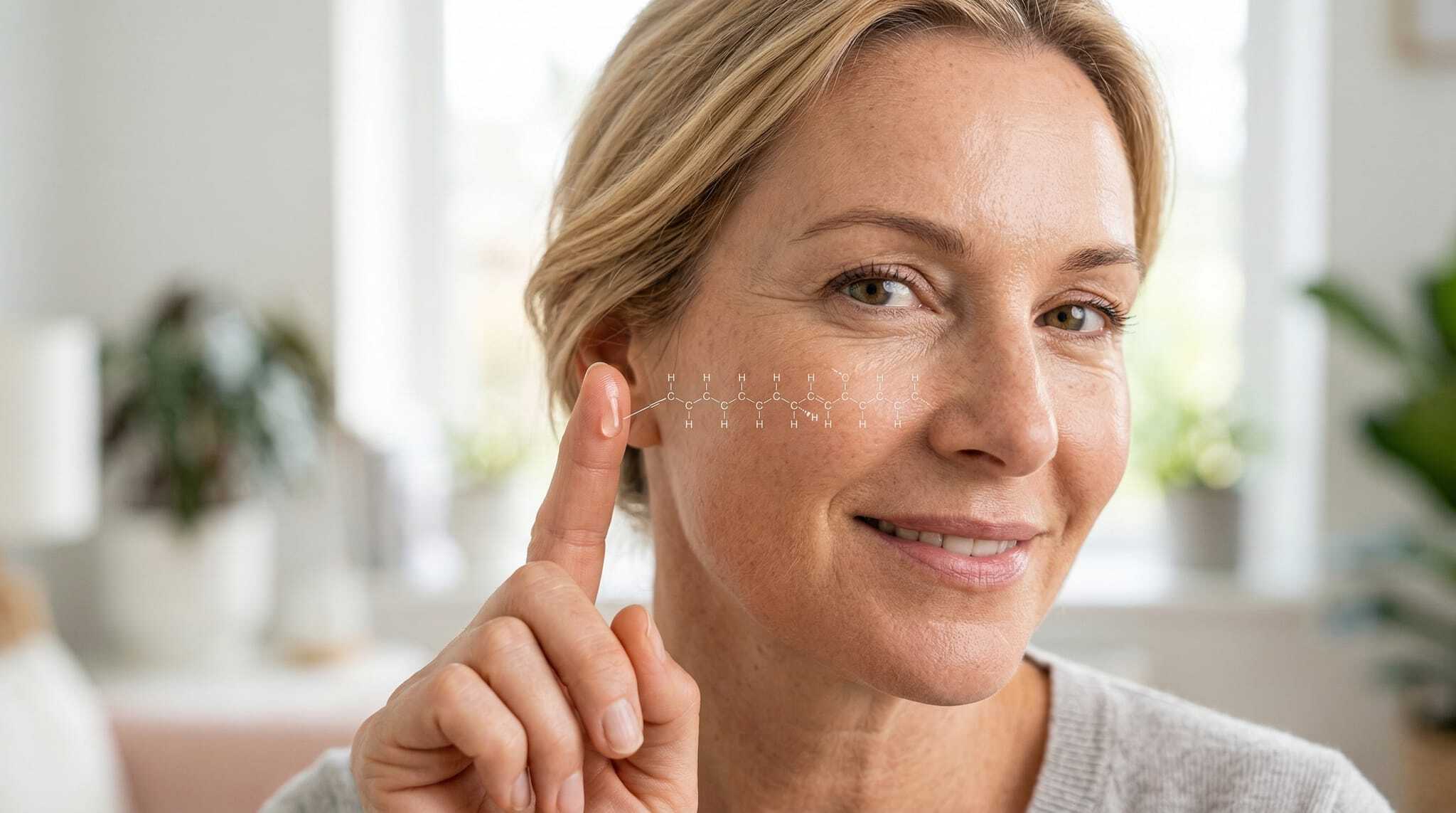
Tetrahexyldecyl ascorbate is L-ascorbic acid esterified with isopalmitic acid. The structural change does three things:
- Lipophilicity: Unlike pure ascorbic acid, THD ascorbate is fat-soluble. It partitions into the lipid layers of the stratum corneum rather than being repelled by them.
- pH neutrality: It is stable in formulations at skin-friendly pH (4-6), instead of requiring the irritating pH 2.0-3.5 range that pure ascorbic acid demands.
- Esterase activation: Once inside the skin, endogenous esterases cleave the fatty tail, releasing free L-ascorbic acid where it can do its job.
In effect, THD ascorbate is a delivery prodrug. The skin does the final activation step.
What Vitamin C Does Once It Gets There
The benefits of ascorbic acid are not hypothetical. As an obligate cofactor for prolyl and lysyl hydroxylase, vitamin C is required for the hydroxylation steps that make collagen stable. Without sufficient dermal ascorbic acid, collagen synthesis stalls regardless of how many “collagen-boosting” peptides are around it.
Instead of trying to push a water-soluble molecule through a lipid wall, formulators attached vitamin C to a fatty (lipid-soluble) tail.
A 2022 review in Antioxidants synthesized the cosmeceutical evidence: vitamin C functions as both an enzyme cofactor for collagen maturation and a stimulator of collagen gene expression, with measurable increases in collagen mRNA in topically treated skin [1]. The same review noted the chronic problem with traditional vitamin C — chemical instability and poor skin penetration — and explicitly named advanced delivery systems (liposomes, nanoparticles, esters like THD) as the leading approach to solve it.
Earlier dermal fibroblast work established the mechanism: ascorbic acid selectively increased type I and type III procollagen mRNA in cultured human skin fibroblasts, dependent on both transcription and mRNA stabilization [2]. This is not vague antioxidant hand-waving — it is a specific signaling effect on collagen gene expression.
The Stability Twist
Here is where most THD ascorbate marketing gets quiet. THD is dramatically more shelf-stable than ascorbic acid — but a 2021 study in the International Journal of Molecular Sciences showed that THD on its own is a relatively poor antioxidant once exposed to the singlet oxygen and reactive nitrogen species that exist in real skin [3]. The authors found that THD degrades almost completely within six minutes under oxidative stress in the absence of a stabilizing co-ingredient.
When THD was paired with acetyl zingerone (a stabilizing antioxidant), the degradation slowed dramatically — and only then did the formulation enhance keratinocyte differentiation and collagen synthesis in a meaningful way [3]. The takeaway is not that THD ascorbate doesn’t work. The takeaway is that THD ascorbate without a stabilizer is largely getting destroyed before it does its job.
For consumers, this means the ingredient list around THD matters as much as the THD percentage. A bottle that lists 10% THD and nothing else useful is making a weaker promise than the marketing implies.
How THD Ascorbate Compares to Other Vitamin C Forms
| Form | Solubility | Stability | Penetration | Best pH |
|---|---|---|---|---|
| L-ascorbic acid | Water | Poor | Limited (needs pH 2-3.5) | 2.0-3.5 |
| Sodium ascorbyl phosphate | Water | Good | Moderate | 6-7 |
| Magnesium ascorbyl phosphate | Water | Good | Moderate | 6-7 |
| Ascorbyl glucoside | Water | Good | Slow conversion | 5-7 |
| Ascorbyl palmitate | Lipid | Moderate | Limited dermal | 4-5 |
| Tetrahexyldecyl ascorbate | Lipid | Good | Strong, dermal | 4-6 |
A bottle that lists 10% THD and nothing else useful is making a weaker promise than the marketing implies.
THD’s selling point is the combination: a lipid-soluble form that crosses the barrier and a neutral pH that is comfortable for sensitive skin. The trade-off is that it requires enzymatic conversion in the skin, and the efficiency of that conversion is rarely measured in published data — most efficacy claims rely on in-vitro assays often funded by ingredient suppliers. The same trade-offs decide which form ends up in a vitamin C face cream, where water-rich emulsions push formulators toward derivatives.
When THD Ascorbate Makes Sense
THD ascorbate is a strong choice for:
- People who tolerate L-ascorbic acid poorly (stinging, redness, low pH intolerance)
- Sensitive or rosacea-prone skin where pH 2.5 serums are non-starters (see our rosacea skincare guide)
- Combination routines where vitamin C needs to coexist with other actives at neutral pH
- Anyone whose AM serum is constantly turning brown — a clear sign of LAA oxidation in the bottle
It is a less obvious fit when:
- The formulation contains no co-antioxidant (vitamin E, ferulic acid, acetyl zingerone)
- Cost is a constraint — THD-based serums tend to sit at premium price points
- The user can tolerate pH 2.5-3.0 L-ascorbic acid and prefers maximally documented in-vivo evidence
The Bigger Lesson: Delivery Is the Active
The story of THD ascorbate is the story of modern cosmetic chemistry in miniature. The molecule is not new — vitamin C has been studied for collagen synthesis since the 1930s. What changed was the delivery system. Tethering ascorbic acid to a fatty tail did not make vitamin C better at building collagen. It made vitamin C reach the cells that build collagen.
The same logic applies across every “next-generation” skincare actives category. Peptides, growth factors, and retinoids all have the same fundamental challenge: the stratum corneum is a barrier built to keep things out, and most actives are too large, too charged, or too unstable to get past it.
Where This Connects to Nanoretinol
The retinol world has its own version of this problem. Conventional retinol is unstable, irritating, and only fractionally penetrates the epithelial barrier. The traditional fix has been the same as L-ascorbic acid’s: brute-force concentration (higher percentages) paired with formulation tricks that damage the barrier on the way in. The result is the burning, peeling, and redness that send most retinol users back to the drawer.
Nanoretinol addresses retinol’s penetration problem using biomimetic lipid nanoparticles — particles externally identical to the skin’s own cell membranes. The skin recognizes them as “self” and allows passage through the epithelial barrier without disrupting it. This is conceptually similar to THD’s fatty-tail trick, but the engineering is a generation further along: full lipid-nanoparticle encapsulation derived from drug-delivery research in oncology. Independent clinical testing demonstrated 232% greater collagen recovery and 73% greater elastin recovery versus conventional retinol [4].
For consumers, the takeaway is straightforward: when comparing serums, ask not just “what’s the active?” but “how does it get there?” An expensive ingredient that stays on the surface is no better than a cheap one. A well-delivered active at a modest concentration almost always outperforms an undeliverable active at a high one.
A Practical Decision
If you are already using a stable LAA serum (typically 10-20%, pH 2.5-3.5, in an opaque tinted bottle) and tolerating it well, switching to THD is optional. If you have stopped LAA because of stinging, oxidation, or co-formulation conflicts, THD ascorbate is the most evidence-supported alternative — provided you pick one paired with vitamin E or another stabilizer.
For the harder question of how to address the deeper structural side of aging — the collagen and elastin loss that vitamin C alone cannot fully reverse — pairing a stable vitamin C with a well-delivered retinoid is what the evidence supports. The vitamin C handles oxidative defense and supports collagen cofactoring. The retinoid does the rebuilding.
References
- Boo YC. Ascorbic Acid (Vitamin C) as a Cosmeceutical to Increase Dermal Collagen for Skin Antiaging Purposes: Emerging Combination Therapies. Antioxidants (Basel). 2022;11(9):1663. doi:10.3390/antiox11091663
- Geesin JC, Darr D, Kaufman R, Murad S, Pinnell SR. Ascorbic acid specifically increases type I and type III procollagen messenger RNA levels in human skin fibroblast. Journal of Investigative Dermatology. 1988;90(4):420-424. doi:10.1111/1523-1747.ep12460849
- Swindell WR, Randhawa M, Quijas G, Bojanowski K, Chaudhuri RK. Tetrahexyldecyl Ascorbate (THDC) Degrades Rapidly under Oxidative Stress but Can Be Stabilized by Acetyl Zingerone to Enhance Collagen Production and Antioxidant Effects. International Journal of Molecular Sciences. 2021;22(16):8756. doi:10.3390/ijms22168756
- North Biomedical LLC. “Nanoretinol vs. Conventional Retinol: Efficacy in Collagen and Elastin Recovery.” Clinical Study Summary, 2024. northbiomedical.com/documents/Nanoretinol-Study_Summary.pdf