Castor Oil for Face: Does It Really Help Wrinkles? What the Science Says
A myth-vs-evidence guide for women 40+ chasing the viral anti-aging trend
Scroll through skincare TikTok for ten minutes and you will meet someone holding a small amber bottle, promising that a few drops of castor oil rubbed into the face each night will melt away wrinkles, lift jowls, and erase under-eye crepiness. The before-and-after photos look convincing. The price tag is almost nothing. And the pitch is irresistible: a single, ancient, “natural” oil that does what a cabinet full of serums could not.
So is castor oil good for your face, or is this another beautiful story the internet tells itself? The honest answer is more interesting than either the hype or the backlash. Castor oil does something real for your skin. It just isn’t the thing the viral videos claim. Let me walk you through what the science actually shows.
This article is specifically about facial use, wrinkles, pores, and the eye area. For dry hands, feet, elbows, and body-skin barrier use, see the separate guide to castor oil for skin.
What Castor Oil Actually Is
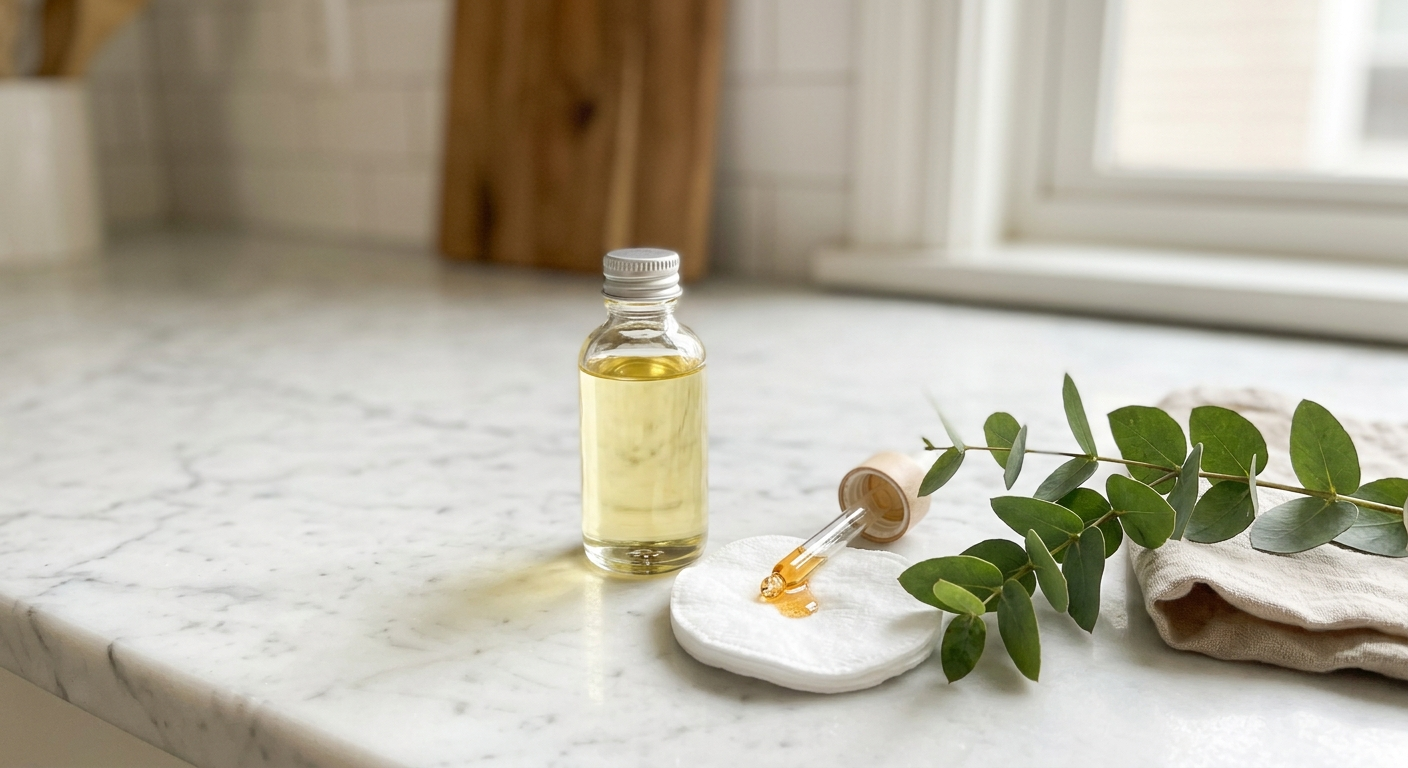
Castor oil is pressed from the seeds of Ricinus communis, and chemically it is one of the most unusual plant oils on earth. Where most vegetable oils are a mixed bag of fatty acids, castor oil is roughly 85 to 90 percent a single one: ricinoleic acid, a hydroxylated monounsaturated fatty acid that exists at meaningful concentrations almost nowhere else in nature [1]. That extra hydroxyl group is why castor oil feels the way it does: thick, sticky, syrupy, dramatically more viscous than jojoba or rosehip.
Think of that viscosity as the whole story in miniature. A molecule that heavy and that polar does not slip easily through the skin’s outer wall. It sits on top. And sitting on top, it turns out, is exactly what castor oil is good at.
Strip away the marketing and you are left with a very good occlusive moisturizer, and that is not a backhanded compliment.
What Castor Oil Genuinely Does for Skin
Strip away the marketing and you are left with a very good occlusive moisturizer, and that is not a backhanded compliment. Occlusives are the heavyweight class of moisturizing agents. They form a hydrophobic film across the stratum corneum that slows the rate at which water evaporates from your skin into the air, a process dermatologists call transepidermal water loss, or TEWL. By corralling moisture beneath that film, occlusives raise the water content of the surface layers, and well-hydrated skin is plumper, smoother, and more pliable than dehydrated skin [2].
This is the engine behind those flattering before-and-after photos. When you trap water in the stratum corneum, fine, dry-weather creases soften within hours, because they were partly the optics of dehydration in the first place. Castor oil is also a capable emollient: its lipids slide into the microscopic gaps between surface skin cells and fill them, so the surface scatters light more evenly and reads as softer and more radiant [2]. These are real, measurable castor oil benefits for skin, and they explain why your face genuinely looks better the morning after.
There is a second, gentler benefit. Ricinoleic acid carries documented anti-inflammatory activity. In controlled experimental models, repeated topical application of ricinoleic acid produced a marked reduction in inflammatory swelling, with effects in the same family as established anti-inflammatory comparators [3]. For skin that runs red or reactive, a soothing occlusive is a reasonable, low-cost addition to a routine.
What Castor Oil Does Not Do
Here is where the trend and the evidence part ways. Looking smoother and being younger are not the same thing, and castor oil only delivers the first.
Wrinkles that matter to women over 40 are not surface dryness. They are structural. As we age, the dermis, the living scaffold beneath the surface, loses collagen and elastin, the proteins that give skin its bounce and tension. Reversing that loss requires reaching the fibroblasts in the dermis and convincing them to manufacture new collagen. It is the difference between ironing a shirt and re-weaving the fabric.
There is no credible clinical evidence that castor oil stimulates collagen synthesis, rebuilds elastin, or reduces wrinkle depth at the dermal level.
Castor oil cannot reach the loom. The same heavy, polar molecule that makes it a fine occlusive makes it a poor penetrator; it largely stays at the surface, which is precisely why it works as a barrier. There is no credible clinical evidence that castor oil stimulates collagen synthesis, rebuilds elastin, or reduces wrinkle depth at the dermal level. The smoothing it offers is real but temporary, a hydration effect that fades as the water it trapped equilibrates back out. When the viral claim is about castor oil for face wrinkles in the structural, collagen-rebuilding sense, the science simply does not support it.
The Risks Worth Knowing
“Natural” does not mean “inert,” and castor oil for skin carries a few honest caveats. Because it is so occlusive, it can trap not only water but also dead cells and sebum, and for acne-prone or congestion-prone faces that can mean clogged pores and breakouts.
More notably, castor oil is a documented contact allergen. Allergic contact dermatitis and cheilitis traced specifically to castor oil and its ricinoleic acid component are well described in the dermatology literature, classically reported from lip products where the oil is used at high concentration [4]. Reactions are uncommon, but they are real, and they show up as redness, itching, swelling, or darkening. The under-eye and eyelid skin is the thinnest and most reactive on the face, so the popular habit of dabbing castor oil there to “treat” crepey lids is exactly where caution matters most. Patch-test on your inner arm for a few days before putting any new oil near your eyes.
If the Goal Is Actually Reversing Aging
So use castor oil for what it is: an inexpensive, soothing occlusive that makes skin look softer and more comfortable tonight. As a finishing layer to seal in hydration, it earns its place, much like a plant oil such as rosehip does.
But if your goal is to genuinely reverse visible aging, to soften the structural lines, restore firmness, and rebuild what time has thinned, you need an ingredient that reaches the dermis and speaks to your fibroblasts. That ingredient is a retinoid. Retinoids are the most rigorously validated anti-aging molecules in dermatology: topical tretinoin has been shown in controlled human studies to restore type I collagen formation in photodamaged skin, the exact structural repair castor oil cannot touch [5]. Retinoids drive cell turnover and switch collagen production back on, which is why they, and not oils, are the proven path to boosting collagen.
The historical catch with conventional retinol is the very mechanism that makes it work: it disrupts the skin barrier to force turnover, which is why so many women meet it with redness, flaking, and irritation, then quit. This is the problem we built Nanoretinol to solve. At North Biomedical, we encapsulate retinol inside biomimetic lipid nanoparticles, a kind of biological Trojan horse the skin recognizes as “self” and ushers across the epithelial barrier without damaging it. The result is delivery without the assault. In our head-to-head testing, this approach produced 232 percent greater collagen recovery and 73 percent greater elastin recovery than conventional retinol, and over a 56-day clinical evaluation, participants saw 61 percent improved firmness and 56 percent improved elasticity, with milder, minimal side effects [6].
Because efficiency of delivery, not raw concentration, is what determines results, Nanoretinol stabilizes a gentle 0.2 percent retinol in a water-based, 99 percent natural, vegan gel suited to all skin types, including sensitive skin and the delicate eye contour where castor oil asks for caution.
Where That Leaves the Trend
Castor oil is not a scam, and it is not a wrinkle cure. It is a competent, comforting occlusive that hydrates, soothes, and flatters, with a small but genuine risk of irritation. Enjoy it for those honest virtues. Just don’t ask it to do a job its chemistry was never built for. When you want to actually rebuild what the years have worn down, reach for the molecule the evidence stands behind, delivered in a way your skin can finally tolerate.
References
- Yeboah A, Ying S, Lu J, Xie Y, Amoanimaa-Dede H, Boateng KGA, Chen M, Yin X. “Castor oil (Ricinus communis): a review on the chemical composition and physicochemical properties.” Food Science and Technology (Campinas). 2021;41(Suppl 2). doi:10.1590/fst.19620
- Purnamawati S, Indrastuti N, Danarti R, Saefudin T. “The Role of Moisturizers in Addressing Various Kinds of Dermatitis: A Review.” Clinical Medicine & Research. 2017;15(3-4):75-87. doi:10.3121/cmr.2017.1363
- Vieira C, Evangelista S, Cirillo R, Lippi A, Maggi CA, Manzini S. “Effect of ricinoleic acid in acute and subchronic experimental models of inflammation.” Mediators of Inflammation. 2000;9(5):223-228. doi:10.1080/09629350020025737
- Andersen KE, Nielsen R. “Lipstick dermatitis related to castor oil.” Contact Dermatitis. 1984;11(4):253-254. doi:10.1111/j.1600-0536.1984.tb00996.x
- Griffiths CE, Russman AN, Majmudar G, Singer RS, Hamilton TA, Voorhees JJ. “Restoration of collagen formation in photodamaged human skin by tretinoin (retinoic acid).” New England Journal of Medicine. 1993;329(8):530-535. doi:10.1056/NEJM199308193290803
- North Biomedical LLC. “Nanoretinol vs. Conventional Retinol: Efficacy in Collagen and Elastin Recovery.” Clinical Study Summary, 2024.