Cracked Fingertips: Why They Split and How to Heal Them Fast
Fingertip skin is thick, stiff and washed all day, so in winter it splits instead of bending. What seals an open crack, what the hand-washing trials show, and how to stop it coming back
A cracked fingertip is a small injury with an outsized effect. A split no longer than a grain of rice can make buttoning a coat, peeling an orange or typing a password genuinely painful. It tends to appear in the same place every winter, usually beside the nail or across the pad of the thumb and index finger, and it can take weeks to close if you keep reopening it.
The good news is that fingertip cracks are mostly a mechanical problem. Skin that is too dry to bend simply splits along the line where it flexes. Put the water back, keep it there, and protect the crack while it knits, and the split has a real chance to close instead of reopening every day.
Why fingertips crack instead of just feeling dry
The skin is unusually thick. The outer layer of skin, the stratum corneum, is a wall of flattened dead cells. On the face it is only about 9 cells deep, but on the palms and soles it averages about 47 layers [1]. Thick skin is tough, but when it dries out it turns stiff, like old leather. Thin skin wrinkles when it bends. Thick, dry skin cracks.
Fingertips bend thousands of times a day. Every grip, pinch and keystroke folds the skin at the same creases. Once that skin loses flexibility, the fold becomes a fault line.
Cold air and indoor heat pull water out. A review of how climate affects skin concluded that low humidity and low temperatures weaken the skin barrier and make it more vulnerable to mechanical stress [2]. That is exactly the combination that splits a fingertip: drier skin plus constant bending.
Your skin on the fingertips can carry about five times as many layers of dead cells as your face, so it cracks long before it looks dry.
Washing strips the oils between skin cells. Soap and hot water dissolve the fats that hold the outer layer together. Health care workers, who wash all day, are the textbook example. A review of their hand dermatitis points out that frequent washing, gloves and harsh detergents are the usual culprits, and that alcohol hand rubs are actually less irritating than soap and water, although they sting on skin that is already damaged [3].
Your skin on the fingertips can carry about five times as many layers of dead cells as your face, so it cracks long before it looks dry.
How to heal a crack that is already open
- Clean it gently. Rinse with lukewarm water and pat dry. Skip alcohol wipes on an open split; they burn and dry the edges further.
- Seal it with an ointment. Petroleum jelly is the classic choice for a reason. In a study of barrier recovery, petrolatum sped up repair rather than slowing it, because it slips between the outer skin cells and stands in for the missing fats [6]. A thin layer pressed into the crack keeps the edges soft so they can knit instead of pulling apart.
- Cover it. A small adhesive bandage or a liquid bandage keeps the ointment in place and stops the split reopening each time you bend the finger.
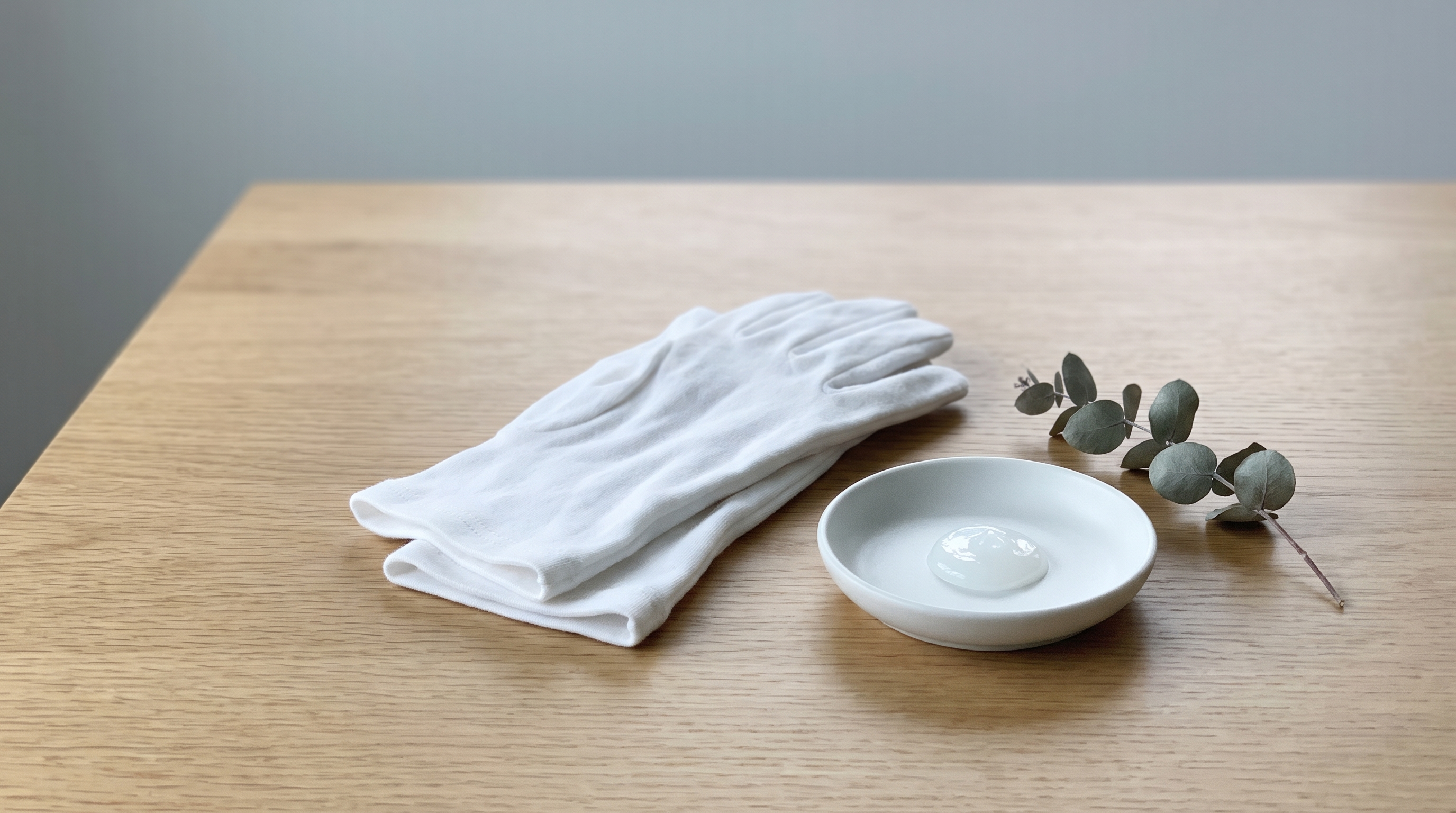
- Treat it overnight. Apply a thick layer of ointment to the whole fingertip at bedtime and wear thin cotton gloves. Our guide to hand masks covers glove-based overnight treatments in more detail.
- Leave the edges alone. Do not trim, file or pick at the hard rim of skin around the crack while it is healing.
If the edges of the split are thick and hard, a cream with urea helps. Urea draws water into the skin and, at higher strengths, softens thickened skin, and a review of the clinical literature found it effective and well tolerated for dry, rough skin [7]. Use it on the thickened rim, not inside an open crack, where it can sting.
What the hand-washing trials show
The best evidence for preventing cracked hands comes from people who wash constantly. In a randomized trial, 132 volunteers washed their hands with soap 15 times a day for 2 weeks. Those who washed without any moisturizer saw their skin get significantly worse. Every group that applied a moisturizer after washing stayed stable, and several of the products measurably improved hydration and reduced water loss through the skin [4].
Your skin can survive 15 soap washes a day for 2 weeks without getting worse, but only when a moisturizer follows each wash, far better than soap alone.
A larger real-world study tested the same idea in hospital wards. Wards that got easy-access cream dispensers and regular reminders saw a bigger relative improvement in hand dermatitis scores, 56% compared with 44% in wards without the program, although the main outcomes did not differ significantly between groups [5]. The lesson is practical: the cream that works is the one sitting next to the sink.
Your skin can survive 15 soap washes a day for 2 weeks without getting worse, but only when a moisturizer follows each wash, far better than soap alone.
How to stop fingertips cracking again
Prevention is mostly about timing. The minute after you dry your hands is when a moisturizer does the most good.
- Moisturize after every wash. Keep a tube of hand cream beside each sink and in your bag. Look for glycerin, which pulls water into the outer skin layer and helps it repair, and is especially useful in cold, dry weather [8].
- Use a richer product at night. Thick creams and ointments outperform light lotions on very dry hands. Our guide to ointment for dry skin explains when to step up to one.
- Wear gloves. Rubber gloves with a cotton liner for dishes and cleaning, warm gloves outdoors.
- Turn the water down. Lukewarm water strips fewer oils than hot water.
- Add humidity. A humidifier in the bedroom slows overnight water loss. More winter strategies are in our guide to winter dry skin.
When a cracked fingertip needs a doctor
Ordinary dryness cracks are clean, shallow splits that start to improve within days of the routine above. See a doctor if the crack is red, hot, swollen or oozing, which can mean infection; if your hands have itchy blisters, weeping patches or thick, scaly plaques; if the cracking appeared after starting a new soap, glove or product, which can point to an allergy; or if splits keep returning despite 3 to 4 weeks of consistent care. Those need a diagnosis, not just a richer cream.
Fingertips, aging hands and retinol
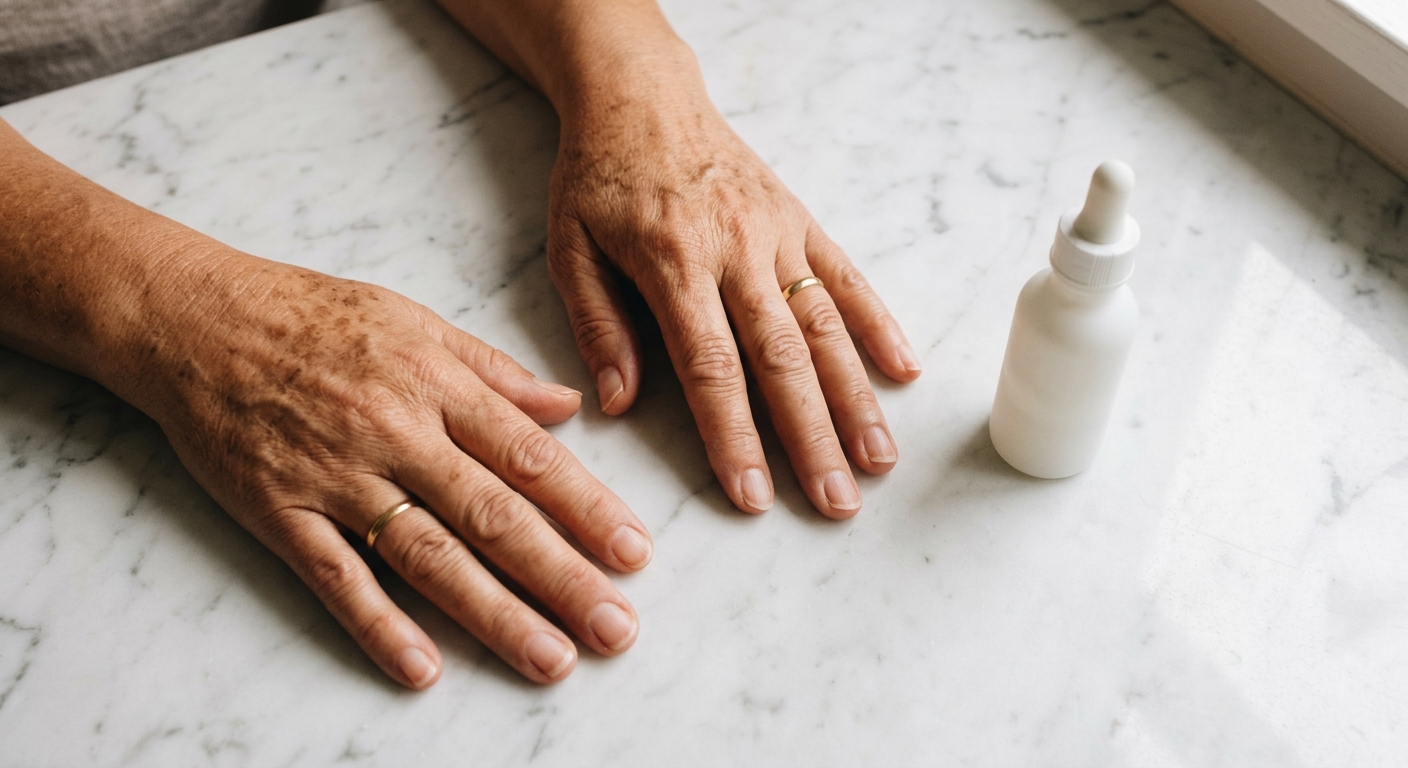
Many people notice cracked fingertips for the first time in their fifties, along with drier, thinner-looking hands overall. Part of that is simply less oil and slower barrier repair with age. Part of it is the collagen loss that makes the back of the hand look crepey.
Retinol helps with that second problem, but it belongs on intact skin, never on an open crack. Heal the fingertips first, then use any retinoid on the back of the hands on alternate nights, followed by a rich cream. Our guide to the best hand cream for aging hands covers that routine.
The vehicle matters as much as the ingredient. Many conventional retinol formulas rely on solvents that loosen the skin’s lipid barrier to push retinol through, the same barrier your fingertips are already short of. Nanoretinol delivers 0.2% retinol inside biomimetic lipid nanoparticles in a light, water-based gel, so it does not depend on breaking the barrier down. In North Biomedical’s study it was 232% more effective in collagen recovery and 73% more effective in elastin recovery than conventional retinol, with a 61% increase in skin firmness after 56 days [9]. Seal the cracks first, then work on the skin around them.
References
- Ya-Xian Z, Suetake T, Tagami H. “Number of cell layers of the stratum corneum in normal skin - relationship to the anatomical location on the body, age, sex and physical parameters.” Archives of Dermatological Research. 1999;291(10):555-559. doi:10.1007/s004030050453
- Engebretsen KA, Johansen JD, Kezic S, Linneberg A, Thyssen JP. “The effect of environmental humidity and temperature on skin barrier function and dermatitis.” Journal of the European Academy of Dermatology and Venereology. 2016;30(2):223-249. doi:10.1111/jdv.13301
- Kampf G, Löffler H. “Prevention of irritant contact dermatitis among health care workers by using evidence-based hand hygiene practices: a review.” Industrial Health. 2007;45(5):645-652. doi:10.2486/indhealth.45.645
- Williams C, Wilkinson SM, McShane P, et al. “A double-blind, randomized study to assess the effectiveness of different moisturizers in preventing dermatitis induced by hand washing to simulate healthcare use.” British Journal of Dermatology. 2010;162(5):1088-1092. doi:10.1111/j.1365-2133.2010.09643.x
- Soltanipoor M, Kezic S, Sluiter JK, et al. “Effectiveness of a skin care programme for the prevention of contact dermatitis in healthcare workers (the Healthy Hands Project): A single-centre, cluster randomized controlled trial.” Contact Dermatitis. 2019;80(6):365-373. doi:10.1111/cod.13214
- Ghadially R, Halkier-Sorensen L, Elias PM. “Effects of petrolatum on stratum corneum structure and function.” Journal of the American Academy of Dermatology. 1992;26(3 Pt 2):387-396. PubMed 1564142
- Pan M, Heinecke G, Bernardo S, Tsui C, Levitt J. “Urea: a comprehensive review of the clinical literature.” Dermatology Online Journal. 2013;19(11):20392. PubMed 24314769
- Fluhr JW, Darlenski R, Surber C. “Glycerol and the skin: holistic approach to its origin and functions.” British Journal of Dermatology. 2008;159(1):23-34. doi:10.1111/j.1365-2133.2008.08643.x
- North Biomedical LLC. “Nanoretinol vs. Conventional Retinol: Efficacy in Collagen and Elastin Recovery.” Clinical Study Summary, 2024. Study summary