
Dark Spot Body Lotion: Which Actives Actually Fade Body Spots
Niacinamide, kojic acid, lactic acid and arbutin all claim to even out arms, legs and chest. What the evidence shows, how long it takes, and which spots a lotion cannot touch
Most dark spot advice is written for the face. Yet the spots that bother many people after 40 sit somewhere else: scattered across the forearms, on the backs of the hands, along the shins, or in a freckled patch across the chest and shoulders. Covering those areas with a tiny bottle of face serum is expensive and slow, which is why dark spot body lotions have become a category of their own.
The labels are crowded with promises. Underneath them, almost every formula leans on one of a small group of actives. Some have decent human evidence behind them, some mostly have lab data, and none of them works without one boring habit. This guide sorts them out.
What a body lotion is up against
The flat brown spots that appear on sun-exposed body skin are mostly solar lentigines, the same spots people call sun spots, age spots or liver spots. Each one is a patch where pigment cells have been switched on by years of UV light and keep producing more melanin than the skin around them. If you want the full picture of why they form and how they differ from other marks, our guide to dark spots on the body covers the causes in detail.
For a lotion, that biology sets three challenges. First, the pigment is made continuously, so any product has to keep working for months. Second, body skin covers a huge area, so the formula has to be pleasant and affordable enough to use generously every day. Third, arms and legs get a lot of casual sun that never gets counted.
Your skin keeps making new pigment every day, so a spot that fades over 12 weeks can darken again in far less than a week of unprotected sun.
Your skin keeps making new pigment every day, so a spot that fades over 12 weeks can darken again in far less than a week of unprotected sun.
The actives, ranked by evidence
Niacinamide
Niacinamide is the most practical starting point for body skin because it is gentle, cheap and easy to formulate into a lotion. It does not stop pigment cells from making melanin. Instead, it slows the transfer of finished pigment packets from pigment cells into the surrounding skin cells, which is where the color becomes visible. In laboratory models, niacinamide cut that transfer by 35 to 68 percent, and in a paired clinical study, a 5% niacinamide moisturizer reduced hyperpigmentation compared with the plain base after 4 weeks [1]. A later 12-week split-face trial of 5% niacinamide found fewer hyperpigmented spots, less red blotchiness and less sallowness on aging facial skin [2]. The trials were on faces, but there is no biological reason body spots should behave differently.
Lactic acid
Lactic acid is the active with the most direct body evidence. In a 22-week double-blind trial, women aged 40 to 70 applied an 8% L-lactic acid cream twice daily to the face and the outer forearms. On the forearms, the lactic acid cream significantly reduced mottled hyperpigmentation, sallowness and roughness compared with the plain cream [3]. The authors called the effect modest, which is the honest word for it. Lactic acid also helps dry body skin hold water, so a lactic acid lotion does two jobs at once. It can sting on freshly shaved legs, so apply it at a different time of day from shaving.
Kojic acid
Kojic acid is a natural compound made by fungi during fermentation, and it blocks tyrosinase, the enzyme pigment cells use to build melanin. It is widely used in lotions and soaps for exactly that reason [4]. The weakness is the evidence: most of it comes from enzyme and cell studies or small trials that combine kojic acid with other actives, and kojic acid can irritate or sensitize some people. Our kojic acid lotion guide covers how to use it and when to stop.
Arbutin
Arbutin, a plant-derived relative of hydroquinone, also works by blocking tyrosinase, and its alpha form is the version most often found in brightening formulas [5]. It is generally well tolerated, which makes it a reasonable partner for niacinamide in a body lotion. As with kojic acid, the human data are thinner than the marketing suggests.
Retinoids
Retinoids have the strongest record against age spots of anything you can apply at home. In a 10-month trial, prescription 0.1% tretinoin lightened facial liver spots in 83 percent of users compared with 29 percent on the plain cream, with similar results on the arms, and the lightened spots had not returned 6 months after treatment stopped [6]. Expert reviews list topical retinoids among the best-supported creams for these spots [7]. Retinol, the cosmetic retinoid, is converted in the skin to the same active form, though more slowly and more gently. If you want a retinoid for your arms and legs, our guide to retinol body lotion explains how to start without irritation.
Your skin on the forearms and shins can look visibly more even after 12 to 22 weeks of steady use, yet daily sunscreen matters more than which lotion you pick.
How long body spots take to fade
Expect a slow curve rather than a sudden change. In the niacinamide trial, the first measurable change came at 4 weeks. The forearm data for lactic acid were read at 22 weeks, and the tretinoin study ran for 10 months before reporting its headline numbers. A realistic plan for body spots is to judge a lotion at 12 weeks, not at two.
Your skin on the forearms and shins can look visibly more even after 12 to 22 weeks of steady use, yet daily sunscreen matters more than which lotion you pick.
That is not an exaggeration. In a one-year study, people who applied a broad-spectrum SPF 30 every day saw mottled and discrete pigmentation improve by 40 to 52 percent, with changes visible from week 12, and they used no brightening active at all [8]. Sunscreen lets the skin’s own turnover gradually clear old pigment while stopping new pigment from replacing it. On the body, that means sunscreen on the forearms, hands and the front of the legs whenever they are uncovered, not only at the beach.
Which spots a lotion cannot fade
A lotion works on flat pigment in the top layer of the skin. It will not flatten a raised, rough or waxy spot, and it will not remove spots that sit deeper in the skin. Large, dense sun spots often need an in-office treatment: expert consensus names freezing and lasers as the most effective first options, with creams best used to maintain the result [7]. If a stubborn spot on the hand is the main concern, our age spot cream guide compares stronger creams for that small, visible area.
Any spot that is new, growing, changing color, has an irregular edge, itches or bleeds should be checked by a dermatologist before you treat it with anything.
How to choose a dark spot body lotion
- Pick one main active you can use daily: niacinamide or lactic acid are the easiest to live with on large areas.
- Look for a partner, not a cocktail: niacinamide with arbutin, or lactic acid with niacinamide, covers two mechanisms without stacking irritants.
- Mind the format: a lotion that sinks in quickly is one you will actually use morning and night.
- Skip the fragrance: perfumes are a common cause of irritation on large areas of skin, and irritation can leave its own dark marks.
- Pair it with sunscreen: use your lotion at night and a broad-spectrum SPF 30 or higher on exposed areas in the morning.
Where Nanoretinol fits
Body lotions are the right tool for wide, scattered spots on the arms and legs. The face, neck and chest are different: the skin is thinner, more exposed, and shows wrinkles and loss of firmness alongside the spots. That is where a retinoid earns its place, because retinoids speed skin renewal and support collagen at the same time.
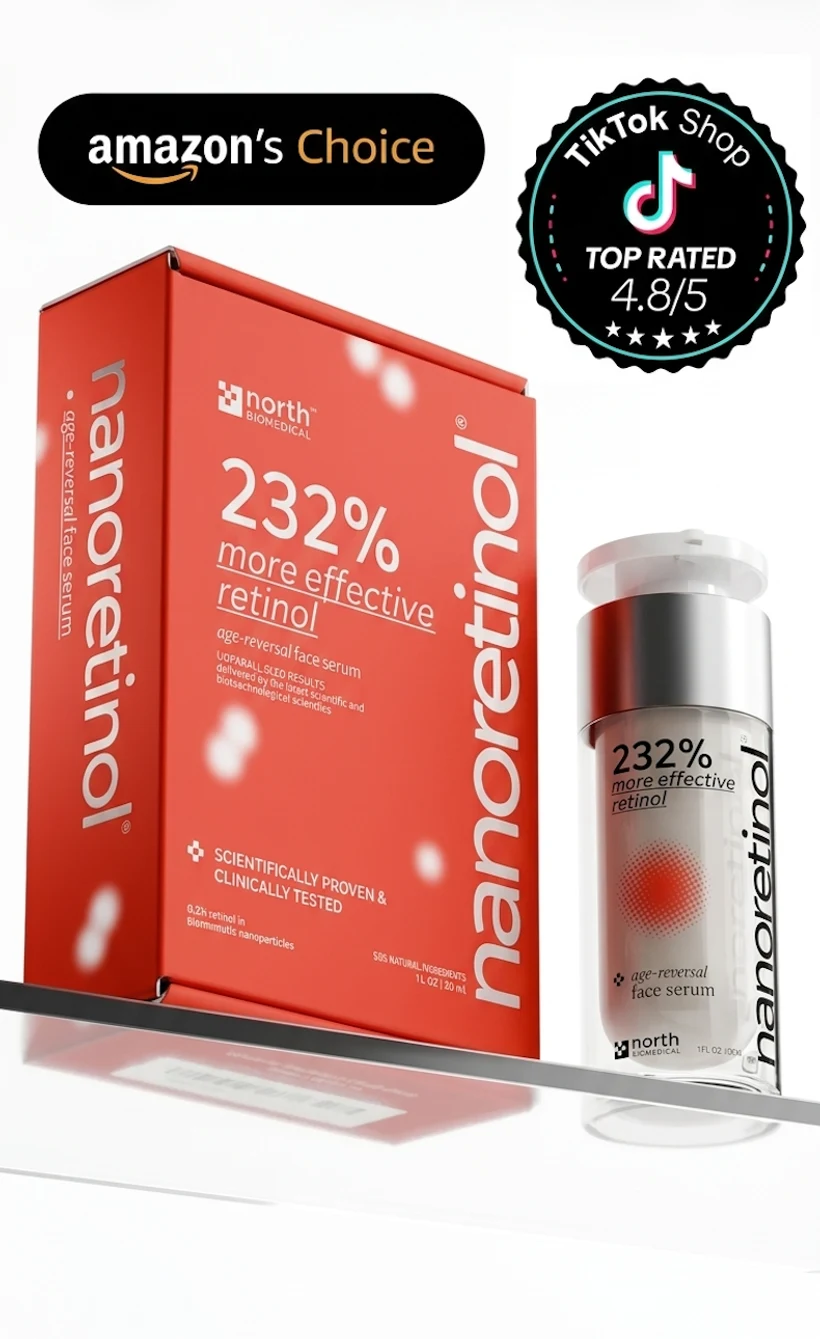
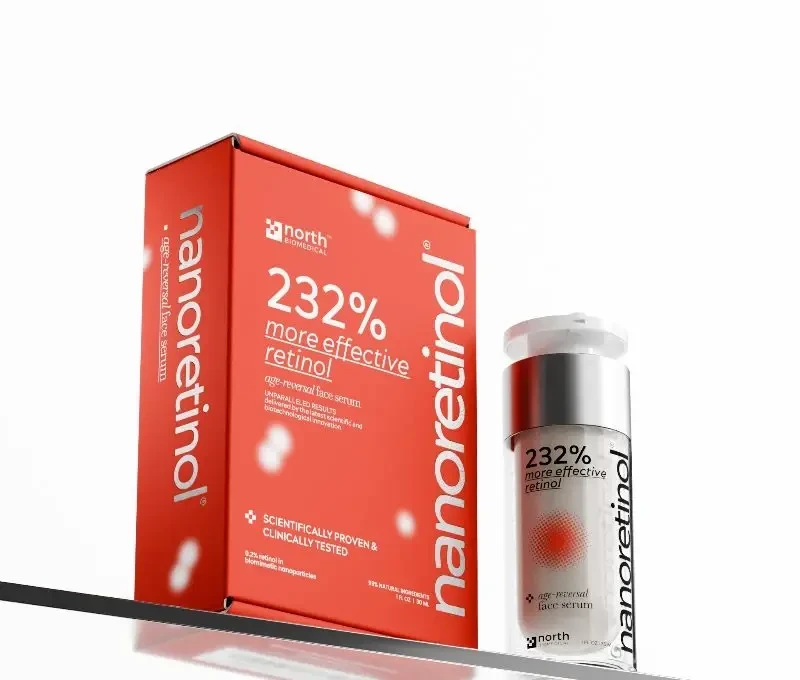
The catch has always been tolerability. Conventional retinol formulas can cause redness and peeling, especially on the neck and chest. Nanoretinol delivers 0.2% retinol inside biomimetic lipid nanoparticles, a gentler delivery system that does not need to break down the skin barrier to get the retinol in. In clinical testing over 56 days, users saw a 61 percent increase in skin firmness and a 56 percent increase in elasticity, and in laboratory testing Nanoretinol was 232 percent more effective in collagen recovery than conventional retinol [9]. Apply it at night to the face, neck and chest, keep your dark spot lotion for the arms and legs, and use sunscreen on all of it the next morning.
References
- Hakozaki T, Minwalla L, Zhuang J, et al. “The effect of niacinamide on reducing cutaneous pigmentation and suppression of melanosome transfer.” British Journal of Dermatology. 2002;147(1):20-31. doi:10.1046/j.1365-2133.2002.04834.x
- Bissett DL, Oblong JE, Berge CA. “Niacinamide: A B vitamin that improves aging facial skin appearance.” Dermatologic Surgery. 2005;31(7 Pt 2):860-865. doi:10.1111/j.1524-4725.2005.31732
- Stiller MJ, Bartolone J, Stern R, et al. “Topical 8% glycolic acid and 8% L-lactic acid creams for the treatment of photodamaged skin. A double-blind vehicle-controlled clinical trial.” Archives of Dermatology. 1996;132(6):631-636. PubMed 8651713
- Saeedi M, Eslamifar M, Khezri K. “Kojic acid applications in cosmetic and pharmaceutical preparations.” Biomedicine & Pharmacotherapy. 2019;110:582-593. doi:10.1016/j.biopha.2018.12.006
- Boo YC. “Arbutin as a Skin Depigmenting Agent with Antimelanogenic and Antioxidant Properties.” Antioxidants. 2021;10(7):1129. doi:10.3390/antiox10071129
- Rafal ES, Griffiths CE, Ditre CM, et al. “Topical tretinoin (retinoic acid) treatment for liver spots associated with photodamage.” New England Journal of Medicine. 1992;326(6):368-374. doi:10.1056/NEJM199202063260603
- Ortonne JP, Pandya AG, Lui H, Hexsel D. “Treatment of solar lentigines.” Journal of the American Academy of Dermatology. 2006;54(5 Suppl 2):S262-S271. doi:10.1016/j.jaad.2005.12.043
- Randhawa M, Wang S, Leyden JJ, et al. “Daily Use of a Facial Broad Spectrum Sunscreen Over One-Year Significantly Improves Clinical Evaluation of Photoaging.” Dermatologic Surgery. 2016;42(12):1354-1361. doi:10.1097/DSS.0000000000000879
- North Biomedical LLC. “Nanoretinol vs. Conventional Retinol: Efficacy in Collagen and Elastin Recovery.” Clinical Study Summary, 2024. Study summary