How to Get Rid of Dark Spots on Your Body: A Head-to-Toe Guide
Why pigmentation shows up on your chest, arms, shoulders, and legs — and the dark spot remover strategy that actually works on body skin.
We pour attention into our faces and forget everything below the jawline — until a summer top, a sleeveless dress, or a swimsuit reveals a scatter of brown spots across the chest, shoulders, and arms. Body dark spots are extremely common after 40, and the search for a dark spot remover for the body usually ends in disappointment, because most people reach for the wrong product and the wrong expectations.
The good news: the biology of body pigmentation is well understood, and the ingredients that fade it are the same proven actives that work on the face. The catch is that body skin plays by slightly different rules.
What Those Spots Actually Are
Most body dark spots fall into two camps.
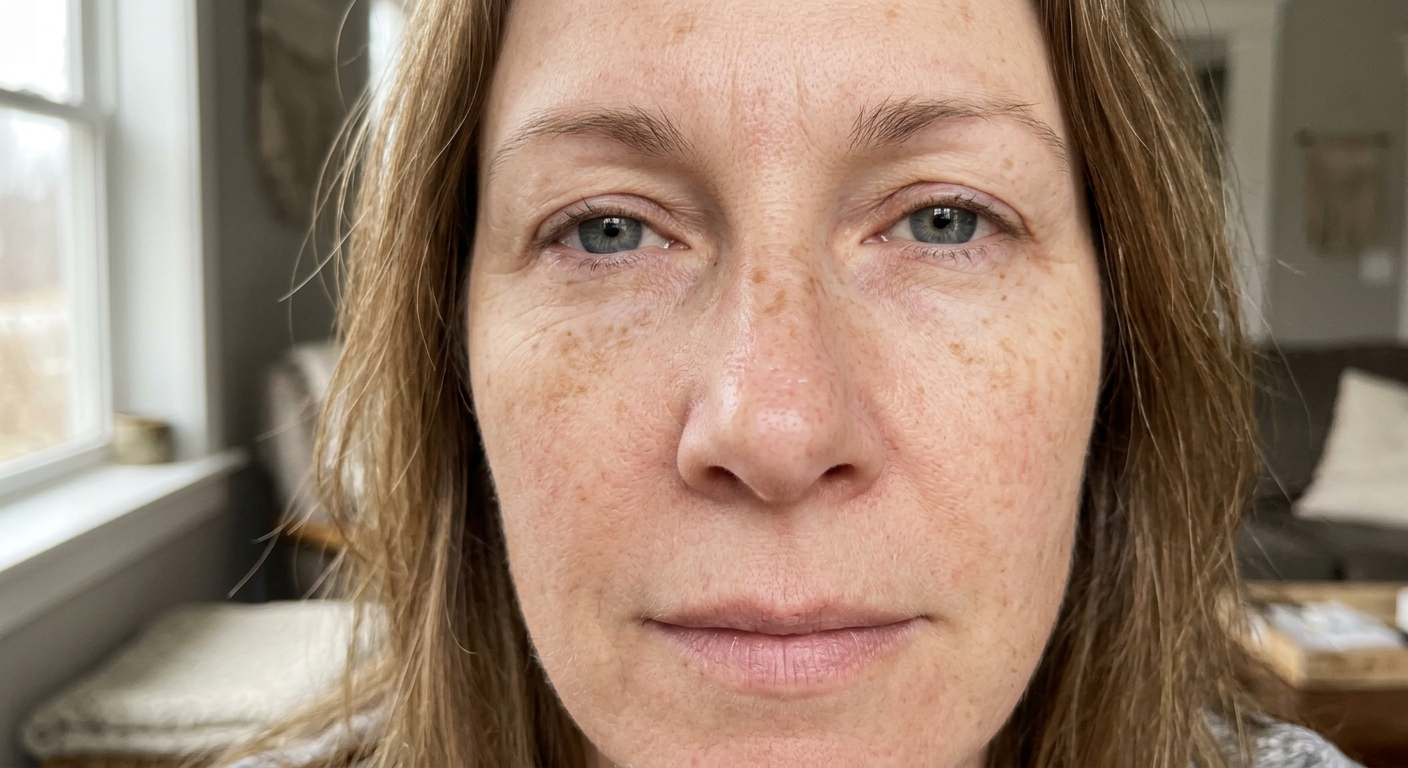
The first is solar lentigines — sun spots. Decades of cumulative ultraviolet exposure prompt the pigment cells in chronically exposed areas to multiply and overproduce melanin in flat, defined patches. This is why they cluster exactly where the sun lands hardest: the décolletage, the tops of the shoulders, the forearms, and the backs of the hands. A systematic review of clinical trials confirms that these lesions are a direct consequence of photodamage and respond to treatments that target melanin and accelerate cell renewal [1].
The second is post-inflammatory hyperpigmentation (PIH) — the brown shadow left behind after a bug bite, an ingrown hair, a shaving nick, or a healed body breakout. Here the inflammation itself triggers a burst of pigment that lingers long after the original injury is gone. If most of your marks trace back to old blemishes or irritation, our guide to post-inflammatory hyperpigmentation explains that mechanism in depth.
Telling them apart matters, because sun spots demand sun protection above all, while PIH demands you calm the inflammation that keeps feeding it.
Here the inflammation itself triggers a burst of pigment that lingers long after the original injury is gone.
Why Body Skin Is Harder to Treat Than Your Face
Body skin is thicker, slower to turn over, and far more neglected than facial skin. It also covers a much larger surface area, which makes generously slathering on expensive actives impractical and explains why a kojic acid soap is such a popular, if limited, shortcut, and why a leave-on kojic acid lotion usually does more for arms, legs and underarms. That combination is why body pigmentation tends to be stubborn — not because the spots are different, but because the canvas is tougher and the routine is usually inconsistent.
It also means location should guide your strategy. The high-visibility, high-value zones — the chest and the backs of the hands — deserve your most effective products, while broader areas like the legs can be managed more simply. We cover the regional specifics in our dedicated guides to dark spots on the chest, dark spots on the arms, and age spots on the hands.
The Dark Spot Remover Ingredients That Earn Their Place
Forget the drugstore “fade” creams promising results in a week. A genuine dark spot remover works on the pigment pathway, and only a few ingredients have the evidence to back it up.
Retinoids lead the field. The landmark New England Journal of Medicine trial on sun-induced pigmentation found that topical tretinoin significantly lightened the spots and kept them faded for at least six months after treatment stopped [2]. Retinoids speed the shedding of pigment-laden cells and help redistribute clustered melanin — the same reason they are the backbone of any serious retinol for dark spots plan.
Niacinamide blocks the handoff of pigment from melanocytes to surface cells. A controlled study showed 5% niacinamide measurably reduced hyperpigmentation and evened tone, and because it is gentle, it suits the larger surface areas of the body, which is where a niacinamide body lotion earns its place [3].
In testing it delivered 232% greater collagen recovery than ordinary retinol while proving significantly gentler on skin cells.
Vitamin C interrupts tyrosinase, the enzyme that manufactures melanin. In a double-blind trial, 5% ascorbic acid produced objective skin lightening, and a broader systematic review confirms its role as a depigmenting agent that pairs well with a strong safety profile [4][5]. It will not match a retinoid alone, but as a daily antioxidant layer it helps prevent new spots while the heavier actives fade the old ones.
And underpinning all of it: sunscreen. Without daily protection on exposed body skin, every other ingredient is bailing water out of a boat with the drain open.
The Delivery Problem on Body Skin
Here is the practical obstacle. The single most effective spot-fading active — retinol — is also the most irritating, and body areas like the chest and inner arms are surprisingly delicate. Conventional retinol formulations push their active inward by disrupting the skin barrier, which on thinner body skin can mean redness, flaking, and the kind of irritation that ironically triggers more PIH.
This is exactly the failure point that Nanoretinol is engineered around. Its retinol is wrapped in biomimetic lipid nanoparticles that the skin accepts as its own and lets through without breaching the barrier — no burning, no peeling, no inflammation-driven darkening. It is a water-based, 99% natural formulation gentle enough for sensitive skin and even the eye contour, which makes it well suited to the delicate décolletage where sun spots are most visible. In testing it delivered 232% greater collagen recovery than ordinary retinol while proving significantly gentler on skin cells. For high-value zones like the chest, that combination of potency and tolerability is precisely what stubborn body pigmentation requires.
A Workable Body Plan
Concentrate your effort where it shows. Each night, apply a gentle retinol such as Nanoretinol to the chest and the backs of the hands, building frequency gradually. Each morning, protect every exposed area with broad-spectrum SPF — this is the step that determines whether you are fading spots or just treading water. Use niacinamide or vitamin C as supporting players across wider areas, and resist the urge to pick at body blemishes, since that is what plants fresh PIH.
Expect a slower timeline than on the face. Body skin can take twelve weeks or more to show clear fading, and consistency beats intensity every time.
When to See a Professional
Most body dark spots are cosmetic. But any spot that changes shape, grows, develops irregular borders, bleeds, or simply looks different from its neighbors deserves a dermatologist’s eyes — that is a safety check, not a skincare question. For everything else, the path is steady and proven: protect, fade with real actives, and deliver them in a form your skin will actually tolerate.
References
- Mardani G, Nasiri MJ, Namazi N, Farshchian M, Abdollahimajd F. “Treatment of Solar Lentigines: A Systematic Review of Clinical Trials.” Journal of Cosmetic Dermatology. 2025;24(4):e70133. doi:10.1111/jocd.70133
- Rafal ES, Griffiths CE, Ditre CM, Finkel LJ, Hamilton TA, Ellis CN, Voorhees JJ. “Topical tretinoin (retinoic acid) treatment for liver spots associated with photodamage.” New England Journal of Medicine. 1992;326(6):368-374. doi:10.1056/NEJM199202063260603
- Hakozaki T, Minwalla L, Zhuang J, Chhoa M, Matsubara A, Miyamoto K, Greatens A, Hillebrand GG, Bissett DL, Boissy RE. “The effect of niacinamide on reducing cutaneous pigmentation and suppression of melanosome transfer.” British Journal of Dermatology. 2002;147(1):20-31. doi:10.1046/j.1365-2133.2002.04834.x
- Espinal-Perez LE, Moncada B, Castanedo-Cazares JP. “A double-blind randomized trial of 5% ascorbic acid vs. 4% hydroquinone in melasma.” International Journal of Dermatology. 2004;43(8):604-607. doi:10.1111/j.1365-4632.2004.02134.x
- Sanadi RM, Deshmukh RS. “The effect of Vitamin C on melanin pigmentation – A systematic review.” Journal of Oral and Maxillofacial Pathology. 2020;24(2):374-382. doi:10.4103/jomfp.JOMFP_207_20