Dark Spots on Forehead: What Causes Them and How to Fade Them
Forehead hyperpigmentation is almost always a sun story — here is the science behind it and the ingredients that actually lighten it.
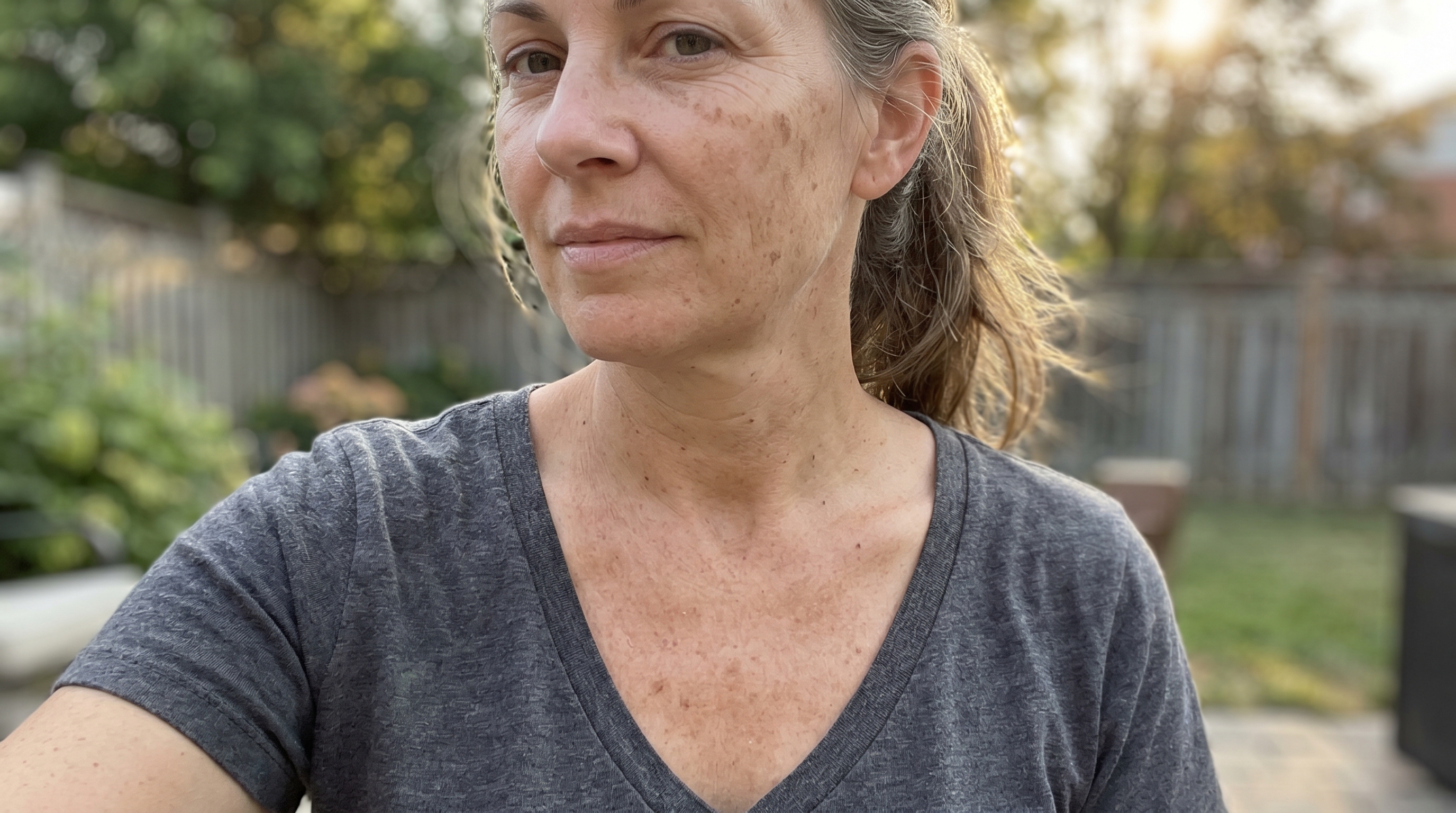
You notice them in the worst possible lighting — the car visor mirror at noon, or a front-facing camera in a bright room. Flat brown patches scattered across the forehead that were not there a decade ago, and that foundation only half-hides. The good news is that forehead dark spots are one of the most studied and most treatable pigment problems in all of skincare. The better news is that you almost certainly do not need a laser to start fading them.
The forehead earns its spots honestly. It is one of the highest, most forward-facing planes on your body, which means it catches more cumulative ultraviolet light over a lifetime than almost anywhere else. Decades of that exposure quietly reprogram the pigment-producing cells in your skin, and the forehead is usually where the bill comes due first.
Why the Forehead Collects Pigment
Your skin makes color through specialized cells called melanocytes, which sit at the base of the epidermis and manufacture pigment packets called melanosomes. Those packets get handed off to surrounding skin cells, where they act like tiny parasols shading the cell nucleus from UV damage. It is an elegant protective system — until it gets stuck in the “on” position.
Years of sun exposure cause clusters of melanocytes to become chronically overactive. They keep pumping out pigment even when you are indoors, and they distribute it unevenly. The result is a discrete brown spot rather than an even tan. Because the forehead is angled toward the sky and rarely shaded by the brow or nose the way the under-eyes are, it absorbs a disproportionate share of a lifetime’s UV dose.
Hormones and inflammation pile on. A forgotten breakout, an aggressive exfoliation, or even friction from glasses can leave behind a darker mark, and the forehead’s constant sun exposure makes those marks darker and more stubborn than they would be elsewhere.
What Those Spots Actually Are
Getting the label right matters, because the cause shapes the fix.
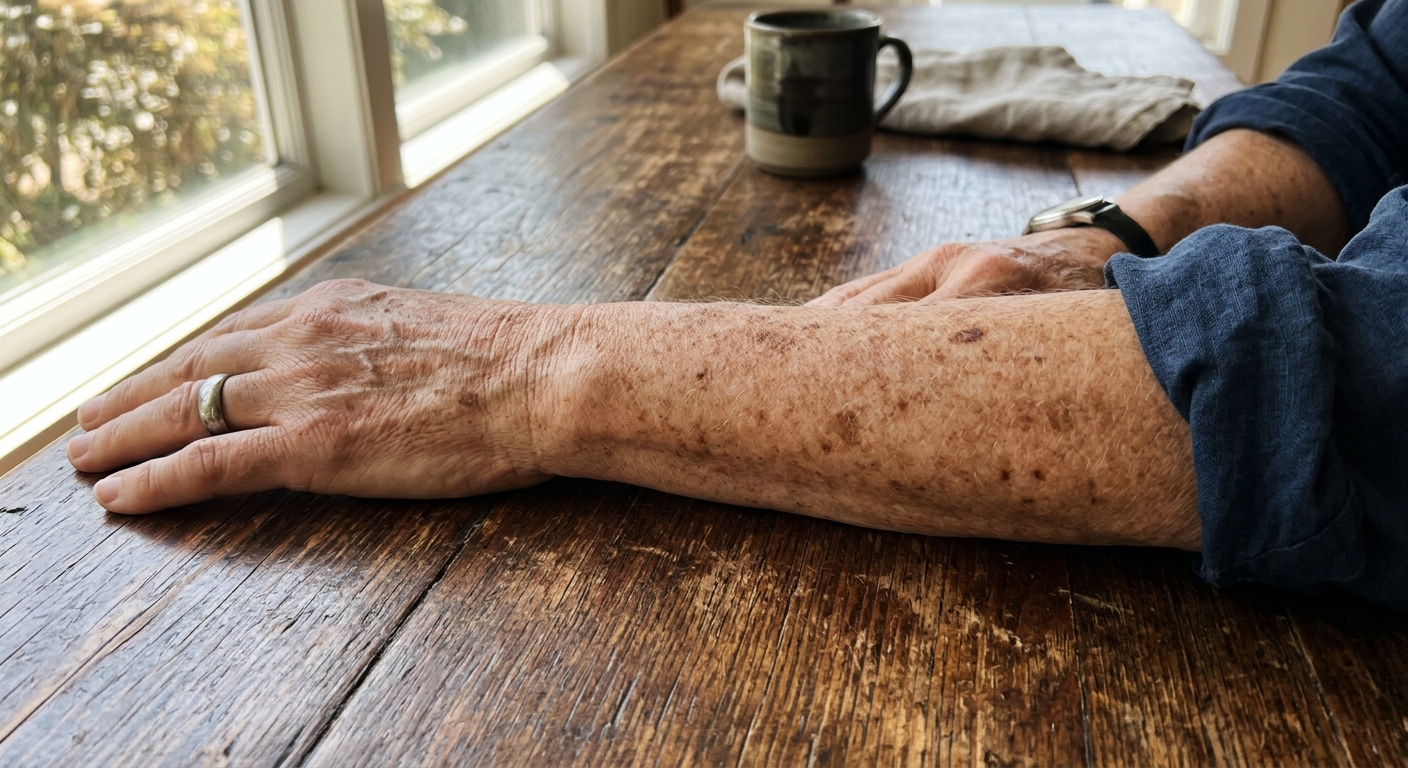
Solar lentigines — commonly called sun spots or age spots — are the most common forehead culprit. They are sharply defined, tan-to-dark-brown, and a direct receipt for accumulated UV exposure. A 2025 systematic review of 41 clinical trials confirmed that they respond to a predictable hierarchy of treatments, from topical agents through to lasers [1].
Decades of that exposure quietly reprogram the pigment-producing cells in your skin, and the forehead is usually where the bill comes due first.
Post-inflammatory hyperpigmentation (PIH) is the brown shadow left after a pimple, a scratch, or irritation heals. On a sun-exposed forehead, PIH lingers far longer than it should.
Melasma shows up as larger, blotchier patches, often symmetric across the forehead and upper cheeks, and is driven by a mix of hormones, heat, and light. It is the most temperamental of the three and the most likely to rebound if you are careless with sun protection.
Most forehead “age spots” are a blend of the first two. If you have wide, map-like patches that flare in summer, see a dermatologist to rule in melasma — the strategy shifts.
The One Rule Everything Else Depends On
Here is the part most people skip and then wonder why nothing works.
Every brightening ingredient on earth is fighting a losing battle if UV light keeps switching your melanocytes back on each morning. Broad-spectrum sunscreen is not an optional finishing step in a dark-spot routine — it is the foundation the entire routine is built on. Used daily, it does double duty: it prevents new spots and it stops your active treatments from being undone hour by hour.
Think of it this way: treating dark spots without daily sun protection is like bailing out a boat without plugging the hole. You can find more on pairing pigment correctors with daily protection in our guide to sunscreen for hyperpigmentation.
In a head-to-head trial, 4% niacinamide performed comparably to 4% hydroquinone — the long-standing prescription benchmark — while causing fewer side effects.
What Actually Fades Forehead Dark Spots
Once sun protection is locked in, a handful of ingredients have real, repeatable evidence behind them.
Retinoids — speeding the pigment out
Retinoids (the vitamin A family that includes retinol and prescription tretinoin) work on pigment through a clever indirect route: they accelerate skin-cell turnover, which pushes pigmented cells toward the surface and out faster than they would shed on their own. A systematic review of randomized controlled trials found that topical tretinoin consistently improved mottled hyperpigmentation and lentigines, with benefits appearing as early as one month and lasting up to two years [2]. Retinoids are the closest thing to a multitasker in this category, simultaneously addressing the fine lines that tend to keep forehead spots company. Our primer on retinol for dark spots breaks down exactly how this works.
Niacinamide — intercepting the handoff
Niacinamide takes a different angle. Rather than slowing pigment production, it blocks the transfer of those melanosome packets from melanocytes to surrounding skin cells. A landmark study demonstrated that niacinamide significantly reduced hyperpigmentation by suppressing this melanosome transfer [3]. In a head-to-head trial, 4% niacinamide performed comparably to 4% hydroquinone — the long-standing prescription benchmark — while causing fewer side effects [4]. It is gentle enough to layer with almost anything.
Vitamin C and other brighteners
Vitamin C is a well-documented antioxidant that supports a more even tone and helps defend against the UV-driven free-radical damage that fuels pigment in the first place [5]. It pairs naturally with sunscreen in the morning. Other evidence-backed options include azelaic acid, tranexamic acid, and alpha arbutin — useful additions if a single active is not moving the needle. See our deep dive on tranexamic acid for dark spots for a strong melasma-friendly option.
A Realistic Forehead Routine
You do not need ten products. You need a few proven ones, used consistently.
- Morning: gentle cleanse, vitamin C serum, broad-spectrum SPF 30 or higher (reapplied if you are outdoors).
- Evening: gentle cleanse, a retinoid, moisturizer. Add niacinamide either morning or night.
Consistency beats intensity every time. Pigment correction is measured in weeks and months, not days, and the single fastest way to fail is to quit a retinoid because of early flaking — or to skip sunscreen and quietly reload the spots you just spent a season fading.
Where Nanoretinol Fits
The catch with traditional retinol is tolerance. On the forehead — a high-movement, often-exposed zone — the redness, peeling, and stinging that conventional retinol can cause are exactly what makes people abandon it before it has time to work. And inconsistent use is the enemy of pigment correction.
This is the problem Nanoretinol was built to solve. It encapsulates stabilized retinol inside biomimetic lipid nanoparticles — particles the skin recognizes as “self” and allows through the barrier without the harsh disruption conventional formulas rely on. The result is genuine retinol activity with markedly less of the irritation that derails so many routines. It is notable that the broader retinoid literature explicitly points to nanoparticle delivery systems as the way forward for improving tolerability without sacrificing efficacy [6]. At a fully stabilized 0.2% in a lightweight, water-based, 99% natural formula, Nanoretinol is designed to be the version of retinol you can actually keep using on delicate forehead skin — night after night, which is precisely what fading dark spots requires.
The Takeaway
Forehead dark spots are a sun story with a hopeful ending. Protect the skin every single day, give a well-tolerated retinoid and a brightener like niacinamide a few months to work, and the patches that took decades to form will genuinely lighten. The science here is unusually settled — the only variable left is whether you stick with it.
References
- Mardani G, Nasiri MJ, Namazi N, Farshchian M, Abdollahimajd F. “Treatment of Solar Lentigines: A Systematic Review of Clinical Trials.” Journal of Cosmetic Dermatology. 2025;24(4):e70133. doi:10.1111/jocd.70133
- Sitohang IBS, Makes WI, Sandora N, Suryanegara J. “Topical tretinoin for treating photoaging: A systematic review of randomized controlled trials.” International Journal of Women’s Dermatology. 2022;8(1):e003. doi:10.1097/JW9.0000000000000003
- Hakozaki T, Minwalla L, Zhuang J, et al. “The effect of niacinamide on reducing cutaneous pigmentation and suppression of melanosome transfer.” British Journal of Dermatology. 2002;147(1):20-31. doi:10.1046/j.1365-2133.2002.04834.x
- Navarrete-Solís J, Castanedo-Cázares JP, Torres-Álvarez B, et al. “A Double-Blind, Randomized Clinical Trial of Niacinamide 4% versus Hydroquinone 4% in the Treatment of Melasma.” Dermatology Research and Practice. 2011;2011:379173. doi:10.1155/2011/379173
- Pullar JM, Carr AC, Vissers MCM. “The Roles of Vitamin C in Skin Health.” Nutrients. 2017;9(8):866. doi:10.3390/nu9080866
- Mukherjee S, Date A, Patravale V, Korting HC, Roeder A, Weindl G. “Retinoids in the treatment of skin aging: an overview of clinical efficacy and safety.” Clinical Interventions in Aging. 2006;1(4):327-348. doi:10.2147/ciia.2006.1.4.327