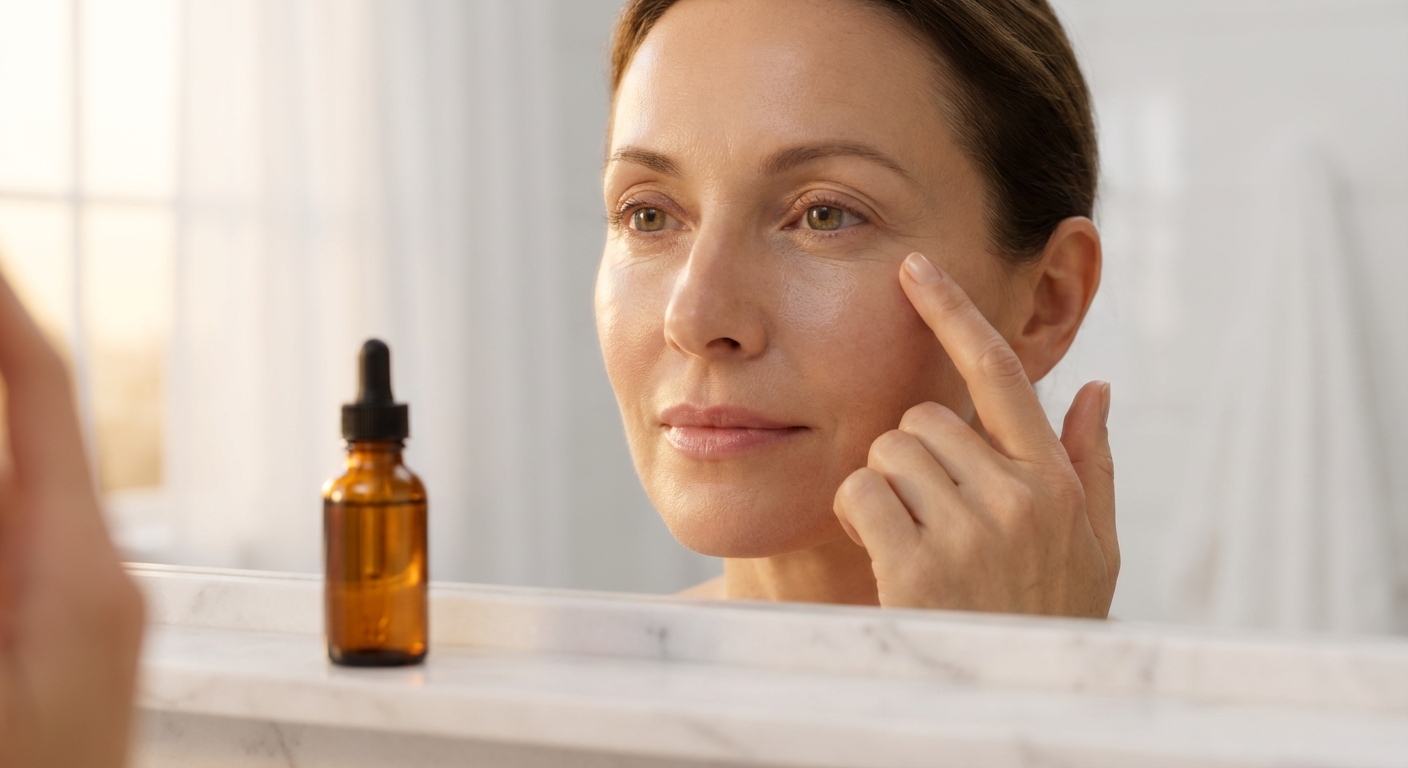
Eye Patches for Wrinkles: What They Do in the Hours After You Peel Them Off
Three completely different products share one shelf label — and only one of them delivers anything
Twenty minutes with a pair of under-eye patches produces one of the most convincing results in skincare. You peel them off, the crepiness has softened, the fine lines have shallowed, and the mirror agrees. Six hours later the effect is largely gone.
That is not a defective product. It is the product working exactly as its mechanism allows — and “eye patches for wrinkles” is a shelf label covering three mechanisms that behave completely differently. Knowing which one you’re holding is the whole decision.
The eye area exaggerates everything
Periorbital skin responds faster and more visibly to small changes than anywhere else on the face because there is so little of it. Mapping eight facial sites with high-frequency ultrasound in 118 adults, researchers measured epidermal and dermal thickness at the forehead, glabella, temple, eyelid, nasal dorsum, zygoma, submandibular area, and neck — and the eyelid sits at the thin end of that range [1].
Thin tissue changes shape for very little reason. A small gain in water content is enough to visibly flatten a fine line, which is why the eye area is where occlusive products look most impressive and where their impermanence is most obvious.
Type one: hydrogel and sheet patches (occlusive hydration)
Most under-eye patches — the gel crescents, the collagen sheets, the cooling hydrogels — work by trapping water against the stratum corneum. Occlusion does this reliably and it does it fast.
It also undoes itself fast. When investigators occluded skin for just 30 minutes and then measured what happened, stratum corneum water content and skin penetration both rose significantly, and the follow-up measurement after an hour back in ambient conditions was designed specifically to capture how transient that state is [2]. The swollen corneocytes give the water back to the air, the layer thins, and the line reappears.
If your lines are the product of decades of UV exposure and collagen loss, immobilising the area overnight changes nothing structural.
This is genuinely useful — for a wedding, a photograph, a morning after a bad night. It is not a treatment, and no amount of consistency converts it into one, because the mechanism has no dermal component at all.
Topical hydration can do more when it is sustained rather than sprinted. Seventy-six women aged 30 to 60 applied 0.1% hyaluronan formulations of five different molecular weights to the periocular area twice daily for 60 days, against a vehicle cream around the other eye, with hydration, elasticity, and replica-measured wrinkle depth tracked at 30 and 60 days [3]. That produced measurable change — but note the dose: twice daily for two months, not one patch for twenty minutes.
Type two: reusable silicone patches (immobilisation)
Silicone patches are a different proposition. They occlude, but their main claim is mechanical: worn overnight, they hold the skin still.
There is a real target for that. Reviewing the biomechanics of facial aging, Anson, Kane, and Lambros distinguish expression wrinkles from sleep wrinkles, which arise from compression, shear, and stress forces acting on the face in lateral or prone sleeping positions, and differ from expression lines in cause, location, and anatomical pattern [4].
If your lines are being folded into you nightly by a pillow, a patch that prevents the fold is addressing the actual cause — the same logic behind the broader category of silicone wrinkle patches. If your lines are the product of decades of UV exposure and collagen loss, immobilising the area overnight changes nothing structural. The two situations look similar in the mirror and respond completely differently.
Over 56 days of use, skin firmness increased 61% and elasticity 56%.
Type three: dissolving microneedle patches (actual delivery)
The one category that puts an active into the skin rather than water onto it uses arrays of dissolving microneedles, usually built from a hyaluronic acid backbone that carries a payload past the stratum corneum as it dissolves.
This has been tested with controls. An ascorbic acid–loaded dissolving microneedle patch was applied to the crow’s-feet area every four days in a double-blind study of 23 subjects, with the opposite side receiving a control patch, alongside cumulative irritation and sensitisation testing [5]. A later patch combining a hyaluronic acid backbone with acetyl octapeptide-3 and an ascorbic acid derivative was evaluated for puncture ability, safety, and efficacy against a hyaluronic-acid-only placebo in 24 subjects [6].
These are small studies, and the format is expensive per use. But mechanistically this is the only patch type that clears the barrier, and the trials are structured accordingly — repeated application over weeks, not a single session.
How to actually choose
- Event tomorrow, tired eyes today: hydrogel patch. It does precisely what you want, for precisely as long as you need.
- Lines that look worse on the side you sleep on: silicone, worn overnight, plus a change of sleeping position. You are treating a mechanical cause mechanically.
- Puffiness rather than lines: cooling and light pressure help drainage; neither is a wrinkle mechanism, and expecting texture change from them leads to disappointment. Our guide to under-eye wrinkles separates the two problems.
- Thin, papery, crinkling eyelid skin: no patch reaches this. Crepey eyelids are a dermal problem, and dermal problems need dermal tools.
- Structural change as the goal: a daily active, used for months. Nothing worn for twenty minutes competes.
The part that requires collagen
Every durable improvement in periorbital skin comes back to the dermis — more collagen, better-organised elastin, a thicker load-bearing layer. That is a months-long biological project, and topical vitamin A remains the best-evidenced non-prescription way to start it. In a randomized, double-blind, vehicle-controlled trial, 0.4% retinol applied three times weekly for 24 weeks produced significant clinical improvement over vehicle in 36 elderly adults, with corroborating biopsy findings [7].
Around the eyes, that has always been the awkward recommendation, because the tissue least able to tolerate irritation is the tissue with the most to gain. Conventional retinol barely crosses the epithelial barrier, and formulations that compensate by disrupting the barrier’s lipid organization deliver the burning and flaking that make people abandon retinol on their eyelids within a week.
Nanoretinol was designed around that constraint. It encapsulates 0.2% retinol in biomimetic lipid nanoparticles that the skin recognises as “self” and admits without damaging the epithelial barrier — the same nanotechnology class used in modern drug delivery. Against conventional retinol it has measured 232% greater effectiveness in collagen recovery and 73% greater in elastin recovery, with drastically reduced cytotoxicity in cellular assays and clinical trials confirming minimal, milder side effects. Over 56 days of use, skin firmness increased 61% and elasticity 56%. The formulation is water-based, 99% natural, absorbs to a matte finish, and is safe for the eye contour. It should be used at night, without other retinoid products, followed by sunscreen the next day. For the wider routine around the eyes, our guide to using retinol around the eyes covers frequency and layering.
Fifty-six days against twenty minutes is the real comparison. One is measured in the mirror before you leave the house; the other is measured in the tissue.
Where Patches Fit
Keep the hydrogels in the fridge and use them for what they’re good at — a fast, reliable, honest few hours. Use silicone if a pillow is folding lines into your face. Consider microneedles if you want delivery from a patch format and accept the cost. And keep the expectation clean: patches manage how your eyes look today, while an active that reaches the dermis decides how they look next season.
References
- Meng Y, Feng L, Shan J, Yuan Z, Jin L. “Application of high-frequency ultrasound to assess facial skin thickness in association with gender, age, and BMI in healthy adults.” BMC Medical Imaging. 2022;22(1):113. PMID: 35710358
- Ryatt KS, Mobayen M, Stevenson JM, Maibach HI, Guy RH. “Methodology to measure the transient effect of occlusion on skin penetration and stratum corneum hydration in vivo.” British Journal of Dermatology. 1988;119(3):307-312. PMID: 3179203
- Pavicic T, Gauglitz GG, Lersch P, et al. “Efficacy of cream-based novel formulations of hyaluronic acid of different molecular weights in anti-wrinkle treatment.” Journal of Drugs in Dermatology. 2011;10(9):990-1000. PMID: 22052267
- Anson G, Kane MA, Lambros V. “Sleep Wrinkles: Facial Aging and Facial Distortion During Sleep.” Aesthetic Surgery Journal. 2016;36(8):931-940. PMID: 27329660
- Lee C, Yang H, Kim S, et al. “Evaluation of the anti-wrinkle effect of an ascorbic acid-loaded dissolving microneedle patch via a double-blind, placebo-controlled clinical study.” International Journal of Cosmetic Science. 2016;38(4):375-381. PMID: 26648582
- Shin JY, Han D, Yoon KY, et al. “Clinical Safety and Efficacy Evaluation of a Dissolving Microneedle Patch Having Dual Anti-Wrinkle Effects With Safe and Long-Term Activities.” Annals of Dermatology. 2024;36(4):215-224. PMID: 39082657
- Kafi R, Kwak HS, Schumacher WE, et al. “Improvement of naturally aged skin with vitamin A (retinol).” Archives of Dermatology. 2007;143(5):606-612. PMID: 17515510