Face Balm: When Dry, Aging Skin Needs More Than a Cream
Water-free balms seal moisture in better than any lotion. How a face balm differs from a cream or an oil, which ingredients to look for, and how to use one with retinol
When the heating comes on and the air turns cold, a lot of skin that felt fine in summer starts to feel tight by midday. Lotions disappear within an hour, creams seem to evaporate, and the cheeks and the sides of the nose begin to flake. That is usually when people discover face balms: thick, waxy, water-free products that sit somewhere between a cream and an ointment.
A good balm can change how dry skin feels within a day or two. It can also clog pores, feel heavy, or simply be the wrong tool for skin that needs something else. This guide explains what a face balm is, what the science says about the ingredients inside it, and how to fit one into a routine, including one that uses retinol.
What makes a balm different from a cream or an oil
The difference comes down to water.
- A lotion or cream is an emulsion of water and oil. The water gives an instant feeling of hydration, then evaporates.
- A facial oil contains no water. It softens and smooths, but most oils are light and leave only a thin film. Our guide to facial oil for dry skin explains which ones help.
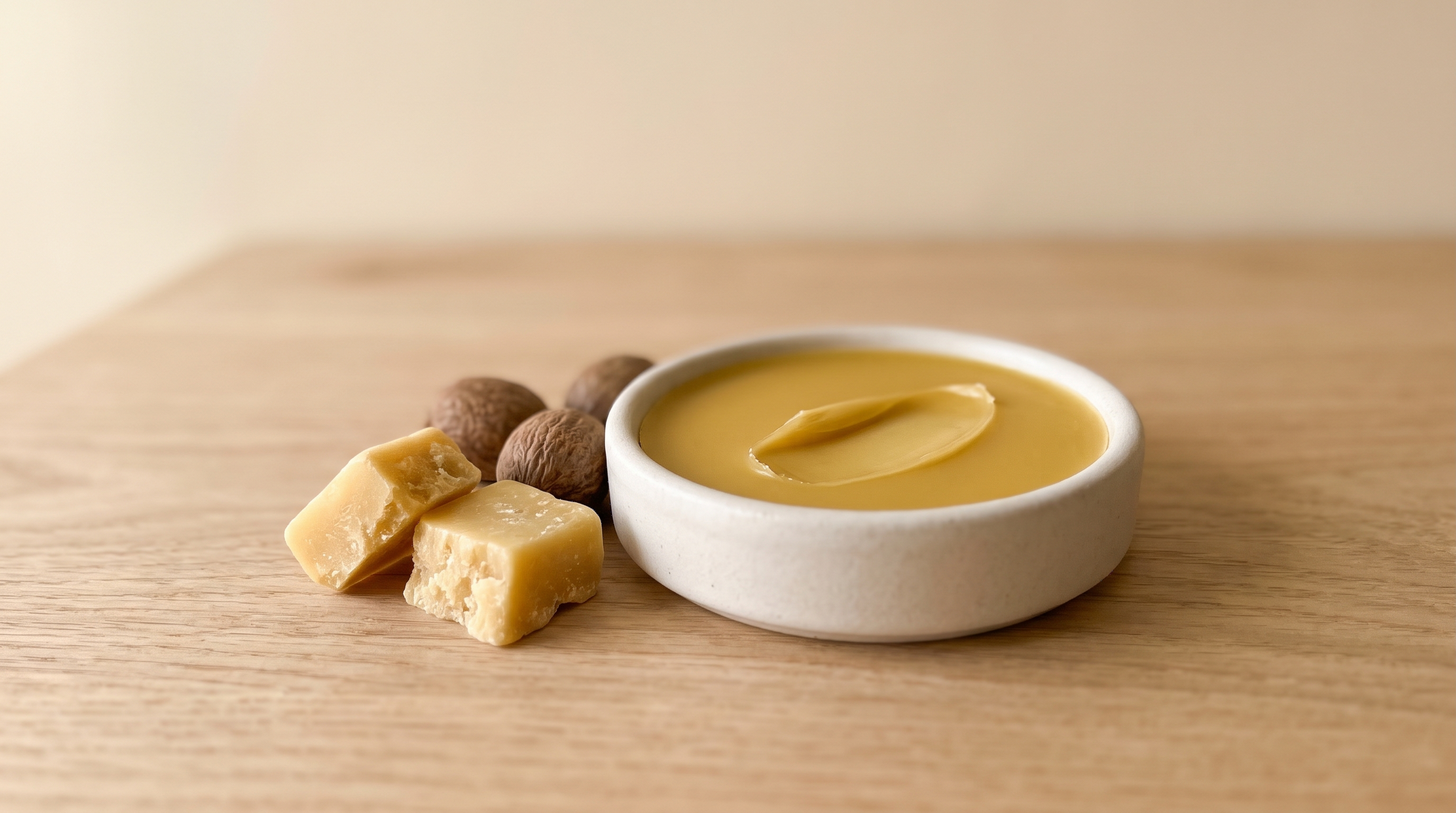
- A balm contains no water either, but it is built on waxes, butters and heavier oils that stay solid or semi-solid at room temperature. That structure leaves a thicker, longer-lasting layer on the skin.
Moisturizer ingredients fall into three groups: humectants that draw water in, emollients that smooth rough patches, and occlusives that slow water loss from the surface [1]. A balm is mostly emollients and occlusives. It does not add water to your skin. Instead, it holds onto the water your skin already has, which is exactly what dry, wind-chapped or aging skin struggles to do on its own.
Your skin keeps its own water longer under a balm than under a lotion, because the water in a lotion evaporates within minutes while waxes and oils stay put for hours.
Your skin keeps its own water longer under a balm than under a lotion, because the water in a lotion evaporates within minutes while waxes and oils stay put for hours.
What occlusion actually does
The most-studied occlusive is petrolatum, the base of many balms and ointments. For years, dermatologists assumed it worked like plastic wrap, blocking water loss from the surface. When researchers tested this on human volunteers, they found something better. After the skin barrier was damaged, petroleum jelly sped up barrier recovery rather than slowing it. Under the microscope, it had worked its way into the spaces between cells in the outer layer, filling the gaps where the skin’s own fats were missing [2].
That matters for aging skin in particular. With age, the outer skin layer holds fewer of its natural fats, and production of cholesterol in particular falls, which is why mature skin repairs more slowly after any irritation [3]. Researchers have also shown that the type of lipid you put back matters. Adding just one or two of the skin’s barrier fats can delay repair, while a balanced mixture of ceramides, cholesterol and fatty acids allows normal recovery and higher ratios speed it up [4]. In skin from people around 80 years old, a mixture dominated by cholesterol significantly sped barrier recovery at 6 hours [5].
Ingredients worth looking for
- Petrolatum: inexpensive, fragrance-free and one of the best-proven barrier helpers [2]. If you can live with the slightly greasy finish, it is hard to beat.
- Shea butter and plant oils: some plant oils and shea butter show anti-inflammatory and barrier-repairing effects in studies, while others can irritate, so the specific oil matters [6]. Sunflower seed oil and shea butter have stronger evidence than most.
- Beeswax and plant waxes: give a balm its structure and form a semi-occlusive layer that reduces water loss [7].
- Squalane: a light, stable oil that makes a balm feel less heavy.
- Ceramides and cholesterol: less common in balms, but well worth finding for mature or easily irritated skin [4].
Your skin after 60 makes fewer of its own barrier fats, so a balm that puts back ceramides and cholesterol gives it the building blocks it is short of.
Your skin after 60 makes fewer of its own barrier fats, so a balm that puts back ceramides and cholesterol gives it the building blocks it is short of.
Ingredients to be cautious about
Fragrance and essential oils are the main problem. Many balms marketed as natural are heavily scented, and fragrance is a frequent cause of irritation from skincare. Heavy butters and coconut oil can congest pores in people prone to breakouts. And menthol, camphor or eucalyptus, sometimes added to balms for a cooling feel, can sting skin that is already dry or chapped.
How to use a face balm
- Make it the last step at night. Cleanse, apply any serum and your usual moisturizer, then warm a pea-sized amount of balm between your fingers and press it onto the driest areas. This is a lighter version of slugging, which uses a full layer of petrolatum overnight.
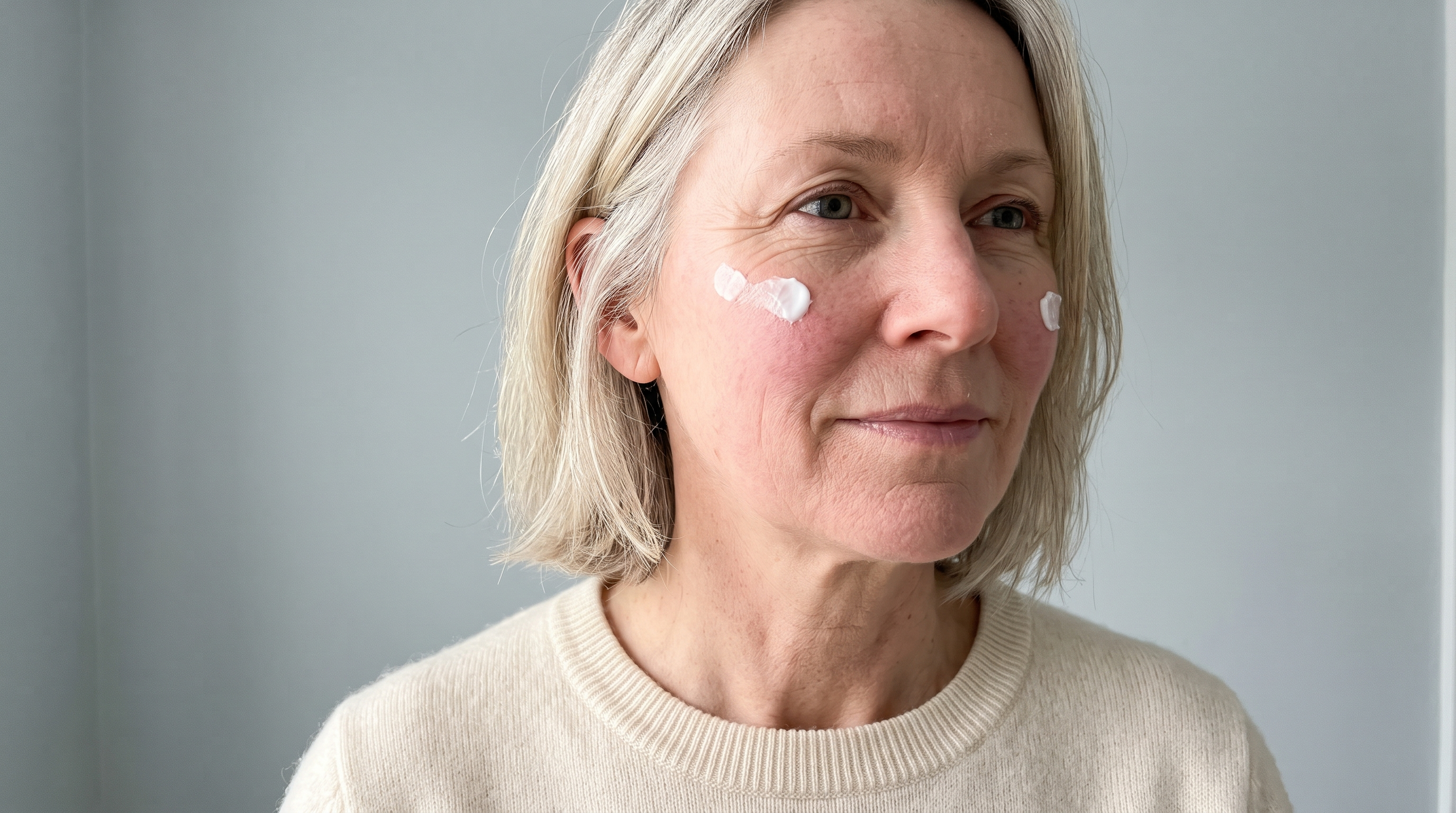
- Target, do not coat. Cheeks, the sides of the nose, the area around the mouth and the outer eye area usually need it most. Skip oily zones.
- Use it as a daytime shield in cold weather. A thin layer over your moisturizer and under sunscreen helps on windy days. For hands and areas that take a beating, a barrier cream is the same idea in a more practical texture.
- Give it 2 weeks. Balms soften flaking quickly, but the barrier itself takes time to recover. Judge the result after a couple of weeks of nightly use.
If your skin is dry everywhere rather than in patches, a richer daily moisturizer may suit you better than a balm on top. Our guide to the best moisturizer for aging skin over 60 explains how needs change after menopause.
Using a balm with retinol
A face balm and a retinoid make a good pair. Retinoids are the best-studied way to rebuild collagen in aging skin. In one study, 4 weeks of retinol increased the proteins that become new collagen, and 12 weeks reduced facial wrinkles [8]. Their main drawback is dryness and flaking, especially in winter, which is the problem a balm solves.
The order matters. Apply your retinoid first on clean, dry skin and give it a few minutes to absorb. Then add moisturizer and finish with the balm. A balm on top helps to seal in moisture and protect the barrier while the retinoid works underneath.
Where Nanoretinol fits
The best balm in the world can make skin comfortable, but it cannot make it firmer. That still requires a retinoid, and the challenge for dry, aging skin is finding one that does not undo the work of the balm. Many conventional retinol formulas use ingredients that loosen the skin’s protective fats to push retinol in, which is why they leave dry skin red and flaky.
Nanoretinol takes a different route. It carries 0.2% retinol inside biomimetic lipid nanoparticles in a water-based gel, so the retinol reaches skin cells without breaking down the barrier on the way in. In clinical testing over 56 days, users saw a 61 percent increase in skin firmness and a 56 percent increase in elasticity, and in laboratory testing it was 232 percent more effective in collagen recovery than conventional retinol [9]. Apply it at night, let it absorb, seal it in with your moisturizer and a thin layer of balm, and wear sunscreen the next morning.
References
- Sethi A, Kaur T, Malhotra SK, Gambhir ML. “Moisturizers: The Slippery Road.” Indian Journal of Dermatology. 2016;61(3):279-287. doi:10.4103/0019-5154.182427
- Ghadially R, Halkier-Sorensen L, Elias PM. “Effects of petrolatum on stratum corneum structure and function.” Journal of the American Academy of Dermatology. 1992;26(3 Pt 2):387-396. PubMed 1564142
- Elias PM, Ghadially R. “The aged epidermal permeability barrier: basis for functional abnormalities.” Clinics in Geriatric Medicine. 2002;18(1):103-120. PubMed 11913735
- Man MQ, Feingold KR, Thornfeldt CR, Elias PM. “Optimization of physiological lipid mixtures for barrier repair.” Journal of Investigative Dermatology. 1996;106(5):1096-1101. doi:10.1111/1523-1747.ep12340135
- Zettersten EM, Ghadially R, Feingold KR, Crumrine D, Elias PM. “Optimal ratios of topical stratum corneum lipids improve barrier recovery in chronologically aged skin.” Journal of the American Academy of Dermatology. 1997;37(3 Pt 1):403-408. PubMed 9308554
- Lin TK, Zhong L, Santiago JL. “Anti-Inflammatory and Skin Barrier Repair Effects of Topical Application of Some Plant Oils.” International Journal of Molecular Sciences. 2017;19(1):70. doi:10.3390/ijms19010070
- Nong Y, Maloh J, Natarelli N, et al. “A review of the use of beeswax in skincare.” Journal of Cosmetic Dermatology. 2023;22(8):2166-2173. doi:10.1111/jocd.15718
- Kong R, Cui Y, Fisher GJ, et al. “A comparative study of the effects of retinol and retinoic acid on histological, molecular, and clinical properties of human skin.” Journal of Cosmetic Dermatology. 2016;15(1):49-57. doi:10.1111/jocd.12193
- North Biomedical LLC. “Nanoretinol vs. Conventional Retinol: Efficacy in Collagen and Elastin Recovery.” Clinical Study Summary, 2024. Study summary