Facial Oil for Dry Skin: Which Oils Help and Which Make It Worse
An oil cannot add water to dry skin, but the right one keeps the water you have. How to choose a facial oil by its fatty acids, and how to layer it
Dry skin feels tight because it is short of two things at once: water inside the outer layer and the fats that hold that water in place. A facial oil can only fix the second problem. Chosen well, it makes skin softer, calmer and less flaky. Chosen badly, it can quietly weaken the very barrier you are trying to repair.
This guide explains what a facial oil does for dry skin, which oils have evidence behind them, which popular oil to leave in the kitchen, and how to layer one so it actually helps.
Why oil alone does not hydrate
The outer layer of skin, the stratum corneum, works like a brick wall. The bricks are flattened dead cells, and the mortar is a mix of ceramides, cholesterol and fatty acids [1]. When that mortar runs low, water escapes from the skin into the air and the surface turns rough, tight and flaky.
Oils are emollients and partial occlusives. They fill the gaps between lifting flakes, which is why skin feels smoother within seconds, and they form a thin film that slows water loss [2]. What they do not do is bring water in. That job belongs to humectants such as glycerin and hyaluronic acid, which pull water into the skin.
Your skin will feel softer within minutes of a few drops of oil, but it takes 2 to 4 weeks of steady use to see fewer flakes than before.
So the best results come from pairing the two: water and a humectant first, oil on top to hold them in. An oil smoothed over bone-dry skin seals in very little.
Not all oils are equal: the fatty acid that matters
Plant oils are mostly made of fatty acids, and two of them decide how an oil behaves on dry skin.
Your skin will feel softer within minutes of a few drops of oil, but it takes 2 to 4 weeks of steady use to see fewer flakes than before.
Linoleic acid is an omega-6 fatty acid the skin uses to build its own barrier lipids. Oils rich in it, such as sunflower, safflower and grapeseed, tend to support the barrier and feel light.
Oleic acid is an omega-9 fatty acid that makes oils feel rich and cushiony. The catch is that it loosens the orderly lipid layers of the stratum corneum. In a study on human skin, oleic acid applied to the surface increased its permeability, which is exactly why formulators use it to push other ingredients through the barrier [3].
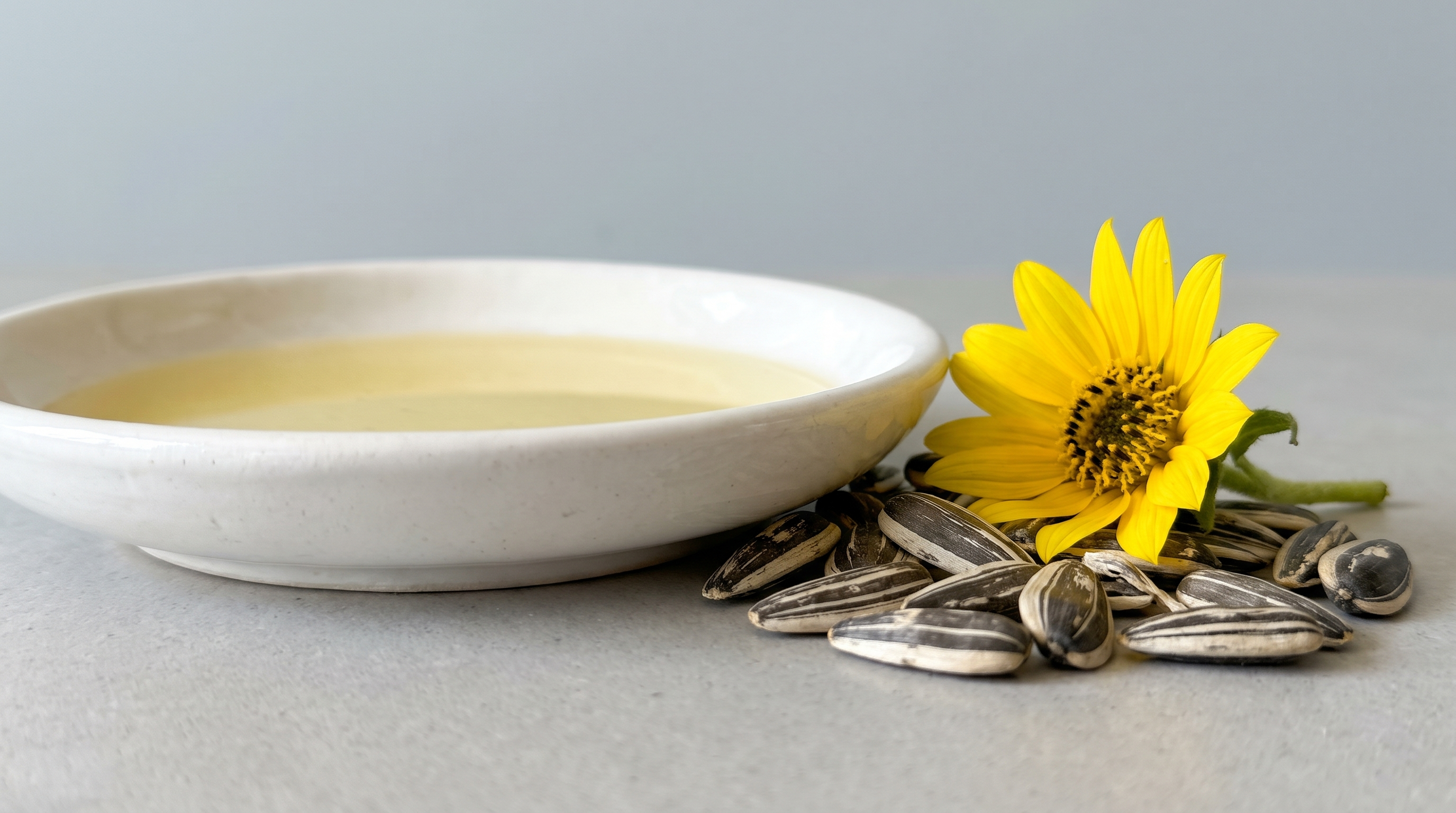
The clearest test of the difference came from the University of Sheffield. Adults with and without a history of eczema applied six drops of olive oil to one forearm and six drops of sunflower seed oil to the other, twice a day for four weeks. Olive oil, which is high in oleic acid, reduced the integrity of the skin barrier and caused mild redness. Sunflower seed oil preserved the barrier and improved hydration [4].
The best facial oils for dry skin
A review of topical plant oils grouped them by what they do to the barrier, and the oils below are the ones that hold up best for dry faces [5].
- Sunflower seed oil: high in linoleic acid, inexpensive and the one with direct human barrier data. A good everyday choice for dry, easily irritated skin.
- Squalane: a stable, saturated form of squalene, a lipid your own sebum contains. It is light, does not go rancid quickly and suits dry skin that dislikes heavy textures [6]. Our deeper guide to squalane oil for skin covers how it is made and how to spot a good one.
- Jojoba oil: technically a liquid wax, not a true oil, with a structure close to the waxes in human sebum. It sits comfortably on dry skin without feeling greasy.
- Argan oil: a balanced mix of oleic and linoleic acid plus vitamin E. Richer than sunflower, still well tolerated by most dry skin.
- Rosehip oil: high in linoleic and linolenic acids, light and fast-absorbing, though it oxidises quickly once opened, so buy small bottles.
Oils to use carefully
Olive oil is the obvious one. Its oleic acid and the evidence above make it a poor choice for a dry or sensitive face, however natural it feels.
Your skin barrier can end up weaker after 4 weeks of olive oil than before you started, because its main fatty acid loosens the barrier you hoped to repair.
Your skin barrier can end up weaker after 4 weeks of olive oil than before you started, because its main fatty acid loosens the barrier you hoped to repair.
Coconut oil feels rich but is heavy and can clog pores in acne-prone areas, so keep it to the body.
Essential oils such as lavender, citrus or peppermint are fragrance, not moisturisers. They are a common cause of irritation and allergy, and they add nothing that a dry barrier needs. A facial oil for dry skin should list one or a few carrier oils and no added scent.
How to layer a facial oil
The order matters more than the brand.
- Cleanse gently and leave the face slightly damp.
- Apply a hydrating serum or toner with glycerin or hyaluronic acid.
- Follow with your moisturiser, ideally one with ceramides.
- Press two to four drops of oil over the top, or mix one drop into the moisturiser.
At night, the oil goes last. In the morning, keep it light so that sunscreen still spreads evenly, or move the oil to the evening entirely. If flaking is your main complaint and an oil alone is not shifting it, the causes and fixes in our guide to dry, flaky skin on the face are worth working through before you add more products.
Two to four drops is enough. More oil does not mean more moisture, and a thick slick mainly ends up on the pillow.
Dry skin, aging skin and retinol
Dryness and aging tend to arrive together. After menopause in particular, skin makes less oil and holds less water, and fine lines look deeper on a dry surface. A facial oil improves how those lines look on the day, but it does not change the collagen beneath them, and readers whose main goal is firmness rather than comfort will find oils compared for that job in our article on the best face oil for aging skin, where richer oils play a different role.
The ingredient with the strongest evidence for rebuilding collagen is retinol. In a 24-week trial in adults with an average age of 87, 0.4% retinol improved fine wrinkling and increased collagen production compared with the arm treated with the plain lotion base [7]. The problem is that dry skin often struggles with retinol, because conventional formulas can leave it flaky and sore.
Nanoretinol was made to remove that obstacle. It delivers 0.2% retinol inside biomimetic lipid nanoparticles in a light, water-based gel, so it does not need the petroleum-derived chemicals that conventional formulas use to force retinol through the barrier. In North Biomedical’s clinical study it was 232% more effective in collagen recovery and 73% more effective in elastin recovery than conventional retinol, and users saw a 61% increase in firmness and a 56% increase in elasticity after 56 days, with milder side effects than conventional retinol [8].
For dry skin, a simple evening routine works well: Nanoretinol on clean skin, a ceramide moisturiser, then a few drops of sunflower, squalane or jojoba oil to seal everything in. The retinol works on the layer underneath while the oil keeps the surface comfortable.
References
- Harding CR. “The Stratum Corneum: Structure and Function in Health and Disease.” Dermatologic Therapy. 2004;17(Suppl 1):6-15. doi:10.1111/j.1396-0296.2004.04s1001.x
- Lodén M. “Role of Topical Emollients and Moisturizers in the Treatment of Dry Skin Barrier Disorders.” American Journal of Clinical Dermatology. 2003;4(11):771-788. doi:10.2165/00128071-200304110-00005
- Tanojo H, Boelsma E, Junginger HE, Ponec M, Boddé HE. “In Vivo Human Skin Permeability Enhancement by Oleic Acid: A Laser Doppler Velocimetry Study.” Journal of Controlled Release. 1999;58(1):97-104. PubMed: 10021493
- Danby SG, AlEnezi T, Sultan A, Lavender T, Chittock J, Brown K, Cork MJ. “Effect of Olive and Sunflower Seed Oil on the Adult Skin Barrier: Implications for Neonatal Skin Care.” Pediatric Dermatology. 2013;30(1):42-50. doi:10.1111/j.1525-1470.2012.01865.x
- Lin TK, Zhong L, Santiago JL. “Anti-Inflammatory and Skin Barrier Repair Effects of Topical Application of Some Plant Oils.” International Journal of Molecular Sciences. 2017;19(1):70. doi:10.3390/ijms19010070
- Huang ZR, Lin YK, Fang JY. “Biological and Pharmacological Activities of Squalene and Related Compounds: Potential Uses in Cosmetic Dermatology.” Molecules. 2009;14(1):540-554. doi:10.3390/molecules14010540
- Kafi R, Kwak HS, Schumacher WE, Cho S, Hanft VN, Hamilton TA, et al. “Improvement of Naturally Aged Skin with Vitamin A (Retinol).” Archives of Dermatology. 2007;143(5):606-612. doi:10.1001/archderm.143.5.606
- North Biomedical LLC. “Nanoretinol vs. Conventional Retinol: Efficacy in Collagen and Elastin Recovery.” Clinical Study Summary, 2024. Study summary