
FaceTite: How Radiofrequency Skin Tightening Firms the Jawline Without a Facelift
The science of heating collagen from the inside, what the studies show for jowls and necks, and the nightly habit that protects the result.
When the Jawline Starts to Blur
For most women, the first real jolt of facial aging is not a wrinkle — it is the loss of the jawline. The crisp border between face and neck softens. Little pouches of skin gather at the corners of the mouth. The neck looks looser in profile than it does head-on. This is skin laxity, and it comes from the same root cause as most aging: the collagen and elastin that once held the skin taut are thinning faster than the body replaces them.
Once laxity sets in, creams alone cannot fully reverse it, and for decades the only real answer was a surgical facelift. FaceTite sits in the middle ground that has opened up since — a minimally invasive way to tighten loose lower-face and neck skin using heat delivered beneath the surface, without the incisions, scars, or weeks of recovery a lift requires.
What FaceTite Is
FaceTite is a form of radiofrequency-assisted lipolysis, or RFAL. Through a tiny entry point, a slim probe is guided just under the skin while a matching electrode glides along the surface above it. Radiofrequency energy passes between the two, and the tissue caught in that field — fat, fibrous septae, and the underside of the dermis — heats in a controlled, monitored way.
That heat is the whole point. Collagen is a protein that contracts and remodels when warmed to a precise range. Controlled radiofrequency heating denatures collagen across defined thermal windows — roughly 55 to 70°C for the deeper coagulation that drives tightening — causing the fibers to contract immediately and then triggering a months-long wound-healing wave of fresh collagen and elastin, a process called neocollagenesis [1]. You get an instant snap of tightening followed by a slow, continued firming.
In quantitative follow-up, RFAL produced soft-tissue contraction of up to roughly 34% over twelve months, compared with only about 6% for conventional liposuction — a nearly five-fold advantage in skin retraction.
Why Heat-Based Tightening Outperforms Liposuction Alone
The reason RFAL exists is a gap that ordinary fat removal could never close. Suction-assisted liposuction empties fat but does little for the skin left behind, so on an older, lax neck it can actually make sagging worse. Radiofrequency was added specifically to contract that draped tissue [2].
The numbers are striking. In quantitative follow-up, RFAL produced soft-tissue contraction of up to roughly 34% over twelve months, compared with only about 6% for conventional liposuction — a nearly five-fold advantage in skin retraction [3]. That difference is exactly what a softening jawline needs.
What the Studies Show for the Neck and Lower Face
The most relevant evidence comes from a series of 55 patients, mean age 51, treated with RFAL for the neck and lower face. Eighty-five percent were satisfied with their contouring and degree of skin tightening, and two independent surgeons rated the results good to excellent in 52 of the 55 cases [3]. Average operating time was about 45 minutes, performed under local anesthesia, and complications were minor — transient firmness in a small share of patients, resolving with massage.
That profile — meaningful tightening, local anesthesia, a single session, days rather than weeks of downtime — is what makes FaceTite attractive for mild to moderate laxity. It sits on the same shelf as the energy treatments in our guide to non-surgical skin tightening and the microneedling-plus-radiofrequency approach of Morpheus8, each reaching the deeper layers in a different way.
A surgical lift also carries a measurable, if low, risk profile: across more than 129,000 patients the overall complication rate was 1.8%.
The Honest Limits
FaceTite is not a facelift, and it is fair about who it suits. For significant sagging — heavy jowls, substantial excess skin — surgical rhytidectomy remains the gold standard and simply outperforms any energy device, because it removes tissue rather than shrinking it. A surgical lift also carries a measurable, if low, risk profile: across more than 129,000 patients the overall complication rate was 1.8% [4]. FaceTite’s appeal is the trade — less correction than surgery, but far less downtime and risk, for the right candidate with early-to-moderate laxity like the concerns in our guides to sagging jowls and skin laxity.
And like every collagen-stimulating treatment, it addresses the symptom, not the clock. FaceTite provokes one strong wave of new collagen; it does not stop the ongoing thinning that caused the laxity in the first place. Results relax gradually over the following years, which is why what you do at home matters as much as what happens in the clinic.
Protecting the Result at Home
If FaceTite works by triggering collagen, the maintenance question answers itself: keep the collagen signal going. The best-documented topical for that is a retinoid. In the landmark trial on the subject, type I collagen formation was 56% lower in photodamaged skin than in sun-protected skin, and topical retinoic acid produced roughly an 80% increase in new collagen formation versus a 14% decrease under an inactive control [5]. A nightly retinoid works on the same fibroblasts a radiofrequency treatment wakes up, making it the logical long-term partner to any tightening procedure.
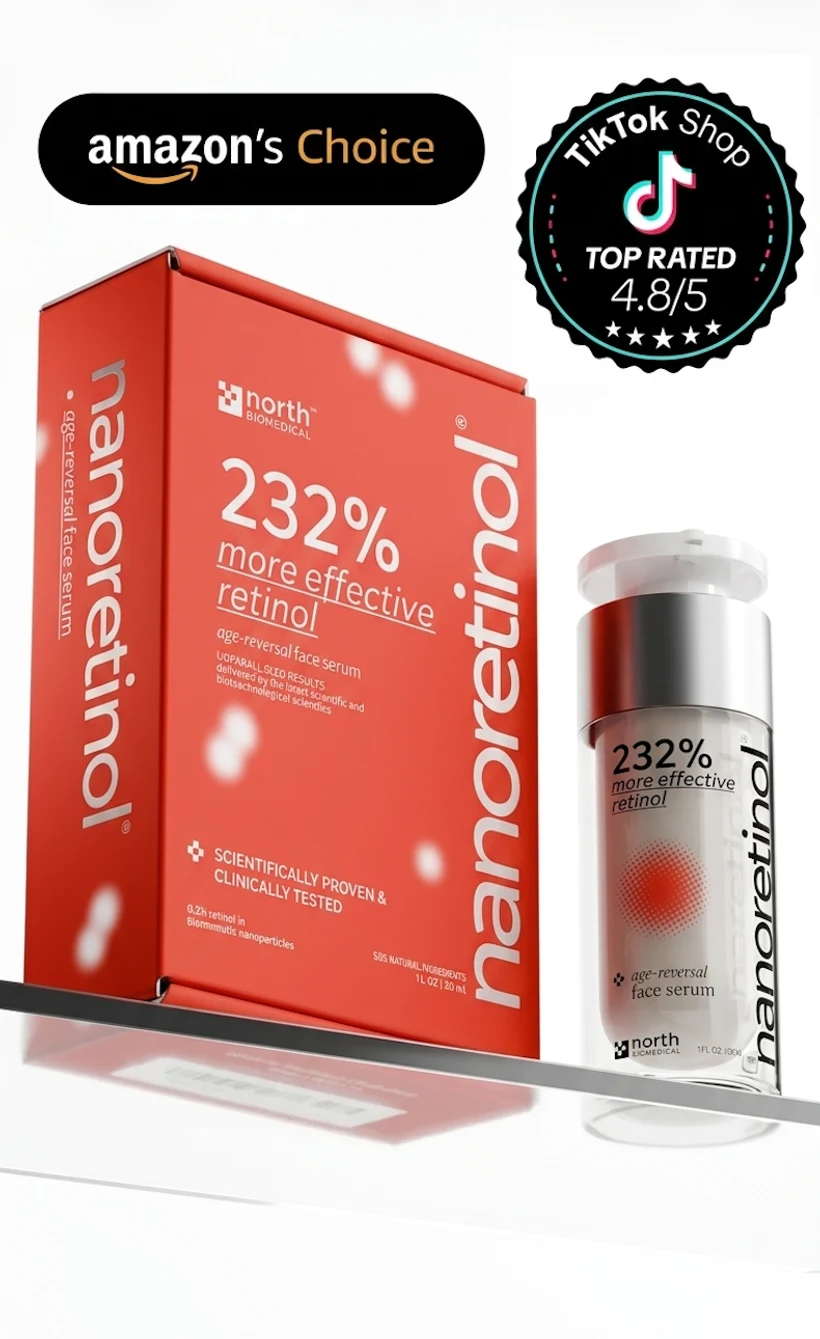
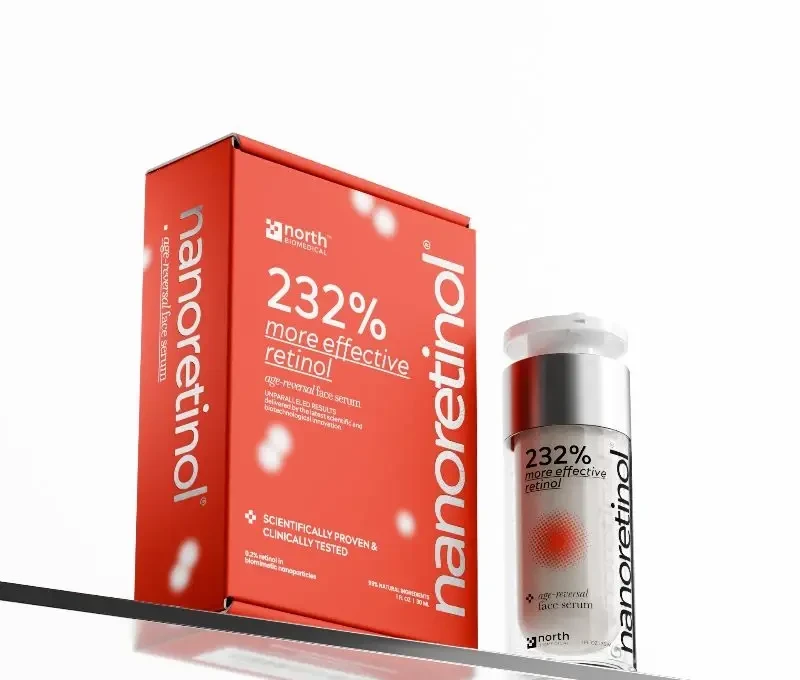
The catch with traditional retinol is getting it through the barrier without the irritation that makes people quit. Nanoretinol was built around that problem, wrapping retinol in biomimetic lipid nanoparticles the skin recognizes as its own and lets pass, so the active reaches the dermis without stripping the barrier. In North Biomedical’s clinical comparison, that delivery was 232% more effective at collagen recovery and 73% more effective at elastin recovery than conventional retinol, with users seeing a 61% rise in firmness and a 56% rise in elasticity over 56 days [6]. Its gentle, water-based 0.2% formula is an easy nightly habit to protect an investment made in the clinic.
FaceTite can hand back a jawline in a single afternoon. Keeping it sharp is the work of the ordinary nights that follow.
References
- Zhang B, Tan X, Zhang Q, Wu M. “The Landscape of Radiofrequency Technology for Skin Rejuvenation.” Health Science Reports. 2025;9(1):e71575. doi:10.1002/hsr2.71575
- Theodorou SJ, Del Vecchio D, Chia CT. “Soft Tissue Contraction in Body Contouring With Radiofrequency-Assisted Liposuction: A Treatment Gap Solution.” Aesthetic Surgery Journal. 2018;38(suppl_2):S74-S83. doi:10.1093/asj/sjy037
- Keramidas E, Rodopoulou S. “Radiofrequency-assisted Liposuction for Neck and Lower Face Adipodermal Remodeling and Contouring.” Plastic and Reconstructive Surgery – Global Open. 2016;4(8):e850. doi:10.1097/GOX.0000000000000809
- Meretsky CR, Hausner P, Flynn BP, Schiuma AT. “A Systematic Review and Comparative Analysis of Reconstructive Rhytidectomy: Advantages, Disadvantages, and Patient Outcomes.” Cureus. 2024;16(10):e71006. doi:10.7759/cureus.71006
- Griffiths CE, Russman AN, Majmudar G, Singer RS, Hamilton TA, Voorhees JJ. “Restoration of collagen formation in photodamaged human skin by tretinoin (retinoic acid).” New England Journal of Medicine. 1993;329(8):530-535. doi:10.1056/NEJM199308193290803
- North Biomedical LLC. “Nanoretinol vs. Conventional Retinol: Efficacy in Collagen and Elastin Recovery.” Clinical Study Summary, 2024. Study summary